华东师范大学学报(自然科学版) ›› 2026, Vol. 2026 ›› Issue (2): 151-163.doi: 10.3969/j.issn.1000-5641.2026.02.014

• FMCW雷达与信号处理 • 上一篇    

基于Lanczos压缩的FMCW雷达目标检测方案

刘颖, 邢贝贝, 尹志新, 黄磊磊*(), 石春琦   

  1. 华东师范大学 微电子电路与系统研究所, 上海 200241
  • 收稿日期:2025-09-15 接受日期:2025-12-19 出版日期:2026-03-25 发布日期:2026-04-03
  • 通讯作者: 黄磊磊 E-mail:llhuang@cee.ecnu.edu.cn
  • 基金资助:
    上海市科委资助项目 (22DZ2229004)

Lanczos compression-based FMCW radar target detection scheme

Ying LIU, Beibei XING, Zhixin YIN, Leilei HUANG*(), Chunqi SHI   

  1. Institute of Microelectronic Circuits and Systems, East China Normal University, Shanghai 200241, China
  • Received:2025-09-15 Accepted:2025-12-19 Online:2026-03-25 Published:2026-04-03
  • Contact: Leilei HUANG E-mail:llhuang@cee.ecnu.edu.cn

摘要:

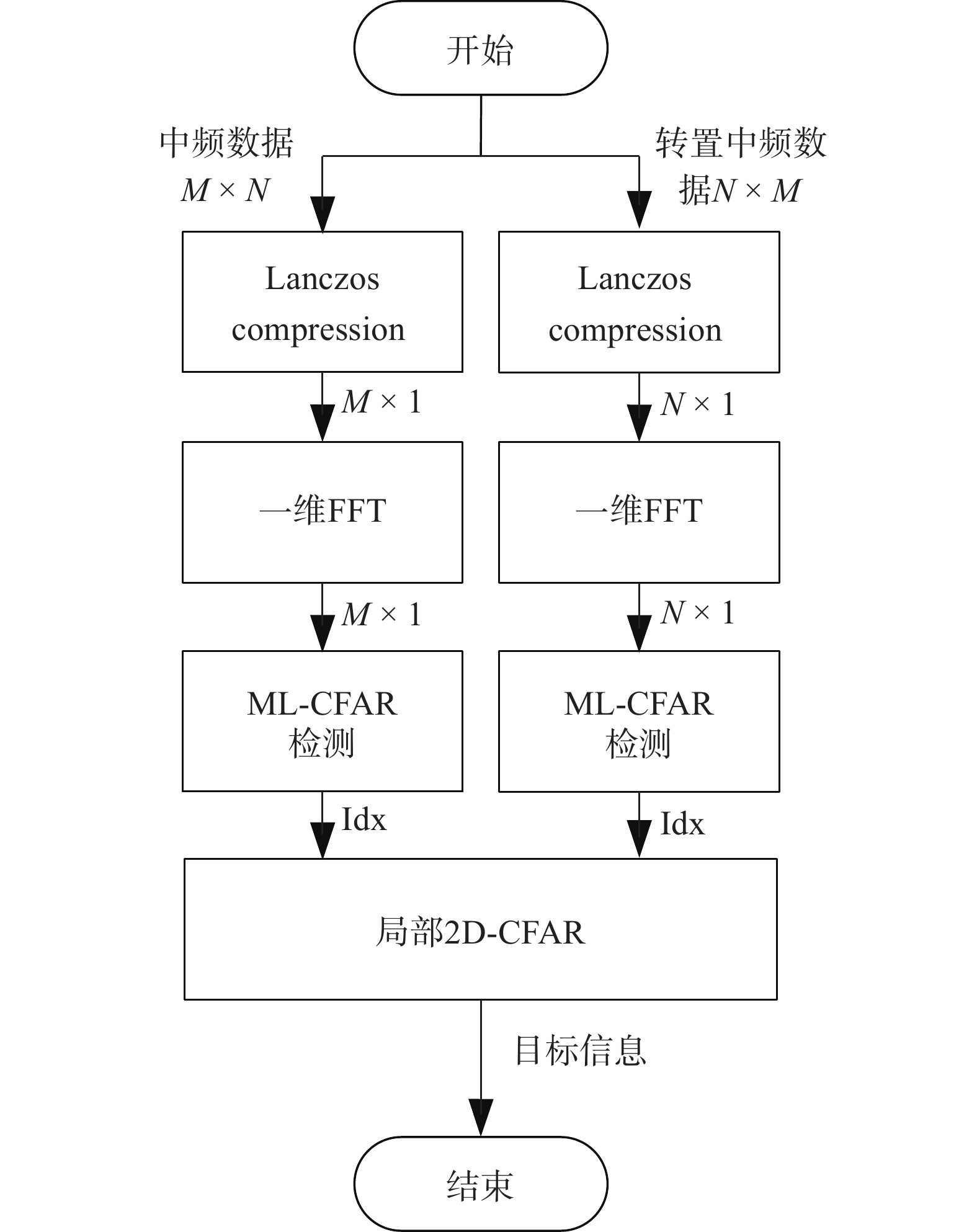
调频连续波 (FMCW) 毫米波雷达因其高分辨率、强穿透能力与低功耗特性, 在自动驾驶、安防监控等领域广泛应用. 然而, 传统的基于二维快速傅里叶变换 (2D-FFT) 的目标检测方法在处理大规模中频数据时, 计算复杂度高、耗时长, 难以满足毫秒级实时性需求. 针对上述问题, 本文提出一种基于Lanczos压缩的恒虚警检测加速方法, 并部署在FPGA (Field Programmable Gate Array)上. 该方法通过Krylov子空间投影逼近主成分向量, 能够实现从$ O\left(NM\mathrm{log}(NM\right)) $$ O\left(NM\right) $的复杂度下降. 算法在主成分投影后采用一维CFAR (Constant False Alarm Rate)获取候选点, 并结合精简的二维CFAR窗口进行目标确认, 能有效降低运算量并保持检测精度. 在Xilinx XC7Z020CLG400 FPGA平台上的实测结果表明, 该方案在处理256×512矩阵时耗时为0.36 ms, 平均功耗仅0.76 W. 在公开数据集与模拟多目标场景下, 系统实现了0.48%的平均虚警率和2.93%的漏检率, 验证了所提方法的高精度、低耗时和高能效特性. 该研究为毫米波雷达实时目标检测提供了一种高性能、低功耗的硬件实现方案, 具有广阔的工程应用前景.

关键词: 调频连续波, 目标检测, Lanczos, 二维快速傅里叶变换

Abstract:

Frequency Modulated Continuous-Wave (FMCW) radar has been widely adopted in fields such as autonomous driving and security surveillance due to its high resolution, strong penetration capability, and low power consumption. However, traditional target detection methods based on two-dimensional Fast Fourier Transform (2D-FFT) suffer from high computational complexity and significant latency when processing large-scale intermediate frequency (IF) data, making it challenging to meet millisecond-level real-time requirements. To address these issues, this paper proposes a Lanczos compression-based accelerated Constant False Alarm Rate (CFAR) detection method deployed on an FPGA platform. By employing Krylov subspace projection to approximate principal component vectors, the computational complexity is reduced from O(NMlog(NM)) to O(NM). The algorithm first applies one-dimensional CFAR after principal component projection to obtain candidate points, followed by a refined two-dimensional CFAR window for target confirmation, effectively reducing computational load while maintaining detection accuracy. Experimental results on the Xilinx XC7Z020CLG400 FPGA platform demonstrate that the proposed scheme achieves a latency of only 0.36 ms when processing a 256×512 matrix, with an average power consumption of 0.76 W. In both public datasets and simulated multi-target scenarios, the system achieved an average false alarm rate of 0.48% and a miss rate of 2.93%, validating the high precision, low latency, and energy efficiency of the proposed method. This research provides a high-performance, low-power hardware solution for real-time target detection in millimeter-wave radar applications, with broad prospects for engineering applications.

Key words: frequency modulated continuous wave (FMCW), target detection, Lanczos, 2D-FFT

中图分类号: