
 中文核心期刊
华东师范大学学报(自然科学版) ›› 2026, Vol. 2026 ›› Issue (3): 69-87.doi: 10.3969/j.issn.1000-5641.2026.03.006
董心涵, 闫中正*( )
)
收稿日期:2025-03-12
接受日期:2026-03-12
出版日期:2026-05-25
发布日期:2026-05-27
通讯作者:
闫中正
E-mail:zzyan@sklec.ecnu.edu.cn
基金资助:
Xinhan DONG, Zhongzheng YAN*()
Received:2025-03-12
Accepted:2026-03-12
Online:2026-05-25
Published:2026-05-27
Contact:
Zhongzheng YAN
E-mail:zzyan@sklec.ecnu.edu.cn
摘要:
本研究采用分解袋法, 以长江口崇明东滩湿地为研究区, 基于自然潮滩高程梯度选取高潮滩 (HM) 和低潮滩 (LM) 两个样地, 通过为期一年的野外实验, 探讨本地植物芦苇 (Phragmites australis) 和外来植物互花米草 (Spartina alterniflora) 凋落物分解对土壤碳库的影响. 结果表明, HM样地平均分解速率高于LM样地, 互花米草和芦苇在HM的平均分解速率分别达
中图分类号:
董心涵, 闫中正. 不同潮滩高程下芦苇与互花米草凋落物分解对土壤有机碳的影响[J]. 华东师范大学学报(自然科学版), 2026, 2026(3): 69-87.
Xinhan DONG, Zhongzheng YAN. Effects of Phragmites australis and Spartina alterniflora litter decomposition on soil organic carbon at different tidal flat elevations[J]. J* E* C* N* U* N* S*, 2026, 2026(3): 69-87.
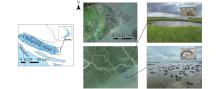
图1
研究区域位置"
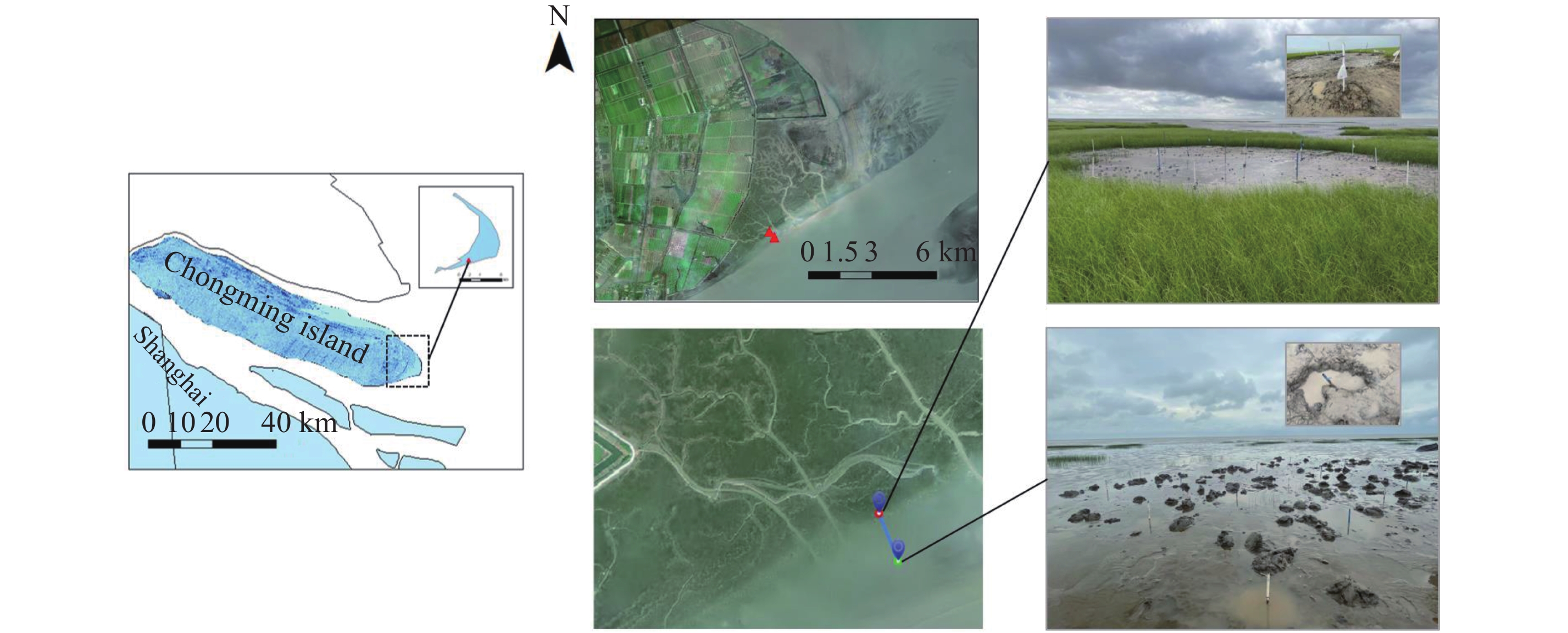
表1
HM和LM样地的土壤初始性质"
| 样地 | 温度/℃ | 水分/% | 盐度/ppt | 氧化还原电位/mV | 黏土/% | 粉砂/% | 砂土/% |
| HM | 22.4±1.0A | 44.5±8.6A | 1.7±0.6A | 72.7±171.2A | 4.1 | 70.5 | 25.4 |
| LM | 25.2±0.6B | 44.6±6.0A | 1.7±0.4A | 205.1±154.5B | 3.1 | 59.9 | 37.1 |
表2
芦苇和互花米草凋落物的初始性质"
| 凋落物 | TN/(g·kg–1) | TC/(g·kg–1) | C/N | 半纤维素/% | 纤维素/% | 可溶性化合物/% | 木质素/% |
| SA | 6.1±0.8A | 419.3±1.2A | 69.2±9.4A | 13.7±0.1A | 35.7±0.1A | 43.7±0.1A | 6.9±0.1A |
| PA | 9.5±0.3B | 394.4±3.0B | 41.5±1.6B | 12.7±0.6A | 36.9±1.3A | 41.9±2.0A | 8.5±0.1B |
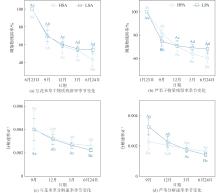
图2
在一年的分解周期内, 互花米草 (SA) 和芦苇 (PA) 凋落物在高潮滩 (HM) 和低潮滩 (LM) 的干物质残留率以及基于Olson分解模型的分解速率的变化 注: 不同的上标大写字母表示同一时间HM和LM之间的SA或PA凋落物数据在p < 0.05水平上有显著差异, 不同的小写字母表示同一样地不同时间之间的SA或PA凋落物数据在p < 0.05水平上有显著差异."
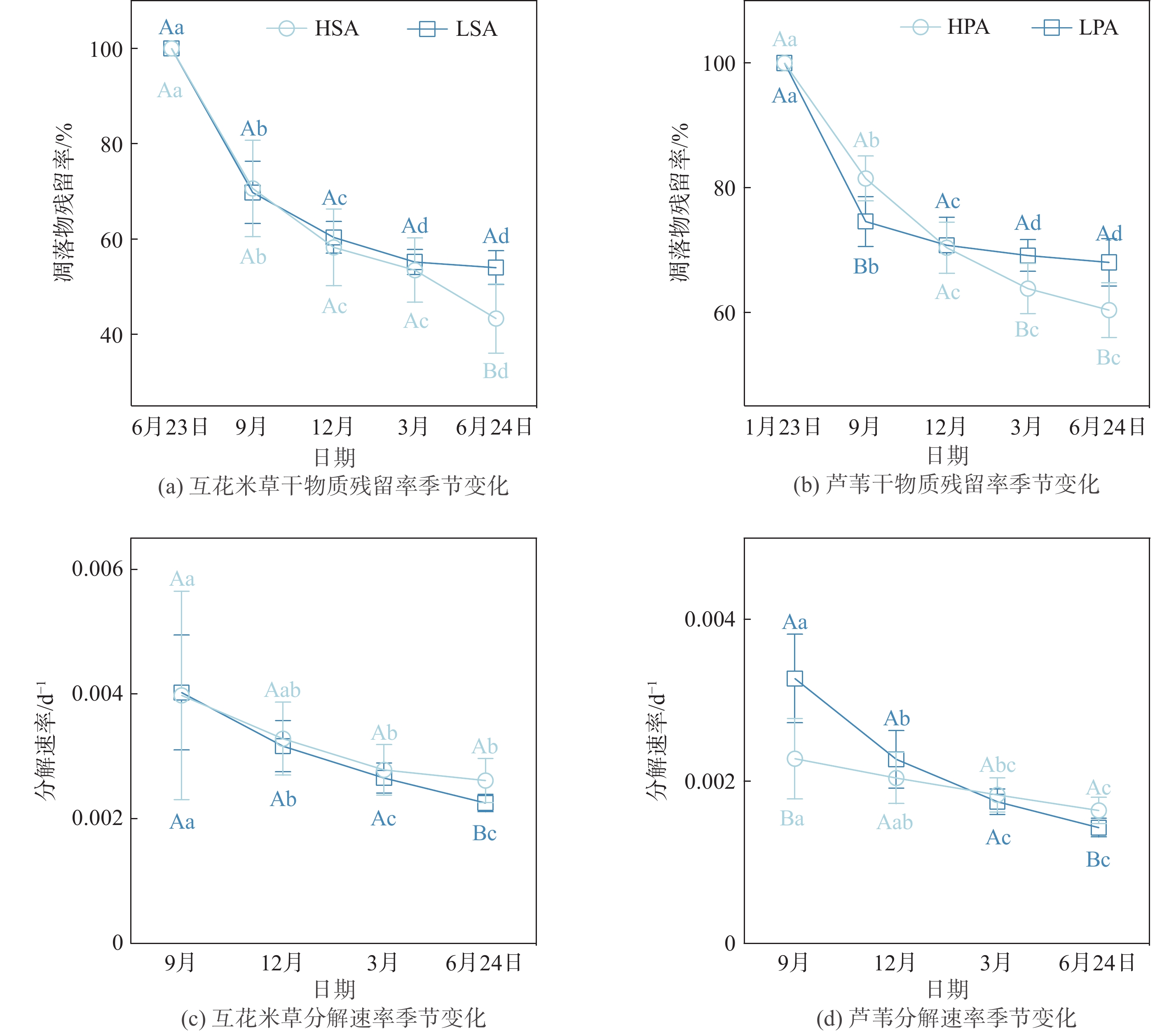
图3
分解过程中互花米草 (SA) 和芦苇 (PA) 凋落物在高潮滩 (HM) 和低潮滩 (LM) 的TC、TN及其元素积累指数 (AI) 和C/N 注: 不同的上标大写字母或*、**、***表示同一时间HM和LM之间的SA或PA凋落物数据在p<0.05水平上有显著差异, *表示p<0.05, **表示p<0.01, ***表示p<0.001; 不同的小写字母表示同一样地不同时间之间的SA或PA凋落物数据在p<0.05水平上有显著差异; DW表示干重 (Dry Weight)."
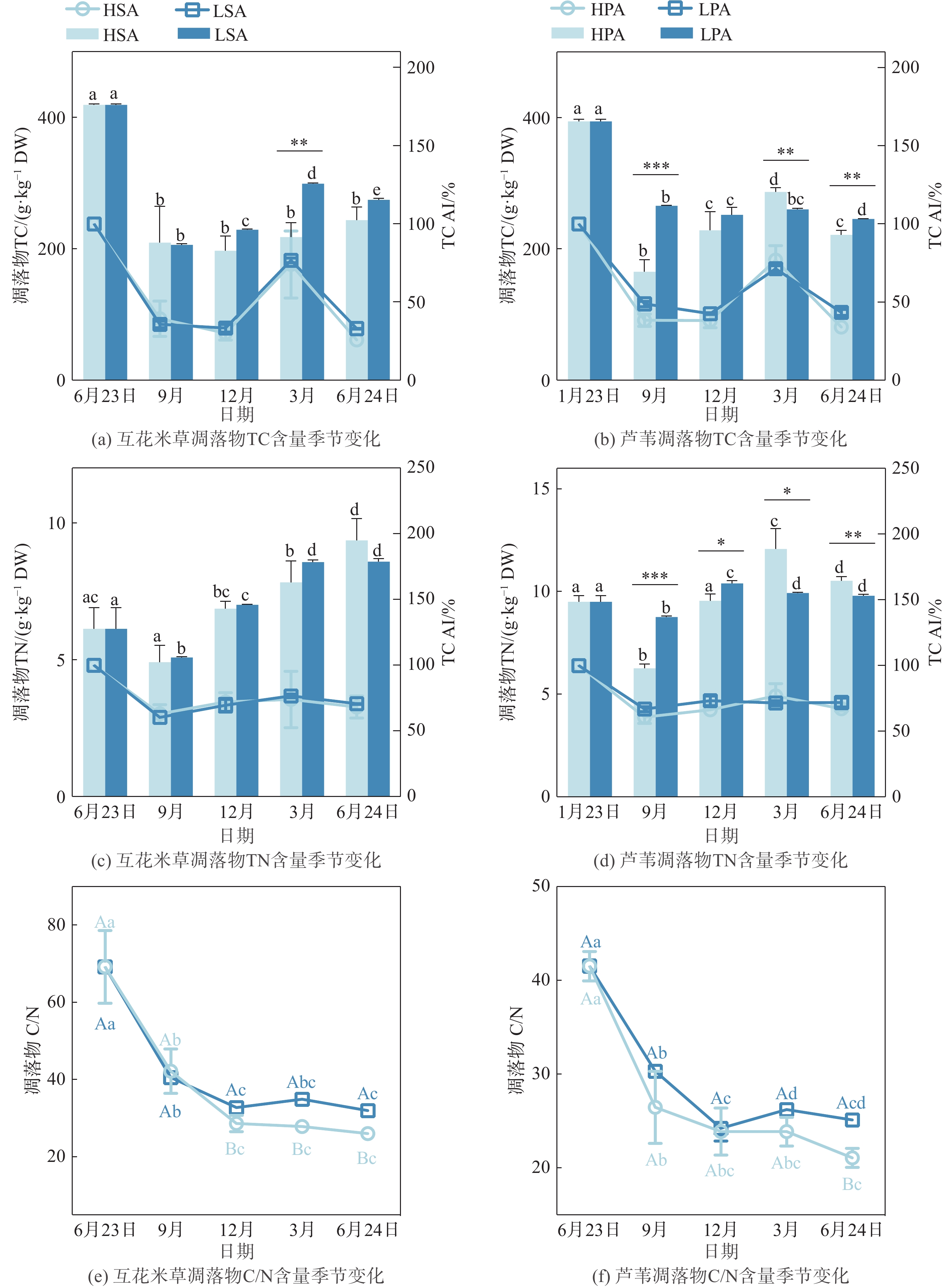
表3
分解过程中高潮滩 (HM) 和低潮滩 (LM) 互花米草 (SA) 和芦苇 (PA) 凋落物邻近土壤和空白对照土壤的温度、水分、盐度、pH、TN和C/N"
| 样本 | 温度/℃ | 水分/% | |||||||
| 90 d | 180 d | 270 d | 360 d | 90 d | 180 d | 270 d | 360 d | ||
| HM-SA | 29.1±1.0Aa | 7.9±0.5Ab | 12.4±0.6Ac | 20.7±0.3Ad | 48.9±2.6Aa | 57.6±6.5Ab | 56.4±5.9Ab | 51.5±2.1Aa | |
| LM-SA | 27.9±0.3Ba | 9.4±0.4Bb | 11.8±0.5Bc | 21.9±0.1Bd | 49.7±3.3Aa | 65.3±9.2Ab | 61.8±6.5Ab | 52.1±4.1Aa | |
| HM-PA | 28.6±0.8Aa | 8.4±0.3Ab | 11.8±0.6Ac | 20.8±0.5Ad | 48.3±1.6Aa | 48.7±9.3Aa | 55.8±8.2Ab | 44.8±6.9Aa | |
| LM-PA | 27.7±0.4Ba | 9.3±0.6Bb | 11.9±1.6Ac | 22.2±0.3Bd | 49.9±4.9Aa | 60.8±9.1Bb | 55.1±6.4Aab | 52.0±2.3Ba | |
| HM-Control | 30.5±0.7Aa | 8.5±0.1Ab | 11.4±1.1Ac | 20.6±0.3Ad | 44.8±6.1Aa | 55.8±2.1Aa | 47.3±12.1Aa | 44.2±6.6Aa | |
| LM-Control | 28.5±0.2Ba | 9.8±0.3Bb | 11.1±0.7Ac | 22.3±0.1Bd | 37.5±2.5Aa | 52.2±20.5Aab | 61.0±1.5Ab | 49.4±1.3Aab | |
| 样本 | 盐度/ppt | pH | |||||||
| 90 d | 180 d | 270 d | 360 d | 90 d | 180 d | 270 d | 360 d | ||
| HM-SA | 0.67±0.11Aa | 2.20±0.66Ab | 1.60±0.29Ab | 0.46±0.08Ac | 8.57±0.15Aa | 8.80±0.10Ab | 9.25±0.05Ac | 8.99±0.10Ab | |
| LM-SA | 0.90±0.20Ba | 2.67±0.58Ab | 2.28±0.35Bb | 0.85±0.32Ba | 8.90±0.00Ba | 9.03±0.06Ba | 9.03±0.21Aa | 8.93±0.15Aa | |
| HM-PA | 0.72±0.14Aa | 1.63±0.47Ab | 1.72±0.47Ab | 0.50±0.15Ac | 8.63±0.15Aa | 9.01±0.10Ab | 9.17±0.15Ab | 9.09±0.10Ab | |
| LM-PA | 0.89±0.32Aa | 2.40±0.57Bb | 1.91±0.31Ab | 1.03±0.20Ba | 8.90±0.10Aa | 8.95±0.05Aa | 8.95±0.15Aa | 8.93±0.15Aa | |
| HM-Control | 0.66±0.07Aa | 1.88±0.23Ab | 1.40±0.64Ab | 0.53±0.05Aa | 8.93±0.15Aa | 9.03±0.15Aa | 9.03±0.15Aa | 9.02±0.25Aa | |
| LM-Control | 0.47±0.06Ba | 2.10±1.23Ab | 2.35±0.24Ab | 0.53±0.08Aa | 9.15±0.05Aa | 9.15±0.05Aa | 9.20±0.10Aa | 9.30±0.20Aa | |
| 样本 | TN/(g·kg–1) | C/N | |||||||
| 90 d | 180 d | 270 d | 360 d | 90 d | 180 d | 270 d | 360 d | ||
| HM-SA | 0.42±0.11Aa | 0.30±0.05Ab | 0.47±0.12Aa | 0.29±0.05Ab | 5.77±0.98Aa | 11.68±3.09Ab | 8.30±0.87Ac | 9.94±1.01Ac | |
| LM-SA | 0.49±0.18Aa | 0.39±0.06Bab | 0.32±0.16Bbc | 0.23±0.05Bc | 5.92±1.29Aa | 10.21±3.52Ab | 6.18±2.25Ba | 6.66±0.64Ba | |
| HM-PA | 0.39±0.09Aab | 0.42±0.08Aa | 0.34±0.07Ab | 0.25±0.05Ac | 6.06±1.18Aa | 9.24±1.57Ab | 9.03±0.88Ab | 9.21±1.70Ab | |
| LM-PA | 0.69±0.31Ba | 0.38±0.14Ab | 0.32±0.09Ab | 0.25±0.07Ab | 5.26±0.93Aa | 8.51±1.57Ab | 5.23±1.51Ba | 7.34±1.63Bb | |
| HM-Control | 0.41±0.07Aa | 0.32±0.04Aab | 0.25±0.11Ab | 0.26±0.05Ab | 4.03±0.22Aa | 8.58±0.55Ab | 6.87±1.18Abc | 6.10±1.48Ac | |
| LM-Control | 0.37±0.06Aa | 0.26±0.14Aa | 0.24±0.04Aa | 0.22±0.07Aa | 3.71±0.41Aa | 6.35±0.31Bb | 4.39±0.31Bc | 4.88±0.18Ac | |
图4
分解过程中高潮滩 (HM) 和低潮滩 (LM) 互花米草 (SA) 和芦苇 (PA) 凋落物邻近土壤和空白对照土壤的SOC和DOC、MBC的含量及其在SOC中占比的变化 注: *、**、***表示同一时间HM和LM之间的SA、PA或空白对照土壤数据在p<0.05水平上有显著差异, *表示p<0.05, **表示p<0.01, ***表示p<0.001; 不同的小写字母表示同一样地不同时间之间的SA、PA或空白对照土壤数据在p<0.05水平上有显著差异; DW表示干重 (Dry Weight)."
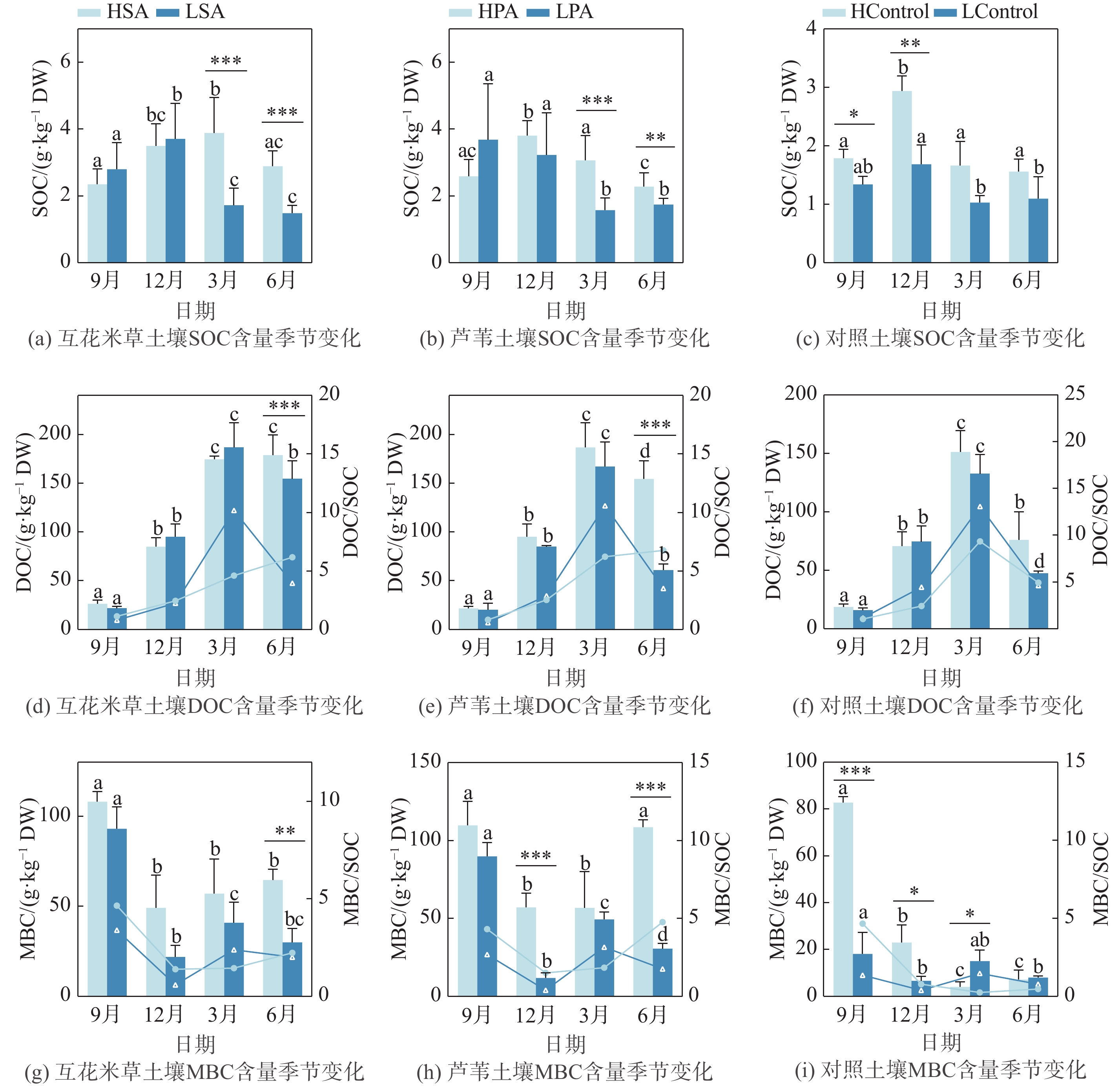
图5
分解过程中高潮滩 (HM) 和低潮滩 (LM) 互花米草 (SA) 和芦苇 (PA) 凋落物邻近土壤和空白对照土壤的POC和MAOC的含量及其在SOC中占比的变化, 以及土壤MAOC的C/N变化 注: *、***表示同一时间HM和LM之间的SA、PA或空白对照土壤数据在p<0.05水平上有显著差异, *表示p<0.05, ***表示p<0.001; 不同的小写字母表示同一样地不同时间之间的SA、PA或空白对照土壤数据在p<0.05水平上有显著差异, DW表示干重 (Dry Weight)."
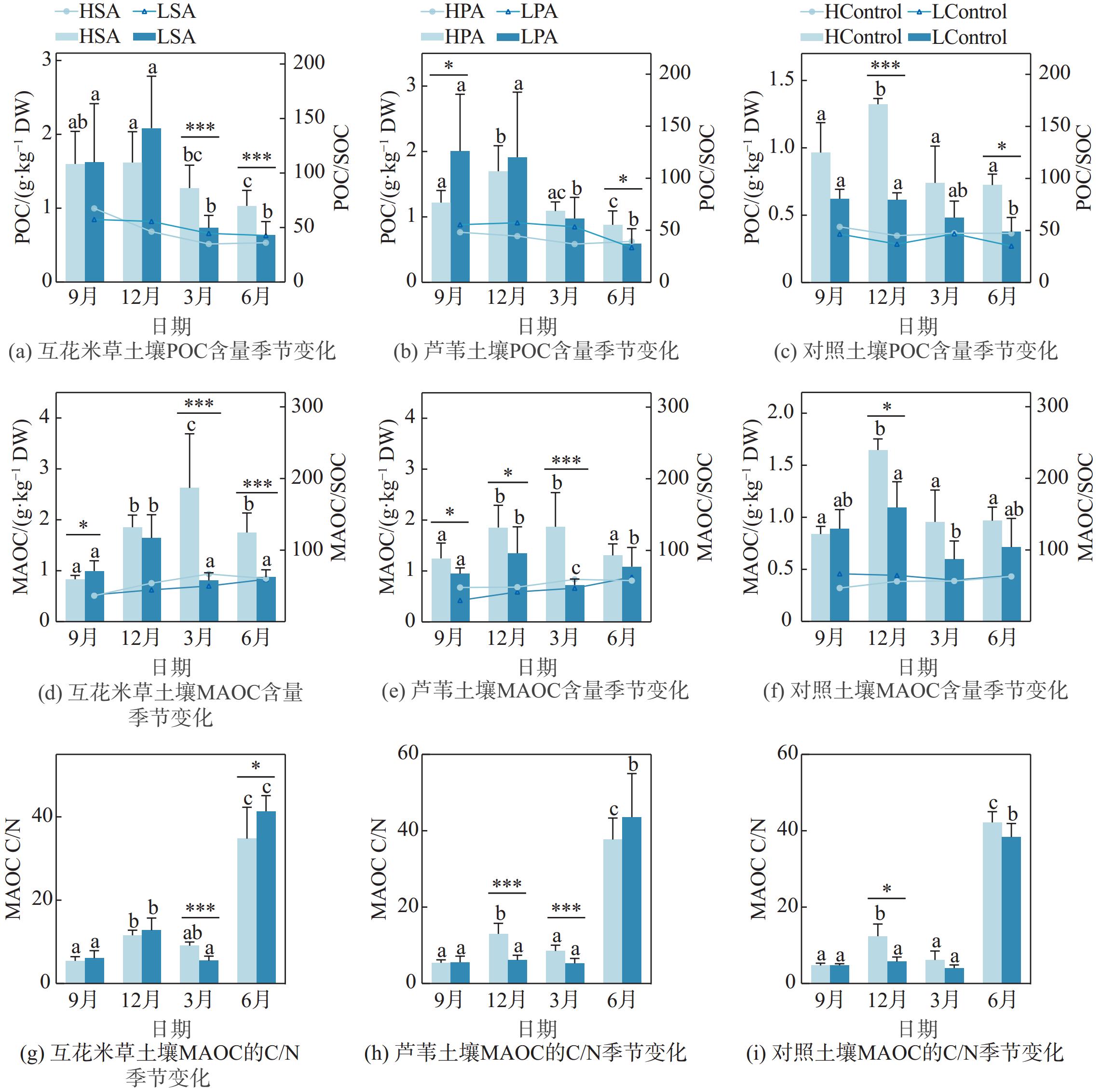
表4
植物类型 (SA、PA) 与潮滩高程 (HM、LM) 对碳组分、凋落物分解速率 (k) 及干物质残留率 (LR) 影响的重复测量方差分析结果"
| 变量 | 效应 | F | p-value |
| SOC | 时间 | 9.388 | |
| 高程 | 7.691 | ||
| 时间×高程 | 7.650 | ||
| DOC | 时间 | 142.800 | < |
| 高程 | 39.690 | < | |
| 时间×高程 | 22.850 | < | |
| 时间×植物类型 | 3.490 | ||
| MBC | 时间 | 46.680 | < |
| 高程 | 55.910 | < | |
| 植物类型 | 6.756 | ||
| 时间×高程 | 6.127 | ||
| 时间×植物类型 | 5.373 | ||
| 高程×植物类型 | 8.958 | ||
| 时间×高程×植物类型 | 5.330 | ||
| POC | 时间 | 22.850 | < |
| 时间×高程 | 3.978 | ||
| MAOC | 时间 | 12.410 | |
| 高程 | 54.120 | < | |
| 时间×高程 | 13.370 | ||
| 时间×高程×植物类型 | 4.660 | ||
| k | 时间 | 31.58 | < |
| 植物类型 | 80.36 | < | |
| LR | 时间 | 87.100 | < |
| 高程 | 9.307 | ||
| 植物类型 | 145.500 | < | |
| 时间×高程 | 10.250 |
表5
SA和PA凋落物分解速率k与土壤环境因素之间的相关性分析"
| 凋落物k | 温度 | 水分 | 盐度 | pH | TN | C/N | SOC | DOC | MBC | POC | MAOC |
| SA-k | 0.29* | −0.11 | −0.05 | −0.48* | 0.48** | −0.17 | 0.19 | −0.47* | 0.60** | 0.51** | −0.15 |
| PA-k | 0.32** | 0.03 | −0.05 | −0.28 | 0.52** | −0.27* | 0.36** | −0.57** | 0.16 | 0.41** | −0.11 |
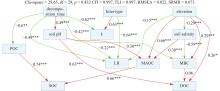
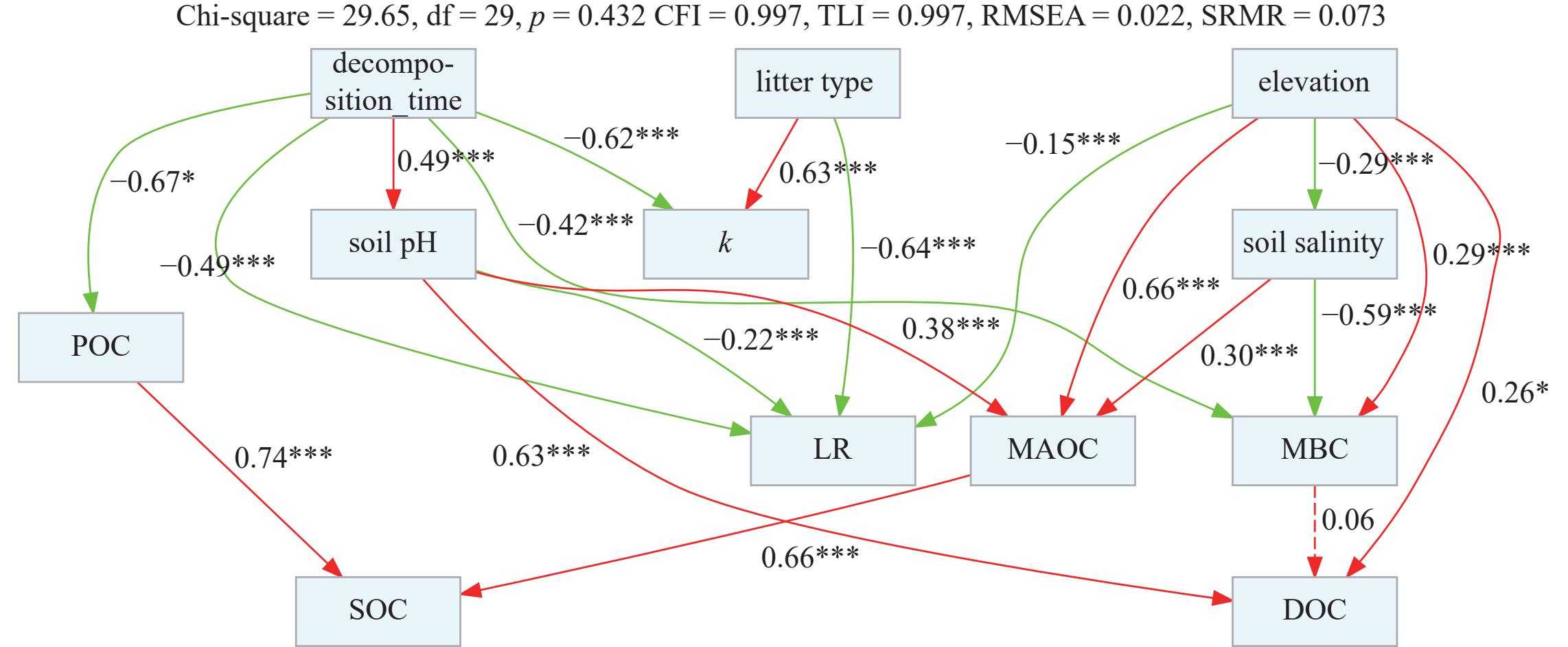
图6
土壤碳组分及凋落物分解影响因子的结构方程分析 注: decomposition time为分解时间; litter type为凋落物类型; elevation为潮滩高程; k为凋落物分解速率; LR为干物质残留率; soil pH为土壤pH; soil salinity为土壤盐度; POC为颗粒有机碳; MAOC为矿物结合有机碳; MBC为微生物量碳; DOC为溶解有机碳; SOC为土壤有机碳.*表示p<0.05, ***表示p<0.001; 模型拟合指标为CFI = 0.997, TLI = 0.997, RMSEA = 0.022."
| 1 | KIRWAN M L, BLUM L K.. Enhanced decomposition offsets enhanced productivity and soil carbon accumulation in coastal wetlands responding to climate change. Biogeosciences, 2011, 8 (4): 987- 993. |
| 2 | K RAMESH REDDY R D D. Biogeochemistry of Wetlands: Science and Applications [M]. Boca Raton: CRC Press, 2008. |
| 3 | AMUNDSON R.. The carbon budget in soils. Annual Review of Earth and Planetary Sciences, 2001, 29, 535- 562. |
| 4 | KAYRANLI B, SCHOLZ M, MUSTAFA A, et al.. Carbon storage and fluxes within freshwater wetlands: A critical review. Wetlands, 2010, 30 (1): 111- 124. |
| 5 | YU J M, WANG X T, YANG S X, et al.. Divergent response of blue carbon components to wetland types and hydrological effects in typical estuarine wetlands of Jiaozhou Bay, China. Journal of Environmental Management, 2023, 347, 119233. |
| 6 | 张晓涵, 田慧敏, 陈雪初, 等.. 长江口横沙岛不同发育年限盐沼植被生长特征及其固碳功能差异. 华东师范大学学报(自然科学版), 2024 (1): 113- 121. |
| 7 | CASTELLANO M J, MUELLER K E, OLK D C, et al.. Integrating plant litter quality, soil organic matter stabilization, and the carbon saturation concept. Global Change Biology, 2015, 21 (9): 3200- 3209. |
| 8 | MCNICOL G, SILVER W L.. Non-linear response of carbon dioxide and methane emissions to oxygen availability in a drained histosol. Biogeochemistry, 2015, 123 (1): 299- 306. |
| 9 | WANG W Q, WANG C, SARDANS J, et al.. Storage and release of nutrients during litter decomposition for native and invasive species under different flooding intensities in a Chinese wetland. Aquatic Botany, 2018, 149, 5- 16. |
| 10 | HAN G X, CHU X J, XING Q H, et al.. Effects of episodic flooding on the net ecosystem CO2 exchange of a supratidal wetland in the Yellow River Delta. Journal of Geophysical Research: Biogeosciences, 2015, 120 (8): 1506- 1520. |
| 11 | WU L L, SONG Z L, WU Y T, et al.. Organic matter composition and stability in estuarine wetlands depending on soil salinity. Science of the Total Environment, 2024, 945, 173861. |
| 12 | SCHLÜTER S, LEUTHER F, ALBRECHT L, et al.. Microscale carbon distribution around pores and particulate organic matter varies with soil moisture regime. Nature Communications, 2022, 13, 2098. |
| 13 | PEREZ B C, DAY J W, ROUSE L J, et al.. Influence of Atchafalaya River discharge and winter frontal passage on suspended sediment concentration and flux in fourleague bay, Louisiana. Estuarine, Coastal and Shelf Science, 2000, 50 (2): 271- 290. |
| 14 | HECKMAN K A, POSSINGER A R, BADGLEY B D, et al.. Moisture-driven divergence in mineral-associated soil carbon persistence. Proceedings of the National Academy of Sciences of the United States of America, 2023, 120 (7): e2210044120. |
| 15 | SUN Z G, MOU X J, SUN W L.. Decomposition and heavy metal variations of the typical halophyte litters in coastal marshes of the Yellow River estuary, China. Chemosphere, 2016, 147, 163- 172. |
| 16 | WANG M, WANG Q, SHA C Y, et al.. Spartina alterniflora invasion affects soil carbon in a C3 plant-dominated tidal marsh. Scientific Reports, 2018, 8, 628. |
| 17 | 狄丽燕, 孔范龙, 王森, 等.. 胶州湾滨海湿地凋落物分解对土壤有机碳矿化的影响. 生态学报, 2019, 39 (22): 8483- 8493. |
| 18 | BU N S, QU J F, LI Z L, et al.. Effects of Spartina alterniflora invasion on soil respiration in the Yangtze River Estuary, China. PLoS One, 2015, 10 (3): e0121571. |
| 19 | CHIMNEY M J, PIETRO K C.. Decomposition of macrophyte litter in a subtropical constructed wetland in south Florida (USA). Ecological Engineering, 2006, 27 (4): 301- 321. |
| 20 | ZHANG D Q, HUI D F, LUO Y Q, et al.. Rates of litter decomposition in terrestrial ecosystems: Global patterns and controlling factors. Journal of Plant Ecology, 2008, 1 (2): 85- 93. |
| 21 | WHALEN J K, GUL S, POIRIER V, et al.. Transforming plant carbon into soil carbon: Process-level controls on carbon sequestration. Canadian Journal of Plant Science, 2014, 94 (6): 1065- 1073. |
| 22 | ZHENG Y, HU Z K, PAN X, et al.. Carbon and nitrogen transfer from litter to soil is higher in slow than rapid decomposing plant litter: A synthesis of stable isotope studies. Soil Biology and Biochemistry, 2021, 156, 108196. |
| 23 | 徐志明.. 崇明岛东部潮滩沉积. 海洋与湖沼, 1985, 16 (3): 231- 239. |
| 24 | 布乃顺, 王坤, 侯玉乐, 等.. 半月周期的潮汐对滨海湿地土壤理化性质的影响. 长江流域资源与环境, 2015, 24 (11): 1898- 1905. |
| 25 | KVALE E P.. The origin of neap–spring tidal cycles. Marine Geology, 2006, 235 (1/2/3/4): 5- 18. |
| 26 | ZHU Q, VAN PROOIJEN B C, WANG Z B, et al.. Bed-level changes on intertidal wetland in response to waves and tides: A case study from the Yangtze River Delta. Marine Geology, 2017, 385, 160- 172. |
| 27 | CAMBARDELLA C A, ELLIOTT E T.. Particulate soil organic-matter changes across a grassland cultivation sequence. Soil Science Society of America Journal, 1992, 56 (3): 777- 783. |
| 28 | VANCE E D, BROOKES P C, JENKINSON D S.. An extraction method for measuring soil microbial biomass C. Soil Biology and Biochemistry, 1987, 19 (6): 703- 707. |
| 29 | OLSON J S.. Energy storage and the balance of producers and decomposers in ecological systems. Ecology, 1963, 44 (2): 322- 331. |
| 30 | VAN SOEST P J.. Use of detergents in the analysis of fibrous feeds. Ⅱ. a rapid method for the determination of fiber and lignin. Journal of AOAC International, 1963, 46 (5): 829- 835. |
| 31 | LUO Y, ZHOU X. Soil Respiration and the Environment[M]. Burlington: Academic Press, 2010. |
| 32 | ROTH V N, LANGE M, SIMON C, et al.. Persistence of dissolved organic matter explained by molecular changes during its passage through soil. Nature Geoscience, 2019, 12 (9): 755- 761. |
| 33 | WANG Q, WANG Z, PEÑUELAS J, et al.. Decaying logs and gap positions jointly mediate the structure and function of soil bacterial community in the forest ecosystem. Forest Ecology and Management, 2024, 567, 122070. |
| 34 | SU B W, GAO C, JI J C, et al.. Soil bacterial succession with different land uses along a millennial chronosequence derived from the Yangtze River flood plain. Science of the Total Environment, 2024, 908, 168531. |
| 35 | LI B, LI Y B, FANIN N, et al.. Stoichiometric imbalances between soil microorganisms and their resources regulate litter decomposition. Functional Ecology, 2023, 37 (12): 3136- 3149. |
| 36 | THULLEN J S, NELSON S M, CADE B S, et al.. Macrophyte decomposition in a surface-flow ammonia-dominated constructed wetland: Rates associated with environmental and biotic variables. Ecological Engineering, 2008, 32 (3): 281- 290. |
| 37 | MENDELSSOHN I A, SORRELL B K, BRIX H, et al.. Controls on soil cellulose decomposition along a salinity gradient in a Phragmites australis wetland in Denmark. Aquatic Botany, 1999, 64 (3/4): 381- 398. |
| 38 | ROACHE M C, BAILEY P C, BOON P I.. Effects of salinity on the decay of the freshwater macrophyte, Triglochin procerum. Aquatic Botany, 2006, 84 (1): 45- 52. |
| 39 | SARASWATI S, DUNN C, MITSCH W J, et al.. Is peat accumulation in mangrove swamps influenced by the “enzymic latch” mechanism?. Wetlands Ecology and Management, 2016, 24 (6): 641- 650. |
| 40 | KIDA M, TANABE M, TOMOTSUNE M, et al.. Changes in dissolved organic matter composition and dynamics in a subtropical mangrove river driven by rainfall. Estuarine, Coastal and Shelf Science, 2019, 223, 6- 17. |
| 41 | PRIHA O, SMOLANDER A.. Nitrogen transformations in soil under Pinus sylvestris, Picea abies and Betula pendula at two forest sites. Soil Biology and Biochemistry, 1999, 31 (7): 965- 977. |
| 42 | KITTLE D L, MCGRAW J B, GARBUTT K.. Plant litter decomposition in wetlands receiving acid mine drainage. Journal of Environmental Quality, 1995, 24 (2): 301- 306. |
| 43 | BALDOCK J A, SKJEMSTAD J O.. Role of the soil matrix and minerals in protecting natural organic materials against biological attack. Organic Geochemistry, 2000, 31 (7/8): 697- 710. |
| 44 | GRANDY A S, NEFF J C.. Molecular C dynamics downstream: The biochemical decomposition sequence and its impact on soil organic matter structure and function. Science of the Total Environment, 2008, 404 (2/3): 297- 307. |
| 45 | PLAZA C, COURTIER-MURIAS D, FERNÁNDEZ J M, et al.. Physical, chemical, and biochemical mechanisms of soil organic matter stabilization under conservation tillage systems: A central role for microbes and microbial by-products in C sequestration. Soil Biology and Biochemistry, 2013, 57, 124- 134. |
| 46 | HUANG W J, HALL S J.. Elevated moisture stimulates carbon loss from mineral soils by releasing protected organic matter. Nature Communications, 2017, 8, 1774. |
| 47 | DUAN H, WANG L, ZHANG Y N, et al.. Variable decomposition of two plant litters and their effects on the carbon sequestration ability of wetland soil in the Yangtze River estuary. Geoderma, 2018, 319, 230- 238. |
| 48 | SOKOL N W, WHALEN E D, JILLING A, et al.. Global distribution, formation and fate of mineral-associated soil organic matter under a changing climate: A trait-based perspective. Functional Ecology, 2022, 36 (6): 1411- 1429. |
| 49 | BENESCH M, GLASER B, DIPPOLD M, et al.. Soil microbial C and N turnover under Cupressus lusitanica and natural forests in southern Ethiopia assessed by decomposition of 13C- and 15 N-labelled litter under field conditions. Plant and Soil, 2015, 388 (1): 133- 146. |
| 50 | XU X, LIU H, LIU Y Z, et al.. Human eutrophication drives biogeographic salt marsh productivity patterns in China. Ecological Applications, 2020, 30 (2): e02045. |
| 51 | WANG L, LI Y, HEI J, et al.. Impacts of Spartina alterniflora invasion on soil carbon components of particulate and mineral-associated organic matter and soil organic matter mineralization in estuarine wetlands. Applied Soil Ecology, 2025, 206, 105857. |
| 52 | LIANG C, SCHIMEL J P, JASTROW J D.. The importance of anabolism in microbial control over soil carbon storage. Nature Microbiology, 2017, 2, 17105. |
| 53 | COTRUFO M F, HADDIX M L, KROEGER M E, et al.. The role of plant input physical-chemical properties, and microbial and soil chemical diversity on the formation of particulate and mineral-associated organic matter. Soil Biology and Biochemistry, 2022, 168, 108648. |
| 54 | 周金戈, 覃国铭, 张靖凡, 等.. 中国盐沼湿地蓝碳碳汇研究进展. 热带亚热带植物学报, 2022, 30 (6): 765- 781. |
| 55 | DYNARSKI K A, BOSSIO D A, SCOW K M.. Dynamic stability of soil carbon: Reassessing the “permanence” of soil carbon sequestration. Frontiers in Environmental Science, 2020, 8, 514701. |
| 56 | LIAO C Z, LUO Y Q, JIANG L F, et al.. Invasion of Spartina alterniflora enhanced ecosystem carbon and nitrogen stocks in the Yangtze Estuary, China. Ecosystems, 2007, 10 (8): 1351- 1361. |
| 57 | ZHANG Y H, DING W X, LUO J F, et al.. Changes in soil organic carbon dynamics in an Eastern Chinese coastal wetland following invasion by a C4 plant Spartina alterniflora. Soil Biology and Biochemistry, 2010, 42 (10): 1712- 1720. |
| 58 | GUO X Q, LIU Y J, XIE T, et al.. Impact of ecological restoration on carbon sink function in coastal wetlands: A review. Water, 2025, 17 (4): 488. |
| 59 | 刘博远, 陈雪初, 张晓涵, 等.. 秸秆埋藏对富营养化盐沼湿地碳汇功能的影响. 华东师范大学学报(自然科学版), 2025 (2): 34- 41. |
| [1] | 关阅章, 刘安田, 仲启铖, 王开运. 滨海围垦湿地芦苇凋落物分解对模拟增温的响应[J]. 华东师范大学学报(自然科学版), 2013, 2013(5): 27-34. |
| [2] | 邓泓;叶志鸿;黄铭洪. 湿地植物根系泌氧的特征[J]. 华东师范大学学报(自然科学版), 2007, 2007(6): 69-76. |
| 阅读次数 | ||||||
|
全文 |
|
|||||
|
摘要 |
|
|||||
