
 中文核心期刊
J* E* C* N* U* N* S* ›› 2025, Vol. 2025 ›› Issue (1): 124-137.doi: 10.3969/j.issn.1000-5641.2025.01.010
• Computer Science • Previous Articles
Yiping LIANG, Luwei XIAO, Linlin WANG*( )
)
Received:2024-01-09
Online:2025-01-25
Published:2025-01-20
Contact:
Linlin WANG
E-mail:llwang@cs.ecnu.edu.cn
CLC Number:
Yiping LIANG, Luwei XIAO, Linlin WANG. Label-perception augmented causal analysis of mental health over social media[J]. J* E* C* N* U* N* S*, 2025, 2025(1): 124-137.
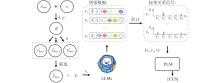
Fig.1
Framework of the method"
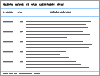
Table 1
Statistical details for two datasets"
| 数据集 | 训练集的样本数量/条 | 测试集的样本数量/条 | 标签 | 标签数/个 |
| Intent_SDCNL | 370 | 无理由(NR, 19%) 虐待与偏见(BA, 13%) 药物(M, 12%) 人际关系(R, 20%) 职业(JC, 12%) 异化(A, 23%) | 6 | |
| SAD | 980 | 财务困难(FP, 9%) 情感波动(ET, 10%) 家庭事务(FI, 11%) 学校(S, 11%) 健康, 疲劳或身体疼痛(H, 11%) 社交关系(SR, 9%) 其他(O, 14%) 日常决策(ED, 5%) 工作(W, 19%) | 9 |
Table 2
The task instruction $ p $ and meta-prompt $ \delta ,\eta $ on Intent_SDCNL and SAD"
| 内容 | Intent_SDCNL | SAD |
| 任务指令 | Post: [Post]. Based on the post, Is [Label_desc] the cause of this individual’s mental health issues? You must only return “yes” or “no”. | Post: [Post]. Based on the post, Is [Label_desc] the source of stress of this individual in everyday life? You must only return “yes” or “no”. |
| 元提示 | I’m trying to recognize what causes mental health issues from social media posts. My current cause is: “[Label_desc]” But this cause gets the following examples wrong: [error_string] give only [num_feedbacks] reasons why the cause could have gotten these examples wrong. Wrap each reason with | I’m trying to recognize what causes everyday life stress from social media posts. My current cause is: ”[Label_desc]” But this cause gets the following examples wrong: [error_string] give only [num_feedbacks] reasons why the cause could have gotten these examples wrong. Wrap each reason with |
| 元提示 | I’m trying to recognize what causes mental health issues from social media posts. My current cause is: “[Label_desc]” But this cause gets the following examples wrong: [error_string] Based on these examples the problem with this cause is that [gradient] Based on the above information, wrote [steps_per_gradient] different improved cause phrases without interpretations. Each cause is wrapped with | I’m trying to recognize what causes everyday life stress from social media posts. My current cause is: “[Label_desc]” But this cause gets the following examples wrong: [error_string] Based on these examples the problem with this cause is that [gradient] Based on the above information, wrote [steps_per_gradient] different improved cause phrases without interpretations. Each cause is wrapped with |
Table 3
Micro-F1 of the baseline on the Intent_SDCNL and SAD datasets"
| 模型 | 微观F1/% | 模型 | 微观F1/% | |||
| Intent_SDCNL | SAD | Intent_SDCNL | SAD | |||
| CNN[ | 34.63 | 38.45 | LLaMA2-7B[ | 30.47 | 49.60 | |
| GRU[ | 29.33 | 34.79 | MentaLLaMA-chat-13B[ | 45.52 | 63.62 | |
| BiLSTM[ | 29.49 | 38.50 | ChatGPT_CoT _emo[ | 45.99 | 63.56 | |
| MentalRoBERTa[ | 47.62 | 68.44 | GPT-4_Few-shot[ | 42.37 | 55.68 | |
| BART-Large[ | 43.80 | 59.60 | RoBERTa_base[ | 36.54 | 67.53 | |
| T5-Large[ | 40.20 | 58.10 | MentaLLaMA-7B[ | 32.52 | 49.93 | |
Table 4
The experiment results on Intent_SDCNL and SAD"
| 模型 | 分类器 | 准确度/% | 宏观精确率/% | 宏观召回率/% | 宏观F1/% | |||||||
| Intent_SDCNL | SAD | Intent_SDCNL | SAD | Intent_SDCNL | SAD | Intent_SDCNL | SAD | |||||
| chatglm3-6B | RoBERTa | 62.21±0.27 | 81.24±1.49 | 68.76±1.98 | 76.30±1.12 | 59.20±0.43 | 73.72±0.53 | 59.90±0.36 | 74.03±0.50 | |||
| Longformer | 65.13±0.77 | 82.24±1.26 | 68.63±0.87 | 77.49±1.94 | 60.87±0.28 | 74.80±1.74 | 61.69±0.39 | 75.00±1.91 | ||||
| FLAN-T5 | 50.34±1.09 | 80.47±0.82 | 62.78±5.94 | 75.08±1.77 | 45.95±0.44 | 72.76±1.33 | 45.60±0.45 | 72.52±0.72 | ||||
| GPT-2 | 56.50±0.30 | 81.32±2.02 | 57.48±0.64 | 76.02±3.04 | 52.88±1.01 | 73.78±1.29 | 52.72±1.31 | 73.92±1.96 | ||||
| Qwen-7B | RoBERTa | 57.30±0.42 | 78.14±0.99 | 66.75±5.09 | 75.99±2.30 | 50.71±1.41 | 72.75±0.77 | 49.90±1.49 | 73.20±0.81 | |||
| Longformer | 53.30 ±0.52 | 79.07±1.35 | 58.33±2.02 | 73.61±2.17 | 46.44±0.48 | 71.33±0.65 | 45.89±0.36 | 71.14±1.33 | ||||
| FLAN-T5 | 42.36±0.88 | 77.08±1.47 | 53.07±2.24 | 73.56±2.93 | 33.89±0.57 | 68.50±2.21 | 32.18±1.01 | 68.19±2.86 | ||||
| GPT-2 | 54.69±1.58 | 76.22±1.76 | 54.18±4.49 | 69.92±3.27 | 48.10±1.56 | 68.54±1.48 | 47.36±1.50 | 68.57±1.64 | ||||
| Baichuan-13B-Chat | RoBERTa | 64.99±0.69 | 85.03±1.24 | 64.30±0.11 | 83.56±0.35 | 62.63±0.62 | 79.11±0.23 | 61.76±0.57 | 79.97±0.25 | |||
| Longformer | 65.62±0.75 | 83.40±0.89 | 64.75±1.38 | 79.42±1.71 | 63.34±1.59 | 76.41±1.60 | 62.73±2.04 | 76.62±1.57 | ||||
| FLAN-T5 | 55.52±0.82 | 82.60±1.96 | 56.84±0.55 | 78.46±0.65 | 51.83±0.80 | 74.24±2.10 | 53.03±0.84 | 74.78±2.13 | ||||
| GPT-2 | 61.11±1.83 | 79.67±2.11 | 62.18±1.76 | 75.80±2.87 | 58.16±2.61 | 72.46±1.43 | 58.55±2.00 | 72.09±1.97 | ||||
Table 5
The ablation experiment results on Intent_SDCNL and SAD"
| 变体 | 分类器 | 准确度/% | 宏观F1/% | |||
| Intent_SDCNL | SAD | Intent_SDCNL | SAD | |||
| w/o 增强 | RoBERTa | 58.67 ± 1.86 | 79.81 ± 1.73 | 56.55 ± 1.43 | 71.98 ± 2.13 | |
| Longformer | 59.86 ± 1.44 | 78.08 ± 1.69 | 56.52 ± 1.97 | 72.12 ± 1.39 | ||
| FLAN-T5 | 41.26 ± 2.43 | 71.86 ± 0.24 | 36.60 ± 1.20 | 62.41 ± 1.95 | ||
| GPT-2 | 52.35 ± 0.75 | 72.52 ± 0.85 | 48.65 ± 0.50 | 65.57 ± 0.69 | ||
| w/o 标签语义搜索 (Baichuan-13B-Chat) | RoBERTa | 62.67 ± 1.28 | 83.24 ± 1.49 | 59.78 ± 2.04 | 76.43 ± 0.97 | |
| Longformer | 63.91 ± 0.76 | 80.70 ± 1.04 | 61.37 ± 1.03 | 73.52 ± 1.02 | ||
| FLAN-T5 | 53.17 ± 1.69 | 79.35 ± 1.31 | 47.73 ± 3.30 | 70.65 ± 1.92 | ||
| GPT-2 | 58.39 ± 1.27 | 78.52 ± 2.01 | 55.93 ± 2.12 | 69.68 ± 1.84 | ||
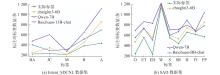
Fig.2
Statistics of the number of co-occurring labels provided by different LLMs on the dataset"
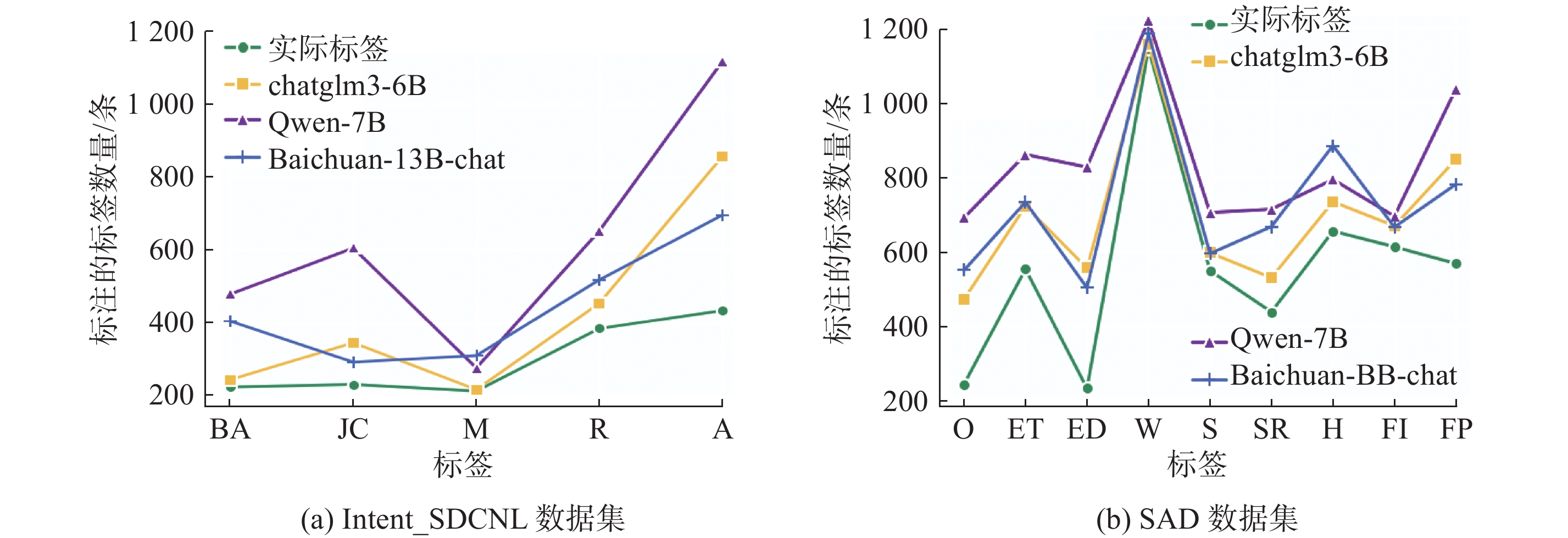
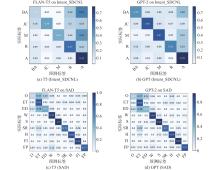
Fig.3
Confusion matrices of FLAN-T5 and GPT-2 on the Intent_SDCNL and SAD test set"

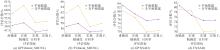
Fig.4
Performance of FLAN-T5 vs. GPT-2 in data distribution balance sensitivity test"
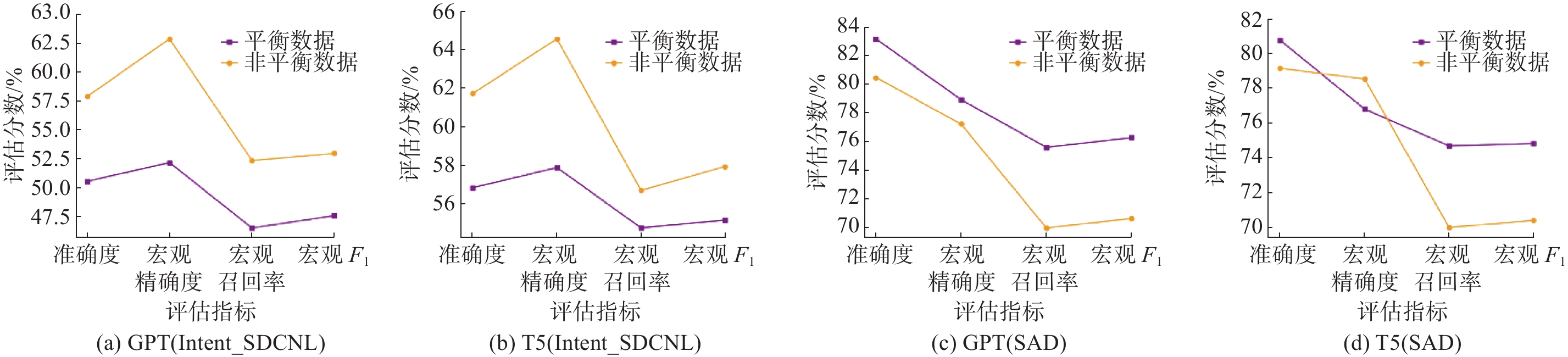
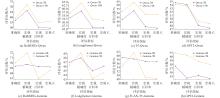
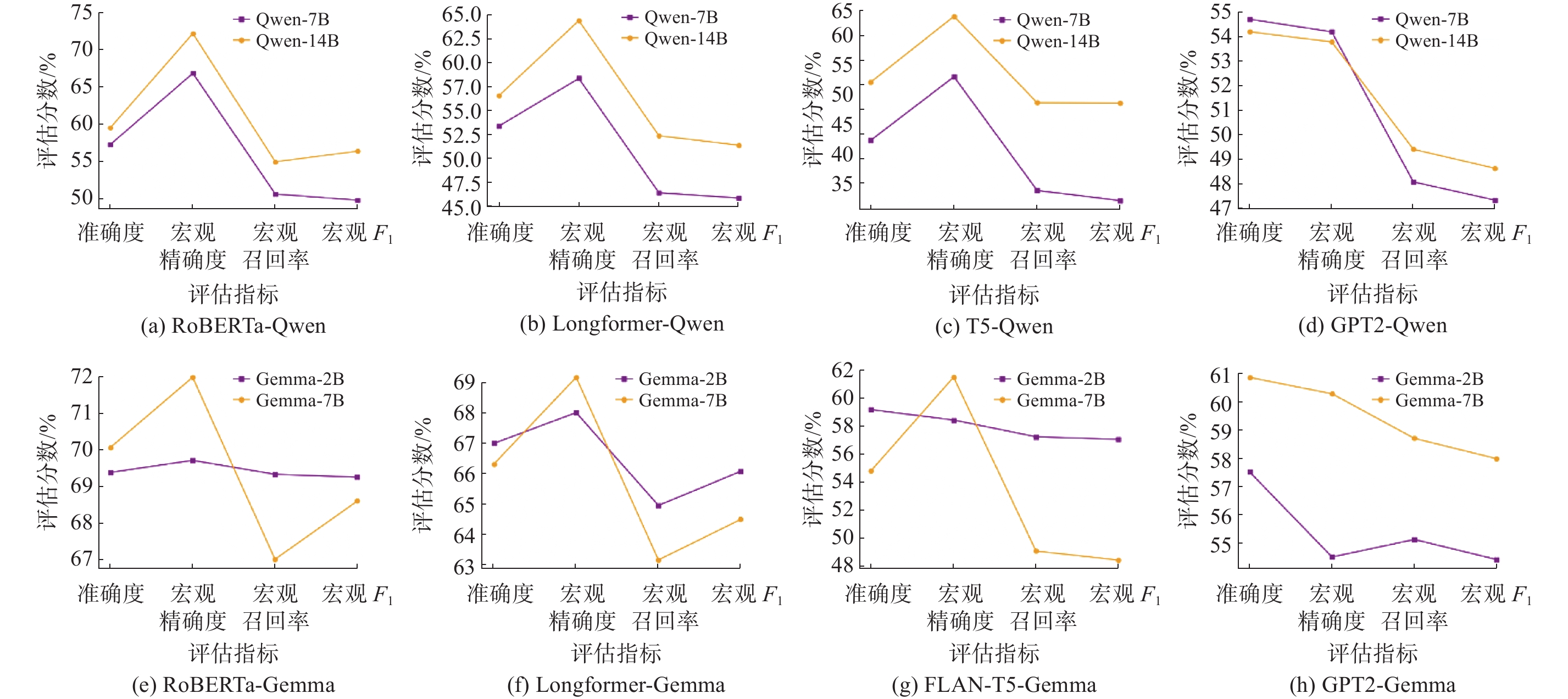
Fig.5
Performance augmented with the Qwen LLMs and the Gemma LLMs"
| 1 | MAURIELLO M L, LINCOLN T, HON G, et al. SAD: A stress annotated dataset for recognizing everyday stressors in SMS-like conversational systems [C]// Extended Abstracts of the 2021 CHI Conference on Human Factors in Computing Systems. 2021: 399. |
| 2 | GARG M, SAXENA C, SAHA S, et al. CAMS: An annotated corpus for causal analysis of mental health issues in social media posts [C]// Proceedings of the Thirteenth Language Resources and Evaluation Conference. 2022: 6387-6396. |
| 3 | SAXENA C, GARG M, ANSARI G. Explainable causal analysis of mental health on social media data [C]// International Conference on Neural Information Processing. 2022: 172-183. |
| 4 | YANG K, JI S, ZHANG T, et al. Towards interpretable mental health analysis with large language models [C]// Proceedings of the 2023 Conference on Empirical Methods in Natural Language Processing. 2023: 6056-6077. |
| 5 | YANG K, ZHANG T, KUANG Z, et al. MentaLLaMA: Interpretable mental health analysis on social media with large language models [EB/OL]. (2023-09-24)[2024-01-06]. https://arxiv.org/abs/2309.13567. |
| 6 | ZHOU Y, MURESANU A I, HAN Z, et al. Large language models are human-level prompt engineers [EB/OL]. (2023-03-10)[2024-01-06]. https://arxiv.org/abs/2211.01910. |
| 7 | XU N, QIAO C, GENG X, et al.. Instance-dependent partial label learning. Advances in Neural Information Processing Systems, 2021, 34, 27119- 27130. |
| 8 | RIBEIRO M T, SINGH S, GUESTRIN C. “Why should I trust you?”: Explaining the predictions of any classifier [C]// Proceedings of the 22nd ACM SIGKDD International Conference on Knowledge Discovery and Data Mining. 2016: 1135-1144. |
| 9 | ZHAO W X, ZHOU K, LI J, et al. A survey of large language models [EB/OL]. (2023-11-24)[2024-01-06]. https://arxiv.org/abs/2303.18223. |
| 10 | TOUVRON H, LAVRIL T, IZACARD G, et al. LLaMA: Open and efficient foundation language models [EB/OL]. (2023-02-27)[2024-01-06]. https://arxiv.org/abs/2302.13971. |
| 11 | VASWANI A, SHAZEER N, PARMAR N, et al. Attention is all you need[J]. Proceedings of the 31st International Conference on Neural Information Processing Systems. 2017: 6000-6010. |
| 12 | DEVLIN J, CHANG M W, LEE K, et al. BERt: Pre-training of deep bidirectional transformers for language understanding [EB/OL]. (2019-05-24)[2024-01-06]. https://arxiv.org/abs/1810.04805. |
| 13 | LIU P, YUAN W, FU J, et al.. Pre-train, prompt, and predict: A systematic survey of prompting methods in natural language processing. ACM Computing Surveys, 2023, 55 (9): 195- 35. |
| 14 | LU Y, BARTOLO M, MOORE A, et al. Fantastically ordered prompts and where to find them: Overcoming few-shot prompt order sensitivity [C]// Proceedings of the 60th Annual Meeting of the Association for Computational Linguistics. 2022: 8086-8098. |
| 15 | HOFFMANN J, BORGEAUD S, MENSCH A, et al.. An empirical analysis of compute-optimal large language model training. Advances in Neural Information Processing Systems, 2022, 35, 30016- 30030. |
| 16 | BROWN T, MANN B, RYDER N, et al.. Language models are few-shot learners. Advances in Neural Information Processing Systems, 2020, 33, 1877- 1901. |
| 17 | CHUNG H W, HOU L, LONGPRE S, et al. Scaling instruction-finetuned language models [EB/OL]. (2022-12-06)[2024-01-06]. https://arxiv.org/abs/2210.11416. |
| 18 | WEI J, WANG X, SCHUURMANS D, et al.. Chain-of-thought prompting elicits reasoning in large language models. Advances in Neural Information Processing Systems, 2022, 35, 24824- 24837. |
| 19 | BLEI D M, KUCUKELBIR A, MCAULIFFE J D.. Variational inference: A review for statisticians. Journal of the American Statistical Association, 2017, 112 (518): 859- 877. |
| 20 | HOFFMAN M, BLEI D M, WANG C, et al.. Stochastic variational inference. Journal of Machine Learning Research, 2013, 14, 1303- 1347. |
| 21 | RANGANATH R, GERRISH S, BLEI D. Black box variational inference [C]// Proceedings of the 17th International Conference on Articial Intelligence and Statistics. 2014: 814-822. |
| 22 | OPPER M, SAAD D. Advanced Mean Field Methods: Theory and Practice [M]. Cambridge: Massachusetts Institute of Technology Press, 2001. |
| 23 | PRYZANT R, ITER D, LI J, et al. Automatic prompt optimization with “gradient descent” and beam search [C]// Proceedings of the 2023 Conference on Empirical Methods in Natural Language Processing. 2023: 7957-7968. |
| 24 | ZHU X. Semi-supervised Learning with Graphs [M]. Pennsylvania, USA: Carnegie Mellon University Press, 2005. |
| 25 | KIPF T N, WELLING M. Variational graph auto-encoders [EB/OL]. (2016-11-21)[2024-01-06]. https://arxiv.org/abs/1611.07308. |
| 26 | KIPF T N, WELLING M. Semi-supervised classification with graph convolutional networks [EB/OL]. (2017-02-22)[2024-01-06]. https://arxiv.org/abs/1609.02907. |
| 27 | FIGURNOV M, MOHAMED S, MNIH A. Implicit reparameterization gradients [C]// Proceedings of the 32nd International Conference on Neural Information Processing Systems. 2018: 439-450. |
| 28 | POPESCU M C, BALAS V E, PERESCU-POPESCU L, et al.. Multilayer perceptron and neural networks. WSEAS Transactions on Circuits and Systems, 2009, 8 (7): 579- 588. |
| [1] | Kaiyan XIAO, Jie LIAN. Sentence classification algorithm based on multi-kernel support vector machine [J]. Journal of East China Normal University(Natural Science), 2023, 2023(6): 85-94. |
| [2] | Qiurong XU, Peng ZHU, Yifeng LUO, Qiwen DONG. Research progress in Chinese named entity recognition in the financial field [J]. Journal of East China Normal University(Natural Science), 2021, 2021(5): 1-13. |
| [3] | MU Zhaonan, LIU Mengzhu, SUN Jieping, WANG Cheng. Research on a Tang Poetry automatic generation system based on an evolutionary algorithm [J]. Journal of East China Normal University(Natural Science), 2020, 2020(6): 129-139. |
| [4] | GUO Xiaozhe, PENG Dunlu, ZHANG Yatong, PENG Xuegui. GRS: A generative retrieval dialogue model for intelligent customer service in the field of e-commerce [J]. Journal of East China Normal University(Natural Science), 2020, 2020(5): 156-166. |
| [5] | WANG Jianing, HE Yi, ZHU Renyu, LIU Tingting, GAO Ming. Relation extraction via distant supervision technology [J]. Journal of East China Normal University(Natural Science), 2020, 2020(5): 113-130. |
| [6] | HAN Chengcheng, LI Lei, LIU Tingting, GAO Ming. Approaches for semantic textual similarity [J]. Journal of East China Normal University(Natural Science), 2020, 2020(5): 95-112. |
| [7] | CHEN Yuan-zhe, KUANG Jun, LIU Ting-ting, GAO Ming, ZHOU Ao-ying. A survey on coreference resolution [J]. Journal of East China Normal University(Natural Sc, 2019, 2019(5): 16-35. |
| Viewed | ||||||
|
Full text |
|
|||||
|
Abstract |
|
|||||
