
 中文核心期刊
J* E* C* N* U* N* S* ›› 2026, Vol. 2026 ›› Issue (3): 44-55.doi: 10.3969/j.issn.1000-5641.2026.03.004
• Carbon Cycling Processes and Organic Matter Characteristics • Previous Articles Next Articles
Qiuxun LIN1, Boshuang WU1, Guangyue DU1, Yuxuan FU1, Yifan PAN1, Mengting QI2, Zhenyang SONG1, Yongqiang ZHOU3, Xiaofei LI1,2,*( )
)
Received:2025-01-17
Accepted:2025-11-05
Online:2026-05-25
Published:2026-05-27
Contact:
Xiaofei LI
E-mail:xfli@sklec.ecnu.edu.cn
CLC Number:
Qiuxun LIN, Boshuang WU, Guangyue DU, Yuxuan FU, Yifan PAN, Mengting QI, Zhenyang SONG, Yongqiang ZHOU, Xiaofei LI. Characteristics and associated sources of fluorescent dissolved organic matter in the Yellow River Estuary, the Changjiang River Estuary and their adjacent seas[J]. J* E* C* N* U* N* S*, 2026, 2026(3): 44-55.
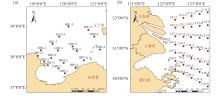
Fig.1
Sampling sites in the Yellow River Estuary (a), the Changjiang River Estuary (b) and their adjacent seas"
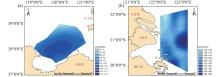
Fig.2
Spatial distribution of FDOM in the Yellow River Estuary (a), the Changjiang River Estuary (b) and their adjacent seas"
Fig.3
Spatial distribution characteristics of FDOM and fluorescence parameters in the Yellow River Estuary, the Changjiang River Estuary and their adjacent seas"
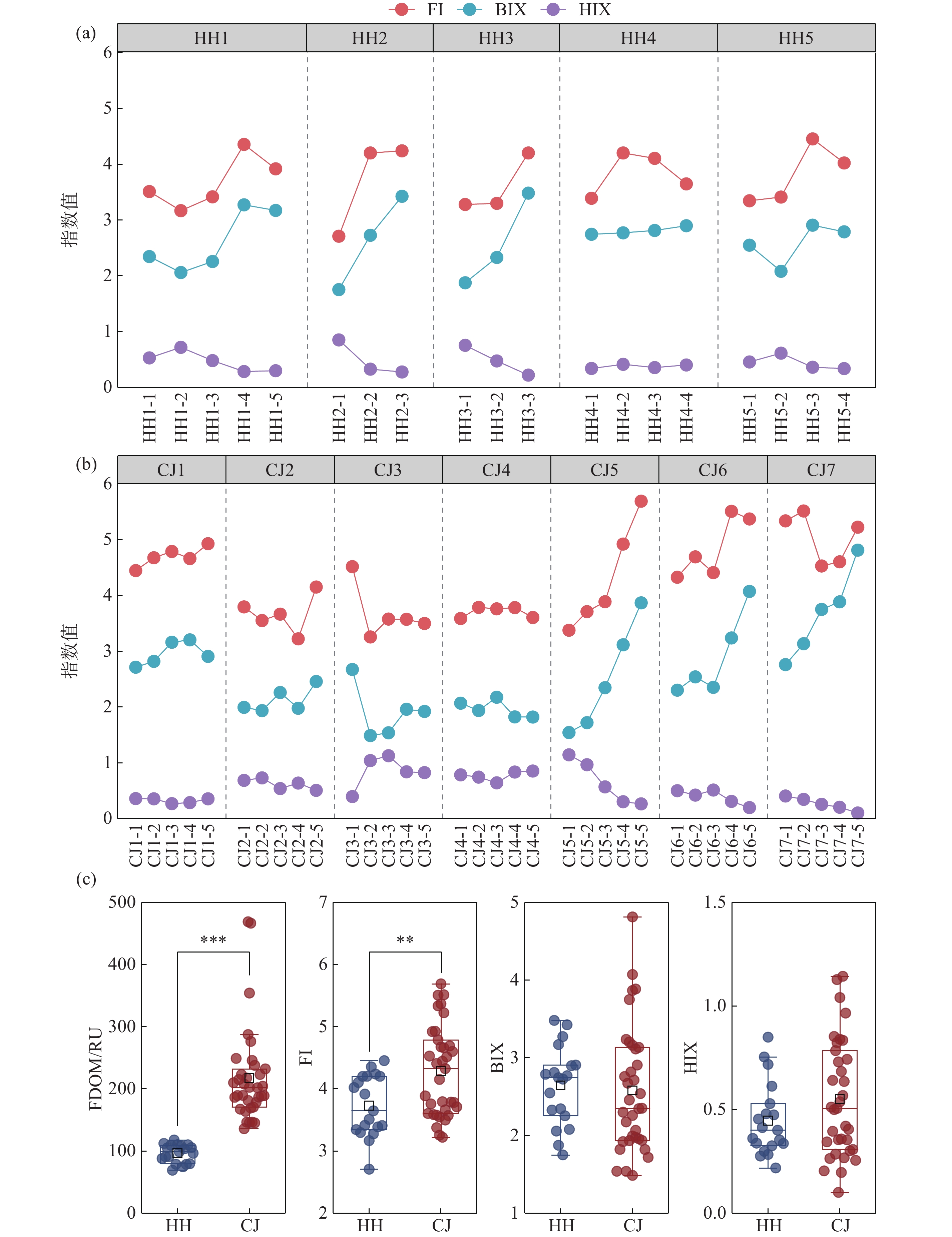
Fig.4
Spatial distribution characteristics of nutrients in the Yellow River Estuary (a)-(e), the Changjiang River Estuary (f)-(j) and their adjacent seas"
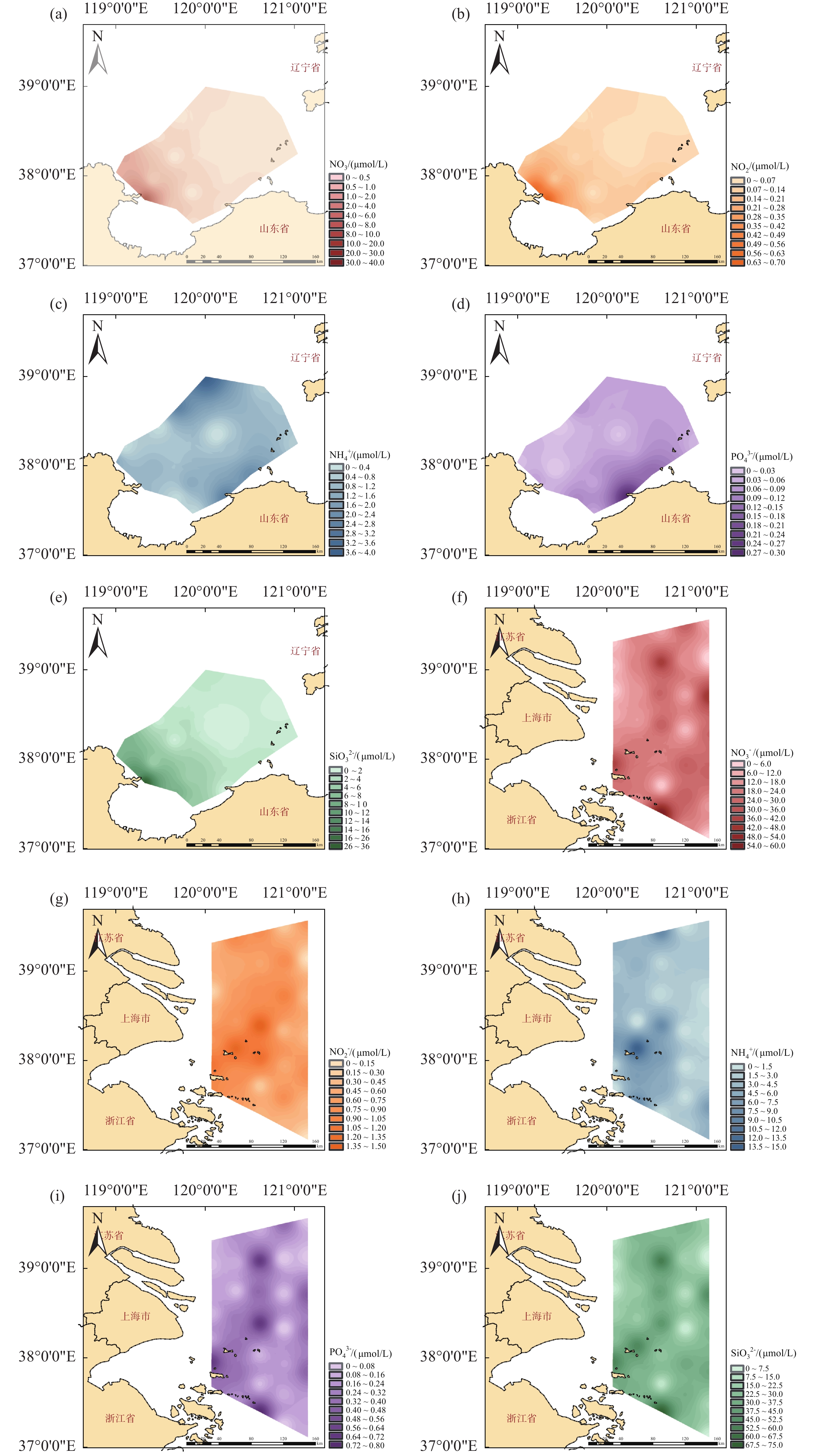
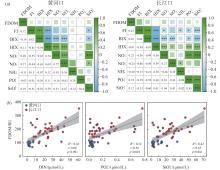
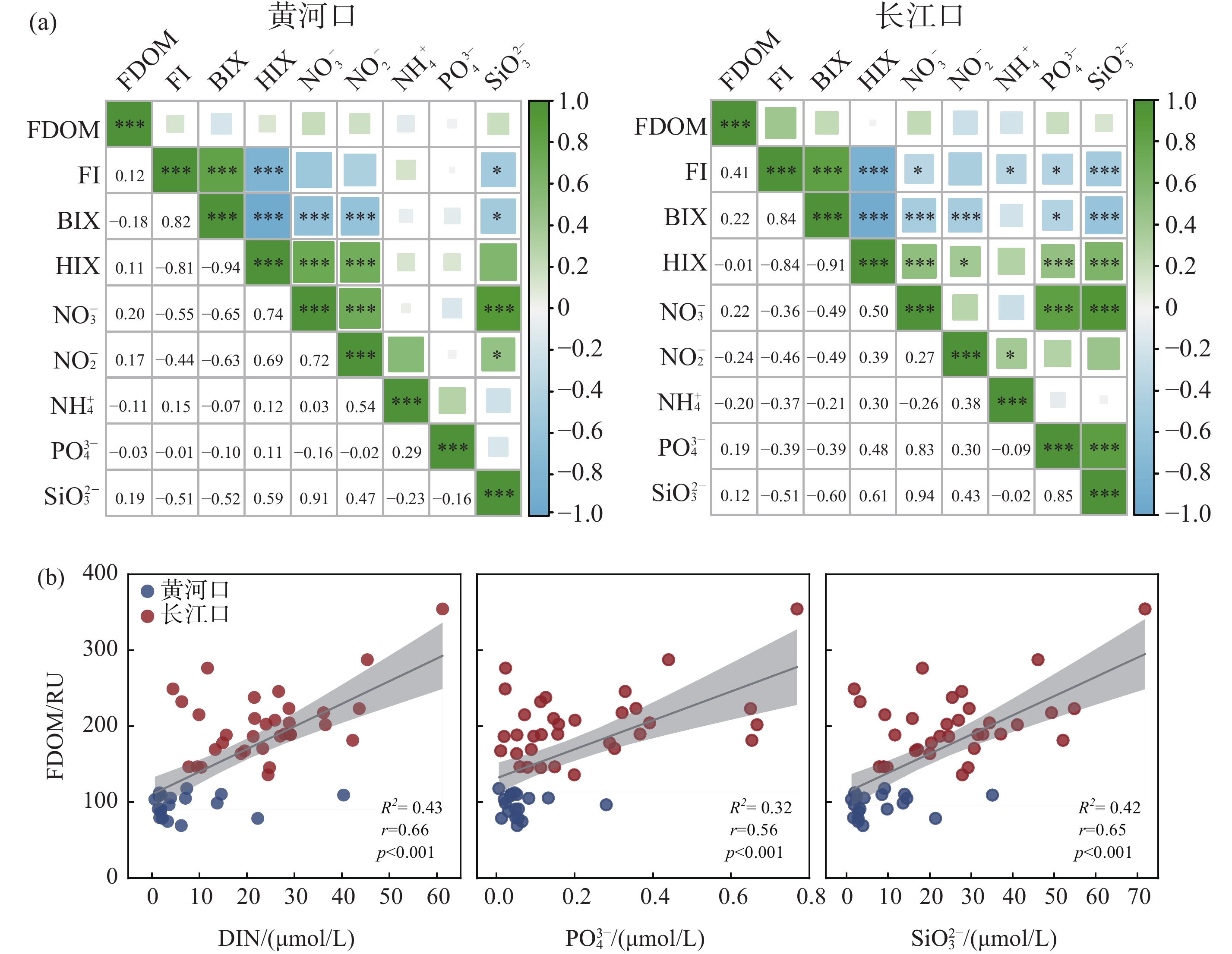
Fig.5
Relationships between fluorescence characteristics and nutrients in the Yellow River Estuary, the Changjiang River Estuary and their adjacent seas"
| 1 | HAN H, KIM H B, KIM J, et al.. Dissolved organic matter in the northwestern Pacific marginal seas: Insight into the distribution of its optical properties. Frontiers in Marine Science, 2023, 10, 1127803. |
| 2 | KIM J, CHO H M, KIM G.. Significant production of humic fluorescent dissolved organic matter in the continental shelf waters of the northwestern Pacific Ocean. Scientific Reports, 2018, 8 (1): 4887. |
| 3 | LØNBORG C, YOKOKAWA T, HERNDL G J, et al.. Production and degradation of fluorescent dissolved organic matter in surface waters of the eastern north Atlantic Ocean. Deep Sea Research Part I: Oceanographic Research Papers, 2015, 96, 28- 37. |
| 4 | KIM J, KIM Y, PARK S E, et al.. Impact of aquaculture on distribution of dissolved organic matter in coastal Jeju Island, Korea, based on absorption and fluorescence spectroscopy. Environmental Science and Pollution Research International, 2022, 29 (1): 553- 563. |
| 5 | 李润, 陈洁南, 陈灏, 等.. 河口盐沼水体溶解态有机质的动态变化特征及降解转化机理——以上海崇明东滩盐沼湿地为例. 华东师范大学学报(自然科学版), 2025 (2): 55- 67. |
| 6 | 陈灏, 何贤强, 李润, 等.. 基于机器学习的长江口表层水体溶解有机碳遥感反演研究. 华东师范大学学报(自然科学版), 2024 (4): 123- 136. |
| 7 | AIKEN G. Fluorescence and dissolved organic matter: A chemist’s perspective [M]// Aquatic Organic Matter Fluorescence. Cambridge: Cambridge University Press, 2014: 35-74. |
| 8 | JEON M H, JUNG J, PARK M O, et al.. Characterization and source of fluorescent dissolved organic matter in the Western Arctic Ocean: New insights from the 2019 summer study. Frontiers in Marine Science, 2023, 10, 1199893. |
| 9 | 王龙, 陈宜华, 王育来. 巢湖流域典型环境介质溶解有机质光谱特征及其环境指示意义 [J]. 环境科学学报, 2021, 41(3): 991-999. |
| 10 | HAN H, NA T, CHO H M, et al.. Large fluxes of continental-shelf-borne dissolved organic carbon in the East China Sea and the Yellow Sea. Marine Chemistry, 2022, 240, 104097. |
| 11 | 洪晨飞, 崔正国, 白莹, 等. 莱州湾荧光溶解有机物的时空分布 [J]. 海洋科学, 2022, 46(6): 15-31. |
| 12 | GUO J Q, LIANG S K, WANG X K, et al.. Distribution and dynamics of dissolved organic matter in the Changjiang Estuary and adjacent sea. Journal of Geophysical Research: Biogeosciences, 2021, 126 (12): e2020JG006161. |
| 13 | HAN H, CHO H M, KWON H K, et al.. Fluorescent dissolved organic matter (FDOM) in the East Sea (Japan sea): Distributions, sources, and sinks. Ocean Science Journal, 2021, 56 (2): 132- 140. |
| 14 | NILOY N M, HABIB S A, ISLAM M I, et al.. Distribution, characteristics and fate of fluorescent dissolved organic matter (FDOM) in the Bay of Bengal. Marine Pollution Bulletin, 2023, 195, 115467. |
| 15 | ZABŁOCKA M, KOWALCZUK P, STOŃ-EGIERT J, et al.. Tracing the origins and transformations of fluorescence dissolved organic matter within western and eastern Greenland’s shelves: A comparative study. Frontiers in Marine Science, 2025, 11, 1476768. |
| 16 | 张璐瑶, 岳甫均, 李军, 等. 莱州湾入海河流河口氮来源及转化过程的同位素解析 [J]. 中国环境科学, 2025, 45(2): 981-990. |
| 17 | LI H G, LI S S, ZHANG M Z, et al.. Typhoon-induced stormwater drives nutrient dynamics and triggers phytoplankton blooms in Laizhou Bay, China. Marine Environmental Research, 2024, 198, 106473. |
| 18 | ALBERTI M, VEIGA S F, CHEN B, et al.. The Yangtze River Delta experienced strong seasonality and regular summer upwelling during the warm mid-Holocene. Communications Earth & Environment, 2024, 5, 492. |
| 19 | YANG Y, GAO C, YAMOAH K A, et al.. Contributions of the Yangtze River and Yellow River to terrestrial organic carbon deposition in the Yangtze River Estuary during the last 700 years. Marine Chemistry, 2023, 255, 104298. |
| 20 | CHAI C, YU Z M, SHEN Z L, et al.. Nutrient characteristics in the Yangtze River Estuary and the adjacent East China Sea before and after impoundment of the Three Gorges Dam. Science of the Total Environment, 2009, 407 (16): 4687- 4695. |
| 21 | WANG W B, WANG X, SHU X, et al.. Internal transformation and damming regulate the longitudinal variation of DOM bioavailability in a large river. Environmental Research, 2024, 260, 119605. |
| 22 | YANG F X, YU Z G, BOUWMAN A F, et al.. Significant impacts of artificial regulation on nutrient concentrations and transport in Huanghe River. Journal of Oceanology and Limnology, 2024, 42 (6): 1865- 1879. |
| 23 | WANG H, RAN X B, BOUWMAN A F, et al.. Damming alters the particulate organic carbon sources, burial, export and estuarine biogeochemistry of rivers. Journal of Hydrology, 2022, 607, 127525. |
| 24 | WU X, WANG H J, BI N S, et al.. Climate and human battle for dominance over the Yellow River’s sediment discharge: From the Mid-Holocene to the Anthropocene. Marine Geology, 2020, 425, 106188. |
| 25 | WANG Y, GAO L, MING Y, et al. Recent declines in nutrient concentrations and fluxes in the lower Changjiang River [J]. Estuaries and Coasts, 2023, 46: 1475-1493. |
| 26 | TONG Y D, ZHAO Y, ZHEN G C, et al.. Nutrient loads flowing into coastal waters from the main rivers of China (2006-2012). Scientific Reports, 2015, 5, 16678. |
| 27 | 石学法, 吴斌, 乔淑卿, 等. 中国东部近海沉积有机碳的分布、埋藏及碳汇效应 [J]. 中国科学: 地球科学, 2024, 54(10): 3113-3133. |
| 28 | HAN L L, WANG Y H, XU Y P, et al.. Water- and base-extractable organic matter in sediments from Lower Yangtze River–estuary–east China Sea continuum: Insight into accumulation of organic carbon in the river-dominated margin. Frontiers in Marine Science, 2021, 8, 617241. |
| 29 | ZHANG J, ZHANG G S, DU Y N, et al.. From the water sources of the Tibetan Plateau to the ocean: State of nutrients in the Changjiang linked to land use changes and climate variability. Science China Earth Sciences, 2022, 65 (11): 2127- 2174. |
| 30 | LI M C, XIE W, LI P H, et al.. Establishing a terrestrial proxy based on fluorescent dissolved organic matter from sediment pore waters in the East China Sea. Water Research, 2020, 182, 116005. |
| 31 | STEDMON C A, BRO R.. Characterizing dissolved organic matter fluorescence with parallel factor analysis: A tutorial. Limnology and Oceanography: Methods, 2008, 6 (11): 572- 579. |
| 32 | 陈慕雨, 陈霖, 韩露露, 等. 长江口及邻近海域有色溶解有机物的来源、组成和影响因素 [J]. 海洋科学进展, 2023, 41(4): 637-656. |
| 33 | HUGUET A, VACHER L, RELEXANS S, et al.. Properties of fluorescent dissolved organic matter in the Gironde Estuary. Organic Geochemistry, 2009, 40 (6): 706- 719. |
| 34 | XIE M W, CHEN M, WANG W X.. Spatial and temporal variations of bulk and colloidal dissolved organic matter in a large anthropogenically perturbed estuary. Environmental Pollution, 2018, 243, 1528- 1538. |
| 35 | LI P, SHI B W, WANG Y P, et al.. Analysis of the characteristics of offshore currents in the Changjiang (Yangtze River) estuarine waters based on buoy observations. Acta Oceanologica Sinica, 2017, 36 (4): 13- 20. |
| 36 | 周倩倩, 苏荣国, 白莹, 等. 舟山渔场有色溶解有机物(CDOM)的三维荧光-平行因子分析 [J]. 环境科学, 2015, 36(1): 163-171. |
| 37 | 张锋, 李瑞杰, 孙杰, 等. 长江口及其邻近海域两定点周日海流观测的准调和分析 [J]. 海洋湖沼通报, 2019, 41(5): 57-63. |
| 38 | 叶林安, 王莉波, 江志法, 等. 2015年东海区营养盐的分布变化特征 [J]. 上海海洋大学学报, 2017, 26(3): 432-439. |
| 39 | 梁文健, 秦礼萍, 刘兆冰, 等. 东黄渤海11-12月有色溶解有机质的分布特征 [J]. 海洋环境科学, 2019, 38(6): 905-910. |
| 40 | CHEN Y, ZHOU Y L, MARTIN P.. The validity of optical properties as tracers of terrigenous dissolved organic carbon during extensive remineralization in coastal waters. Journal of Geophysical Research: Biogeosciences, 2024, 129 (9): e2024JG008147. |
| 41 | 吴保生, 郑珊, 沈逸, 等. 黄河下游平滩流量的影响因素与复杂响应 [J]. 应用基础与工程科学学报, 2025, 33(1): 145-157. |
| 42 | HOSEN J D, MCDONOUGH O T, FEBRIA C M, et al.. Dissolved organic matter quality and bioavailability changes across an urbanization gradient in headwater streams. Environmental Science & Technology, 2014, 48 (14): 7817- 7824. |
| 43 | ASMALA E, STEDMON C A, THOMAS D N.. Linking CDOM spectral absorption to dissolved organic carbon concentrations and loadings in boreal estuaries. Estuarine, Coastal and Shelf Science, 2012, 111, 107-117. |
| 44 | 廖巍, 张龙军, 陈洪涛, 等. 2001—2011年黄河口营养盐变化及入海通量估算 [J]. 中国海洋大学学报(自然科学版), 2013, 43(1): 81-86. |
| 45 | 束乐乐, 杨红, 王春峰, 等. 长江口门附近水体溶解性有机质的荧光组分特征 [J]. 海洋环境科学, 2023, 42(2): 176-184. |
| 46 | 薛飞扬, 秦华伟, 李凤超, 等. 黄河口近岸海域有色溶解有机质的时空分布及光降解特性 [J]. 环境化学, 2023, 42(3): 904-917. |
| 47 | WEISER M W, SWANSON J, GHOSH N, et al.. Improving estimates of dissolved organic carbon (DOC) concentration from in situ fluorescence measurements across estuaries and coastal wetlands. Environmental Science & Technology, 2024, 58 (21): 9213- 9226. |
| 48 | ZHANG L, WU Y C, LI J L, et al.. Hydrodynamics and dissolved organic matter components shaped the fate of dissolved heavy metals in an intensely anthropogenically disturbed estuary. Science of the Total Environment, 2024, 934, 173293. |
| 49 | 吴傲琳, 钟正浩, 于松, 等. 近20年黄河口营养盐结构演变及现状研究 [J]. 渔业科学进展, 2024, 45(2): 1-13. |
| 50 | WANG K, ZHAO L L, ZHU Y G, et al.. Characterization of nutrients, heavy metals, petroleum and their impact on phytoplankton in Laizhou Bay: Implications for environmental management and monitoring. Journal of Ocean University of China, 2024, 23 (3): 822- 834. |
| 51 | 谭皓月, 曹慧群, 卢士强, 等. 长江口2022年水动力及营养盐时空分布规律模拟研究 [J]. 环境科学研究, 2025, 38(2): 272-281. |
| 52 | 苏海, 娄保锋, 邓世江, 等. 长江口入海总氮通量变化及区域来源特征 [J]. 长江流域资源与环境, 2024, 33(9): 2018-2027. |
| 53 | GE J Z, SHI S Y, LIU J, et al. Interannual variabilities of nutrients and phytoplankton off the Changjiang Estuary in response to changing river inputs [J]. Journal of Geophysical Research: Oceans, 2020, 125(3): 1-23. |
| 54 | WU W T, WANG J J, WANG H, et al.. Trends in nutrients in the Changjiang River. Science of the Total Environment, 2023, 872, 162268. |
| 55 | 杨颖, 刘吉宝, 魏源送, 等. 北运河沉积物中氮磷营养盐及荧光溶解性有机物的污染特征研究 [J]. 环境科学学报, 2022, 42(3): 40-50. |
| 56 | 陈永娟, 胡玮璇, 庞树江, 等. 北运河水体中荧光溶解性有机物空间分布特征及来源分析 [J]. 环境科学, 2016, 37(8): 3017-3025. |
| 57 | 林来昌, 谢蓉蓉, 吴如林, 等. 闽江感潮河段2018—2020年枯水期DOM图谱及特征参数影响 [J]. 北京大学学报(自然科学版), 2023, 59(4): 639-648. |
| 58 | JIANG Y L, ZHAO J F, LI P H, et al.. Linking optical properties of dissolved organic matter to multiple processes at the coastal plume zone in the East China Sea. Environmental Science Processes & Impacts, 2016, 18 (10): 1316- 1324. |
| 59 | SÁNCHEZ-PÉREZ E D, PUJO-PAY M, ORTEGA-RETUERTA E, et al.. Mismatched dynamics of dissolved organic carbon and chromophoric dissolved organic matter in the coastal NW Mediterranean Sea. Science of the Total Environment, 2020, 746, 141190. |
| 60 | LOGINOVA A N, BORCHARD C, MEYER J, et al.. Effects of nitrate and phosphate supply on chromophoric and fluorescent dissolved organic matter in the Eastern Tropical North Atlantic: A mesocosm study. Biogeosciences, 2015, 12 (23): 6897- 6914. |
| [1] | Cheng QIU. Effects of typhoons landfalling on the north bank of Hangzhou Bay, Shanghai, on saltwater intrusion in the Changjiang River Estuary: A case study of typhoons “Bebinca” and “Pulasan” in September 2024 [J]. J* E* C* N* U* N* S*, 2025, 2025(6): 141-151. |
| [2] | Cansheng YE, Minggao ZHAI, Jianrong ZHU. High-precision tidal level prediction in the photovoltaic field offshore the Yellow River estuary [J]. J* E* C* N* U* N* S*, 2025, 2025(4): 158-169. |
| [3] | Yang CAO, Dungang GU, Guanghui LI, Minsheng HUANG, Wenhui HE. A review on the application of slow-release oxygen materials in the remediation of polluted rivers and lakes [J]. Journal of East China Normal University(Natural Science), 2024, 2024(1): 9-16. |
| [4] | Yuxin YUAN, Jiamin LIU, Ling PAN, Lihong WANG, Xueli ZHANG, Minsheng HUANG. A review of applications and research progress on the use of nanoparticles for the inhibition of harmful algal bloom [J]. Journal of East China Normal University(Natural Science), 2021, 2021(4): 90-98. |
| [5] | GU Sheng-hua. Saltwater intrusion in the Changjiang River Estuary during the drought in late the spring and early summer of 2011 [J]. Journal of East China Normal University(Natural Sc, 2014, 2014(4): 154-162. |
| [6] | CHANG Fang-qiang, JIA Yong-gang. Study of the wave-induced seabed liquefaction failure of the Chengdao Sea at the Yellow River Estuary [J]. Journal of East China Normal University(Natural Sc, 2011, 2011(4): 69-74. |
| [7] | SONG Yun -;LI De-zhi-;ZHOU Yan-;LI Hong-;KE Shi-zhen-;SUN Yu-bing-;WANG Chun-ye-;ZHAO Lu-qing-;LI Li-ke-. Spatio-temporal variation of main soil nutrientsin three islands in Chongming (Chinese) [J]. Journal of East China Normal University(Natural Sc, 2009, 2009(5): 85-93. |
| [8] | CHANG Fangqiang;JIA Yonggang;CHANG Fangwei. Study on seabed nonuniformity liquefaction under wave forces atChengdao Sea of Yellow River estuary, China [J]. Journal of East China Normal University(Natural Sc, 2009, 2009(3): 83-89. |
| Viewed | ||||||
|
Full text |
|
|||||
|
Abstract |
|
|||||
