
 中文核心期刊
J* E* C* N* U* N* S* ›› 2026, Vol. 2026 ›› Issue (5): 26-41.doi: 10.3969/j.issn.1000-5641.2026.05.003
• Data Systems and Platforms • Previous Articles Next Articles
Cheqing JIN*( ), Qian ZHOU, Zhao ZHANG, Yanqin YANG
Received:2026-07-01
Accepted:2026-08-27
Online:2026-09-25
Published:2026-09-12
Contact:
Cheqing JIN
E-mail:cqjin@dase.ecnu.edu.cn
CLC Number:
Cheqing JIN, Qian ZHOU, Zhao ZHANG, Yanqin YANG. Design and prospects of scalable blockchain architecture[J]. J* E* C* N* U* N* S*, 2026, 2026(5): 26-41.
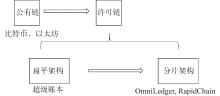
Fig.1
Evolution of blockchain architectures"
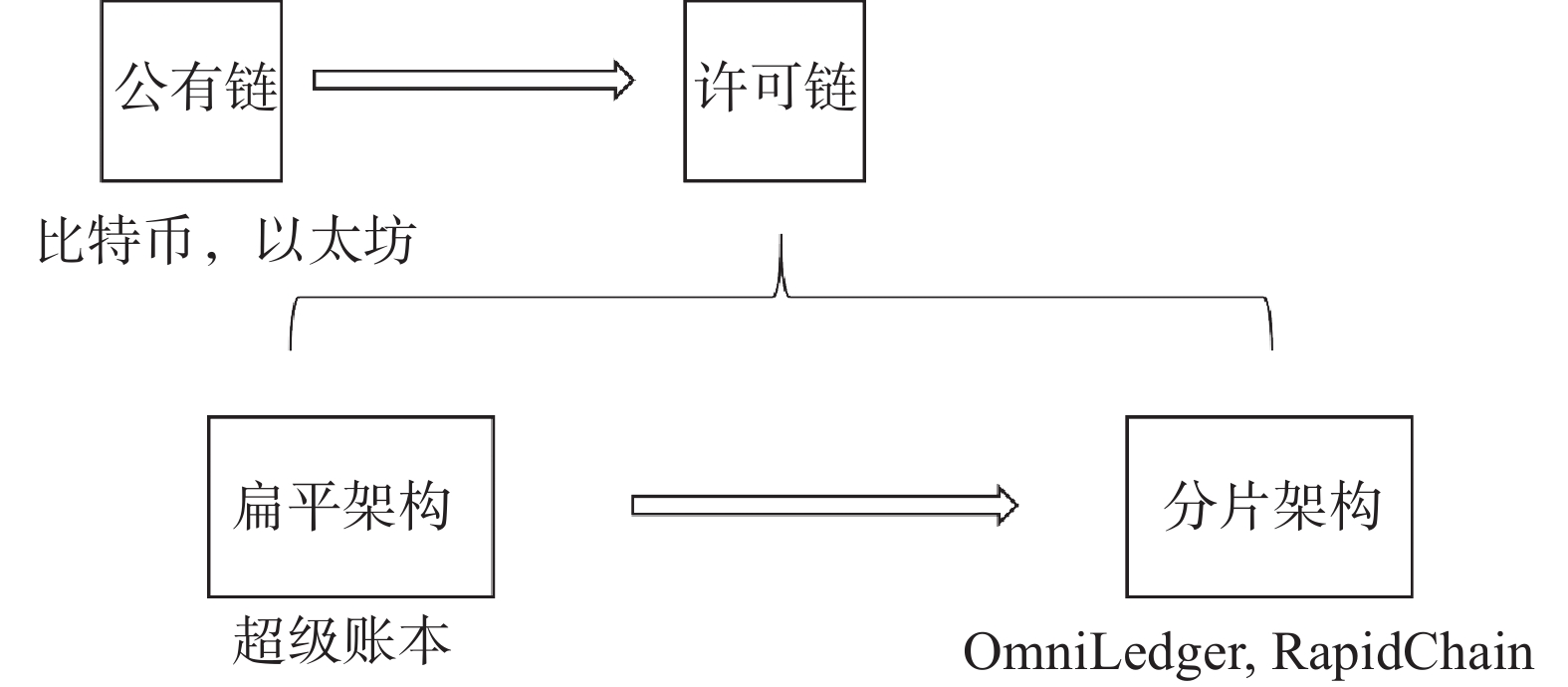
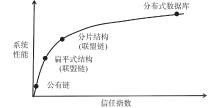
Fig.2
Trust index"
Table 1
Comparison of scalability approaches"
| 扩容技术路线 | 核心作用层级 | 性能提升幅度 | 核心技术瓶颈 / 安全风险 |
| 网络与存储优化 | 底层基础设施/主链 | 较小 (与硬件性能相关) | 受限于物理网络带宽与单节点硬件上限 |
| 共识机制创新 | 主链 | 中等 (优化共识延时) | 难以突破“不可能三角”, 性能提升需与安全性/去中心化程度做权衡 |
| 扁平化分片 | 主链 (架构重构) | 较大 (横向扩展) | 跨片交易协调开销高、重分片状态迁移代价大 |
| DAG 架构 | 主链 (拓扑重构) | 极大 (并发执行) | 高并发下, 如何实现全局共识、确保系统安全性与去中心化 |
| 状态通道 | 二层网络 | 极高 (仅限特定通道内) | 资金占用率高、通道流通性及路由问题、参与者离线风险; 通用复杂合约能力有限 |
| Rollup (ZK/Op) | 二层网络 | 极大 (计算与数据压缩) | 依然存在对底层主链数据可用性的深度依赖 |
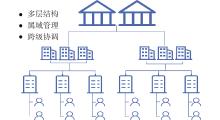
Fig.3
Hierarchical business scenarios"
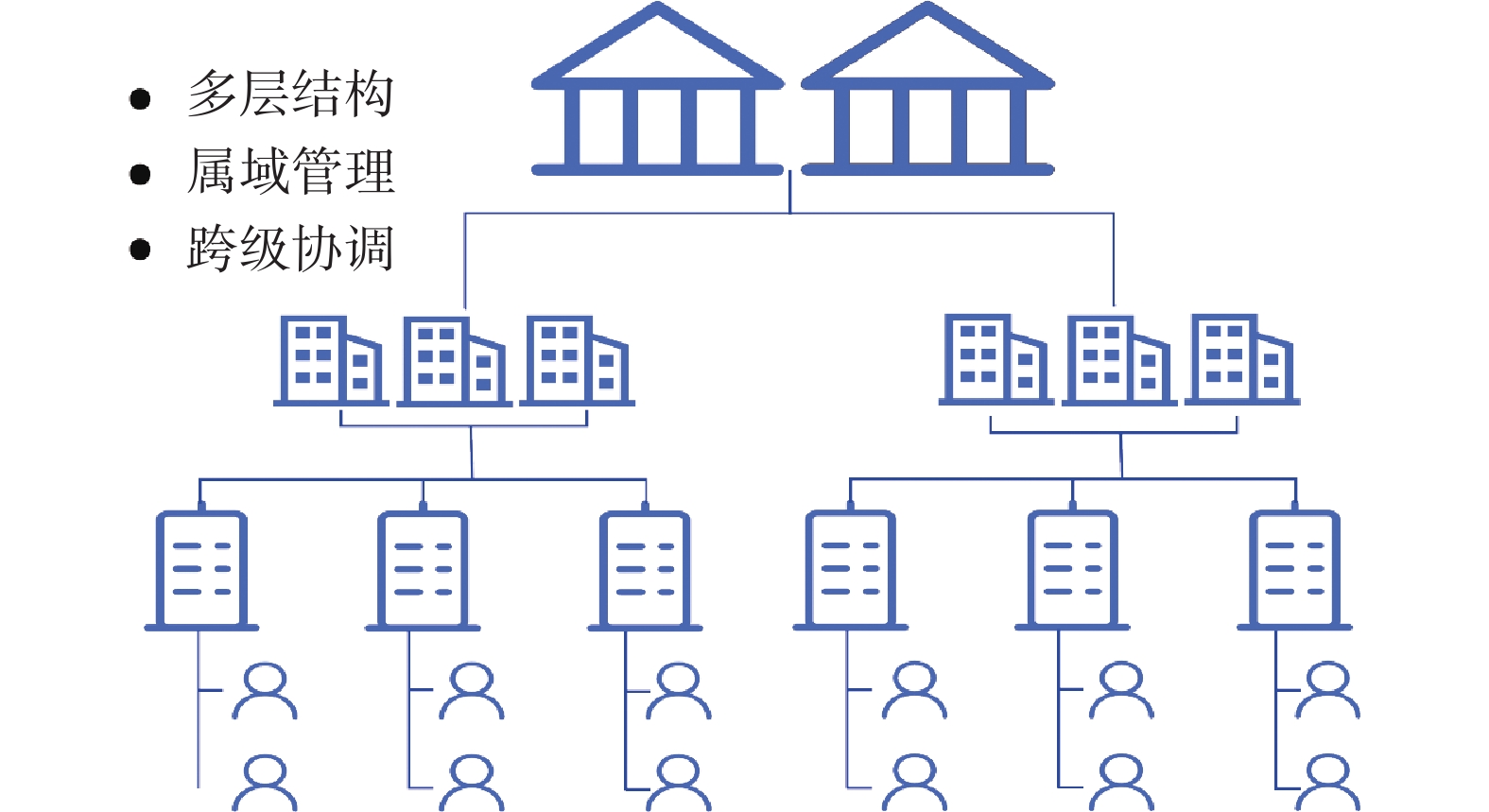
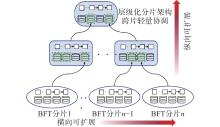
Fig.4
Hierarchical hybrid sharding architecture"
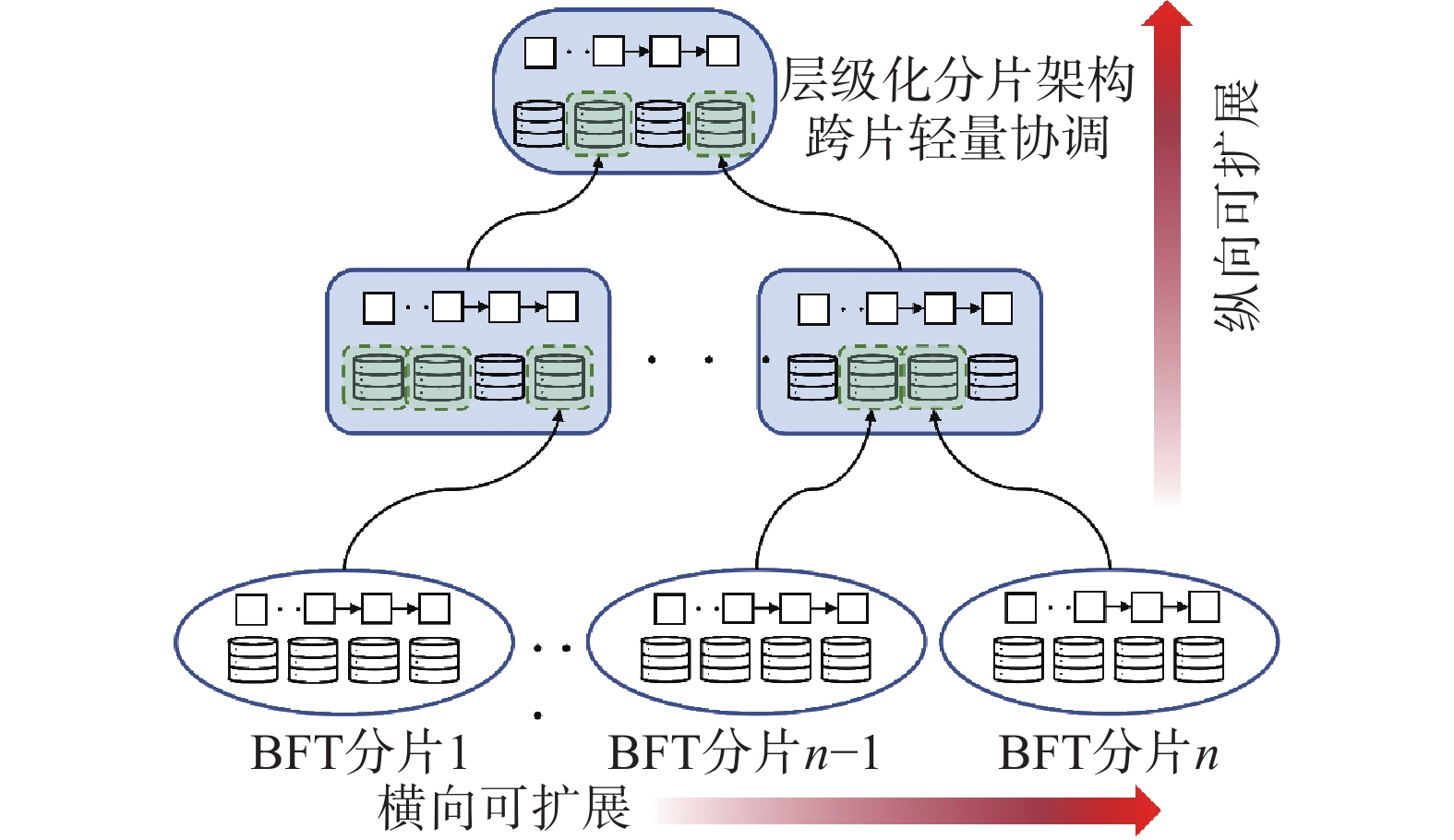
Fig.5
Scalable storage scheme"
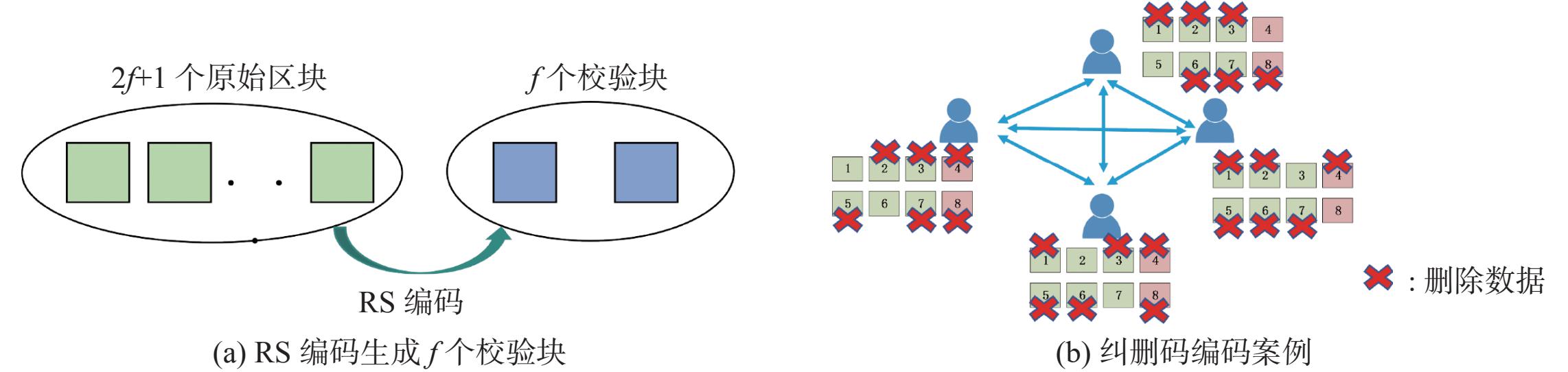
Fig.6
Elastic and scalable leaderless Byzantine fault-tolerant consensus"
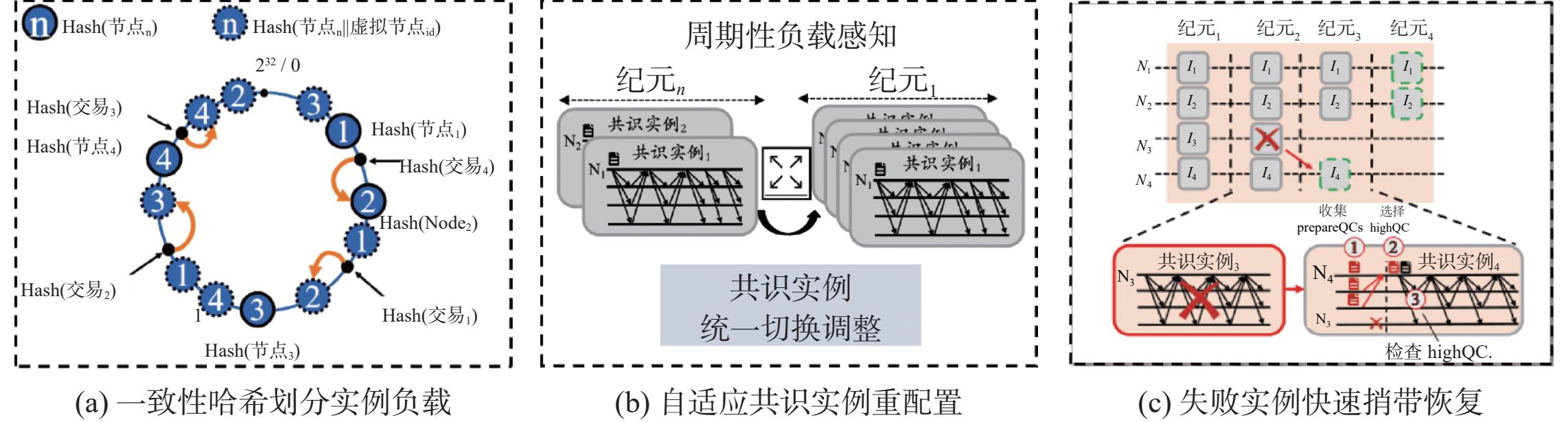
Table 2
Scalable transaction execution methods"
| 序号 | 观察 | 思路 | 方法 |
| 1 | 能否利用处理器芯片的多核特性? | 发掘多核并发能力, 单节点交易并发验证 | [ |
| 2 | 是否处理完一个区块后才可处理下一区块? | 结合流水线方法并行处理 | [ |
| 3 | 批量交易处理可否加速? | 引入确定性并发机制 | [ |
| 4 | 是否可以结合共识协议进行优化? | 结合无主共识协议, 优化执行效率 | [ |
| 1 | Nakamoto S. Bitcoin: a peer-to-peer electronic cash system [EB/OL]. (2008-10-31)[2026-06-17]. https://cdn.nakamotoinstitute.org/docs/bitcoin.pdf |
| 2 | Xie J F, Yu F R, Huang T, et al.. A survey on the scalability of blockchain systems. IEEE Network, 2019, 33 (5): 166- 173. |
| 3 | 孙知信, 张鑫, 相峰, 等. 区块链存储可扩展性研究进展 [J]. 软件学报, 2021, 32(1): 1-20. |
| 4 | 李贝, 吴昊, 贺小伟, 等.. 区块链系统的存储可扩展性综述. 计算机科学, 2023, 50 (1): 318- 333. |
| 5 | 陈宝超, 马立原, 徐昊, 等.. 区块链可扩展性研究综述: 架构、数据与协议. 网络空间安全科学学报, 2025, 3 (2): 12- 27. |
| 6 | Rebello G A F, Camilo G F, de Souza L A C, et al.. A survey on blockchain scalability: From hardware to layer-two protocols. IEEE Communications Surveys & Tutorials, 2024, 26 (4): 2411- 2458. |
| 7 | Reno S, Roy K.. Navigating the blockchain trilemma: a review of recent advances and emerging solutions in decentralization, security, and scalability optimization. Computers, Materials and Continua, 2025, 84 (2): 2061- 2119. |
| 8 | Stonebraker M, Cetintemel U. “One size fits all”: an idea whose time has come and gone [C]//21st International Conference on Data Engineering (ICDE'05). IEEE, 2005: 2-11. |
| 9 | Chiedu C C, Gai K K, Wei Y H, et al. A survey on on-chain-off-chain scalability in blockchain [C]//2025 IEEE 11th Conference on Big Data Security on Cloud (BigDataSecurity). IEEE, 2025: 71-82. |
| 10 | Kokoris-Kogias E, Jovanovic P, Gasser L, et al. OmniLedger: A secure, scale-out, decentralized ledger via sharding [C]//2018 IEEE Symposium on Security and Privacy (SP). IEEE, 2018: 583-598. |
| 11 | Zamani M, Movahedi M, Raykova M. RapidChain: Scaling blockchain via full sharding [C]//Proceedings of the 2018 ACM SIGSAC Conference on Computer and Communications Security. ACM, 2018: 931-948. |
| 12 | Castro M, Liskov B. Practical Byzantine fault tolerance [C]//Proceedings of the Third Symposium on Operating Systems Design and Implementation. 1999: 173-186. |
| 13 | Yin M F, Malkhi D, Reiter M K, et al. HotStuff: BFT consensus with linearity and responsiveness [C]//Proceedings of the 2019 ACM Symposium on Principles of Distributed Computing. ACM, 2019: 347-356. |
| 14 | Buterin V, Hernandez D, Kamphefner T, et al. Combining GHOST and Casper [PP/OL]. V3. arXiv (2020-05-11)[2026-06-29]. https://doi.org/10.48550/arXiv.2003.03052. |
| 15 | Baudet M, Ching A, Chursin A, et al. State machine replication in the Libra Blockchain [R]. Libra Association, 2019. |
| 16 | 长安链团队. 长安链·ChainMaker 技术白皮书[R]. 北京: 北京微芯区块链与边缘计算研究院, 2021. |
| 17 | Klarman U, Basu S, Kuzmanovic A, et al. BloXroute: a scalable trustless blockchain distribution network whitepaper [R]. 2018. |
| 18 | 邵奇峰, 张召, 朱燕超, 等.. 企业级区块链技术综述. 软件学报, 2019, 30 (9): 2571- 2592. |
| 19 | Buterin V. A next-generation smart contract and decentralized application platform [R]. Ethereum Foundation, 2014. |
| 20 | Yakovenko A. Solana: a new architecture for a high performance blockchain [R]. Solana Labs, 2018. |
| 21 | Lin H R, Feng H, Zhou Y J, et al. ParallelEVM: operation-level concurrent transaction execution for EVM-compatible blockchains [C]//Proceedings of the Twentieth European Conference on Computer Systems. ACM, 2025: 211-225. |
| 22 | Zhang Z T, Han H X, Yan Z, et al.. A survey on cross-shard transaction allocation optimization and processing mechanisms. IEEE Communications Surveys & Tutorials, 2026, 28, 2198- 2225. |
| 23 | Zilliqa Team. The Zilliqa technical white paper [R]. Zilliqa, 2017. |
| 24 | Wang J P, Wang H. Monoxide: Scale out blockchains with asynchronous consensus zones [C]//Proceedings of the 16th USENIX Symposium on Networked Systems Design and Implementation (NSDI'19). 2019: 95-112. |
| 25 | Buterin V, Feist D, Loerakker D, et al. EIP-4844: shard blob transactions [Z/OL]. (2022-02-25)[2026-06-29]. https://eips.ethereum.org/EIPS/eip-4844. |
| 26 | Popov S. The tangle [R]. IOTA, 2018. |
| 27 | Baird L. The Swirlds hashgraph consensus algorithm: fair, fast, Byzantine fault tolerance [R]. Swirlds, 2016. |
| 28 | Wei Q W, Dang S P, Ge Z H, et al.. Performance analysis of direct acyclic graph-based ledgers in low-to-high load regime. IEEE Transactions on Mobile Computing, 2025, 24 (11): 12441- 12455. |
| 29 | Torralba-Agell A, Pérez-Solà C. Security assumptions in permissionless blockchains and layer 2 scalability solutions: a comprehensive taxonomy [J]. Blockchain: Research and Applications, 2025: 100388. |
| 30 | Avarikioti Z, Maffei M, Wang Y H. A security framework for general blockchain layer 2 protocols [PP/OL]. V2. arXiv (2026-05-18)[2026-06-17]. https://doi.org/10.48550/arXiv.2504.14965. |
| 31 | Poon J, Dryja T. The Bitcoin lightning network: scalable off-chain instant payments [R]. 2016. |
| 32 | Wu T Y, Xue Y H, Li H N, et al.. A survey of multi-blockchain: architectures, technologies, and applications. Computers, Materials & Continua, 2026, 87 (3): 1- 10. |
| 33 | Poon J, Buterin V. Plasma: scalable autonomous smart contracts [R]. Working Draft, 2017. |
| 34 | Kalodner H, Goldfeder S, Chen X Q, et al. Arbitrum: scalable, private smart contracts [C]//Proceedings of the 27th USENIX Security Symposium. 2018: 1353-1370. |
| 35 | Silva M I, Messias J, Livshits B. A public dataset for the ZKsync Rollup [EB/OL]. (2024-07-26)[2026-06-27]. https://arxiv.org/abs/2407.18699. |
| 36 | Ben-Sasson E, Bentov I, Horesh Y, et al. Scalable, transparent, and post-quantum secure computational integrity [R/OL]. IACR Cryptology ePrint Archive. (2018-03-06)[2026-06-27]. https://eprint.iacr.org/2018/046. |
| 37 | Scroll. Scroll whitepaper [R/OL]. (2024-06-24)[2026-06-27]. https://scroll.io/files/whitepaper.pdf. |
| 38 | Consensys. Linea prover documentation [R/OL]. IACR Cryptology ePrint Archive. (2024-07-22)[2026-06-27]. https://eprint.iacr.org/2022/1633. |
| 39 | Celestia Labs. Celestia's data availability layer [EB/OL]. (2025-12-05)[2026-06-17]. https://docs.celestia.org/learn/celestia-101/data-availability. |
| 40 | Al-Bassam M. LazyLedger: a distributed data availability ledger with client-side smart contracts [PP/OL]. V4. arXiv (2019-06-08)[2026-06-20]. https://doi.org/10.48550/arXiv.1905.09274. |
| 41 | Tang H B, Zhang H, Zhang Z Y, et al. Towards high-performance transactions via hierarchical blockchain sharding [C]//Carretero J, Shende S, Garcia-Blas J, et al. Euro-Par 2024: Parallel Processing. Cham: Springer Nature Switzerland, 2024: 373-388. |
| 42 | Qi X D, Zhang Z, Jin C Q, et al.. A reliable storage partition for permissioned blockchain. IEEE Transactions on Knowledge and Data Engineering, 2021, 33 (1): 14- 27. |
| 43 | Qi X D, Zhang Z, Jin C Q, et al. BFT-store: storage partition for permissioned blockchain via erasure coding [C]//2020 IEEE 36th International Conference on Data Engineering (ICDE). IEEE, 2020: 1926-1929. |
| 44 | Tong X, Zhang Z, Jin C Q, et al. Stretch-BFT: workload-adaptive and stretchable consensus protocol for permissioned blockchain [C]//2023 42nd International Symposium on Reliable Distributed Systems (SRDS). IEEE, 2023: 1-13. |
| 45 | Jin C Q, Pang S F, Qi X D, et al.. A high performance concurrency protocol for smart contracts of permissioned blockchain. IEEE Transactions on Knowledge and Data Engineering, 2022, 34 (11): 5070- 5083. |
| 46 | Qi X D, Chen Z H, Zhuo H Z, et al. SChain: scalable concurrency over flexible permissioned blockchain [C]//2023 IEEE 39th International Conference on Data Engineering (ICDE). IEEE, 2023: 1901-1913. |
| 47 | Chen Z H, Yang T J, Zheng Y X, et al.. Spectrum: speedy and strictly-deterministic smart contract transactions for blockchain ledgers. Proceedings of the VLDB Endowment, 2024, 17 (10): 2541- 2554. |
| 48 | Tong X, Ye Z M, Zhang Z, et al. TELL: efficient transaction execution protocol towards leaderless consensus [C]//2024 IEEE 40th International Conference on Data Engineering (ICDE). IEEE, 2024: 1902-1915. |
| 49 | Liu X Y, Kong L J, Su Y H, et al. On and off-chain load balancing model based on Stackelberg game [C]//Gao H H, Wang X H. Collaborative Computing: Networking, Applications and Worksharing. Cham: Springer Nature Switzerland, 2026: 60-80. |
| [1] | Zhao ZHANG, Xinran LI. Distributed multi-agent collaboration framework for open environments [J]. J* E* C* N* U* N* S*, 2026, 2026(5): 42-50. |
| [2] | Nannan GENG, Jikun WANG, Shouxiang HAN, Chunqi SHI. Design of a high-precision third-order NS SAR ADC for audio applications [J]. J* E* C* N* U* N* S*, 2026, 2026(2): 117-127. |
| [3] | Can LIU, Kangjie ZHAO, Runxi ZHANG. A high-energy-efficiency and high-linearity digital transmitter based on switched capacitor power amplifier (SCPA) for Wi-Fi communications [J]. J* E* C* N* U* N* S*, 2026, 2026(2): 12-24. |
| [4] | Menghan HU, Wenjing CHENG, Xiang DAI, Yiqing LIU. Open source hardware: Driving force and future trends for the new industrial revolution [J]. J* E* C* N* U* N* S*, 2025, 2025(5): 162-169. |
| [5] | Shaojie QIAO, Yuhe JIANG, Chenxu LIU, Cheqing JIN, Nan HAN, Shuaiwei HE. Algorithm for security management and privacy protection of education big data based on smart contracts [J]. Journal of East China Normal University(Natural Science), 2024, 2024(5): 128-140. |
| [6] | Danqi LIU, Peng CAI. Separate management strategies for Part metadata under the storage-computing separation architecture [J]. Journal of East China Normal University(Natural Science), 2023, 2023(5): 40-50. |
| [7] | Yingjie YANG, Gang QIN, Shugang CHEN, Furong YIN, Zhao ZHANG, Cheqing JIN. Development and application of blockchain-based inspection certificates in the steel supply chain [J]. Journal of East China Normal University(Natural Science), 2022, 2022(5): 36-47. |
| [8] | Chaoran HUANG, Xing TONG, Zhao ZHANG, Cheqing JIN, Yingjie YANG, Gang QIN. Research on contract architecture and data privacy for education-oriented blockchain applications [J]. Journal of East China Normal University(Natural Science), 2022, 2022(5): 61-72. |
| [9] | Jizhou LI, Xin LIN. Neural architecture search algorithms based on a recursive structure [J]. Journal of East China Normal University(Natural Science), 2022, 2022(4): 31-42. |
| [10] | Yang YU, Huiqi HU, Xuan ZHOU. Optimization of LSM-tree storage systems based on non-volatile memory [J]. Journal of East China Normal University(Natural Science), 2021, 2021(5): 37-47. |
| [11] | Furong YIN, Chengyu ZHU, Bin ZHAO, Zhao ZHANG. Erasure code partition storage based on the CITA blockchain [J]. Journal of East China Normal University(Natural Science), 2021, 2021(5): 48-59. |
| [12] | Sijia DENG, Xing TONG, Haibo TANG, Zhao ZHANG, Cheqing JIN. Blockchain-oriented data management middleware [J]. Journal of East China Normal University(Natural Science), 2021, 2021(5): 60-73. |
| [13] | XIAO Dalong, ZHANG Jingwei, YANG Qing, ZHOU Ya. A method for community contribution incentives based on ethereum [J]. Journal of East China Normal University(Natural Science), 2020, 2020(6): 82-89. |
| [14] | HUANG Libo, WANG Wei, XU Yanjun, CHEN Xugang. A certificate management system for the completion of online education based on blockchain technology [J]. Journal of East China Normal University(Natural Science), 2020, 2020(6): 72-81. |
| [15] | LIU Feng, YANG Jie, LI Zhibin, QI Jiayin. Research on an endogenous data interaction protocol for the dual-middle platform and dual-chain architecture [J]. Journal of East China Normal University(Natural Science), 2020, 2020(5): 44-55. |
| Viewed | ||||||
|
Full text |
|
|||||
|
Abstract |
|
|||||
