
 中文核心期刊
J* E* C* N* U* N* S* ›› 2026, Vol. 2026 ›› Issue (3): 69-87.doi: 10.3969/j.issn.1000-5641.2026.03.006
• Carbon Cycling Processes and Organic Matter Characteristics • Previous Articles Next Articles
Xinhan DONG, Zhongzheng YAN*( )
)
Received:2025-03-12
Accepted:2026-03-12
Online:2026-05-25
Published:2026-05-27
Contact:
Zhongzheng YAN
E-mail:zzyan@sklec.ecnu.edu.cn
CLC Number:
Xinhan DONG, Zhongzheng YAN. Effects of Phragmites australis and Spartina alterniflora litter decomposition on soil organic carbon at different tidal flat elevations[J]. J* E* C* N* U* N* S*, 2026, 2026(3): 69-87.
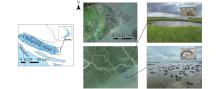
Fig.1
The location and characteristics of the experimental sites"
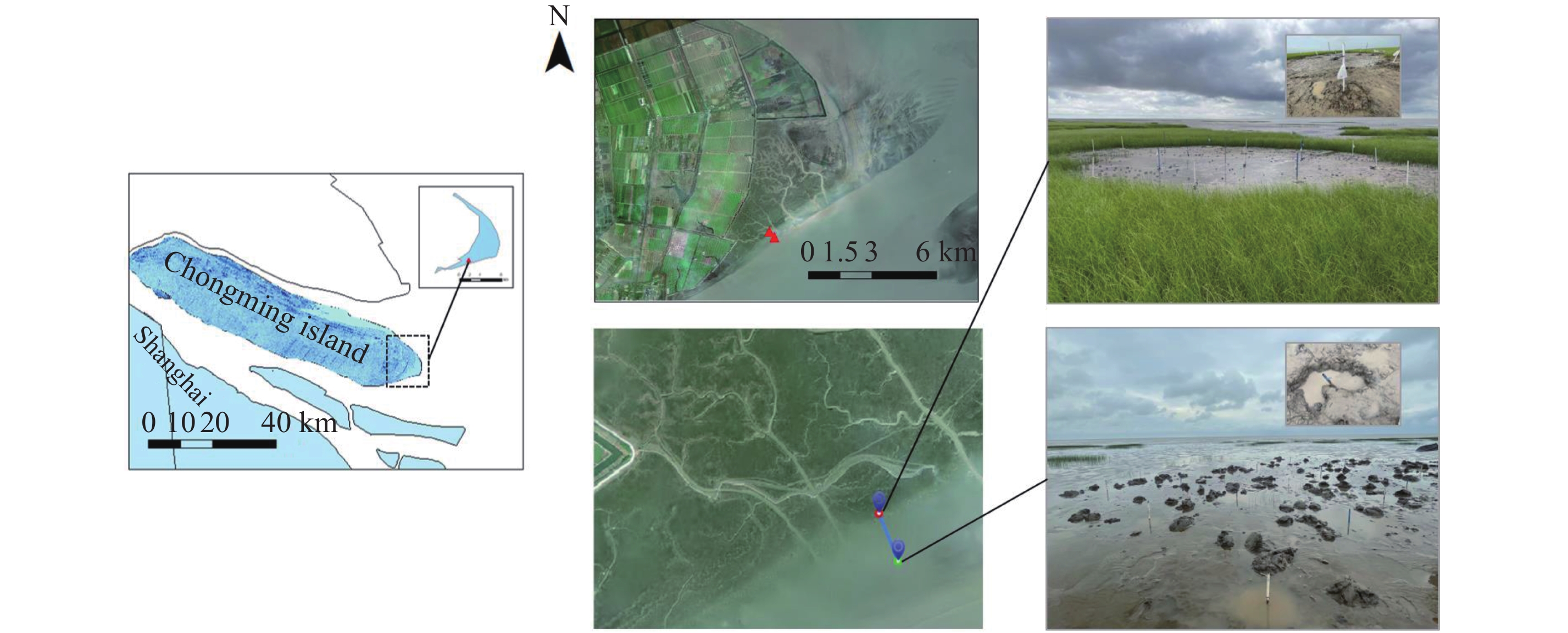
Table 1
The initial properties of soil at the high (HM) and low (LM) marshland sites"
| 样地 | 温度/℃ | 水分/% | 盐度/ppt | 氧化还原电位/mV | 黏土/% | 粉砂/% | 砂土/% |
| HM | 22.4±1.0A | 44.5±8.6A | 1.7±0.6A | 72.7±171.2A | 4.1 | 70.5 | 25.4 |
| LM | 25.2±0.6B | 44.6±6.0A | 1.7±0.4A | 205.1±154.5B | 3.1 | 59.9 | 37.1 |
Table 2
The initial properties of Spartina alterniflora and Phragmites australis litter"
| 凋落物 | TN/(g·kg–1) | TC/(g·kg–1) | C/N | 半纤维素/% | 纤维素/% | 可溶性化合物/% | 木质素/% |
| SA | 6.1±0.8A | 419.3±1.2A | 69.2±9.4A | 13.7±0.1A | 35.7±0.1A | 43.7±0.1A | 6.9±0.1A |
| PA | 9.5±0.3B | 394.4±3.0B | 41.5±1.6B | 12.7±0.6A | 36.9±1.3A | 41.9±2.0A | 8.5±0.1B |
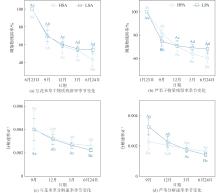
Fig.2
Changes in dry mass remaining and rates of decomposition based on the Olson decomposition model for Spartina alterniflora (SA) and Phragmites australis (PA) litter in the high (HM) and low (LM) marshland sites over a 1-year decomposition cycle"
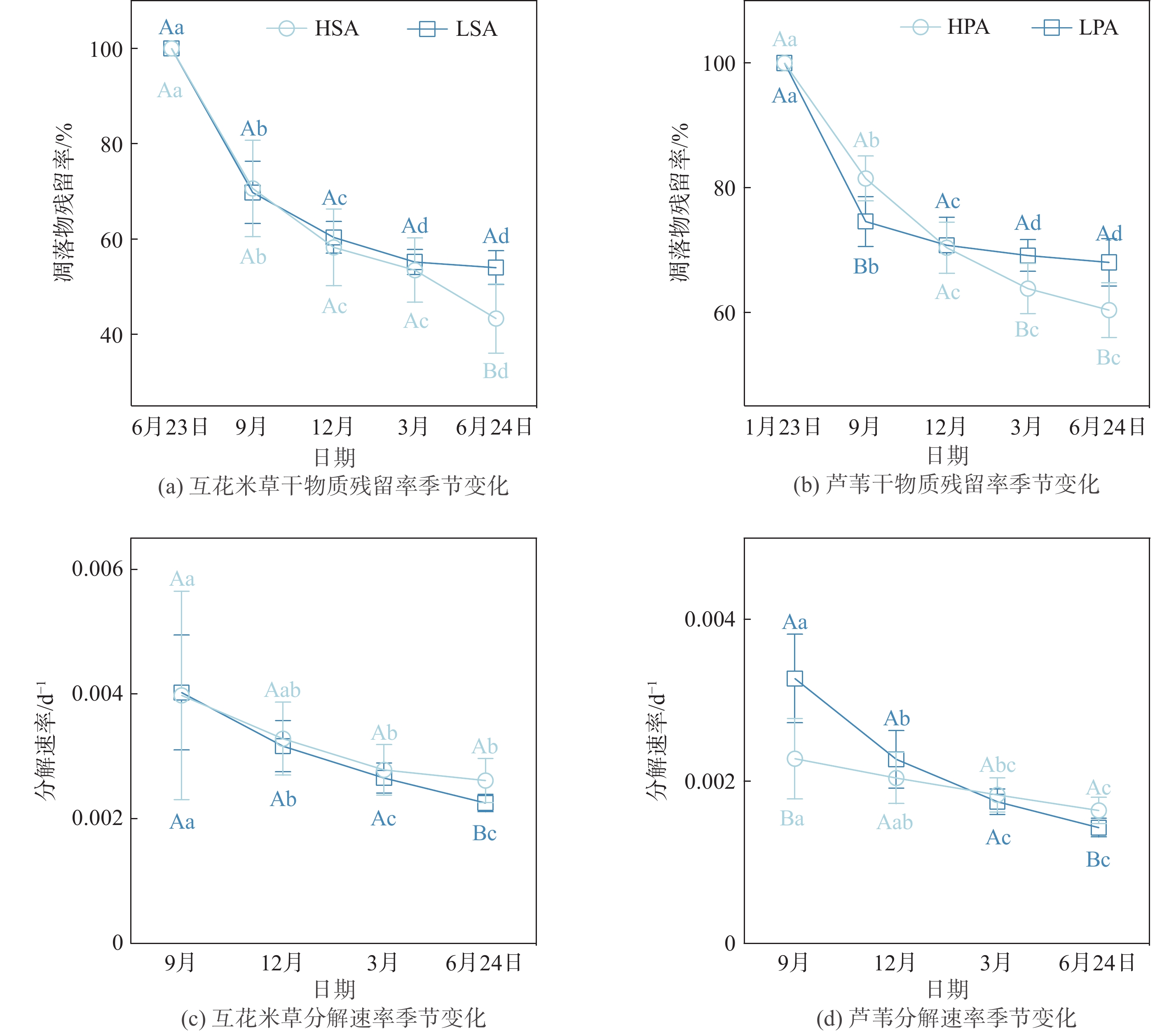
Fig.3
Changes in total carbon (TC), total nitrogen (TN), element accumulation index (AI), and C/N ratio of Spartina alterniflora (SA) and Phragmites australis (PA) litter in the high (HM) and low (LM) marshland sites during decomposition"
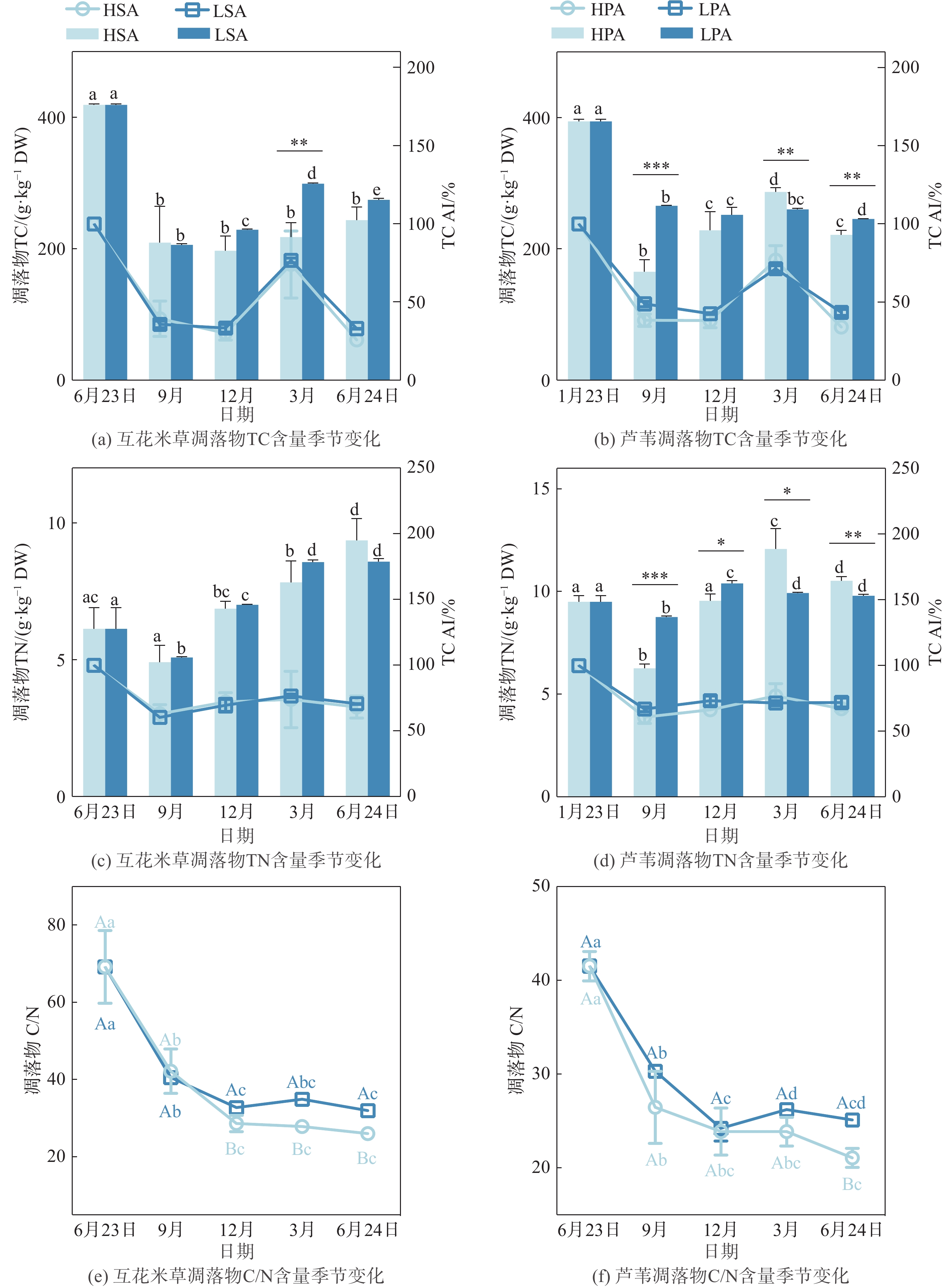
Table 3
Temperature, moisture, salinity, pH, total nitrogen (TN), and the C/N ratio of soils adjacent to Spartina alterniflora (SA) and Phragmites australis (PA) litter and control soils in the high (HM) and low (LM) marshland sites during decomposition"
| 样本 | 温度/℃ | 水分/% | |||||||
| 90 d | 180 d | 270 d | 360 d | 90 d | 180 d | 270 d | 360 d | ||
| HM-SA | 29.1±1.0Aa | 7.9±0.5Ab | 12.4±0.6Ac | 20.7±0.3Ad | 48.9±2.6Aa | 57.6±6.5Ab | 56.4±5.9Ab | 51.5±2.1Aa | |
| LM-SA | 27.9±0.3Ba | 9.4±0.4Bb | 11.8±0.5Bc | 21.9±0.1Bd | 49.7±3.3Aa | 65.3±9.2Ab | 61.8±6.5Ab | 52.1±4.1Aa | |
| HM-PA | 28.6±0.8Aa | 8.4±0.3Ab | 11.8±0.6Ac | 20.8±0.5Ad | 48.3±1.6Aa | 48.7±9.3Aa | 55.8±8.2Ab | 44.8±6.9Aa | |
| LM-PA | 27.7±0.4Ba | 9.3±0.6Bb | 11.9±1.6Ac | 22.2±0.3Bd | 49.9±4.9Aa | 60.8±9.1Bb | 55.1±6.4Aab | 52.0±2.3Ba | |
| HM-Control | 30.5±0.7Aa | 8.5±0.1Ab | 11.4±1.1Ac | 20.6±0.3Ad | 44.8±6.1Aa | 55.8±2.1Aa | 47.3±12.1Aa | 44.2±6.6Aa | |
| LM-Control | 28.5±0.2Ba | 9.8±0.3Bb | 11.1±0.7Ac | 22.3±0.1Bd | 37.5±2.5Aa | 52.2±20.5Aab | 61.0±1.5Ab | 49.4±1.3Aab | |
| 样本 | 盐度/ppt | pH | |||||||
| 90 d | 180 d | 270 d | 360 d | 90 d | 180 d | 270 d | 360 d | ||
| HM-SA | 0.67±0.11Aa | 2.20±0.66Ab | 1.60±0.29Ab | 0.46±0.08Ac | 8.57±0.15Aa | 8.80±0.10Ab | 9.25±0.05Ac | 8.99±0.10Ab | |
| LM-SA | 0.90±0.20Ba | 2.67±0.58Ab | 2.28±0.35Bb | 0.85±0.32Ba | 8.90±0.00Ba | 9.03±0.06Ba | 9.03±0.21Aa | 8.93±0.15Aa | |
| HM-PA | 0.72±0.14Aa | 1.63±0.47Ab | 1.72±0.47Ab | 0.50±0.15Ac | 8.63±0.15Aa | 9.01±0.10Ab | 9.17±0.15Ab | 9.09±0.10Ab | |
| LM-PA | 0.89±0.32Aa | 2.40±0.57Bb | 1.91±0.31Ab | 1.03±0.20Ba | 8.90±0.10Aa | 8.95±0.05Aa | 8.95±0.15Aa | 8.93±0.15Aa | |
| HM-Control | 0.66±0.07Aa | 1.88±0.23Ab | 1.40±0.64Ab | 0.53±0.05Aa | 8.93±0.15Aa | 9.03±0.15Aa | 9.03±0.15Aa | 9.02±0.25Aa | |
| LM-Control | 0.47±0.06Ba | 2.10±1.23Ab | 2.35±0.24Ab | 0.53±0.08Aa | 9.15±0.05Aa | 9.15±0.05Aa | 9.20±0.10Aa | 9.30±0.20Aa | |
| 样本 | TN/(g·kg–1) | C/N | |||||||
| 90 d | 180 d | 270 d | 360 d | 90 d | 180 d | 270 d | 360 d | ||
| HM-SA | 0.42±0.11Aa | 0.30±0.05Ab | 0.47±0.12Aa | 0.29±0.05Ab | 5.77±0.98Aa | 11.68±3.09Ab | 8.30±0.87Ac | 9.94±1.01Ac | |
| LM-SA | 0.49±0.18Aa | 0.39±0.06Bab | 0.32±0.16Bbc | 0.23±0.05Bc | 5.92±1.29Aa | 10.21±3.52Ab | 6.18±2.25Ba | 6.66±0.64Ba | |
| HM-PA | 0.39±0.09Aab | 0.42±0.08Aa | 0.34±0.07Ab | 0.25±0.05Ac | 6.06±1.18Aa | 9.24±1.57Ab | 9.03±0.88Ab | 9.21±1.70Ab | |
| LM-PA | 0.69±0.31Ba | 0.38±0.14Ab | 0.32±0.09Ab | 0.25±0.07Ab | 5.26±0.93Aa | 8.51±1.57Ab | 5.23±1.51Ba | 7.34±1.63Bb | |
| HM-Control | 0.41±0.07Aa | 0.32±0.04Aab | 0.25±0.11Ab | 0.26±0.05Ab | 4.03±0.22Aa | 8.58±0.55Ab | 6.87±1.18Abc | 6.10±1.48Ac | |
| LM-Control | 0.37±0.06Aa | 0.26±0.14Aa | 0.24±0.04Aa | 0.22±0.07Aa | 3.71±0.41Aa | 6.35±0.31Bb | 4.39±0.31Bc | 4.88±0.18Ac | |
Fig.4
Changes in soil organic carbon (SOC), dissolved organic carbon (DOC), microbial biomass carbon (MBC) contents, and their proportions in SOC of soils adjacent to Spartina alterniflora (SA) and Phragmites australis (PA) litter and control soils in the high (HM) and low (LM) marshland sites during decomposition"
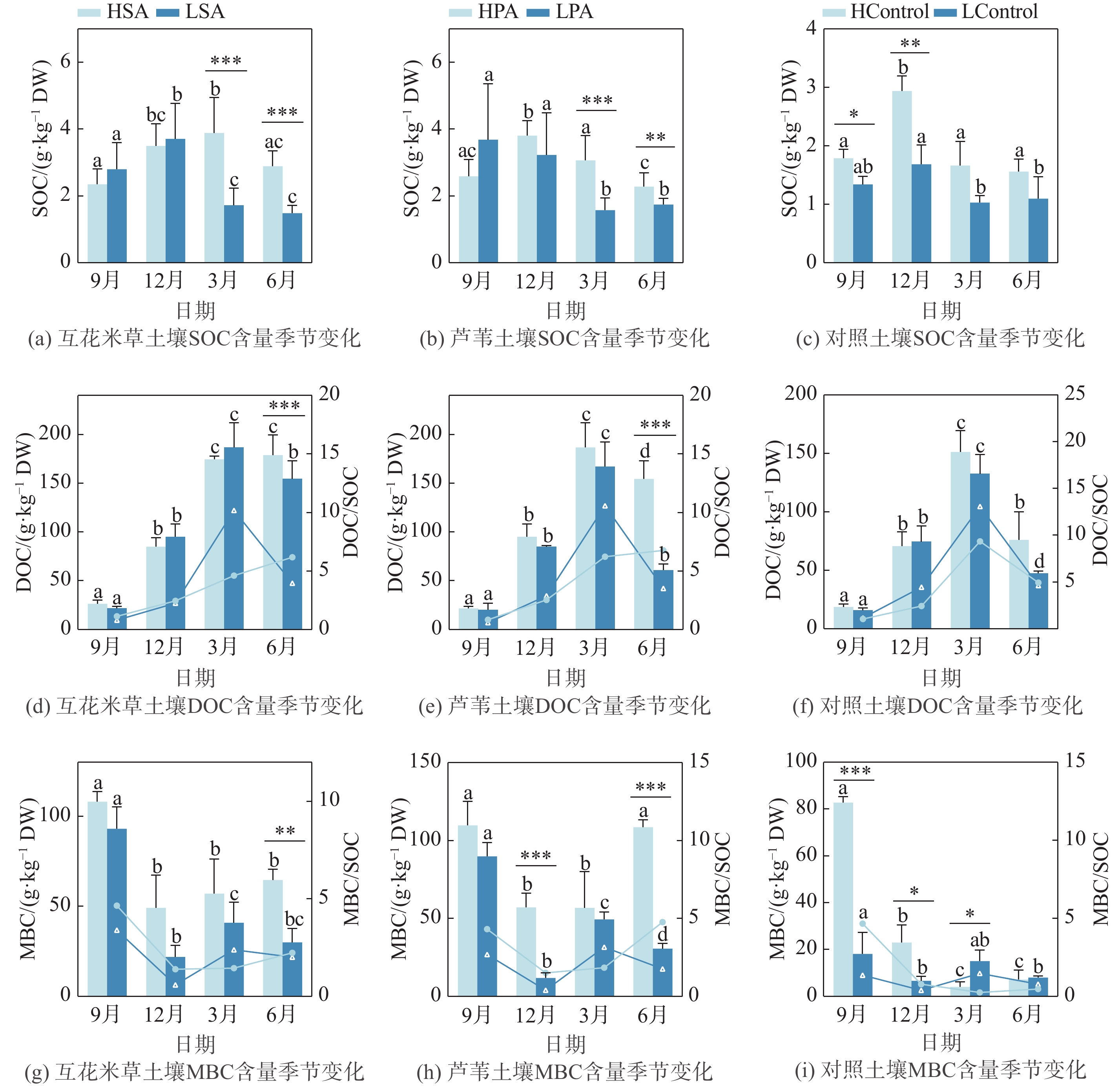
Fig.5
Changes in particulate organic carbon (POC), mineral-associated organic carbon (MAOC) content, and their proportions in soil organic carbon (SOC), as well as the C/N ratio of soil MAOC, of soils adjacent to Spartina alterniflora (SA) and Phragmites australis (PA) litter and control soils in the high (HM) and low (LM) marshland sites during decomposition"
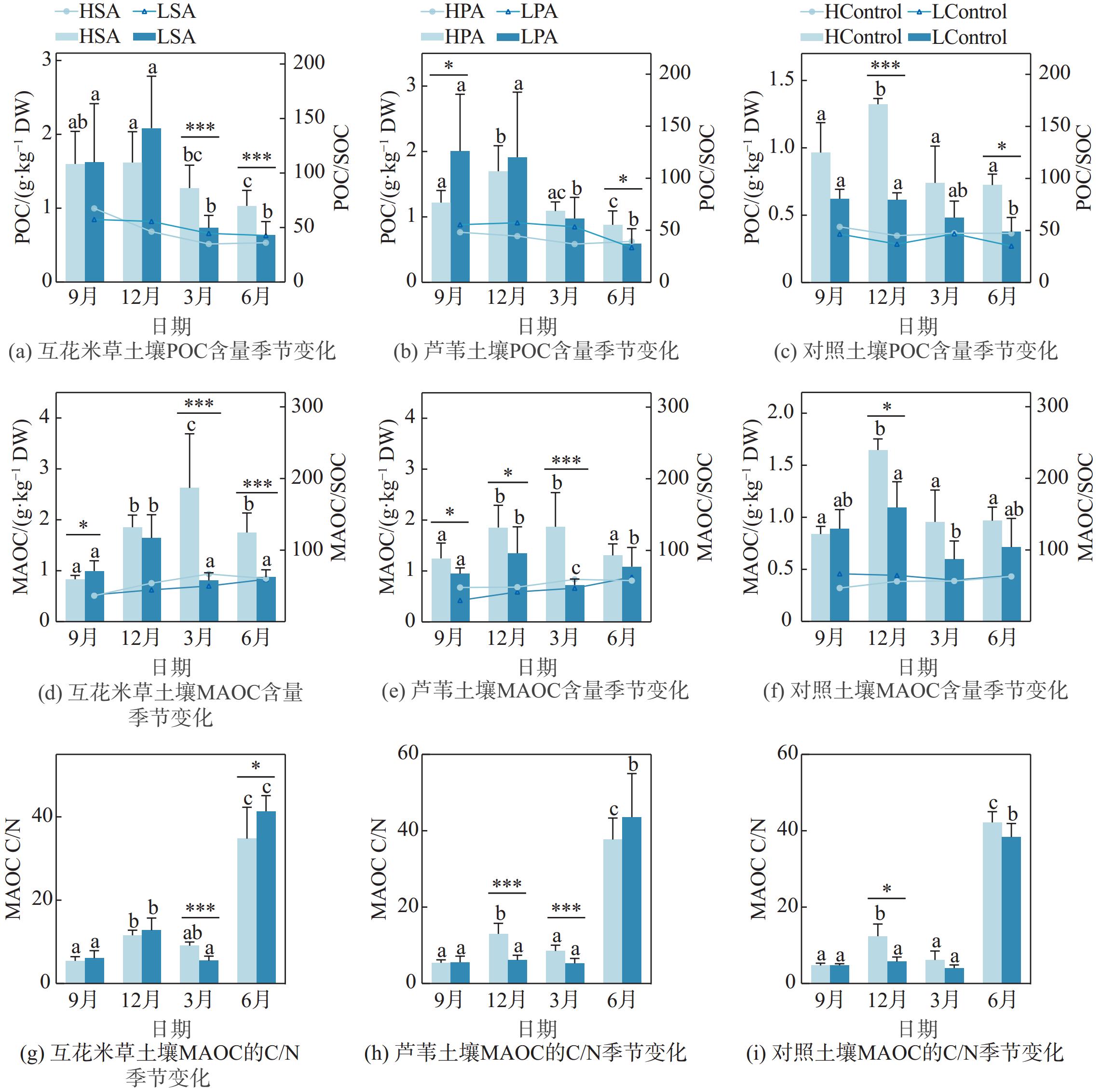
Table 4
Repeated-measures ANOVA results for carbon components, rate of litter decomposition (k), and litter remaining (LR) by plant type (SA, PA) and tidal elevation (HM, LM)"
| 变量 | 效应 | F | p-value |
| SOC | 时间 | 9.388 | |
| 高程 | 7.691 | ||
| 时间×高程 | 7.650 | ||
| DOC | 时间 | 142.800 | < |
| 高程 | 39.690 | < | |
| 时间×高程 | 22.850 | < | |
| 时间×植物类型 | 3.490 | ||
| MBC | 时间 | 46.680 | < |
| 高程 | 55.910 | < | |
| 植物类型 | 6.756 | ||
| 时间×高程 | 6.127 | ||
| 时间×植物类型 | 5.373 | ||
| 高程×植物类型 | 8.958 | ||
| 时间×高程×植物类型 | 5.330 | ||
| POC | 时间 | 22.850 | < |
| 时间×高程 | 3.978 | ||
| MAOC | 时间 | 12.410 | |
| 高程 | 54.120 | < | |
| 时间×高程 | 13.370 | ||
| 时间×高程×植物类型 | 4.660 | ||
| k | 时间 | 31.58 | < |
| 植物类型 | 80.36 | < | |
| LR | 时间 | 87.100 | < |
| 高程 | 9.307 | ||
| 植物类型 | 145.500 | < | |
| 时间×高程 | 10.250 |
Table 5
Correlation analysis of the rates of Spartina alterniflora (SA) and Phragmites australis (PA) litter decomposition (k) and soil environmental factors"
| 凋落物k | 温度 | 水分 | 盐度 | pH | TN | C/N | SOC | DOC | MBC | POC | MAOC |
| SA-k | 0.29* | −0.11 | −0.05 | −0.48* | 0.48** | −0.17 | 0.19 | −0.47* | 0.60** | 0.51** | −0.15 |
| PA-k | 0.32** | 0.03 | −0.05 | −0.28 | 0.52** | −0.27* | 0.36** | −0.57** | 0.16 | 0.41** | −0.11 |
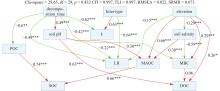
Fig.6
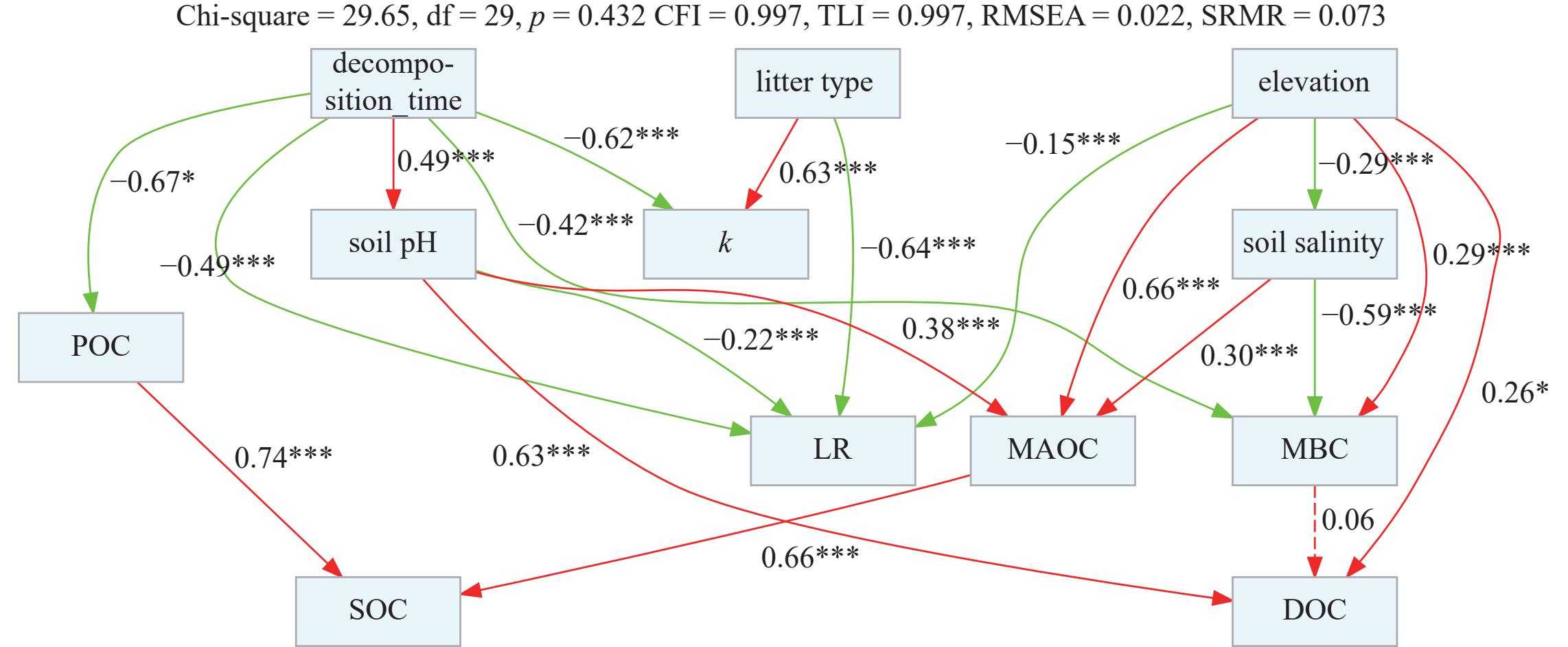
Structural equation modeling of soil environmental factors and carbon fractions in the high (HM) and low (LM) marshland sites during decomposition"
| 1 | KIRWAN M L, BLUM L K.. Enhanced decomposition offsets enhanced productivity and soil carbon accumulation in coastal wetlands responding to climate change. Biogeosciences, 2011, 8 (4): 987- 993. |
| 2 | K RAMESH REDDY R D D. Biogeochemistry of Wetlands: Science and Applications [M]. Boca Raton: CRC Press, 2008. |
| 3 | AMUNDSON R.. The carbon budget in soils. Annual Review of Earth and Planetary Sciences, 2001, 29, 535- 562. |
| 4 | KAYRANLI B, SCHOLZ M, MUSTAFA A, et al.. Carbon storage and fluxes within freshwater wetlands: A critical review. Wetlands, 2010, 30 (1): 111- 124. |
| 5 | YU J M, WANG X T, YANG S X, et al.. Divergent response of blue carbon components to wetland types and hydrological effects in typical estuarine wetlands of Jiaozhou Bay, China. Journal of Environmental Management, 2023, 347, 119233. |
| 6 | 张晓涵, 田慧敏, 陈雪初, 等.. 长江口横沙岛不同发育年限盐沼植被生长特征及其固碳功能差异. 华东师范大学学报(自然科学版), 2024 (1): 113- 121. |
| 7 | CASTELLANO M J, MUELLER K E, OLK D C, et al.. Integrating plant litter quality, soil organic matter stabilization, and the carbon saturation concept. Global Change Biology, 2015, 21 (9): 3200- 3209. |
| 8 | MCNICOL G, SILVER W L.. Non-linear response of carbon dioxide and methane emissions to oxygen availability in a drained histosol. Biogeochemistry, 2015, 123 (1): 299- 306. |
| 9 | WANG W Q, WANG C, SARDANS J, et al.. Storage and release of nutrients during litter decomposition for native and invasive species under different flooding intensities in a Chinese wetland. Aquatic Botany, 2018, 149, 5- 16. |
| 10 | HAN G X, CHU X J, XING Q H, et al.. Effects of episodic flooding on the net ecosystem CO2 exchange of a supratidal wetland in the Yellow River Delta. Journal of Geophysical Research: Biogeosciences, 2015, 120 (8): 1506- 1520. |
| 11 | WU L L, SONG Z L, WU Y T, et al.. Organic matter composition and stability in estuarine wetlands depending on soil salinity. Science of the Total Environment, 2024, 945, 173861. |
| 12 | SCHLÜTER S, LEUTHER F, ALBRECHT L, et al.. Microscale carbon distribution around pores and particulate organic matter varies with soil moisture regime. Nature Communications, 2022, 13, 2098. |
| 13 | PEREZ B C, DAY J W, ROUSE L J, et al.. Influence of Atchafalaya River discharge and winter frontal passage on suspended sediment concentration and flux in fourleague bay, Louisiana. Estuarine, Coastal and Shelf Science, 2000, 50 (2): 271- 290. |
| 14 | HECKMAN K A, POSSINGER A R, BADGLEY B D, et al.. Moisture-driven divergence in mineral-associated soil carbon persistence. Proceedings of the National Academy of Sciences of the United States of America, 2023, 120 (7): e2210044120. |
| 15 | SUN Z G, MOU X J, SUN W L.. Decomposition and heavy metal variations of the typical halophyte litters in coastal marshes of the Yellow River estuary, China. Chemosphere, 2016, 147, 163- 172. |
| 16 | WANG M, WANG Q, SHA C Y, et al.. Spartina alterniflora invasion affects soil carbon in a C3 plant-dominated tidal marsh. Scientific Reports, 2018, 8, 628. |
| 17 | 狄丽燕, 孔范龙, 王森, 等.. 胶州湾滨海湿地凋落物分解对土壤有机碳矿化的影响. 生态学报, 2019, 39 (22): 8483- 8493. |
| 18 | BU N S, QU J F, LI Z L, et al.. Effects of Spartina alterniflora invasion on soil respiration in the Yangtze River Estuary, China. PLoS One, 2015, 10 (3): e0121571. |
| 19 | CHIMNEY M J, PIETRO K C.. Decomposition of macrophyte litter in a subtropical constructed wetland in south Florida (USA). Ecological Engineering, 2006, 27 (4): 301- 321. |
| 20 | ZHANG D Q, HUI D F, LUO Y Q, et al.. Rates of litter decomposition in terrestrial ecosystems: Global patterns and controlling factors. Journal of Plant Ecology, 2008, 1 (2): 85- 93. |
| 21 | WHALEN J K, GUL S, POIRIER V, et al.. Transforming plant carbon into soil carbon: Process-level controls on carbon sequestration. Canadian Journal of Plant Science, 2014, 94 (6): 1065- 1073. |
| 22 | ZHENG Y, HU Z K, PAN X, et al.. Carbon and nitrogen transfer from litter to soil is higher in slow than rapid decomposing plant litter: A synthesis of stable isotope studies. Soil Biology and Biochemistry, 2021, 156, 108196. |
| 23 | 徐志明.. 崇明岛东部潮滩沉积. 海洋与湖沼, 1985, 16 (3): 231- 239. |
| 24 | 布乃顺, 王坤, 侯玉乐, 等.. 半月周期的潮汐对滨海湿地土壤理化性质的影响. 长江流域资源与环境, 2015, 24 (11): 1898- 1905. |
| 25 | KVALE E P.. The origin of neap–spring tidal cycles. Marine Geology, 2006, 235 (1/2/3/4): 5- 18. |
| 26 | ZHU Q, VAN PROOIJEN B C, WANG Z B, et al.. Bed-level changes on intertidal wetland in response to waves and tides: A case study from the Yangtze River Delta. Marine Geology, 2017, 385, 160- 172. |
| 27 | CAMBARDELLA C A, ELLIOTT E T.. Particulate soil organic-matter changes across a grassland cultivation sequence. Soil Science Society of America Journal, 1992, 56 (3): 777- 783. |
| 28 | VANCE E D, BROOKES P C, JENKINSON D S.. An extraction method for measuring soil microbial biomass C. Soil Biology and Biochemistry, 1987, 19 (6): 703- 707. |
| 29 | OLSON J S.. Energy storage and the balance of producers and decomposers in ecological systems. Ecology, 1963, 44 (2): 322- 331. |
| 30 | VAN SOEST P J.. Use of detergents in the analysis of fibrous feeds. Ⅱ. a rapid method for the determination of fiber and lignin. Journal of AOAC International, 1963, 46 (5): 829- 835. |
| 31 | LUO Y, ZHOU X. Soil Respiration and the Environment[M]. Burlington: Academic Press, 2010. |
| 32 | ROTH V N, LANGE M, SIMON C, et al.. Persistence of dissolved organic matter explained by molecular changes during its passage through soil. Nature Geoscience, 2019, 12 (9): 755- 761. |
| 33 | WANG Q, WANG Z, PEÑUELAS J, et al.. Decaying logs and gap positions jointly mediate the structure and function of soil bacterial community in the forest ecosystem. Forest Ecology and Management, 2024, 567, 122070. |
| 34 | SU B W, GAO C, JI J C, et al.. Soil bacterial succession with different land uses along a millennial chronosequence derived from the Yangtze River flood plain. Science of the Total Environment, 2024, 908, 168531. |
| 35 | LI B, LI Y B, FANIN N, et al.. Stoichiometric imbalances between soil microorganisms and their resources regulate litter decomposition. Functional Ecology, 2023, 37 (12): 3136- 3149. |
| 36 | THULLEN J S, NELSON S M, CADE B S, et al.. Macrophyte decomposition in a surface-flow ammonia-dominated constructed wetland: Rates associated with environmental and biotic variables. Ecological Engineering, 2008, 32 (3): 281- 290. |
| 37 | MENDELSSOHN I A, SORRELL B K, BRIX H, et al.. Controls on soil cellulose decomposition along a salinity gradient in a Phragmites australis wetland in Denmark. Aquatic Botany, 1999, 64 (3/4): 381- 398. |
| 38 | ROACHE M C, BAILEY P C, BOON P I.. Effects of salinity on the decay of the freshwater macrophyte, Triglochin procerum. Aquatic Botany, 2006, 84 (1): 45- 52. |
| 39 | SARASWATI S, DUNN C, MITSCH W J, et al.. Is peat accumulation in mangrove swamps influenced by the “enzymic latch” mechanism?. Wetlands Ecology and Management, 2016, 24 (6): 641- 650. |
| 40 | KIDA M, TANABE M, TOMOTSUNE M, et al.. Changes in dissolved organic matter composition and dynamics in a subtropical mangrove river driven by rainfall. Estuarine, Coastal and Shelf Science, 2019, 223, 6- 17. |
| 41 | PRIHA O, SMOLANDER A.. Nitrogen transformations in soil under Pinus sylvestris, Picea abies and Betula pendula at two forest sites. Soil Biology and Biochemistry, 1999, 31 (7): 965- 977. |
| 42 | KITTLE D L, MCGRAW J B, GARBUTT K.. Plant litter decomposition in wetlands receiving acid mine drainage. Journal of Environmental Quality, 1995, 24 (2): 301- 306. |
| 43 | BALDOCK J A, SKJEMSTAD J O.. Role of the soil matrix and minerals in protecting natural organic materials against biological attack. Organic Geochemistry, 2000, 31 (7/8): 697- 710. |
| 44 | GRANDY A S, NEFF J C.. Molecular C dynamics downstream: The biochemical decomposition sequence and its impact on soil organic matter structure and function. Science of the Total Environment, 2008, 404 (2/3): 297- 307. |
| 45 | PLAZA C, COURTIER-MURIAS D, FERNÁNDEZ J M, et al.. Physical, chemical, and biochemical mechanisms of soil organic matter stabilization under conservation tillage systems: A central role for microbes and microbial by-products in C sequestration. Soil Biology and Biochemistry, 2013, 57, 124- 134. |
| 46 | HUANG W J, HALL S J.. Elevated moisture stimulates carbon loss from mineral soils by releasing protected organic matter. Nature Communications, 2017, 8, 1774. |
| 47 | DUAN H, WANG L, ZHANG Y N, et al.. Variable decomposition of two plant litters and their effects on the carbon sequestration ability of wetland soil in the Yangtze River estuary. Geoderma, 2018, 319, 230- 238. |
| 48 | SOKOL N W, WHALEN E D, JILLING A, et al.. Global distribution, formation and fate of mineral-associated soil organic matter under a changing climate: A trait-based perspective. Functional Ecology, 2022, 36 (6): 1411- 1429. |
| 49 | BENESCH M, GLASER B, DIPPOLD M, et al.. Soil microbial C and N turnover under Cupressus lusitanica and natural forests in southern Ethiopia assessed by decomposition of 13C- and 15 N-labelled litter under field conditions. Plant and Soil, 2015, 388 (1): 133- 146. |
| 50 | XU X, LIU H, LIU Y Z, et al.. Human eutrophication drives biogeographic salt marsh productivity patterns in China. Ecological Applications, 2020, 30 (2): e02045. |
| 51 | WANG L, LI Y, HEI J, et al.. Impacts of Spartina alterniflora invasion on soil carbon components of particulate and mineral-associated organic matter and soil organic matter mineralization in estuarine wetlands. Applied Soil Ecology, 2025, 206, 105857. |
| 52 | LIANG C, SCHIMEL J P, JASTROW J D.. The importance of anabolism in microbial control over soil carbon storage. Nature Microbiology, 2017, 2, 17105. |
| 53 | COTRUFO M F, HADDIX M L, KROEGER M E, et al.. The role of plant input physical-chemical properties, and microbial and soil chemical diversity on the formation of particulate and mineral-associated organic matter. Soil Biology and Biochemistry, 2022, 168, 108648. |
| 54 | 周金戈, 覃国铭, 张靖凡, 等.. 中国盐沼湿地蓝碳碳汇研究进展. 热带亚热带植物学报, 2022, 30 (6): 765- 781. |
| 55 | DYNARSKI K A, BOSSIO D A, SCOW K M.. Dynamic stability of soil carbon: Reassessing the “permanence” of soil carbon sequestration. Frontiers in Environmental Science, 2020, 8, 514701. |
| 56 | LIAO C Z, LUO Y Q, JIANG L F, et al.. Invasion of Spartina alterniflora enhanced ecosystem carbon and nitrogen stocks in the Yangtze Estuary, China. Ecosystems, 2007, 10 (8): 1351- 1361. |
| 57 | ZHANG Y H, DING W X, LUO J F, et al.. Changes in soil organic carbon dynamics in an Eastern Chinese coastal wetland following invasion by a C4 plant Spartina alterniflora. Soil Biology and Biochemistry, 2010, 42 (10): 1712- 1720. |
| 58 | GUO X Q, LIU Y J, XIE T, et al.. Impact of ecological restoration on carbon sink function in coastal wetlands: A review. Water, 2025, 17 (4): 488. |
| 59 | 刘博远, 陈雪初, 张晓涵, 等.. 秸秆埋藏对富营养化盐沼湿地碳汇功能的影响. 华东师范大学学报(自然科学版), 2025 (2): 34- 41. |
| [1] | GUAN Yue-zhang, LIU An-tian, ZHONG Qi-cheng, WANG Kai-yun. Responses of decomposition of Phragmites australis litter to simulated temperature enhancement in the reclamed coastal wetland [J]. Journal of East China Normal University(Natural Sc, 2013, 2013(5): 27-34. |
| [2] | DENG Hong;YE Zhi-hong;HUANG Ming-hong. Characteristics of Radial Oxygen Loss from Root of Wetland Plants(Chinese) [J]. Journal of East China Normal University(Natural Sc, 2007, 2007(6): 69-76. |
| Viewed | ||||||
|
Full text |
|
|||||
|
Abstract |
|
|||||
