
 中文核心期刊
J* E* C* N* U* N* S* ›› 2026, Vol. 2026 ›› Issue (1): 54-65.doi: 10.3969/j.issn.1000-5641.2026.01.005
• Innovation in Watershed Ecological Restoration Technologies • Previous Articles Next Articles
Mengyuan YU1,2, Changneng QIU1,2, Minsheng HUANG1,2,*( ), Tong ZHANG1,2, Yao ZHOU1,2, Yi YU1,2, Yangyang YI1,2
Received:2025-06-11
Accepted:2025-10-10
Online:2026-01-25
Published:2026-01-29
Contact:
Minsheng HUANG
E-mail:mshuang@des.ecnu.edu.cn
CLC Number:
Mengyuan YU, Changneng QIU, Minsheng HUANG, Tong ZHANG, Yao ZHOU, Yi YU, Yangyang YI. Effects of hydraulic disturbance and water level changes on the growth of Vallisneria natans and water quality[J]. J* E* C* N* U* N* S*, 2026, 2026(1): 54-65.

Fig.1
Photographs of the experimental simulation devices"
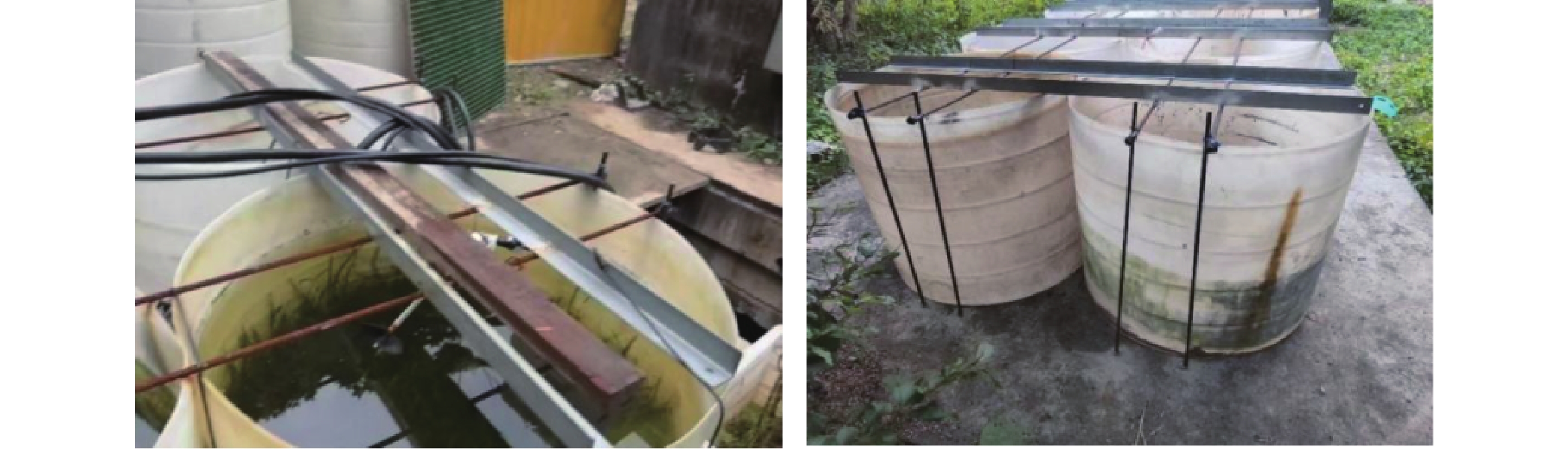

Table 1
Experimental treatment variables"
| 处理组 (简称) | 对应参数 | 处理组 (简称) | 对应参数 | |||
| 水位高度/cm | 扰动时间/h | 水位高度/cm | 扰动时间/h | |||
| 高水位无扰动(GW) | 80 | 0 | 高水位短时间扰动(GD) | 80 | 4 | |
| 低水位无扰动(DW) | 45 | 0 | 低水位长时间扰动(DC) | 45 | 8 | |
| 高水位长时间扰动(GC) | 80 | 8 | 低水位短时间扰动(DD) | 45 | 4 | |
Fig.2
A schematic diagram of the design of the simulation experiment"
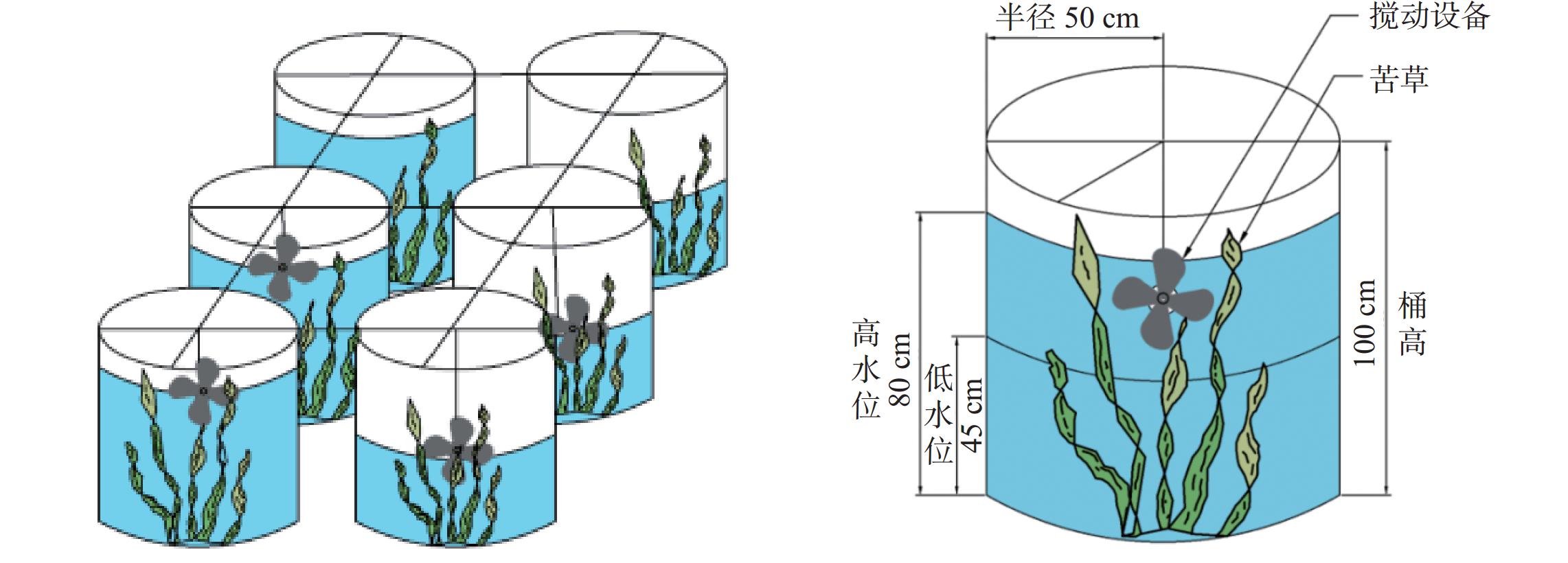
Table 2
Water quality index monitoring variables and methods"
| 监测指标 | 仪器或方法 | 监测指标 | 仪器或方法 | |
| 总磷(TP)、溶磷(DP) | 钼锑抗分光光度法(GB 11893—89) | 氨氮( | 纳氏试剂分光光度法(HJ 535—2009) | |
| 总氮(TN) | 碱性过硫酸钾消解紫外分光光度法(HJ 636—2012) | 高锰酸盐指数(CODMn) | 酸性高锰酸盐法(GB 11892—89) | |
| 硝态氮( | 紫外分光光度法(HJ/T 346—2007) | 五日生化需氧量(BOD5) | 稀释接种法(HJ 505—2009) | |
| 亚硝态氮( | N-(1萘基) -乙二胺光度法(GB 7493—87) | 总叶绿素(Chl) | 分光光度法(HJ 897—2017) |
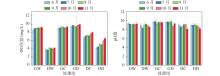
Fig.3
Changes in the dissolved oxygen contents and pH of overlying water in the different experimental groups"
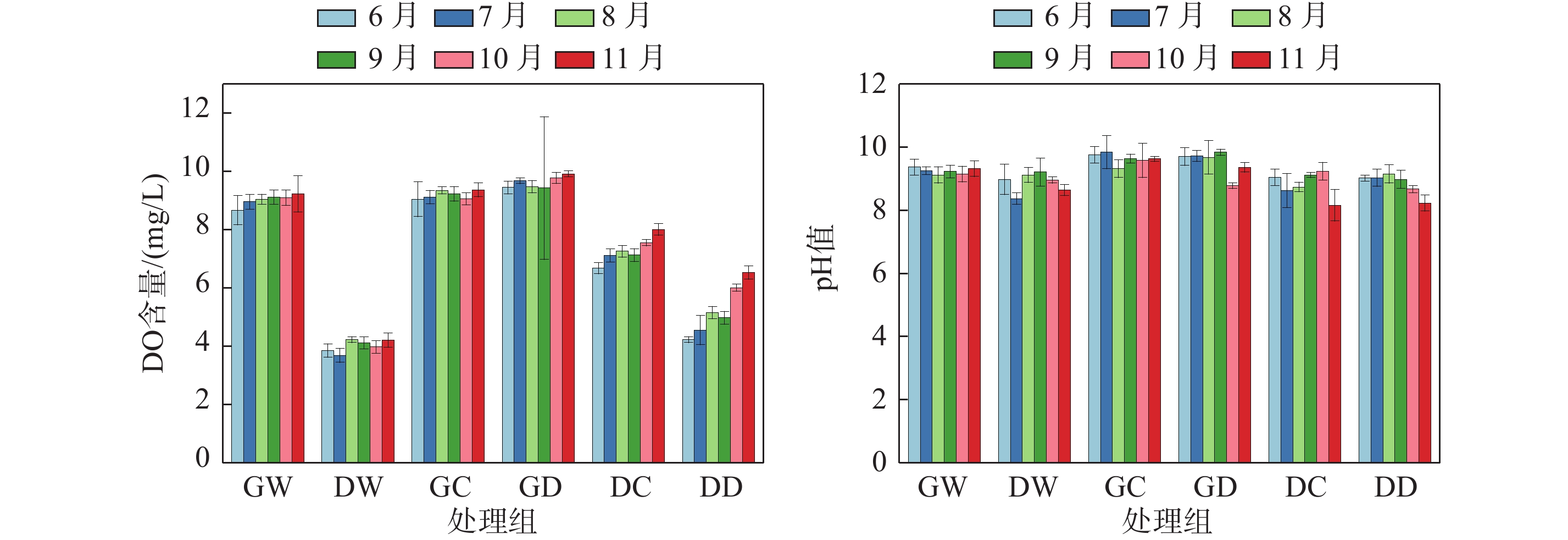
Fig.4
Changes in the concentrations of nitrogen nutrients in overlying water in the different experimental groups"
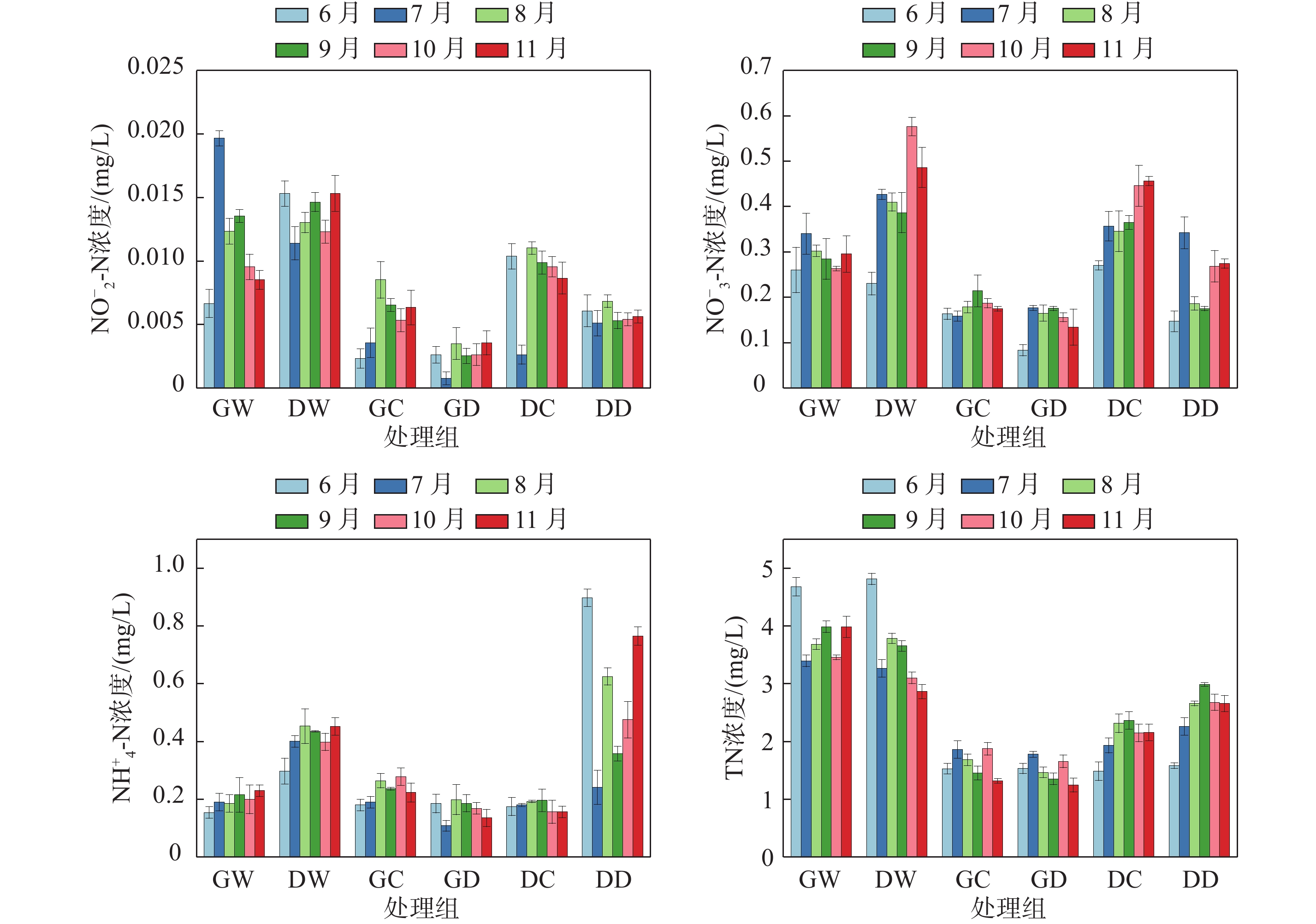
Fig.5
Changes in the phosphorus nutrient contents in overlying water in the different experimental groups"
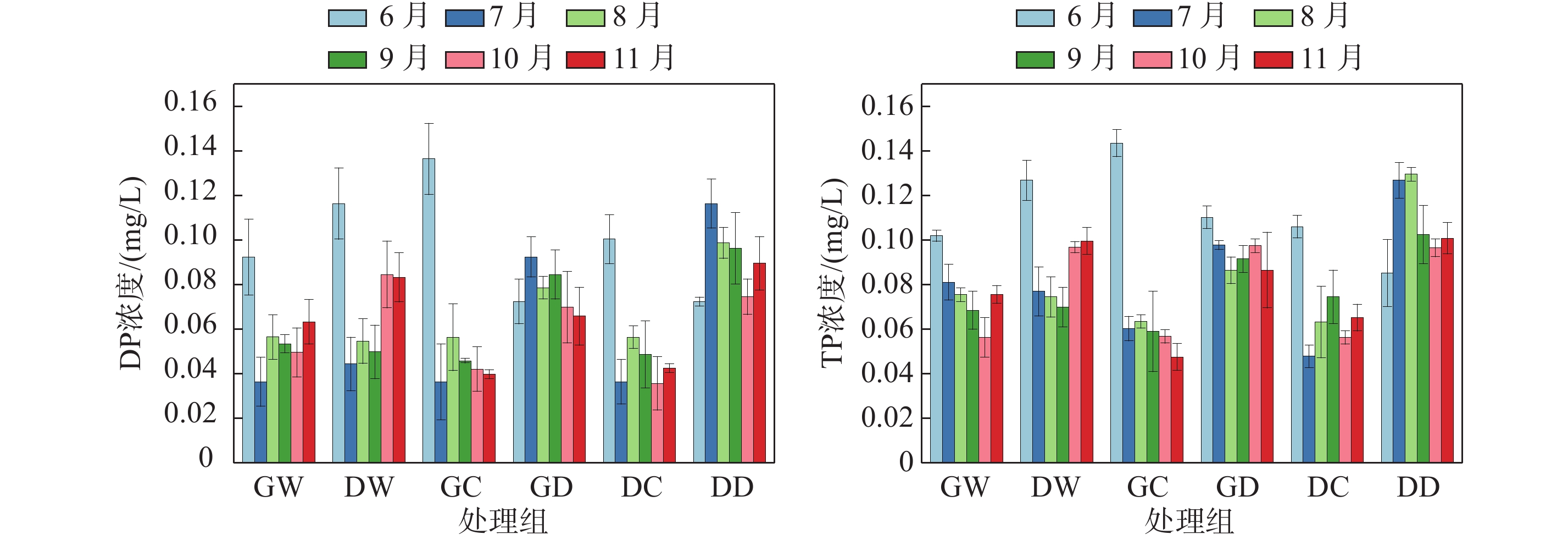
Fig.6
Changes in the concentrations of CODMn and BOD5 in overlying water in the different experimental groups"
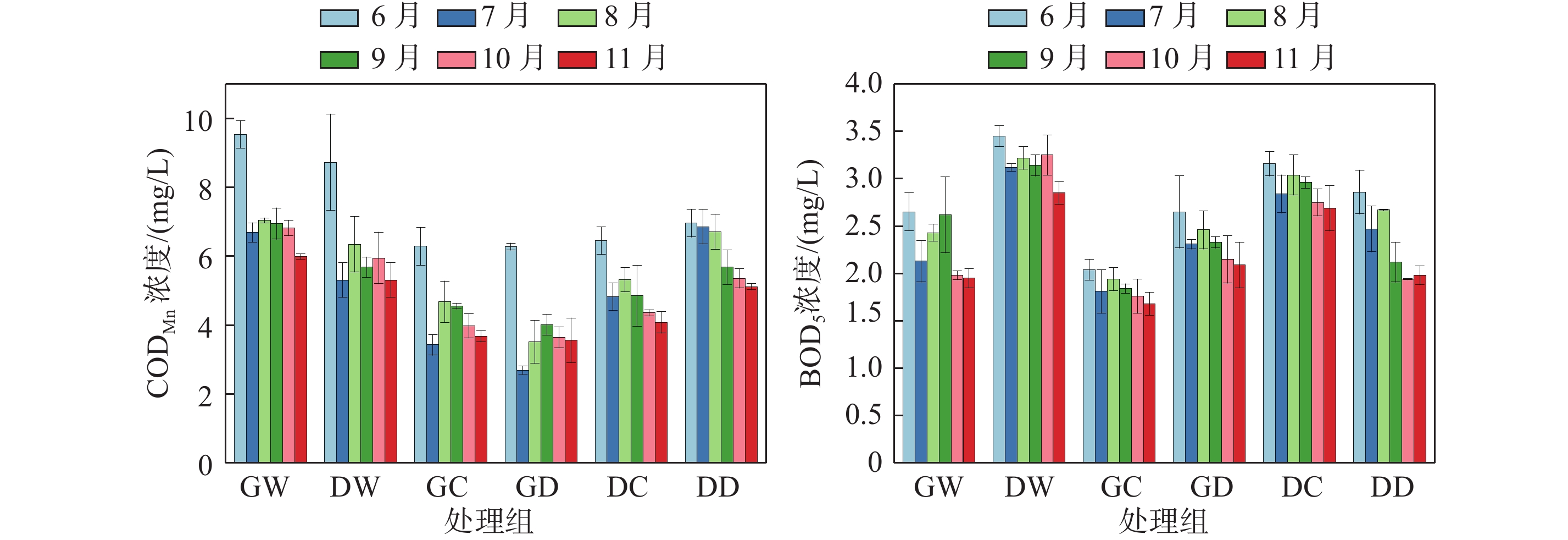
Fig.7
Differences in the peroxidase (POD) and superoxide dismutase (SOD) activities in the different experimental treatment groups"
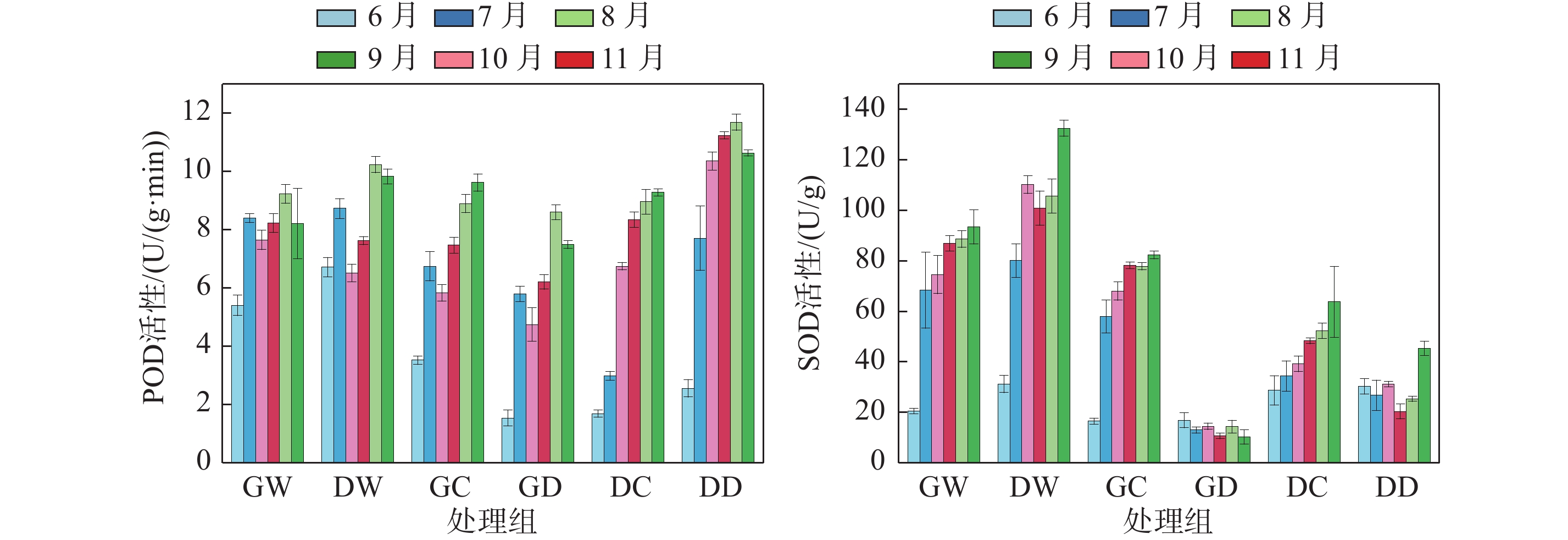
Fig.8
Changes in the content of malondialdehyde (MDA) and soluble protein(SP) in the different experimental groups"
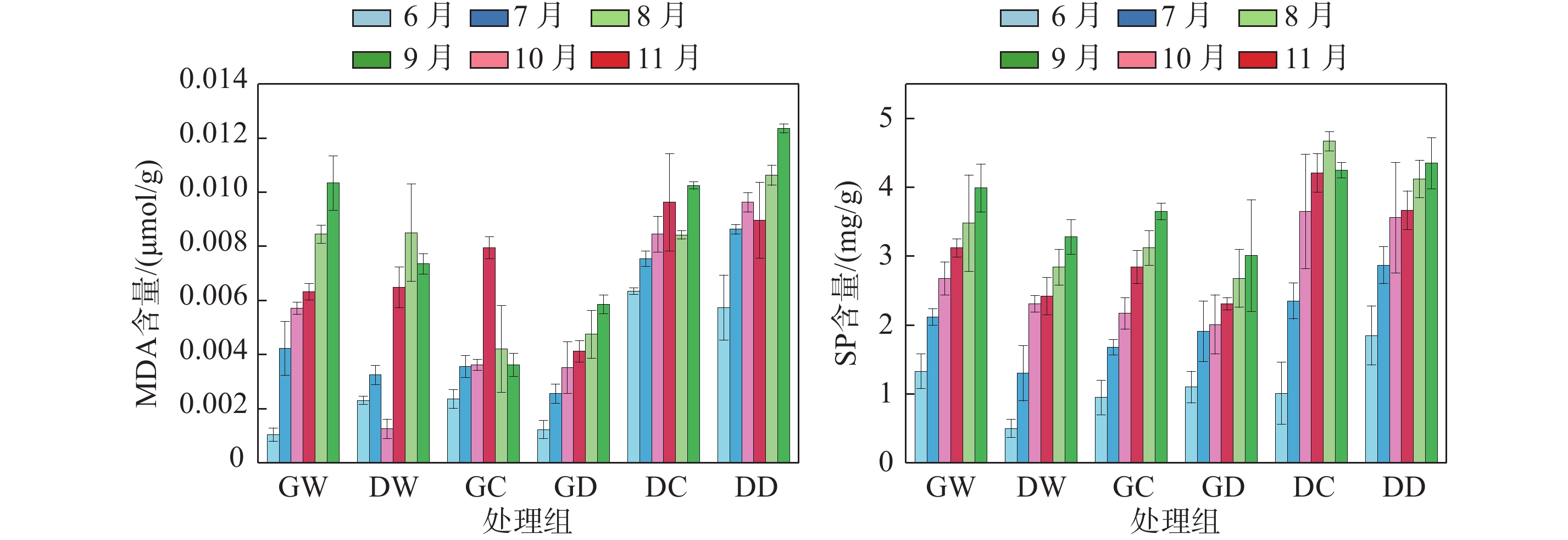
Fig.9
Changes in the total chlorophyll contents of the different experimental groups"
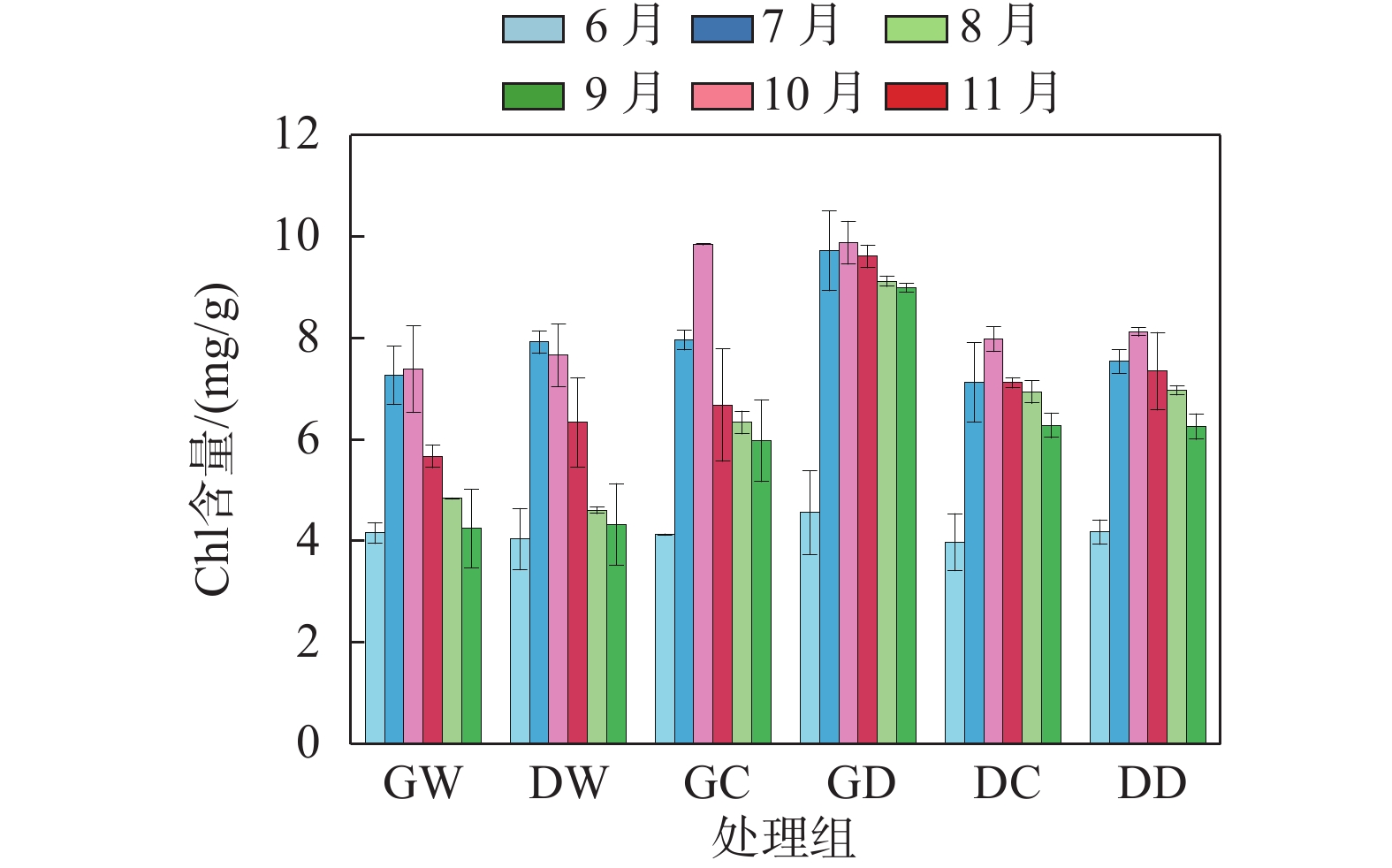
Table 3
Results of two-way ANOVA for the effects of water levels, disturbance duration, and the interaction between water levels and disturbance duration"
| 指标 | 水位 | 扰动时间 | 水位和扰动时间交互作用 | |||||
| F | p | F | p | F | p | |||
| TN | 6.687 | * | 68.997 | ** | 6.199 | * | ||
| NH4 + -N | 26.680 | ** | 6.764 | * | 13.286 | * | ||
| NO2–-N | 10.375 | * | 33.734 | ** | 0.228 | 0.798 | ||
| NO3–-N | 37.901 | ** | 18.751 | ** | 2.122 | 0.137 | ||
| TP | 1.185 | 0.285 | 6.167 | * | 0.567 | 0.573 | ||
| DP | 0.782 | 0.384 | 4.114 | * | 0.676 | 0.516 | ||
| CODMn | 2.633 | 0.115 | 11.580 | ** | 6.172 | * | ||
| BOD5 | 60.711 | ** | 9.153 | * | 15.194 | ** | ||
| POD | 1.482 | 0.233 | 0.927 | 0.407 | 2.024 | 0.150 | ||
| SOD | 0.771 | 0.387 | 24.160 | ** | 3.148 | 0.057 | ||
| MDA | 13.972 | ** | 0.719 | 0.496 | 7.105 | * | ||
| SP | 2.197 | 0.149 | 0.597 | 0.557 | 3.083 | 0.061 | ||
| Chl | 1.347 | 0.255 | 4.222 | * | 1.341 | 0.277 | ||
| 1 | 秦伯强, 胡维平, 陈伟民, 等. 太湖梅梁湾水动力及相关过程的研究 [J]. 湖泊科学, 2000, 12(4): 327-334. |
| 2 | BOWLER J M, HAMADA T.. Late Quaternary stratigraphy and radiocarbon chronology of water level fluctuations in Lake Keilambete, Victoria. Nature, 1971, 232 (5309): 330- 332. |
| 3 | 王超, 张微敏, 王沛芳, 等. 风浪扰动条件下沉水植物对水流结构及底泥再悬浮的影响 [J]. 安全与环境学报, 2014, 14(2): 107-111. |
| 4 | SCHUTTEN J, DAINTY J, DAVY A J.. Root anchorage and its significance for submerged plants in shallow lakes. Journal of Ecology, 2005, 93 (3): 556- 571. |
| 5 | VAN ZUIDAM B G, PEETERS E T H M.. Wave forces limit the establishment of submerged macrophytes in large shallow lakes. Limnology and Oceanography, 2015, 60 (5): 1536- 1549. |
| 6 | CHATELAIN M, GUIZIEN K.. Modelling coupled turbulence–Dissolved oxygen dynamics near the sediment–water interface under wind waves and sea swell. Water Research, 2010, 44 (5): 1361- 1372. |
| 7 | 董彬, 韩睿明, 王国祥. 沉水植物茎叶微界面特性研究进展 [J]. 生态学报, 2017, 37(6): 1769-1776. |
| 8 | WESTLAKE D F.. Some effects of low-velocity currents on the metabolism of aquatic macrophytes. Journal of Experimental Botany, 1967, 18 (2): 187- 205. |
| 9 | BILBY R.. Effects of a spate on the macrophyte vegetation of a stream pool. Hydrobiologia, 1977, 56 (2): 109- 112. |
| 10 | KOCH E W.. Hydrodynamics, diffusion-boundary layers and photosynthesis of the seagrasses Thalassia testudinum and Cymodocea nodosa. Marine Biology, 1994, 118 (4): 767- 776. |
| 11 | MADSEN T V, ENEVOLDSEN H O, JØRGENSEN T B. Effects of water velocity on photosynthesis and dark respiration in submerged stream macrophytes [J]. Plant, Cell & Environment, 1993, 16(3): 317-322. |
| 12 | 梁培瑜, 王烜, 马芳冰. 水动力条件对水体富营养化的影响 [J]. 湖泊科学, 2013, 25(4): 455-462. |
| 13 | VERVUREN P J A, BLOM C W P M, DE KROON H.. Extreme flooding events on the Rhine and the survival and distribution of riparian plant species. Journal of Ecology, 2003, 91 (1): 135- 146. |
| 14 | FERREIRA C S, PIEDADE M T F, FRANCO A C, et al.. Adaptive strategies to tolerate prolonged flooding in seedlings of floodplain and upland populations of Himatanthus sucuuba, a Central Amazon tree. Aquatic Botany, 2009, 90 (3): 246- 252. |
| 15 | 邹丽莎, 聂泽宇, 姚笑颜, 等. 富营养化水体中光照对沉水植物的影响研究进展 [J]. 应用生态学报, 2013, 24(7): 2073-2080. |
| 16 | GULATI R D, DIONISIO PIRES L M, VAN DONK E.. Lake restoration studies: Failures, bottlenecks and prospects of new ecotechnological measures. Limnologica, 2008, 38 (3/4): 233- 247. |
| 17 | RIIS T, HAWES I.. Effect of wave exposure on vegetation abundance, richness and depth distribution of shallow water plants in a New Zealand lake. Freshwater Biology, 2003, 48 (1): 75- 87. |
| 18 | ZHANG X K, LIU X Q, DING Q Z.. Morphological responses to water-level fluctuations of two submerged macrophytes, Myriophyllum spicatum and Hydrilla verticillata free. Journal of Plant Ecology, 2013, 6 (1): 64- 70. |
| 19 | 连光华, 张圣照. 伊乐藻等水生高等植物的快速营养繁殖技术和栽培方法 [J]. 湖泊科学, 1996, 8(S1): 11-16. |
| 20 | SMITH M D, KNAPP A K.. Exotic plant species in a C4-dominated grassland: Invasibility, disturbance, and community structure. Oecologia, 1999, 120 (4): 605- 612. |
| 21 | 王磊. 沉水植物苦草(Vallisneria natans)对水位变化的生理生态适应性及机制研究 [D]. 南京: 南京师范大学, 2021. |
| 22 | 黎慧娟, 倪乐意, 曹特, 等. 弱光照和富营养对苦草生长的影响 [J]. 水生生物学报, 2008, 32(2): 225-230. |
| 23 | 李亚东, 崔艳秋. 武汉东湖苦草种子和块茎发芽实验 [J]. 水生生物学报, 2000, 24(3): 298-300. |
| 24 | 林超, 韩翠敏, 游文华, 等. 不同水体营养条件对刺苦草和密刺苦草生长的影响 [J]. 生态学杂志, 2016, 35(8): 2117-2121. |
| 25 | 耿楠, 王沛芳, 王超, 等. 水动力条件下苦草对沉积物氮释放的影响 [J]. 生态环境学报, 2014, 23(7): 1193-1198. |
| 26 | COOPS H, HOSPER S H.. Water-level management as a tool for the restoration of shallow lakes in the Netherlands. Lake and Reservoir Management, 2002, 18 (4): 293- 298. |
| 27 | 刘永, 郭怀成, 周丰, 等. 湖泊水位变动对水生植被的影响机理及其调控方法 [J]. 生态学报, 2006, 26(9): 3117-3126. |
| 28 | MUNOZ S E, GIOSAN L, THERRELL M D, et al.. Climatic control of Mississippi River flood hazard amplified by river engineering. Nature, 2018, 556 (7699): 95- 98. |
| 29 | WAGNER T, FALTER C M.. Response of an aquatic macrophyte community to fluctuating water levels in an oligotrophic lake. Lake and Reservoir Management, 2002, 18 (1): 52- 65. |
| 30 | 段云平, 石泽敏. 游船旅游活动对洱海水环境的影响分析 [J]. 净水技术, 2015, 34(2): 109-112. |
| 31 | 吕兴菊, 任婧, 高登成, 等. 湖泊水动力变化对沉水植物的影响研究综述 [J]. 生态学报, 2022, 42(10): 4245-4254. |
| 32 | RAO M V, PALIYATH G, ORMROD D P, et al.. Influence of salicylic acid on H2O2 production, oxidative stress, and H2O2-metabolizing enzymes. Salicylic acid-mediated oxidative damage requires H2O2. Plant Physiology, 1997, 115 (1): 137- 149. |
| 33 | 蒋跃平, 葛滢, 岳春雷, 等. 人工湿地植物对观赏水中氮磷去除的贡献 [J]. 生态学报, 2004, 24(8): 1720-1725. |
| 34 | GIANNOPOLITIS C N, RIES S.. Superoxide dismutases: I. occurrence in higher plants. Plant Physiology, 1977, 59 (2): 309- 3l4. |
| 35 | 李合生. 植物生理生化实验原理和技术 [M]. 北京: 高等教育出版社, 2000. |
| 36 | 邹琦. 植物生理学实验指导 [M]. 北京: 中国农业出版社, 2000. |
| 37 | 杨好, 郭新超, 袁静, 等. 春季低温下底质氧化还原电位对沉水植物苦草和菹草生长的影响研究 [J]. 环境工程技术学报, 2025, 15(1): 150-157. |
| 38 | 林海, 殷文慧, 董颖博, 等. 沉水植物对逆境胁迫的响应研究进展 [J]. 环境科技, 2019, 32(1): 63-67. |
| 39 | CHEN S.. Injury of membrane lipid peroxidation to plant cell. Plant Physiology, 1991, 27 (2): 84- 90. |
| 40 | SINGH P, PRASAD S M.. Antioxidant enzyme responses to the oxidative stress due to chlorpyrifos, dimethoate and dieldrin stress in palak (Spinacia oleracea L.) and their toxicity alleviation by soil amendments in tropical croplands. Science of the Total Environment, 2018, 630, 839- 848. |
| 41 | LI B, GU B W, YANG Z G, et al.. The role of submerged macrophytes in phytoremediation of arsenic from contaminated water: A case study on Vallisneria natans (Lour.) Hara. Ecotoxicology and Environmental Safety, 2018, 165, 224- 231. |
| 42 | QIAN J, JIN W, HU J, et al.. Stable isotope analyses of nitrogen source and preference for ammonium versus nitrate of riparian plants during the plant growing season in Taihu Lake Basin. Science of the Total Environment, 2021, 763, 143029. |
| 43 | 郭胜, 李崇明, 郭劲松, 等. 三峡水库蓄水后不同水位期干流氮、磷时空分异特征 [J]. 环境科学, 2011, 32(5): 1266-1272. |
| 44 | MOSLEY L M.. Drought impacts on the water quality of freshwater systems; review and integration. Earth-Science Reviews, 2015, 140, 203- 214. |
| 45 | 杜彦良, 周怀东, 毛战坡, 等. 鄱阳湖水利枢纽工程对水质环境影响研究 [J]. 中国水利水电科学研究院学报, 2011, 9(4): 249-256. |
| 46 | LI Q, GU P, JI X Y, et al.. Response of submerged macrophytes and periphyton biofilm to water flow in eutrophic environment: Plant structural, physicochemical and microbial properties. Ecotoxicology and Environmental Safety, 2020, 189, 109990. |
| 47 | 刘秋美. 水流扰动和物种组合对沉水植物生长和水体氮磷去除的影响 [D]. 武汉: 湖北民族大学, 2024. |
| 48 | 刘子健, 李卫明, 张续同, 等. 静水与流水条件下沉水植物生长对上覆水和沉积物磷迁移的影响 [J]. 环境科学研究, 2023, 36(5): 975-985. |
| 49 | 赵风斌, 徐后涛, 刘艳红, 等. 不同水深下异龙湖苦草的生长特性 [J]. 湿地科学, 2017, 15(2): 214-220. |
| 50 | 顾燕飞, 王俊, 王洁, 等. 不同水深条件下沉水植物苦草(Vallisneria natans)的形态响应和生长策略 [J]. 湖泊科学, 2017, 29(3): 654-661. |
| 51 | 高桂青. 鄱阳湖湿地沉水植物对环境变化的生理生态响应 [D]. 南昌: 南昌大学, 2019. |
| 52 | 王磊, 胡效卿, 张卓伦, 等. 不同水深和基质下苦草(Vallisneria natans)的生理生态适应策略 [J]. 生态学杂志, 2021, 40(8): 2421-2430. |
| 53 | CONNELL J H.. Diversity in tropical rain forests and coral reefs. Science, 1978, 199 (4335): 1302- 1310. |
| 54 | 张松贺, 袁树东, 韩冰. 自然河道中沉水植物苦草对水流的生理响应 [J]. 水资源保护, 2018, 34(3): 96-103. |
| 55 | JIN L, GU Y, YANG T M, et al.. Relationships between allometric patterns of the submerged macrophyte Vallisneria natans, its stoichiometric characteristics, and the water exchange rate. Ecological Indicators, 2021, 131, 108120. |
| 56 | 邓正苗, 谢永宏, 陈心胜, 等. 洞庭湖流域湿地生态修复技术与模式 [J]. 农业现代化研究, 2018, 39(6): 994-1008. |
| 57 | 尤长俊. 城市湿地公园生态修复设计研究——以成都市青龙湖湿地公园为例 [D]. 成都: 西南交通大学, 2017. |
| [1] | Yong ZHANG, Can LI, Hualin ZHANG, Yu ZHAN, Hui WANG, Yifan XIAO, Lili YANG, Jiaqi LIU, Zhenglong KUAI. Evaluation of ecosystem health during ecological restoration of the shallow lakes along the shores of Taihu Lake [J]. Journal of East China Normal University(Natural Science), 2024, 2024(1): 17-28. |
| [2] | QI Ren-hai;XU Ya-tong;LIU Yun. Influence of Dredging on Suzhou Creek Ecology System(Chinese) [J]. Journal of East China Normal University(Natural Sc, 2006, 2006(4): 127-133. |
| Viewed | ||||||
|
Full text |
|
|||||
|
Abstract |
|
|||||
