
 中文核心期刊
J* E* C* N* U* N* S* ›› 2026, Vol. 2026 ›› Issue (4): 102-111.doi: 10.3969/j.issn.1000-5641.2026.04.011
Yiming MA1, Xin LIN1,*( ), Qin NI2, Yangze YU3, Ciping DENG4, Liang HE1
Received:2024-12-03
Online:2026-07-25
Published:2026-07-18
Contact:
Xin LIN
E-mail:xlin@cs.ecnu.edu.cn
CLC Number:
Yiming MA, Xin LIN, Qin NI, Yangze YU, Ciping DENG, Liang HE. Social cognition evaluation framework and question-answering benchmark for large language model[J]. J* E* C* N* U* N* S*, 2026, 2026(4): 102-111.
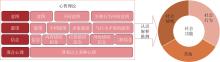
Fig.1
Evaluation framework for machine social cognition"
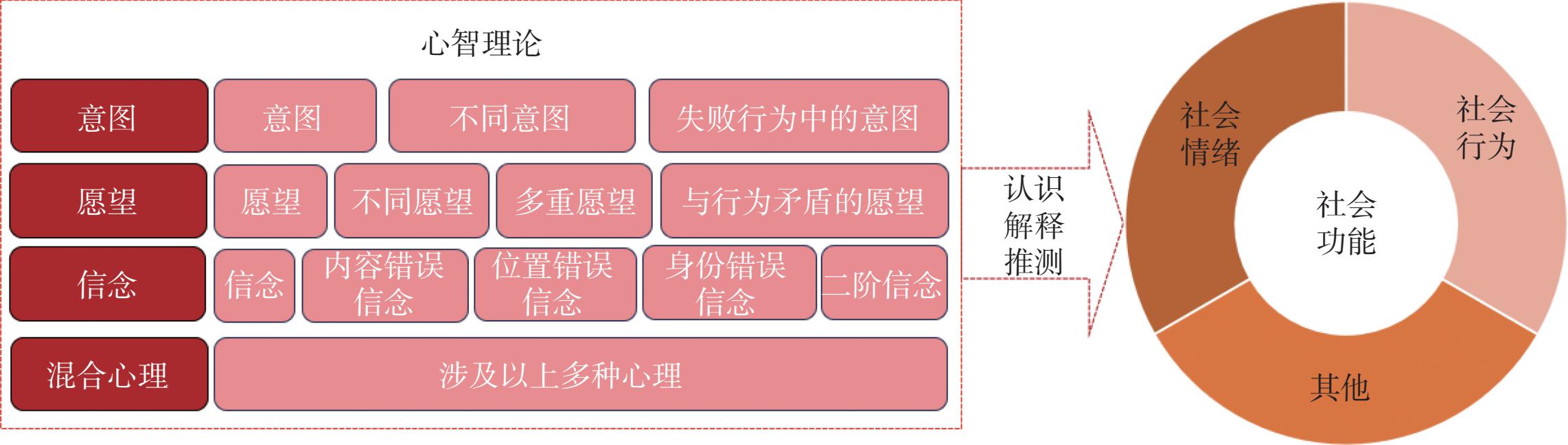

Fig.2
Generating the social cognition question-answering benchmark"
Table 1
Statistical analysis of various benchmark dimensions"
| 心智理论 | 问题数 | 社会功能 | 问题数 | 语言 | 问题数 | 来源 | 问题数 | |||
| 意图 | 社会情绪 | 中文 | 生成 | |||||||
| 愿望 | 社会行为 | 英文 | 爬取 | |||||||
| 信念 | 其他 | |||||||||
| 混合心理 |
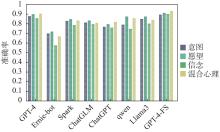
Fig.3
Performance of LLM in different ToM sub-abilities of each model"
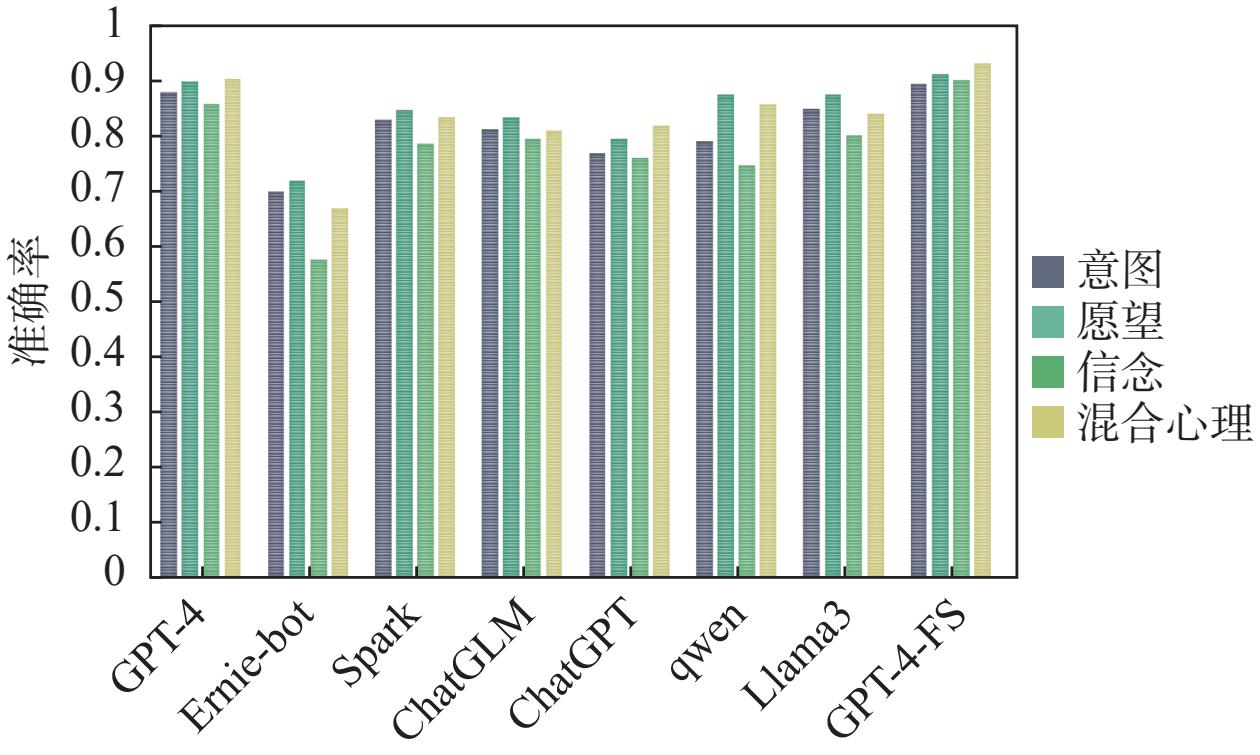
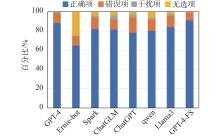
Fig.4
Option preferences of each model"
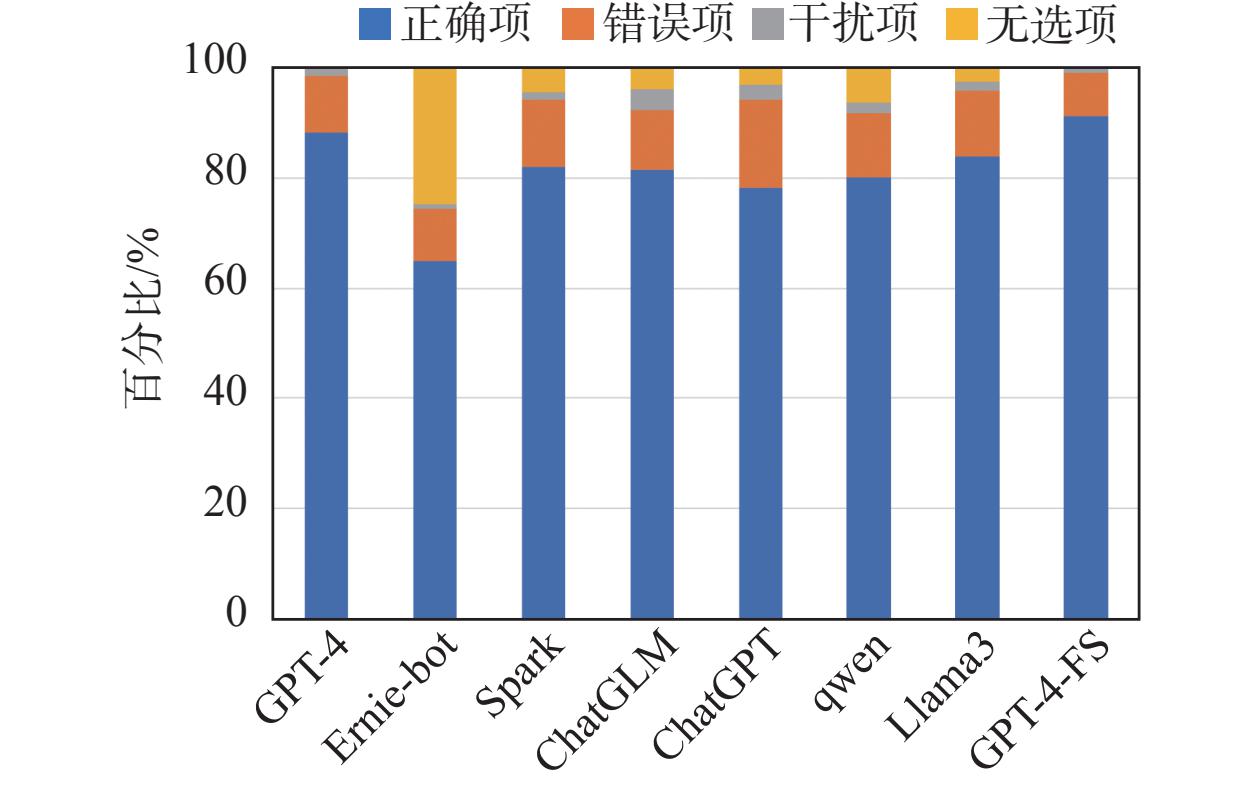
Table 2
Accuracy of LLM on ToM sub-abilities 单位: %"
| LLM | In | DI | IF | De | DD | MD | DC | Be | CFB | LFB | IFB | SB | Mul |
| Ernie-bot | 68.29 | 72.79 | 75.00 | 89.62 | 79.31 | 66.08 | 57.39 | 59.59 | 56.15 | 60.20 | 62.61 | 45.94 | 67.50 |
| Spark | 84.87 | 78.67 | 84.48 | 95.28 | 86.20 | 83.62 | 77.58 | 79.14 | 80.00 | 75.51 | 77.57 | 82.88 | 84.06 |
| ChatGLM | 81.28 | 77.20 | 88.79 | 87.73 | 88.50 | 83.62 | 77.58 | 78.72 | 75.38 | 83.67 | 89.71 | 80.18 | 81.56 |
| ChatGPT | 80.25 | 74.26 | 71.42 | 85.84 | 80.45 | 81.89 | 72.41 | 77.30 | 80.00 | 80.61 | 69.15 | 72.97 | 82.50 |
| GPT-4 | 87.94 | 84.55 | 94.82 | 100 | 93.10 | 86.20 | 84.48 | 88.44 | 84.61 | 82.65 | 87.85 | 79.27 | 90.93 |
| qwen | 78.53 | 81.40 | 80.73 | 100 | 92.41 | 84.26 | 78.50 | 74.87 | 81.60 | 75.28 | 73.73 | 71.15 | 86.49 |
| Llama3 | 84.06 | 80.88 | 95.69 | 100 | 94.25 | 86.09 | 74.78 | 83.70 | 82.03 | 78.57 | 84.11 | 60.00 | 84.74 |
| GPT-4+FS | 90.51 | 85.29 | 93.97 | 100 | 89.66 | 91.38 | 86.21 | 91.34 | 95.35 | 88.78 | 95.33 | 81.08 | 93.75 |
| 平均 | 81.97 | 79.38 | 85.61 | 94.81 | 87.99 | 82.89 | 76.12 | 79.14 | 79.39 | 78.16 | 80.01 | 71.68 | 83.94 |
Table 3
Accuracy of LLM on social function sub-abilities 单位: %"
| LLM | EI | EE | MiE | HE | ME | BI | BE | EL | WL | Hu | Ir |
| Ernie-bot | 74.36 | 55.81 | 72.72 | 60.37 | 53.61 | 75.15 | 64.61 | 56.60 | 61.94 | 77.31 | 39.51 |
| Spark | 86.64 | 80.62 | 88.88 | 77.35 | 74.85 | 86.58 | 79.95 | 83.01 | 82.45 | 88.65 | 75.00 |
| ChatGLM | 86.64 | 75.19 | 79.79 | 74.52 | 72.45 | 85.67 | 84.53 | 73.58 | 81.57 | 78.35 | 66.93 |
| ChatGPT | 84.27 | 79.84 | 76.76 | 86.79 | 71.25 | 83.23 | 76.58 | 71.69 | 78.07 | 77.31 | 68.54 |
| GPT-4 | 96.58 | 84.49 | 90.90 | 86.79 | 81.43 | 92.68 | 87.76 | 70.75 | 92.10 | 94.84 | 77.41 |
| qwen | 92.18 | 81.45 | 92.30 | 78.00 | 64.29 | 83.78 | 77.33 | 68.32 | 83.65 | 87.91 | 70.80 |
| Llama3 | 93.04 | 81.89 | 83.67 | 79.25 | 83.23 | 92.02 | 82.13 | 70.09 | 81.42 | 86.60 | 67.74 |
| GPT-4+FS | 96.89 | 95.35 | 90.90 | 92.45 | 89.22 | 94.51 | 89.74 | 79.25 | 92.10 | 95.88 | 81.45 |
| 平均 | 88.83 | 79.33 | 84.49 | 79.44 | 73.79 | 86.70 | 80.33 | 71.66 | 81.66 | 85.86 | 68.42 |
| 1 | OpenAI, Achiam J, Adler S, et al. GPT-4 technical report [PP/OL]. V6. arXiv (2024-03-04)[2024-10-19]. https://arxiv.org/abs/2303.08774. |
| 2 | Langley C, Cirstea B I, Cuzzolin F, et al.. Theory of mind and preference learning at the interface of cognitive science, neuroscience, and AI: A review. Frontiers in Artificial Intelligence, 2022, 5, 778852. |
| 3 | Wang W S, Wang L T, Zhang C Y, et al.. Social interactions for autonomous driving: A review and perspectives. Foundations and Trends in Robotics, 2022, 10 (3/4): 198- 377. |
| 4 | Premack D, Woodruff G.. Does the chimpanzee have a theory of mind?. Behavioral and Brain Sciences, 1978, 1 (4): 515- 526. |
| 5 | Grant E, Nematzadeh A, Griffiths T L. How can memory-augmented neural networks pass a false-belief task? [C]//Proceedings of the Annual Meeting of the Cognitive Science Society. 2017, 39: 427-432. |
| 6 | Le M, Boureau Y L, Nickel M. Revisiting the evaluation of theory of mind through question answering [C]//Proceedings of the 2019 Conference on Empirical Methods in Natural Language Processing and the 9th International Joint Conference on Natural Language Processing (EMNLP-IJCNLP). Association for Computational Linguistics, 2019: 5872-5877. |
| 7 | Nematzadeh A, Burns K, Grant E, et al. Evaluating theory of mind in question answering [PP/OL]. arXiv (2018-08-28)[2024-10-19]. https://arxiv.org/abs/1808.09352. |
| 8 | Bubeck S, Chandrasekaran V, Eldan R, et al. Sparks of artificial general intelligence: Early experiments with GPT-4 [PP/OL]. V5. arXiv (2023-04-13)[2024-10-19]. https://arxiv.org/abs/2303.12712. |
| 9 | Kosinski M. Evaluating large language models in theory of mind tasks [PP/OL]. V7. arXiv (2023-02-04)[2024-10-19]. https://arxiv.org/abs/2302.02083. |
| 10 | Trott S, Jones C, Chang T, et al.. Do large language models know what humans know?. Cognitive Science, 2023, 47 (7): e13309. |
| 11 | Baron-Cohen S, Leslie A M, Frith U.. Does the autistic child have a “theory of mind”?. Cognition, 1985, 21 (1): 37- 46. |
| 12 | Perner J, Wimmer H.. “John thinks that Mary thinks that…” attribution of second-order beliefs by 5- to 10-year-old children. Journal of Experimental Child Psychology, 1985, 39 (3): 437- 471. |
| 13 | Bennett M, Galpert L.. Children’s understanding of multiple desires. International Journal of Behavioral Development, 1993, 16 (1): 15- 33. |
| 14 | Repacholi B M, Gopnik A.. Early reasoning about desires: Evidence from 14- and 18-month-olds. Developmental Psychology, 1997, 33 (1): 12- 21. |
| 15 | Killen M, Lynn Mulvey K, Richardson C, et al.. The accidental transgressor: morally-relevant theory of mind. Cognition, 2011, 119 (2): 197- 215. |
| 16 | Sap M, Rashkin H, Chen D, et al. Social IQa: commonsense reasoning about social interactions [C]//Proceedings of the 2019 Conference on Empirical Methods in Natural Language Processing and the 9th International Joint Conference on Natural Language Processing (EMNLP-IJCNLP). Association for Computational Linguistics, 2019: 4463-4473. |
| 17 | 毛媛媛, 林欣, 倪琴, 等.. 面向心智理论发展的视频问答研究. 华东师范大学学报(自然科学版), 2025 (6): 46- 52. |
| 18 | Beaudoin C, Leblanc É, Gagner C, et al.. Systematic review and inventory of theory of mind measures for young children. Frontiers in Psychology, 2019, 10, 2905. |
| 19 | Yott J, Poulin-Dubois D.. Are infants’ theory-of-mind abilities well integrated? Implicit understanding of intentions, desires, and beliefs. Journal of Cognition and Development, 2016, 17 (5): 683- 698. |
| 20 | Moghaddam S R, Honey C J. Boosting theory-of-mind performance in large language models via prompting [PP/OL]. V3. arXiv (2023-04-26)[2024-10-19]. https://arxiv.org/abs/2304.11490. |
| [1] | Xinyue LYU, Xinli HUANG. Cold-start problem of federated recommendation systems based on conditional variational autoencoder [J]. J* E* C* N* U* N* S*, 2025, 2025(6): 53-62. |
| [2] | Sijia ZHAO, Fanyu HAN, Wei WANG. Research on the GitHub developer geographic location prediction method based on multi-dimensional feature fusion [J]. J* E* C* N* U* N* S*, 2025, 2025(5): 1-13. |
| [3] | Dexin HE, Fanyu HAN, Wei WANG. Application and evaluation of large language models in open source project topic annotation [J]. J* E* C* N* U* N* S*, 2025, 2025(5): 14-24. |
| [4] | Mingdong YOU, Jiaheng PENG, Fanyu HAN, Wei WANG. A DTA based activity evaluation method for high star GitHub repositories [J]. J* E* C* N* U* N* S*, 2025, 2025(5): 140-150. |
| [5] | Shengyu ZHAO, Wei WANG, Fanyu HAN, Jiaheng PENG, Lan YOU. Open source evaluatology: A framework and methodology for evaluating open source ecosystems based on evaluatology [J]. J* E* C* N* U* N* S*, 2025, 2025(5): 151-161. |
| [6] | Xiaowei CHEN, Wei WANG, Fanyu HAN, Guanglei BAO, Fei DONG, Hao HUO, Chen LIU. OSS Insight: A platform for open source ecosystem spatiotemporal data analysis and insights [J]. J* E* C* N* U* N* S*, 2025, 2025(5): 170-182. |
| [7] | Ruiyang PANG, Xuesong LU. Interactive data structure and algorithm visualization based on AI agents [J]. J* E* C* N* U* N* S*, 2025, 2025(5): 32-42. |
| [8] | Linna XIE, Xuesong LU. Student employment prediction for digital jobs based on behavior in open-source communities [J]. J* E* C* N* U* N* S*, 2025, 2025(5): 87-98. |
| [9] | Yufei FU, Zesong XU, Anhao FENG, Tongquan WEI. Online grant prediction for mobile networks based on traffic perception [J]. J* E* C* N* U* N* S*, 2025, 2025(4): 1-14. |
| [10] | Jiefang CHEN, Chang HUANG. Parallax image mosaic based on matching points and thin plate splines function model optimization [J]. J* E* C* N* U* N* S*, 2025, 2025(4): 15-27. |
| [11] | Xingxing XU, Chang HUANG. Container lock pins recognition based on a self-built dataset with high completeness [J]. J* E* C* N* U* N* S*, 2025, 2025(4): 28-37. |
| [12] | Zheng HU, Chang HUANG. A high robust fast video steganography algorithm in lossy channels [J]. J* E* C* N* U* N* S*, 2025, 2025(4): 38-48. |
| [13] | Jimi HU, Weibing WAN, Feng CHENG, Yuming ZHAO. Rule extraction and reasoning for fusing relation and structure encoding [J]. J* E* C* N* U* N* S*, 2025, 2025(1): 97-110. |
| [14] | Houlong FAN, Ailian FANG, Xin LIN. Knowledge graph completion by integrating textual information and graph structure information [J]. J* E* C* N* U* N* S*, 2025, 2025(1): 111-123. |
| [15] | Yiping LIANG, Luwei XIAO, Linlin WANG. Label-perception augmented causal analysis of mental health over social media [J]. J* E* C* N* U* N* S*, 2025, 2025(1): 124-137. |
| Viewed | ||||||
|
Full text |
|
|||||
|
Abstract |
|
|||||
