
 中文核心期刊
J* E* C* N* U* N* S* ›› 2026, Vol. 2026 ›› Issue (3): 98-109.doi: 10.3969/j.issn.1000-5641.2026.03.008
• Biodiversity and Ecological Responses • Previous Articles Next Articles
Xu LI1, Yuan XU1,2,*( )
)
Received:2024-11-22
Online:2026-05-25
Published:2026-05-27
Contact:
Yuan XU
E-mail:yxu@sklec.ecnu.edu.cn
CLC Number:
Xu LI, Yuan XU. Aquaculture and natural habitats: Comparison of diversity and community structure of benthic ciliates in China’s intertidal zones[J]. J* E* C* N* U* N* S*, 2026, 2026(3): 98-109.
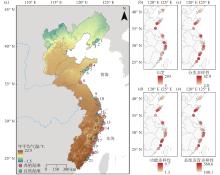
Fig.1
Sampling site locations and distribution of diversity parameters in 21 intertidal mudflats along China's coastal areas"
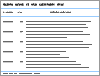
Table 1
Dominant species combinations of benthic ciliate communities in different types of intertidal mudflats"
| 生境 | 优势物种组合 |
| 养殖泥滩 | Holophrya caspica (28.34%)、Blepharisma steini (28.04%)、Holophrya aklitolophon (13.05%)、Prorodon diaphanus (11.24%) |
| 自然泥滩 | Zosterodasys minutus (37.97%)、Holophrya caspica (17.99%)、Holophrya aklitolophon (17.40%) |
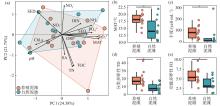
Fig.2
PCA and one-way ANOVA plots of benthic ciliate communities in aquaculture and natural intertidal mudflats"
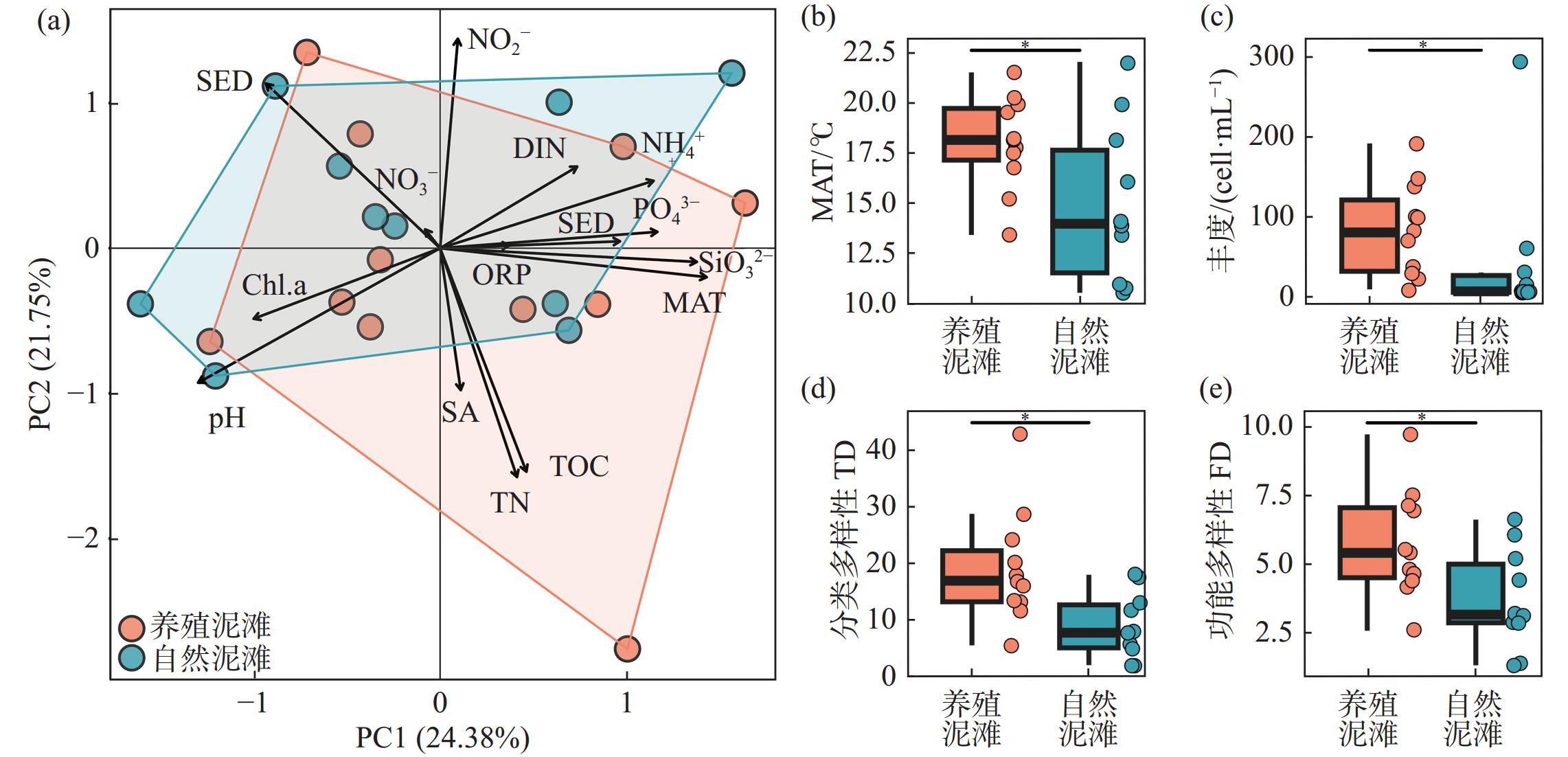
Table 2
Linear regression coefficients of driving factors in linear model"
| 响应变量 | 驱动因子 | 系数 | 标准误差 | 95%置信区间 | p值 |
| 丰度 | PO43– | –0.846 | 0.247 | [–1.36, –0.33] | ** |
| 分类多样性指数TD | MAT | 7.674 | 1.450 | [4.62, 10.73] | *** |
| Chl a | 5.468 | 1.481 | [2.34, 8.59] | ** | |
| NO2– | 4.974 | 1.363 | [2.10, 7.85] | ** | |
| 功能多样性指数FD | MAT | 1.595 | 0.411 | [0.73, 2.46] | ** |
| SiO32– | –0.954 | 0.411 | [–1.82, –0.09] | * | |
| 系统发育多样性指数PD | MAT | 0.286 | 0.105 | [0.07, 0.51] | * |
| SiO32– | –0.266 | 0.105 | [–0.49, –0.05] | * |
Fig.3
Changes in benthic ciliate community abundance, taxonomic diversity, and functional diversity in relation to MAT and latitude in intertidal mudflats"
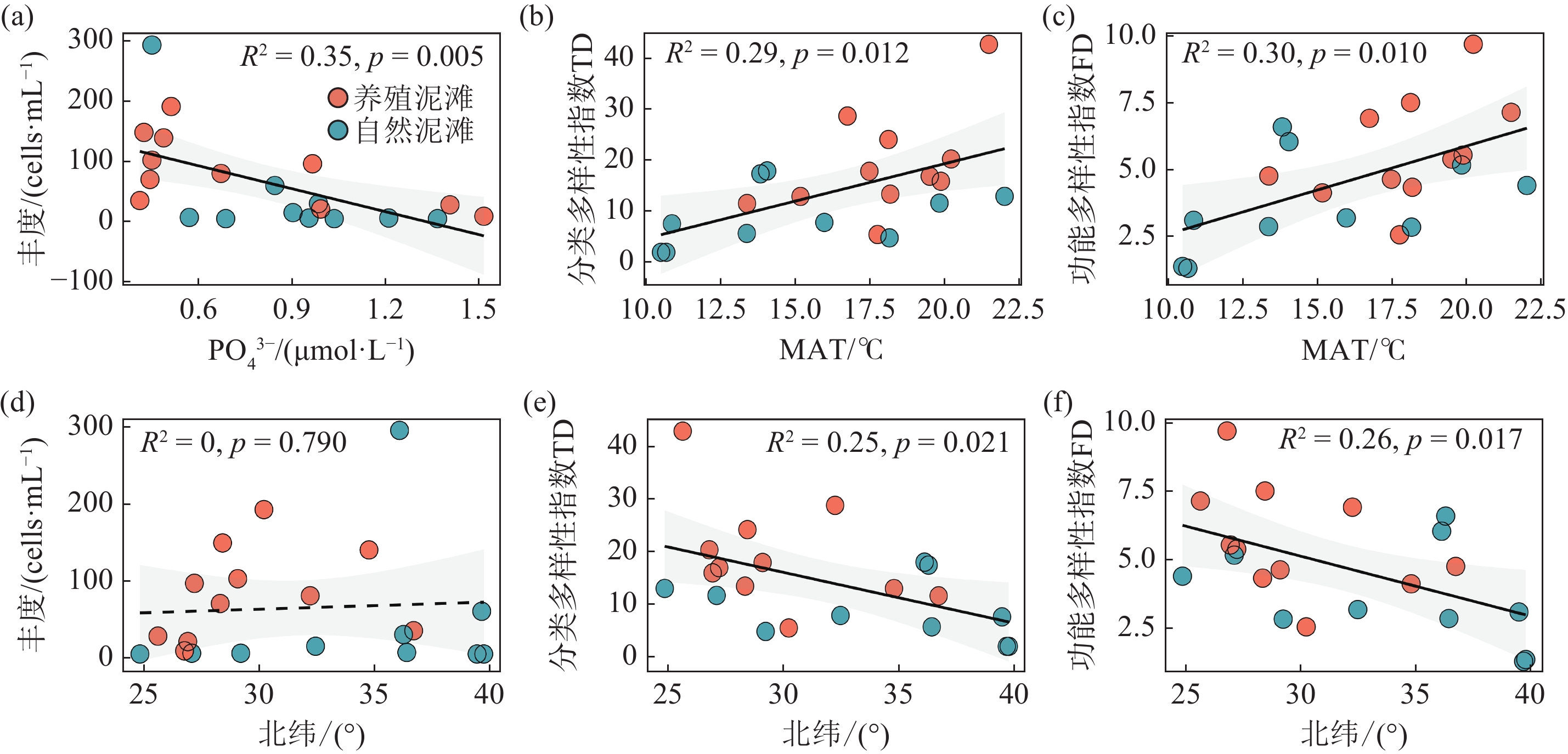
Fig.4
NMDS, PCoA, and VPA analyses of benthic ciliate communities in aquaculture and natural intertidal mudflats"
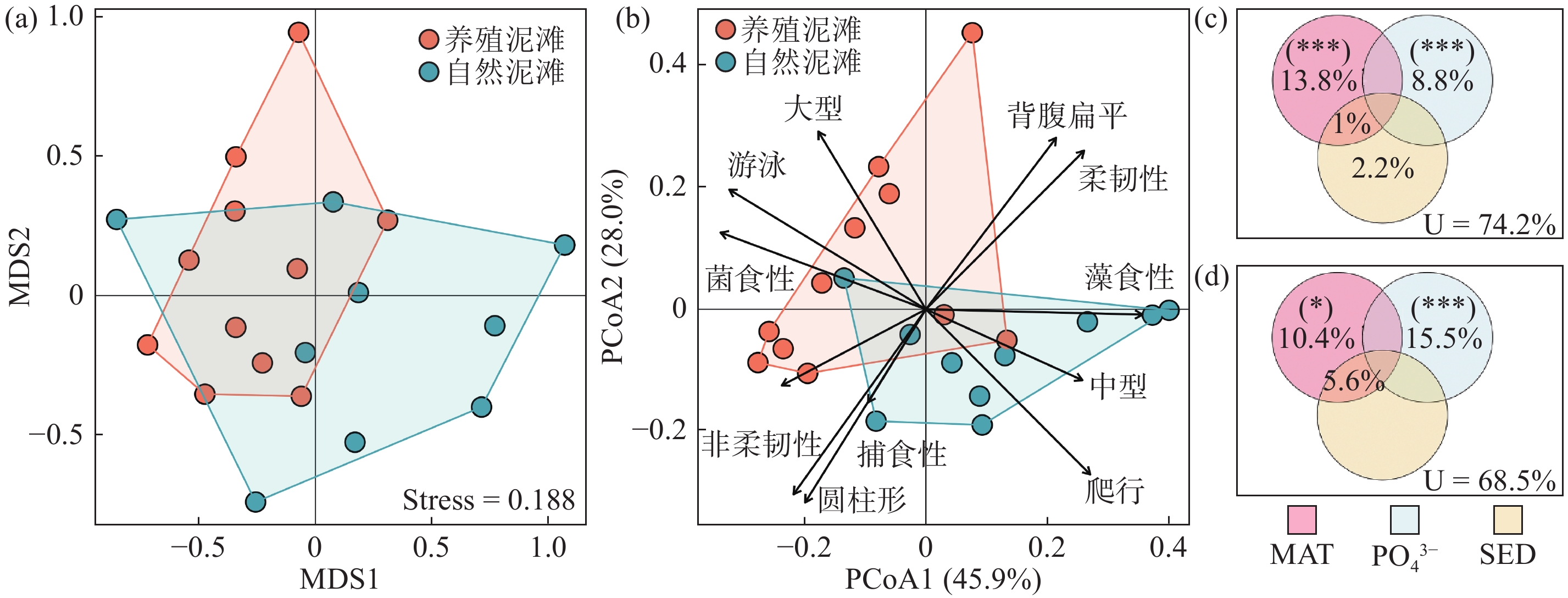
Table 3
dbRDA results for species composition and trait composition of benthic ciliate communities in relation to drivers"
| 组成类型 | 驱动因子 | 单因子解释率/% | AIC值 | Pseudo-F值 | p值 |
| 物种组成 | MAT | 8.1 | 42.093 | 2.754 | *** |
| PO43– | 7.7 | 41.117 | 2.740 | *** | |
| SED | 2.2 | 41.364 | 1.479 | 0.063 | |
| 功能组成 | MAT | 6.7 | 10.488 | 2.428 | * |
| PO43– | 5.6 | 4.617 | ** | ||
| SED | 1.5 | 11.615 | 1.309 | 0.256 |
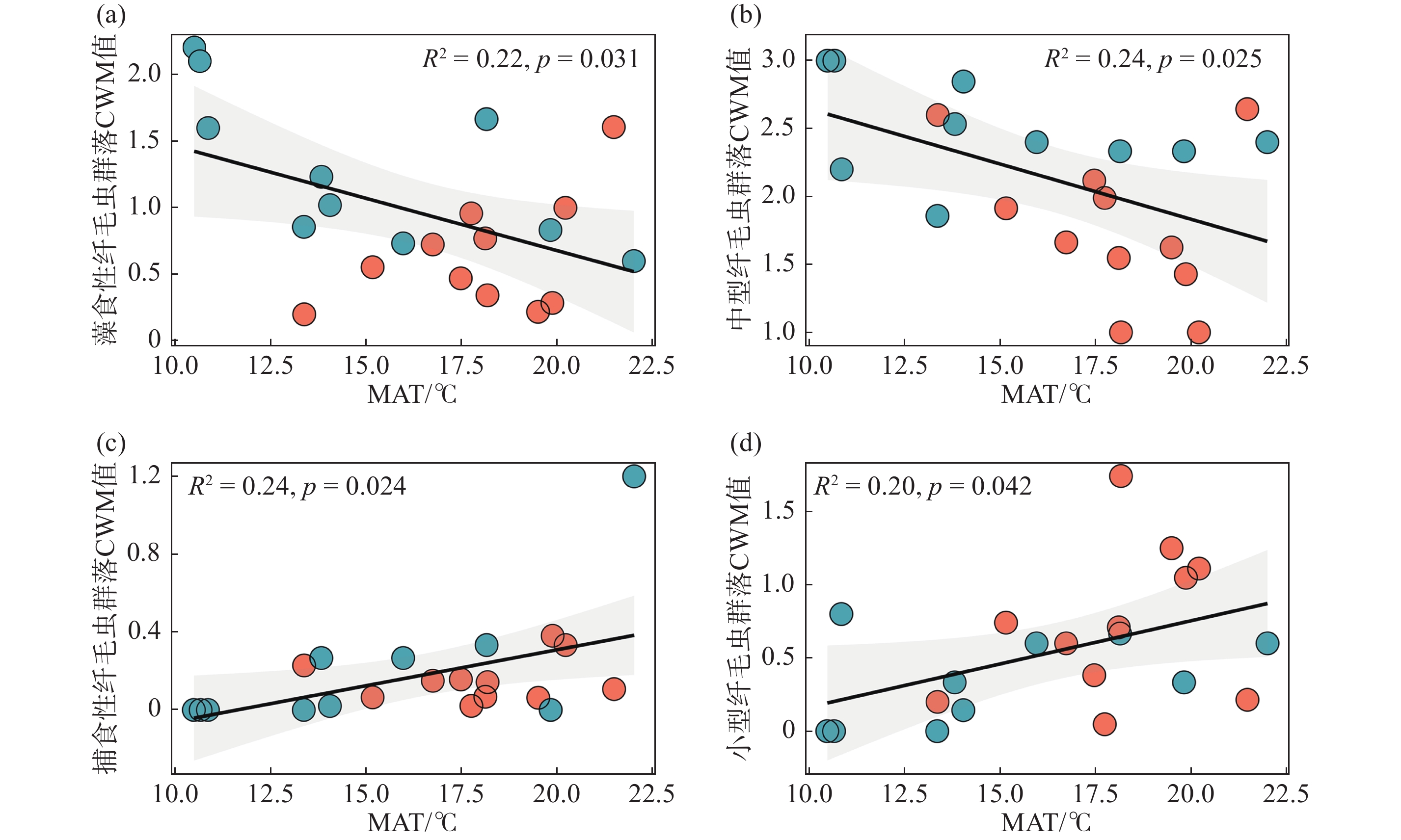
Fig.5
Benthic ciliate community functional traits (algivores, predators, medium size, and small size) in relation to MAT in intertidal mudflats"
| 1 | LEVIN L A, BOESCH D F, COVICH A, et al.. The function of marine critical transition zones and the importance of sediment biodiversity. Ecosystems, 2001, 4 (5): 430- 451. |
| 2 | MARTÍNEZ M L, INTRALAWAN A, VÁZQUEZ G, et al.. The coasts of our world: Ecological, economic and social importance. Ecological Economics, 2007, 63 (2/3): 254- 272. |
| 3 | MURRAY N J, PHINN S R, DEWITT M, et al.. The global distribution and trajectory of tidal flats. Nature, 2019, 565 (7738): 222- 225. |
| 4 | HONG C P, BURNEY J A, PONGRATZ J, et al.. Global and regional drivers of land-use emissions in 1961–2017. Nature, 2021, 589 (7843): 554- 561. |
| 5 | SMALL C, NICHOLLS R J.. A global analysis of human settlement in coastal zones. Journal of Coastal Research, 2003, 19, 584- 599. |
| 6 | WANG X X, XIAO X M, XU X, et al.. Rebound in China’s coastal wetlands following conservation and restoration. Nature Sustainability, 2021, 4 (12): 1076- 1083. |
| 7 | FENG L H, MA Y J.. Evolution of tidal flats in China and ecological exploitation of tidal flat resources. Environmental Earth Sciences, 2012, 67 (6): 1639- 1649. |
| 8 | LONG X H, LIU L P, SHAO T Y, et al.. Developing and sustainably utilize the coastal mudflat areas in China. Science of The Total Environment, 2016, 569, 1077- 1086. |
| 9 | 王丹, 吴反修. 中国渔业统计年鉴2023 [M]. 北京: 中国农业出版社, 2023. |
| 10 | DAVID C P C, STA MARIA Y Y, SIRINGAN F P, et al.. Coastal pollution due to increasing nutrient flux in aquaculture sites. Environmental Geology, 2009, 58 (2): 447- 454. |
| 11 | FARMAKI E G, THOMAIDIS N S, PASIAS I N, et al.. Environmental impact of intensive aquaculture: Investigation on the accumulation of metals and nutrients in marine sediments of Greece. Science of The Total Environment, 2014, 485, 554- 562. |
| 12 | SMITH V H, SCHINDLER D W.. Eutrophication science: Where do we go from here?. Trends in Ecology & Evolution, 2009, 24 (4): 201- 207. |
| 13 | GRALL J, CHAUVAUD L.. Marine eutrophication and benthos: The need for new approaches and concepts. Global Change Biology, 2002, 8 (9): 813- 830. |
| 14 | GAO D Z, LIU M, HOU L J, et al.. Effects of shrimp-aquaculture reclamation on sediment nitrate dissimilatory reduction processes in a coastal wetland of southeastern China. Environmental Pollution, 2019, 255, 113219. |
| 15 | HUANG Y Y, LI Y M, CHEN Q, et al.. Effects of reclamation methods and habitats on macrobenthic communities and ecological health in estuarine coastal wetlands. Marine Pollution Bulletin, 2021, 168, 112420. |
| 16 | BOUCHET V M P, SAURIAU P G.. Influence of oyster culture practices and environmental conditions on the ecological status of intertidal mudflats in the Pertuis Charentais (SW France): A multi-index approach. Marine Pollution Bulletin, 2008, 56 (11): 1898- 1912. |
| 17 | FINLAY B J, CORLISS J O, ESTEBAN G, et al.. Biodiversity at the microbial level: The number of free-living ciliates in the biosphere. The Quarterly Review of Biology, 1996, 71 (2): 221- 237. |
| 18 | ROSSI F, FORSTER R M, MONTSERRAT F, et al.. Human trampling as short-term disturbance on intertidal mudflats: Effects on macrofauna biodiversity and population dynamics of bivalves. Marine Biology, 2007, 151 (6): 2077- 2090. |
| 19 | WEISSE T.. Functional diversity of aquatic ciliates. European Journal of Protistology, 2017, 61, 331- 358. |
| 20 | AZOVSKY A, MAZEI Y.. Do microbes have macroecology? Large-scale patterns in the diversity and distribution of marine benthic ciliates. Global Ecology and Biogeography, 2013, 22 (2): 163- 172. |
| 21 | MIRONOVA E, TELESH I, SKARLATO S.. Diversity and seasonality in structure of ciliate communities in the Neva Estuary (Baltic Sea). Journal of Plankton Research, 2012, 34 (3): 208- 220. |
| 22 | STOECK T, KOCHEMS R, FORSTER D, et al.. Metabarcoding of benthic ciliate communities shows high potential for environmental monitoring in salmon aquaculture. Ecological Indicators, 2018, 85, 153- 164. |
| 23 | XU Y, FAN X P, WARREN A, et al.. Functional diversity of benthic ciliate communities in response to environmental gradients in a wetland of Yangtze Estuary, China. Marine Pollution Bulletin, 2018, 127, 726- 732. |
| 24 | ZHANG J W, CHEN X Y, SOETAERT K, et al.. The relative roles of multiple drivers on benthic ciliate communities in an intertidal zone. Marine Pollution Bulletin, 2023, 187, 114510. |
| 25 | XU Y, SOININEN J, ZHANG S K, et al.. Disentangling the relative roles of natural and anthropogenic-induced stressors in shaping benthic ciliate diversity in a heavily disturbed bay. Science of the Total Environment, 2021, 801, 149683. |
| 26 | MU H W, LI X C, WEN Y N, et al.. A global record of annual terrestrial Human Footprint dataset from 2000 to 2018. Scientific Data, 2022, 9, 176. |
| 27 | SANDERSON E W, JAITEH M, LEVY M A, et al.. The human footprint and the last of the wild: The human footprint is a global map of human influence on the land surface, which suggests that human beings are stewards of nature, whether we like it or not. BioScience, 2002, 52 (10): 891- 904. |
| 28 | VENTER O, SANDERSON E W, MAGRACH A, et al.. Global terrestrial human footprint maps for 1993 and 2009. Scientific Data, 2016, 3, 160067. |
| 29 | 类彦立, 徐奎栋. 海洋微型底栖生物调查规范: HY/T140–2011 [S]. 北京: 中国标准出版社, 2011. |
| 30 | 王苗勋, 许媛.. 甲醛与戊二醛固定剂对基于Ludox–QPS染色方法的研究结果对比. 华东师范大学学报(自然科学版), 2022 (3): 82- 89. |
| 31 | 宋微波, 沃伦 A, 胡晓钟. 中国黄渤海的自由生纤毛虫 [M]. 北京: 科学出版社, 2009. |
| 32 | LYNN D H. The Ciliated Protozoa: Characterization, Classification and Guide to the Literature[M]. 3rd ed. Dordrecht, Netherlands: Springer, 2008. |
| 33 | 范鑫鹏, 潘旭明. 中国盾纤亚纲和咽膜亚纲纤毛虫 [M]. 北京: 科学出版社, 2020. |
| 34 | XU Y, SOININEN J.. Spatial patterns of functional diversity and composition in marine benthic ciliates along the coast of China. Marine Ecology Progress Series, 2019, 627, 49- 60. |
| 35 | GARNIER E, CORTEZ J, BILLÈS G, et al.. Plant functional markers capture ecosystem properties during secondary succession. Ecology, 2004, 85 (9): 2630- 2637. |
| 36 | CLARKE K R, WARWICK R M.. A taxonomic distinctness index and its statistical properties. Journal of Applied Ecology, 1998, 35 (4): 523- 531. |
| 37 | LI Z F, HEINO J, LIU Z Y, et al.. The drivers of multiple dimensions of stream macroinvertebrate beta diversity across a large montane landscape. Limnology and Oceanography, 2021, 66 (1): 226- 236. |
| 38 | 何书金, 王仰麟, 罗明, 等. 中国典型地区沿海滩涂资源开发 [M]. 北京: 科学出版社, 2005. |
| 39 | HU M J, SARDANS J, YAN R B, et al.. Substantial increase in P release following conversion of coastal wetlands to aquaculture ponds from altered kinetic exchange and resupply capacity. Water Research, 2023, 230, 119586. |
| 40 | LIN S Y, ZHOU Y X, WANG W Q, et al.. Losses and destabilization of soil organic carbon stocks in coastal wetlands converted into aquaculture ponds. Global Change Biology, 2024, 30 (9): e17480. |
| 41 | WU H, PENG R H, YANG Y, et al.. Mariculture pond influence on mangrove areas in South China: Significantly larger nitrogen and phosphorus loadings from sediment wash-out than from tidal water exchange. Aquaculture, 2014, 426, 204- 212. |
| 42 | SIDIK F, KUSUMA D W, PRIYONO B, et al. Managing sediment dynamics through reintroduction of tidal flow for mangrove restoration in abandoned aquaculture ponds [M]// Dynamic Sedimentary Environments of Mangrove Coasts. Amsterdam: Elsevier, 2021: 563-582. |
| 43 | MONTANI S, MAGNI P, SHIMAMOTO M, et al.. The effect of a tidal cycle on the dynamics of nutrients in a tidal estuary in the Seto Inland Sea, Japan. Journal of Oceanography, 1998, 54 (1): 65- 76. |
| 44 | FINDLAY S, FISCHER D.. Ecosystem attributes related to tidal wetland effects on water quality. Ecology, 2013, 94 (1): 117- 125. |
| 45 | WILSON A M, MORRIS J T.. The influence of tidal forcing on groundwater flow and nutrient exchange in a salt marsh-dominated estuary. Biogeochemistry, 2012, 108 (1): 27- 38. |
| 46 | GIMMLER A, KORN R, DE VARGAS C, et al.. The Tara Oceans voyage reveals global diversity and distribution patterns of marine planktonic ciliates. Scientific Reports, 2016, 6, 33555. |
| 47 | WEISSE T, KARSTENS N, MEYER V, et al.. Niche separation in common prostome freshwater ciliates: The effect of food and temperature. Aquatic Microbial Ecology, 2001, 26, 167- 179. |
| 48 | CLARKE A, FRASER K P P.. Why does metabolism scale with temperature?. Functional Ecology, 2004, 18 (2): 243- 251. |
| 49 | FUHRMAN J A, STEELE J A, HEWSON I, et al.. A latitudinal diversity gradient in planktonic marine bacteria. Proceedings of the National Academy of Sciences of the United States of America, 2008, 105 (22): 7774- 7778. |
| 50 | FINLAY B J.. The dependence of reproductive rate on cell size and temperature in freshwater ciliated protozoa. Oecologia, 1977, 30 (1): 75- 81. |
| 51 | WEISSE T.. Physiological mortality of planktonic ciliates: Estimates, causes, and consequences. Limnology and Oceanography, 2024, 69 (3): 524- 532. |
| 52 | BROWN J H.. Why are there so many species in the tropics?. Journal of Biogeography, 2014, 41 (1): 8- 22. |
| 53 | KISSLING W D, SEKERCIOGLU C H, JETZ W.. Bird dietary guild richness across latitudes, environments and biogeographic regions. Global Ecology and Biogeography, 2012, 21 (3): 328- 340. |
| 54 | SLATYER R A, HIRST M, SEXTON J P.. Niche breadth predicts geographical range size: A general ecological pattern. Ecology Letters, 2013, 16 (8): 1104- 1114. |
| 55 | SI X F, CADOTTE M W, ZENG D, et al.. Functional and phylogenetic structure of island bird communities. Journal of Animal Ecology, 2017, 86 (3): 532- 542. |
| 56 | 王善, 沈卓, 王庆, 等.. 汕头南澳海域不同养殖区浮游纤毛虫群落结构的比较. 生态学杂志, 2015, 34 (8): 2215- 2221. |
| 57 | LI J Q, XU H L, LIN X F, et al.. Colonization of periphytic ciliated protozoa on an artificial substrate in mariculture waters with notes on responses to environmental factors. Progress in Natural Science, 2009, 19 (10): 1235- 1240. |
| 58 | JACOBS P, RIEGMAN R, VAN DER MEER J.. Impact of introduced juvenile mussel cultures on the pelagic ecosystem of the western Wadden Sea, The Netherlands. Aquaculture Environment Interactions, 2016, 8, 553- 566. |
| 59 | LANGENHEDER S, RAGNARSSON H.. The role of environmental and spatial factors for the composition of aquatic bacterial communities. Ecology, 2007, 88 (9): 2154- 2161. |
| 60 | VERLEYEN E, VYVERMAN W, STERKEN M, et al.. The importance of dispersal related and local factors in shaping the taxonomic structure of diatom metacommunities. Oikos, 2009, 118 (8): 1239- 1249. |
| 61 | JYRKÄNKALLIO-MIKKOLA J, MEIER S, HEINO J, et al.. Disentangling multi-scale environmental effects on stream microbial communities. Journal of Biogeography, 2017, 44 (7): 1512- 1523. |
| 62 | SAMUELSSON K, BERGLUND J, ANDERSSON A.. Factors structuring the heterotrophic flagellate and ciliate community along a brackish water primary production gradient. Journal of Plankton Research, 2006, 28 (4): 345- 359. |
| 63 | HEINO J, TOLKKINEN M, PIRTTILÄ A M, et al.. Microbial diversity and community–environment relationships in boreal streams. Journal of Biogeography, 2014, 41 (12): 2234- 2244. |
| 64 | GRIGOROPOULOU A, SCHMIDT-KLOIBER A, MÚRRIA C.. Incongruent latitudinal patterns of taxonomic, phylogenetic and functional diversity reveal different drivers of caddisfly community assembly across spatial scales. Global Ecology and Biogeography, 2022, 31 (5): 1006- 1020. |
| 65 | SOININEN J, JAMONEAU A, ROSEBERY J, et al.. Global patterns and drivers of species and trait composition in diatoms. Global Ecology and Biogeography, 2016, 25 (8): 940- 950. |
| 66 | ATKINSON D, CIOTTI B J, MONTAGNES D J S.. Protists decrease in size linearly with temperature: ca. 2.5%℃–1. Proceedings of the Royal Society of London Series B: Biological Sciences, 2003, 270 (1533): 2605- 2611. |
| [1] | Xiao SUN. Deodorization performance and microbial mechanisms of sludge-char packed biological trickling filter [J]. J* E* C* N* U* N* S*, 2026, 2026(1): 99-109. |
| [2] | Qin JIN, Chuwen QIU, Xincheng YUAN. Study on bacterial community structure in the intestine of Litopenaeus vannamei and its cultivation environment [J]. J* E* C* N* U* N* S*, 2025, 2025(4): 104-113. |
| [3] | Miaoxun WANG, Yuan XU. Comparison of the fixation effect of formaldehyde and glutaraldehyde on the Ludox–QPS method [J]. Journal of East China Normal University(Natural Science), 2022, 2022(3): 82-89. |
| [4] | YU Chen-di, HOU Li-jun, ZHENG Yan-ling, LIU Min, YIN Guo-yu, GAO Juan, LIU Cheng, CHANG Yong-kai. Community structure and gene expression analysis for nitrifier enrichment cultures [J]. Journal of East China Normal University(Natural Sc, 2019, 2019(3): 164-173. |
| [5] | LUO Zu-kui, LI Yang, LIU Wen, LI Xing-yuan. Differences in biodiversity of diurnal and nocturnal waterbirds between natural and artificial wetlands: A case study from Caohai Nature Reserve and Yangwanqiao Reservoir, Guizhou Province [J]. Journal of East China Normal University(Natural Sc, 2019, 2019(3): 120-130. |
| [6] | WANG Chun-ye, ZHOU Bin, DING Xiao-dong, HUANG Bei. Effects of reclamation on phytoplankton community structure and biodiversity in Jiaojiang Estuary [J]. Journal of East China Normal University(Natural Sc, 2014, 2014(4): 141-153,179. |
| [7] | KANG Meng, XIE Yi-ming, XU Yue, XU Yi-lu, YAN En-rong. Within-community variability of plant leaf N and P contents in Tiantong, Zhejiang Province [J]. Journal of East China Normal University(Natural Sc, 2013, 2013(2): 20-29, 49. |
| [8] | LUO Zu-kui, LIU Wen, LI Zhen-ji, MA Guan-wei, PAN Juan. Characteristics of the avian community in winter in Caohai of Guizhou Province, China [J]. Journal of East China Normal University(Natural Sc, 2012, 2012(4): 102-111. |
| [9] | FENG De-xiang, LIU Yi, YU Na, CHEN Liang, LI Er-chao, CHEN Li-qiao. Study on meta-zooplankton community structure of Dianshan Lake [J]. Journal of East China Normal University(Natural Sc, 2011, 2011(6): 122-131. |
| [10] | BAO Fang-yin, WANG Song, ZHANG Tao, WANG Bang-zheng, CUI Feng. Community structure and biodiversity of birds in Tuohu Nature Reserve, Anhui Province [J]. Journal of East China Normal University(Natural Sc, 2011, 2011(4): 124-133. |
| [11] | ZHANG Kai-xuan, CHE Sheng-quan, MA Shao-chu,WANG Rui, DA Liang-jun. Diversity, spatial pattern and dynamics of vegetation under urbanization in Shanghai (Ⅵ): Community diversity and its structural characteristics of Shanghai Green Belt [J]. Journal of East China Normal University(Natural Sc, 2011, 2011(4): 1-14,74. |
| [12] | SHANG Kan-kan;WANG Jie;YU Qian;ZHAO Ming-shui;DA Liang-jun-. Tertiary relict plant Liquidambar acalycina Chang on Mt. Tianmu in Eastern China: Characteristics of the community and the ecological significance [J]. Journal of East China Normal University(Natural Sc, 2011, 2011(3): 134-144. |
| [13] | CHEN Liang;LIU Yi;YU Na;FENG Deng-xiang;LI Er-chao;JIA Yong-yi;CHEN Li-qiao. Preliminary study on the metazoan zooplankton community structure of Fenshuijiang Reservoir and water quality assessment [J]. Journal of East China Normal University(Natural Sc, 2010, 2010(6): 72-82. |
| [14] | YANG Hong;WANG Yi-pin;BO Fang-fang;JIANG Yue;YOU Wen-hui;. Preliminary study on spatial and temporal variations of phytoplankton community in Lake Dianshan [J]. Journal of East China Normal University(Natural Sc, 2010, 2010(6): 54-63. |
| [15] | CHEN Bin-lin;FANG Tao;LI Dao-ji . Community structure and biodiversity characteristics of macrobenthos off coast of Lianyungang(Chinese) [J]. Journal of East China Normal University(Natural Sc, 2007, 2007(2): 1-10. |
| Viewed | ||||||
|
Full text |
|
|||||
|
Abstract |
|
|||||
