
 中文核心期刊
J* E* C* N* U* N* S* ›› 2026, Vol. 2026 ›› Issue (3): 110-123.doi: 10.3969/j.issn.1000-5641.2026.03.009
• Biodiversity and Ecological Responses • Previous Articles Next Articles
Pengquan ZHONG1, Wei WANG2, Jiawei ZHANG1,2, Xu LI1, Ziqing ZHOU1, Miaoxun WANG1, Yuan XU1,3,*( )
)
Received:2025-01-15
Accepted:2025-11-02
Online:2026-05-25
Published:2026-05-27
Contact:
Yuan XU
E-mail:yxu@sklec.ecnu.edu.cn
CLC Number:
Pengquan ZHONG, Wei WANG, Jiawei ZHANG, Xu LI, Ziqing ZHOU, Miaoxun WANG, Yuan XU. Effects of the ecological restoration project in the coastal wetlands of the Yangtze River Estuary on benthic ciliate communities[J]. J* E* C* N* U* N* S*, 2026, 2026(3): 110-123.
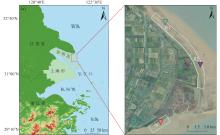
Fig.1
Sampling sites on Chongming Dongtan of the Yangtze River Estuary"
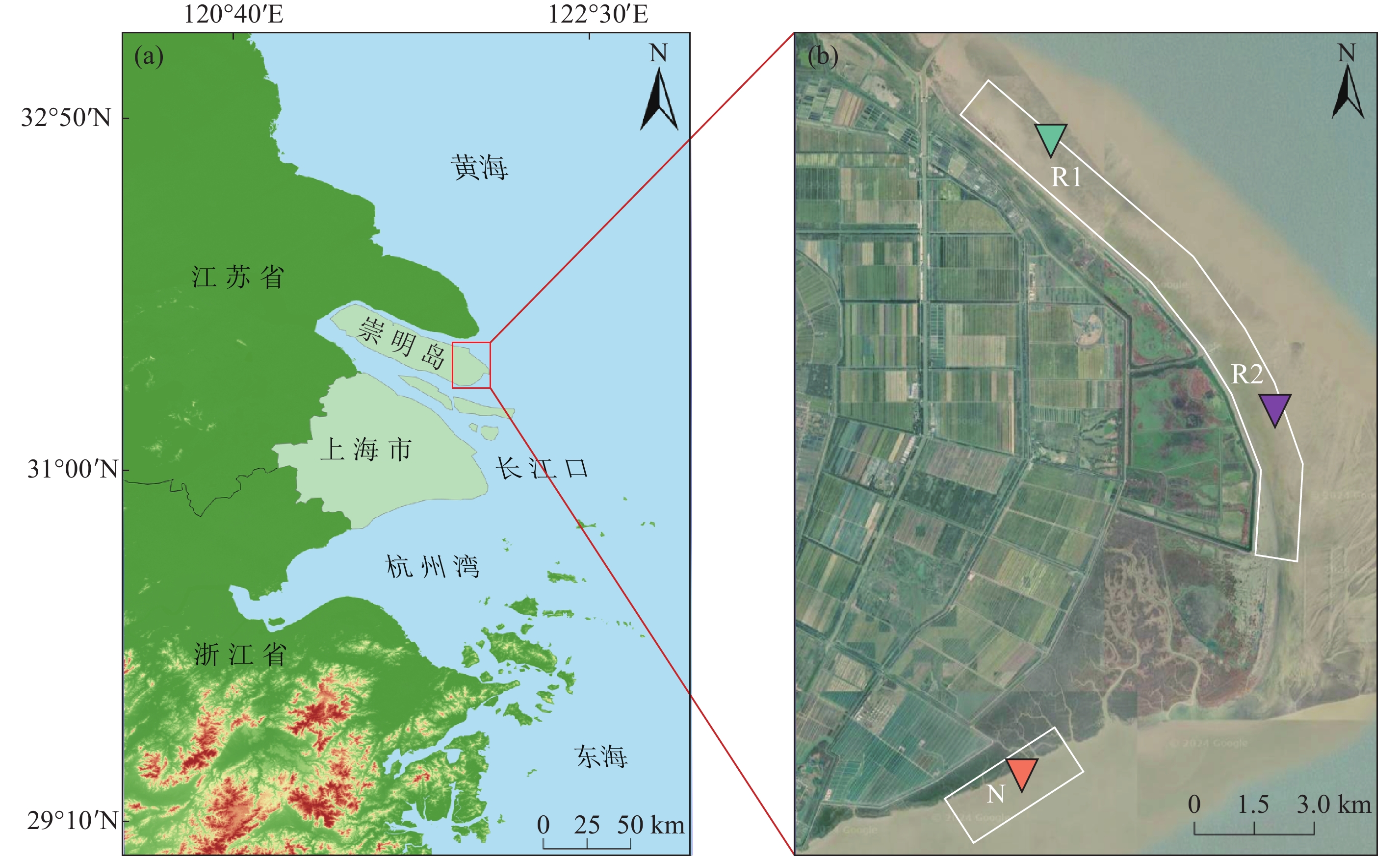
Table 1
Units, means, standard deviations and ranges of all environmental variables measured in Chongming Dongtan"
| 区域 | 盐度/‰ | SED/μm | TOC/% | TN/% | ORP/mV | |||||||||
| 平均值± 标准差 | 范围 | 平均值± 标准差 | 范围 | 平均值± 标准差 | 范围 | 平均值± 标准差 | 范围 | 平均值± 标准差 | 范围 | |||||
| 修复区 | 13±6 | 5~23 | 18.34±9.18 | 5.09~34.85 | 0.75±0.40 | 0.14~1.39 | 0.10±0.05 | 0.03~0.20 | 406.64±67.80 | 203.70~534.00 | ||||
| 天然区 | 3±5 | 0~13 | 43.01±8.36 | 24.16~53.53 | 0.12±0.08 | 0.07~0.41 | 0.03±0.01 | 0.02~0.06 | 430.02±66.58 | 306.30~593.80 | ||||
| 区域 | pH | Chl a/(μg/g) | BA/(109 ind/mL) | MEB/(μg C/mL) | NH4+/(μmol/L) | |||||||||
| 平均值± 标准差 | 范围 | 平均值± 标准差 | 范围 | 平均值± 标准差 | 范围 | 平均值± 标准差 | 范围 | 平均值± 标准差 | 范围 | |||||
| 修复区 | 7.88±0.45 | 7.05~9.07 | 5.33±2.27 | 1.23~10.52 | 1.65±0.75 | 0.49~3.35 | 51.48±28.6 | 9.48~157.56 | 28.36±31.57 | 2.95~144.75 | ||||
| 天然区 | 8.32±0.60 | 7.45~9.45 | 3.76±1.95 | 0.92~7.40 | 1.75±0.81 | 0.40~3.60 | 40.59±25.11 | 13.55~136.63 | 3.23±2.65 | 0.02~10.30 | ||||
| 区域 | NO3–/(μmol/L) | NO2–/(μmol/L) | PO43–/(μmol/L) | SiO32–/(μmol/L) | ||||||||||
| 平均值± 标准差 | 范围 | 平均值± 标准差 | 范围 | 平均值± 标准差 | 范围 | 平均值± 标准差 | 范围 | |||||||
| 修复区 | 10.16±14.19 | 0.13~42.06 | 0.96±1.24 | 0.05~4.85 | 1.48±1.53 | 0.20~9.37 | 68.63±37.08 | 2.40~121.02 | ||||||
| 天然区 | 40.74±33.32 | 0.32~86.05 | 0.86±0.67 | 0.04~2.24 | 0.92±0.44 | 0.38~1.80 | 91.98±42.61 | 40.79~150.82 | ||||||
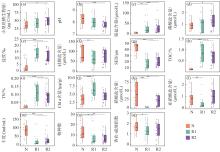
Fig.2
Comparisons of selected environmental factors and α diversity of benthic ciliate communities"
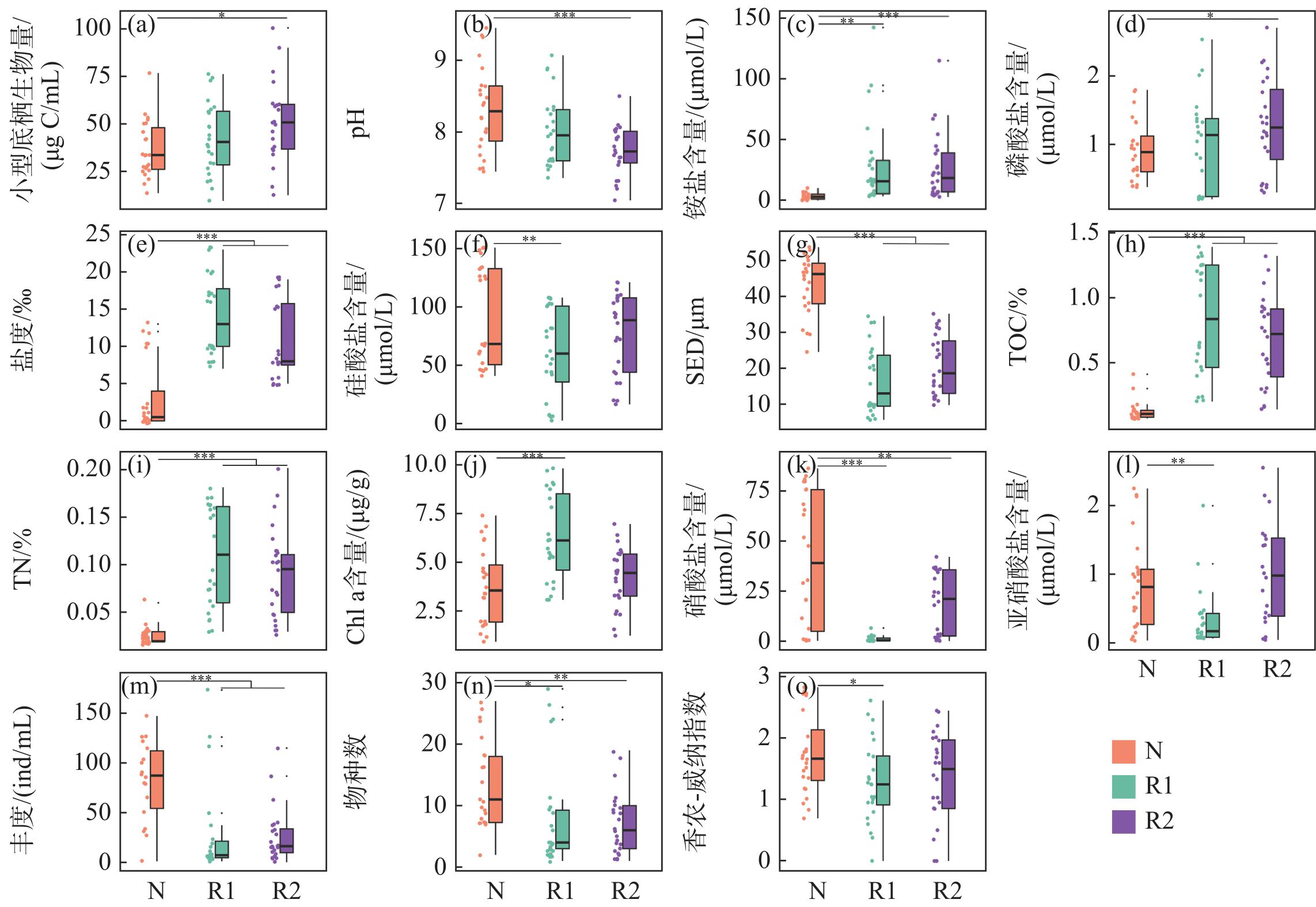
Table 2
Effects of season and area on environmental variables and biodiversity (ANOVA)"
| 参数 | p值 (显著性) | |
| 区域 | 季节 | |
| 盐度 | *** | *** |
| SED | *** | ** |
| TOC含量 | *** | *** |
| TN含量 | *** | *** |
| ORP | *** | |
| pH | ** | *** |
| Chl a含量 | *** | *** |
| BA | *** | |
| MEB | * | * |
| NH4+含量 | ** | |
| NO3–含量 | *** | *** |
| NO2–含量 | *** | |
| PO43–含量 | ** | |
| SiO32–含量 | * | *** |
| 物种数 | ** | *** |
| 丰度 | ** | ** |
| 香农-威纳指数 | * | ** |
Fig.3
Ordination of environmental factors by PCA"
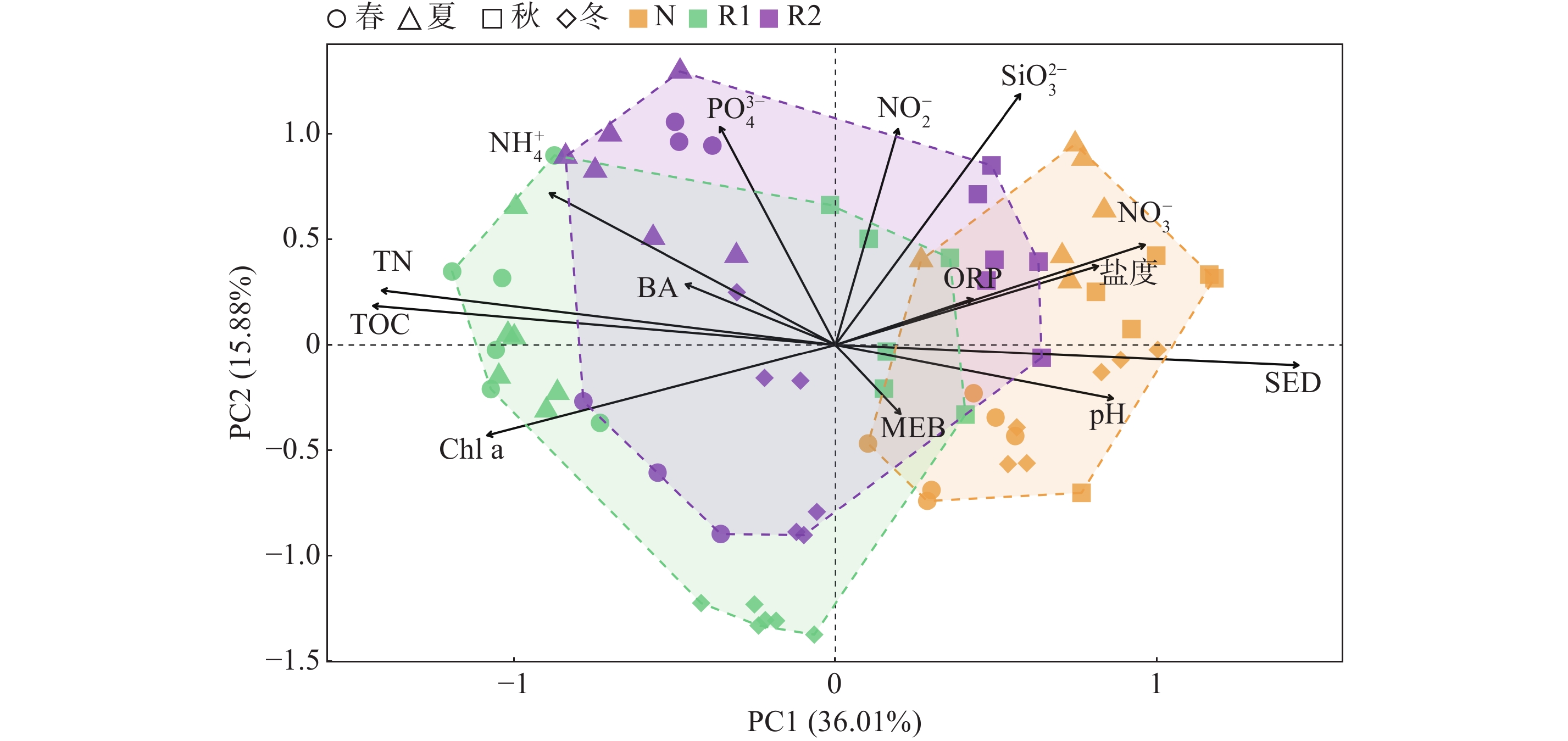
Fig.4
Composition of the benthic ciliate community"
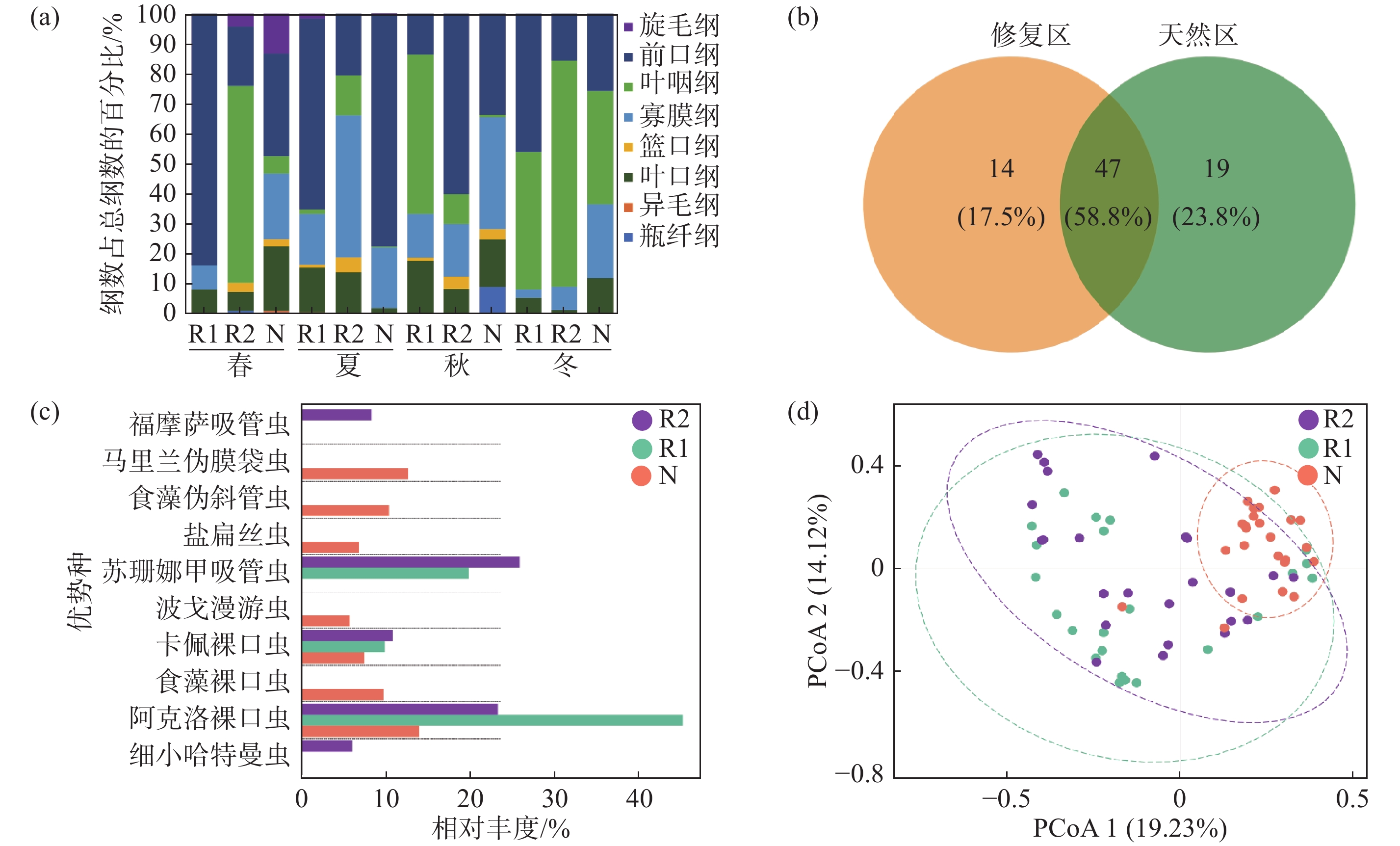
Table 3
Dominant species groups of the benthic ciliate community"
| 类型 | 样点 | 优势物种组合 |
| 修复区 | R1 | 阿克洛裸口虫(Holophrya aklitolophon) (45.12%), 苏珊娜甲吸管虫(Loricophrya susannae) (19.74%), 卡佩裸口虫(Holophrya caspica) (9.79%) |
| R2 | 苏珊娜甲吸管虫 (25.79%), 阿克洛裸口虫 (23.21%), 卡佩裸口虫 (10.73%), 福摩萨吸管虫(Thecacineta fumosae) (8.26%), 细小哈特曼虫(Hartmannula angustipilosa) (5.93%) | |
| 天然区 | N | 阿克洛裸口虫 (13.85%), 马里兰伪膜袋虫(Pseudocyclidium marylandi) (12.58%), 食藻伪斜管虫(Pseudochilodonopsis algivora) (10.31%), 食藻裸口虫(Holophrya alviolata) (9.67%), 卡佩裸口虫 (7.37%), 盐扁丝虫(Platynematum salinarum) (6.76%), 波戈漫游虫(Litonotus bergeri) (5.65%) |
Table 4
Bioenv analysis of the relationship between ciliate species composition and environmental factors"
| 环境因子组合 | 环境变量数 | 相关性 |
| 盐度、PO43–含量、MEB、pH、ORP | 5 | 0.394 |
| 盐度、MEB、pH、ORP | 4 | 0.387 |
| 盐度、PO43–含量、MEB、pH | 4 | 0.379 |
| 盐度、MEB、pH | 3 | 0.377 |
| 盐度、PO43–含量、MEB、ORP | 4 | 0.375 |
Fig.5
Pearson correlation analysis of environmental factors and α diversity of ciliate communities"
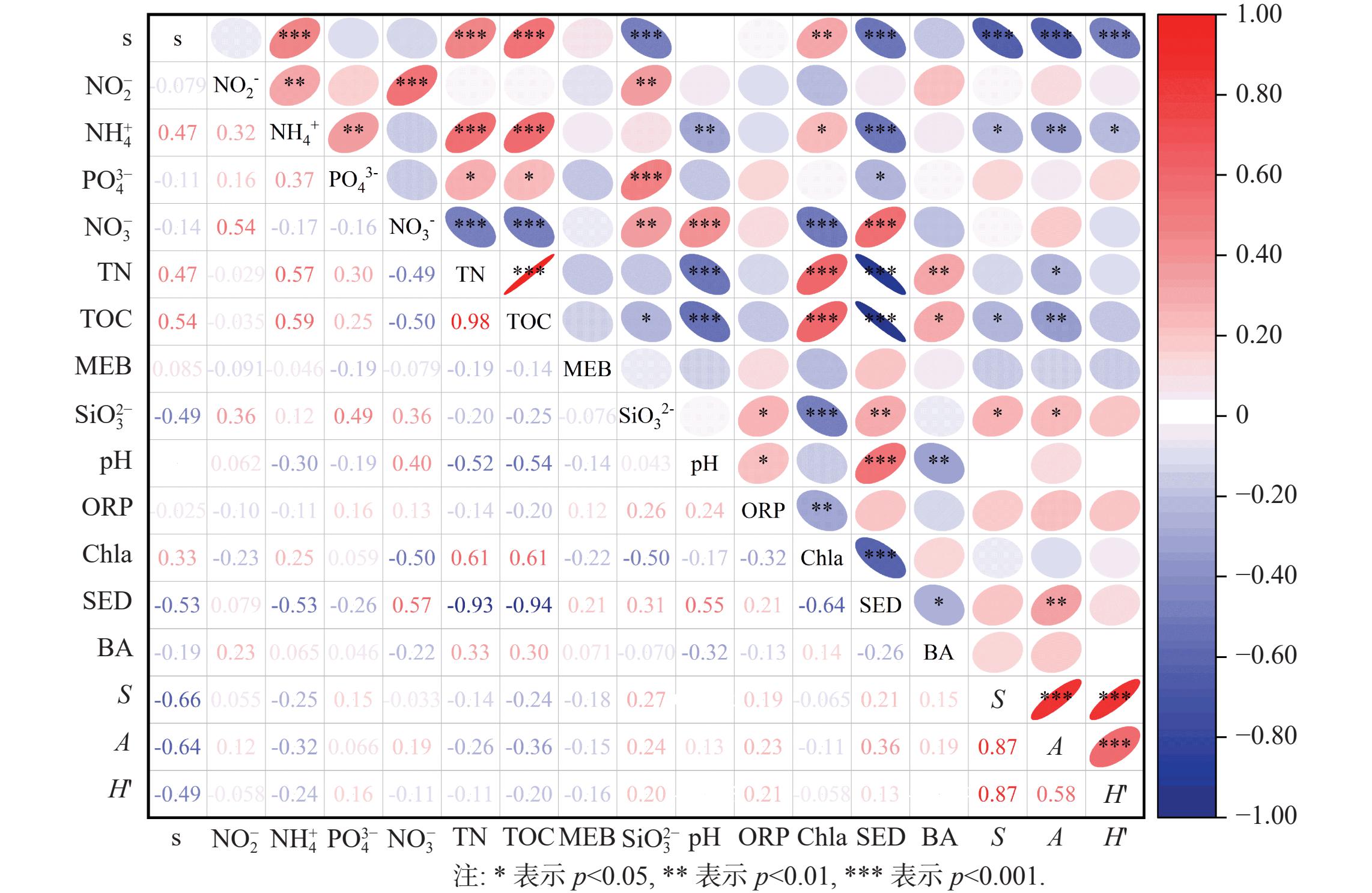
Fig.6
Comparison of environmental factors before and after restoration in the Chongming Dongtan restoration area"
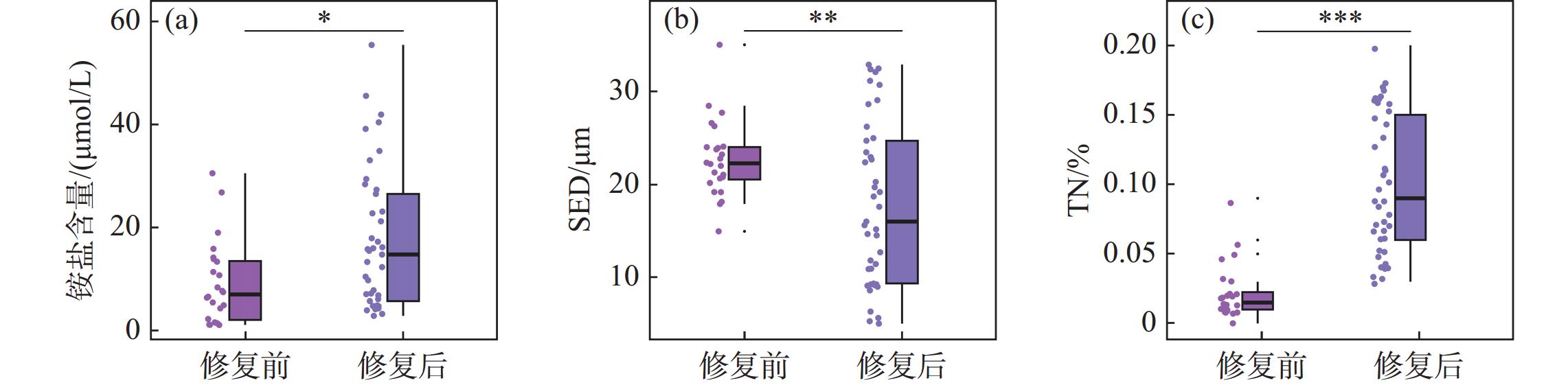
Table 5
Units, means, standard deviations, and ranges of all environmental variables in the restoration area before and after restoration"
| 区域 | SED/μm | TN/% | 铵盐/(μmol/L) | |||||
| 平均值±标准差 | 范围 | 平均值±标准差 | 范围 | 平均值±标准差 | 范围 | |||
| 修复前 | 22.74±4.12 | 14.98~34.98 | 0.02±0.02 | 0~0.09 | 9.10±7.97 | 1.19~30.50 | ||
| 修复后 | 18.34±9.18 | 5.09~34.85 | 0.10±0.05 | 0.03~0.20 | 28.36±31.57 | 2.95~144.75 | ||
| 1 | 王虓, 李德志, 计阳晴, 等.. 上海崇明东滩湿地潮滩梯度下芦苇种群动态分析. 生态与农村环境学报, 2024, 40 (5): 657- 664. |
| 2 | 丁文慧, 李秀珍, 姜俊彦, 等.. 崇明东滩南部河口盐沼植物群落种间关系的数量分析. 应用生态学报, 2016, 27 (5): 1417- 1426. |
| 3 | 孙振华, 虞快.. 崇明东滩鸟类自然保护区的建立及其意义. 上海建设科技, 1998 (4): 24- 26. |
| 4 | ZHAO Z Y, XU Y, YUAN L, et al.. Emergency control of Spartina alterniflora re-invasion with a chemical method in Chongming Dongtan, China. Water Science and Engineering, 2020, 13 (1): 24- 33. |
| 5 | STUDDS C E, KENDALL B E, MURRAY N J, et al.. Rapid population decline in migratory shorebirds relying on Yellow Sea tidal mudflats as stopover sites. Nature Communications, 2017, 8, 14895. |
| 6 | YUAN L, GE Z M, FAN X Z, et al.. Ecosystem-based coastal zone management: A comprehensive assessment of coastal ecosystems in the Yangtze Estuary coastal zone. Ocean & Coastal Management, 2014, 95, 63- 71. |
| 7 | 汤臣栋.. 上海崇明东滩互花米草生态控制与鸟类栖息地优化工程. 湿地科学与管理, 2016, 12 (3): 4- 8. |
| 8 | ALPHIN T D, POSEY M H.. Long-term trends in vegetation dominance and infaunal community composition in created marshes. Wetlands Ecology and Management, 2000, 8 (5): 317- 325. |
| 9 | FERGUSON H J, RAKOCINSKI C F.. Tracking marsh restoration using macrobenthic metrics: Implementing a functional approach. Wetlands Ecology and Management, 2008, 16 (4): 277- 289. |
| 10 | MOSEMAN S M, LEVIN L A, CURRIN C, et al.. Colonization, succession, and nutrition of macrobenthic assemblages in a restored wetland at Tijuana Estuary, California. Estuarine, Coastal and Shelf Science, 2004, 60 (4): 755- 770. |
| 11 | ROVAI A S, BARUFI J B, PAGLIOSA P R, et al.. Photosynthetic performance of restored and natural mangroves under different environmental constraints. Environmental Pollution, 2013, 181, 233- 241. |
| 12 | ROVAI A S, SORIANO-SIERRA E J, PAGLIOSA P R, et al.. Secondary succession impairment in restored mangroves. Wetlands Ecology and Management, 2012, 20 (5): 447- 459. |
| 13 | ZHENG W B, WANG C D, YAN Y, et al.. Insights into an extensively fragmented eukaryotic genome: De novo genome sequencing of the multinuclear ciliate Uroleptopsis citrina. Genome Biology and Evolution, 2018, 10 (3): 883- 894. |
| 14 | MADONI P.. The acute toxicity of nickel to freshwater ciliates. Environmental Pollution, 2000, 109 (1): 53- 59. |
| 15 | STOECK T, KOCHEMS R, FORSTER D, et al.. Metabarcoding of benthic ciliate communities shows high potential for environmental monitoring in salmon aquaculture. Ecological Indicators, 2018, 85, 153- 164. |
| 16 | WEISSE T. Pelagic microbes‐protozoa and the microbial food web [M]//O’SULLIVAN P E, REYNOLDS C S. The Lakes Handbook, Volume 1. Malden, MA, USA: Blackwell Science Ltd., 2007: 417-460. |
| 17 | MIRONOVA E, TELESH I, SKARLATO S.. Diversity and seasonality in structure of ciliate communities in the Neva Estuary (Baltic Sea). Journal of Plankton Research, 2012, 34 (3): 208- 220. |
| 18 | FERNANDES N M, CAMPELLO-NUNES P H, PAIVA T S, et al.. Ciliate diversity from aquatic environments in the Brazilian Atlantic forest as revealed by high-throughput DNA sequencing. Microbial Ecology, 2021, 81 (3): 630- 643. |
| 19 | ZHANG J W, CHEN X Y, SOETAERT K, et al.. The relative roles of multiple drivers on benthic ciliate communities in an intertidal zone. Marine Pollution Bulletin, 2023, 187, 114510. |
| 20 | XU Y, SOININEN J, ZHANG S K, et al.. Disentangling the relative roles of natural and anthropogenic-induced stressors in shaping benthic ciliate diversity in a heavily disturbed bay. Science of the Total Environment, 2021, 801, 149683. |
| 21 | LIU N N, MA Z J.. Ecological restoration of coastal wetlands in China: Current status and suggestions. Biological Conservation, 2024, 291, 110513. |
| 22 | 宋微波, A. 沃伦, 胡晓钟. 中国黄渤海的自由生纤毛虫 [M]. 北京: 科学出版社, 2009. |
| 23 | 范鑫鹏, 潘旭明. 中国盾纤亚纲和咽膜亚纲纤毛虫 [M]. 北京: 科学出版社, 2020. |
| 24 | XU Y, STOECK T, FORSTER D, et al.. Environmental status assessment using biological traits analyses and functional diversity indices of benthic ciliate communities. Marine Pollution Bulletin, 2018, 131, 646- 654. |
| 25 | 王苗勋. 底栖纤毛虫群落对崇明东滩海三棱藨草生态修复工程的响应 [D]. 上海: 华东师范大学, 2022. |
| 26 | TALLEY T S, LEVIN L A.. Modification of sediments and macrofauna by an invasive marsh plant. Biological Invasions, 2001, 3 (1): 51- 68. |
| 27 | 李华. 潮间带盐沼植物的沉积动力学效应研究[D]. 上海: 华东师范大学, 2009. |
| 28 | 梁秋瑶. 不同互花米草治理措施对土壤微生物多样性的影响 [D]. 上海: 华东师范大学, 2020. |
| 29 | CHEN W, GE Z M, FEI B L, et al.. Soil carbon and nitrogen storage in recently restored and mature native Scirpus marshes in the Yangtze Estuary, China: Implications for restoration. Ecological Engineering, 2017, 104, 150- 157. |
| 30 | 陶燕东, 钟胜财, 历成伟, 等.. 南汇东滩湿地海三棱藨草的生态修复效果研究. 海洋湖沼通报 (中英文), 2018, 40 (5): 40- 49. |
| 31 | 胡阳. 2009-2018年长江口水域环境质量演变及湿地生态修复 [D]. 上海: 上海海洋大学, 2021. |
| 32 | KOO B J, JE J G, WOO H.. Experimental restoration of a salt marsh with some comments on ecological restoration of coastal vegetated ecosystems in Korea. Ocean Science Journal, 2011, 46 (1): 47- 53. |
| 33 | 周炎武. 红树林恢复对沉积物中重金属分布、累积及形态的影响[D]. 广州: 中山大学, 2010. |
| 34 | GB 3097—1997 海水水质标准 [S]. |
| 35 | ZHAO H C, ZHANG L, WANG S R, et al.. Features and influencing factors of nitrogen and phosphorus diffusive fluxes at the sediment-water interface of Erhai Lake. Environmental Science and Pollution Research, 2018, 25 (2): 1933- 1942. |
| 36 | LIU S M, QI X H, LI X N, et al.. Nutrient dynamics from the Changjiang (Yangtze River) estuary to the East China Sea. Journal of Marine Systems, 2016, 154, 15- 27. |
| 37 | KLÖTZLI F, GROOTJANS A P.. Restoration of natural and semi-natural wetland systems in central Europe: Progress and predictability of developments. Restoration Ecology, 2001, 9 (2): 209- 219. |
| 38 | FRENCH P W.. Managed realignment–The developing story of a comparatively new approach to soft engineering. Estuarine, Coastal and Shelf Science, 2006, 67 (3): 409- 423. |
| 39 | BURDICK D M, DIONNE M, BOUMANS R M, et al.. Ecological responses to tidal restorations of two northern New England salt marshes. Wetlands Ecology and Management, 1996, 4 (2): 129- 144. |
| 40 | CRAFT C, READER J, SACCO J N, et al.. Twenty-five years of ecosystem development of constructed Spartina alterniflora (loisel) marshes. Ecological Applications, 1999, 9 (4): 1405- 1419. |
| 41 | LYNUM C A, BULSECO A N, DUNPHY C M, et al.. Microbial community response to a passive salt marsh restoration. Estuaries and Coasts, 2020, 43 (6): 1439- 1455. |
| 42 | FENG J X, GUO J M, HUANG Q, et al.. Changes in the community structure and diet of benthic macrofauna in invasive Spartina alterniflora wetlands following restoration with native mangroves. Wetlands, 2014, 34 (4): 673- 683. |
| 43 | TONG C F, BAUSTIAN J J, GRAHAM S A, et al.. Salt marsh restoration with sediment-slurry application: Effects on benthic macroinvertebrates and associated soil–plant variables. Ecological Engineering, 2013, 51, 151- 160. |
| 44 | 张武昌, 陈雪, 李海波, 等.. 海洋浮游桡足类摄食纤毛虫的研究. 海洋与湖沼, 2014, 45 (4): 764- 775. |
| 45 | BLUMENSHINE S C, HAMBRIGHT K D.. Top-down control in pelagic systems: A role for invertebrate predation. Hydrobiologia, 2003, 491 (1): 347- 356. |
| 46 | LÖDER M G J, MEUNIER C, WILTSHIRE K H, et al.. The role of ciliates, heterotrophic dinoflagellates and copepods in structuring spring plankton communities at Helgoland Roads, North Sea. Marine Biology, 2011, 158 (7): 1551- 1580. |
| 47 | MONTAGNES D, ALLEN J, BROWN L, et al.. Role of ciliates and other microzooplankton in the irminger sea (NW Atlantic Ocean). Marine Ecology Progress Series, 2010, 411, 101- 115. |
| 48 | WIACKOWSKI K, KOCERBA-SOROKA W.. Selective predation by a harpacticoid copepod on ciliates in phytotelmata: A laboratory experiment. Hydrobiologia, 2017, 790 (1): 13- 22. |
| 49 | HAMELS I, MOENS T, MUYLAERT K, et al.. Trophic interactions between ciliates and nematodes from an intertidal flat. Aquatic Microbial Ecology, 2001, 26, 61- 72. |
| 50 | REKIK A, AYADI H, ELLOUMI J.. Spatial and seasonal variability of the planktonic ciliates assemblages along the Eastern Mediterranean Coast (Sfax coast, Tunisia). Regional Studies in Marine Science, 2020, 40, 101529. |
| 51 | XU K D, CHOI J K, LEI Y L, et al.. Marine ciliate community in relation to eutrophication of coastal waters in the Yellow Sea. Chinese Journal of Oceanology and Limnology, 2011, 29 (1): 118- 127. |
| 52 | GUI Y Y, KAZMI S S U H, UROOSA, et al.. An approach to discriminating water quality status based on trophic-functional diversity of periphytic protozoan communities in marine ecosystems. Ecohydrology & Hydrobiology, 2022, 22 (4): 660- 669. |
| 53 | ESCARAVAGE V, PRINS T C.. Silicate availability, vertical mixing and grazing control of phytoplankton blooms in mesocosms. Hydrobiologia, 2002, 484, 33- 48. |
| 54 | HOWARTH R W, MARINO R.. Nitrogen as the limiting nutrient for eutrophication in coastal marine ecosystems: Evolving views over three decades. Limnology and Oceanography, 2006, 51 (1part2): 364- 376. |
| 55 | CAPRIULO G M, SMITH G, TROY R, et al.. The planktonic food web structure of a temperate zone estuary, and its alteration due to eutrophication. Hydrobiologia, 2002, 475, 263- 333. |
| 56 | 甘慧媚. 潮间带红树林底栖纤毛虫群落的生态研究[D]. 广州: 中山大学, 2005. |
| 57 | 马族航. 上海崇明岛东滩湿地底栖纤毛虫的物种多样性及其生态学研究 [D]. 上海: 华东师范大学, 2018. |
| 58 | AZOVSKY A I, MAZEI Y A.. Diversity and distribution of free-living ciliates from high-Arctic Kara sea sediments. Protist, 2018, 169 (2): 141- 157. |
| 59 | UNIVERSITY L M S, BURKOVSKY I V, MAZEI Y A, et al.. 21-year dynamics of marine benthic ciliate community in the White Sea intertidal flat: Gradual or discrete?. Russian Journal of Ecosystem Ecology, 2017, 2 (2): 1- 15. |
| 60 | ZHAO Z Y, YUAN L, LI W, et al.. Re-invasion of Spartina alterniflora in restored saltmarshes: Seed arrival, retention, germination, and establishment. Journal of Environmental Management, 2020, 266, 110631. |
| 61 | 宁应之, 沈韫芬.. 中国典型地带土壤原生动物食性的观察. 动物学研究, 1998, 19 (5): 397- 400. |
| 62 | 宁应之, 杨永强, 董玟含, 等.. 土壤纤毛虫群落对不同退还模式生态恢复的响应. 生态学报, 2018, 38 (10): 3628- 3638. |
| 63 | CARRIER-BELLEAU C, DROLET D, MCKINDSEY C W, et al.. Environmental stressors, complex interactions and marine benthic communities' responses. Scientific Reports, 2021, 11, 4194. |
| 64 | XU Y, SOININEN J.. Spatial patterns of functional diversity and composition in marine benthic ciliates along the coast of China. Marine Ecology Progress Series, 2019, 627, 49- 60. |
| 65 | MO Y Y, PENG F, GAO X F, et al.. Low shifts in salinity determined assembly processes and network stability of microeukaryotic plankton communities in a subtropical urban reservoir. Microbiome, 2021, 9 (1): 128. |
| 66 | URRUTXURTU I.. Seasonal succession of tintinnids in the Nervión River estuary, Basque country, Spain. Journal of Plankton Research, 2004, 26 (3): 307- 314. |
| 67 | JYOTHIBABU R, MADHU N V, JAYALAKSHMI K V, et al.. Impact of freshwater influx on microzooplankton mediated food web in a tropical estuary (Cochin backwaters–India). Estuarine, Coastal and Shelf Science, 2006, 69 (3/4): 505- 518. |
| 68 | YANG S L, LI H, YSEBAERT T, et al.. Spatial and temporal variations in sediment grain size in tidal wetlands, Yangtze Delta: On the role of physical and biotic controls. Estuarine, Coastal and Shelf Science, 2008, 77 (4): 657- 671. |
| [1] | Zongyue LIU, Yunyi CHI, Qiang WANG. A study on the control effectiveness of Spartina alterniflora based on combined cutting and herbicide application measures [J]. J* E* C* N* U* N* S*, 2025, 2025(6): 116-127. |
| [2] | Feng TIAN, Lin YUAN, Liquan ZHANG, Yang LI, Lu BAN, Pingya CHEN. Study on seed production, characteristics of dormancy, and germination of Scirpus mariqueter in the Yangtze River Estuary [J]. J* E* C* N* U* N* S*, 2025, 2025(2): 68-76. |
| [3] | Ke YE, Bo TIAN, Yuchun WANG. Development of estuarine tidal flat vegetation index based on Sentinel-2 satellite remote sensing [J]. J* E* C* N* U* N* S*, 2025, 2025(2): 141-153. |
| [4] | Yuyi WANG, Ye HUANG, Jing YANG, Fangfang DING, Tianhao HE, Yushan LI, Lin HUANG, Ye LI, Min LIU. Spatiotemporal differential distribution characteristics and ecological risk assessment of antibiotics in the Yangtze River Estuary and offshore areas [J]. Journal of East China Normal University(Natural Science), 2024, 2024(6): 136-150. |
| [5] | Hao CHEN, Xianqiang HE, Run LI, Fang CAO. Machine learning-based remote sensing retrievals of dissolved organic carbon in the Yangtze River Estuary [J]. Journal of East China Normal University(Natural Science), 2024, 2024(4): 123-136. |
| [6] | Zhi JIN, Jianrong ZHU, Wei QIU. Effects of cascade reservoirs in the Yangtze River Basin on estuarine saltwater intrusion and freshwater resources during late summer and early autumn [J]. Journal of East China Normal University(Natural Science), 2024, 2024(1): 90-103. |
| [7] | Jiaming CHEN, Shiming WANG, Rongrong YANG, Ziyan CHEN, Xia LIANG, Lijun HOU. Temperature adaptability of dark carbon fixation in seawater fromthe Yangtze River Estuary [J]. Journal of East China Normal University(Natural Science), 2024, 2024(1): 104-112. |
| [8] | Zhipeng LI, Jianrong ZHU. Numerical simulation of the North Branch regime change impact on saltwater intrusion in the Yangtze River Estuary from 2007 to 2016 [J]. Journal of East China Normal University(Natural Science), 2022, 2022(3): 109-124. |
| [9] | Zhiyong YOU, Bolin LIU, Cheng LIU, Dengzhou GAO. Temperature sensitivity and controlling factors of nitrogen fixation processes in sediments of the Yangtze River Estuary [J]. Journal of East China Normal University(Natural Science), 2022, 2022(3): 101-108. |
| [10] | Xiang LI, Huimin TIAN, Jingying WU, Siyu CHEN, Mingming ZHAO, Ping XU, Xuechu CHEN, Wenhui YOU. Distribution characteristics and influencing factors of crabs and crab burrows in the Fengxian coastal wetland [J]. Journal of East China Normal University(Natural Science), 2021, 2021(2): 160-170. |
| [11] | ZHU Xiao-jing, YUAN Lin, ZHAO Zhi-yuan, ZHANG Li-quan, LI Wei, WEI Wei, PAN Jia-lin, CHEN Ya-hui. The influence of environmental factors on the settlement of Spartina alterniflora on tidal flats [J]. Journal of East China Normal University(Natural Sc, 2019, 2019(6): 140-152. |
| [12] | MAO Xing-hua, GU Sheng-hua, MO Dan-feng, LI Qi. Relationship between the mean tidal level and the half-tide level in the Yangtze River estuary [J]. Journal of East China Normal University(Natural Sc, 2013, 2013(2): 50-55. |
| [13] | LI Yu-zhong;;CHEN Shen-liang . Formation mechanism of Ruifeng Shoal ditch in the Yangtze River Estuary [J]. Journal of East China Normal University(Natural Sc, 2010, 2010(6): 1-11. |
| [14] | ZHANG Heng;LU Jian-jian. Calculation of the Taxonomic Diversity of Fish Communities in the Yangtze River Estuary(Chinese) [J]. Journal of East China Normal University(Natural Sc, 2007, 2007(2): 11-22. |
| Viewed | ||||||
|
Full text |
|
|||||
|
Abstract |
|
|||||
