
 中文核心期刊
J* E* C* N* U* N* S* ›› 2026, Vol. 2026 ›› Issue (4): 123-133.doi: 10.3969/j.issn.1000-5641.2026.04.013
Zihao GONG, Zhiyun CHEN*( )
)
Received:2024-12-11
Online:2026-07-25
Published:2026-07-18
Contact:
Zhiyun CHEN
E-mail:chenzhy@cc.ecnu.edu.cn
CLC Number:
Zihao GONG, Zhiyun CHEN. FusionSeg: Topic segmentation model based on semantic feature fusion[J]. J* E* C* N* U* N* S*, 2026, 2026(4): 123-133.
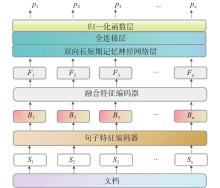
Fig.1
Model architecture"
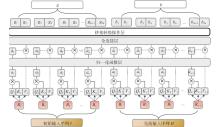
Fig.2
Attention-based fusion weight extraction module"
Fig.3
Loss function overview"
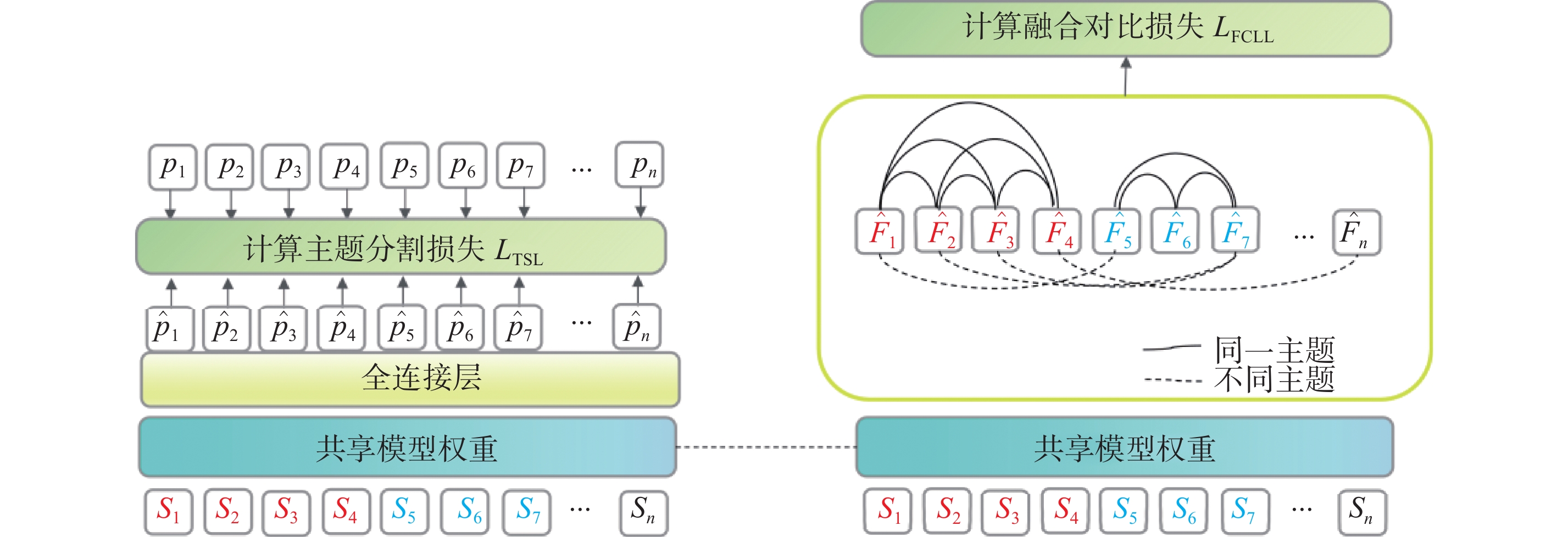
Table 1
Dataset employed in the experimental investigation"
| 数据集名称 | 文档总数/篇 | 平均句子数/(句/篇) | 句平均字符数/(个/句) | 单文档平均主题数/(个/篇) | 单主题平均句子数/(句/个) |
| Wiki-727k 训练集[ | 47.9 | 20.7 | 5.3 | 9.1 | |
| Wiki-727k 开发集[ | 48.1 | 20.8 | 5.3 | 9.1 | |
| Wiki-727k 测试集[ | 48.7 | 20.7 | 5.3 | 9.1 | |
| En-city 数据集[ | 56.5 | / | 8.3 | 6.8 | |
| Wiki-zh 训练集[ | 11.9 | 38.8 | 4.7 | 2.5 | |
| Wiki-zh 开发集[ | 11.8 | 38.7 | 4.7 | 2.5 | |
| Wiki-zh 测试集[ | 11.9 | 38.8 | 4.7 | 2.5 |
Table 2
Experimental results on Wiki-zh and Wiki-727k"
| 模型名称 | Wiki-zh上的实验结果 | Wiki-727k上的实验结果 | |||||
| SeqModel:BERT-Base[ | 0.7840 | 0.6950 | 0.7370 | 0.7060 | 0.6590 | 0.6820 | |
| Hier.BERT (24-Layers)[ | / | / | / | 0.6980 | 0.6350 | 0.6650 | |
| SeqModel:StructBERT-Base[ | 0.7920 | 0.7270 | 0.7580 | / | / | / | |
| Cross-segment BERT-Base 128-128[ | 0.6120 | 0.8020 | 0.6940 | / | / | 0.6400 | |
| Cross-segment BERT-Large 128-128[ | / | / | / | 0.6910 | 0.6320 | 0.6600 | |
| Cross-segment BERT-Large 256-256[ | / | / | / | 0.6150 | 0.7390 | 0.6710 | |
| SeqModel:RoBERTa-Base[ | 0.7460 | 0.7370 | 0.7420 | / | / | / | |
| SeqModel:ELECTRA-Base[ | 0.7350 | 0.7660 | 0.7500 | / | / | / | |
| FusionSeg | 0.8360 | 0.8340 | 0.8350 | 0.8220 | 0.6980 | 0.7550 | |
Table 3
Experimental results on En-city"
| 模型名称 | En-city上的实验结果 | ||
| SEC>T + bloom[ | 14.4 | / | 0.7160 |
| S-LSTM [ | 9.10 | / | 0.7610 |
| BERT-Base + BiLSTM[ | 9.60 | 12.80 | 0.8150 |
| 9.10 | / | / | |
| Tipster[ | 8.30 | / | 0.7980 |
| PEN-NS[ | 8.00 | / | 0.8000 |
| Naive LongT5-Base-DS[ | 8.20 | / | 0.6600 |
| Naive LongT5-Base-SS[ | 9.20 | / | 0.7310 |
| BERT-Base [ | 8.94 | 11.34 | 0.7899 |
| BERT-Base + TSSP + CSSL[ | 8.22 | 10.19 | 0.8020 |
| FusionSeg | 7.31 | 9.94 | 0.8647 |
Table 4
Ablation Experiment Results"
| 模块/方法名称 | En-city上的实验结果 | Wiki-727k上的实验结果 | |||||
| BERT-Base | 8.94 | 11.34 | 0.7899 | / | / | / | |
| BERT-Base + BiLSTM | 9.60 | 12.80 | 0.8150 | 0.6730 | 0.5390 | 0.5990 | |
| BERT-Base + BiLSTM + Fusion Encoder (without attention) | 8.63 | 11.71 | 0.8356 | / | / | / | |
| BERT-Base + BiLSTM + Fusion Encoder | 8.62 | 11.61 | 0.8371 | 0.8100 | 0.6850 | 0.7420 | |
| BERT-Base + BiLSTM + Fusion Encoder (without attention) + FCLL | 7.40 | 10.00 | 0.8638 | / | / | / | |
| BERT-Base + BiLSTM + Fusion Encoder + FCLL | 7.31 | 9.94 | 0.8647 | 0.8220 | 0.6980 | 0.7550 | |
Table 5
Impact of loss weights on fusion contrastive learning"
| En-city上的实验结果 | Wiki-727k上的实验结果 | ||||||
| 0 | 8.62 | 11.61 | 0.8371 | 0.8102 | 0.6851 | 0.7424 | |
| 0.5 | 7.40 | 10.01 | 0.8634 | 0.8171 | 0.6813 | 0.7430 | |
| 0.75 | 7.56 | 10.37 | 0.8669 | 0.8219 | 0.6982 | 0.7550 | |
| 1 | 7.49 | 10.37 | 0.8574 | 0.8283 | 0.6845 | 0.7496 | |
| 1 | Hearst M A. Multi-paragraph segmentation of expository text [C]//32nd Annual Meeting of the Association for Computational Linguistics. Association for Computational Linguistics, 1994: 9-16. |
| 2 | Artemiev A, Parinov D, Grishanov A, et al. Leveraging summarization for unsupervised dialogue topic segmentation [C]//Findings of the Association for Computational Linguistics: NAACL 2024. Association for Computational Linguistics, 2024: 4697-4704. |
| 3 | Ma X B, Xu Y, Zhao H, et al.. Multi-turn dialogue comprehension from a topic-aware perspective. Neurocomputing, 2024, 578, 127385. |
| 4 | Zhang Q L, Chen Q, Li Y L, et al. Sequence model with self-adaptive sliding window for efficient spoken document segmentation [C]//2021 IEEE Automatic Speech Recognition and Understanding Workshop (ASRU). IEEE, 2021: 411-418. |
| 5 | Gklezakos D C, Misiak T, Bishop D. TreeSeg: hierarchical topic segmentation of large transcripts [PP/OL]. arXiv (2024-06-28)[2024-11-12]. https://doi.org/10.48550/arXiv.2407.12028. |
| 6 | Glavaš G, Nanni F, Ponzetto S P. Unsupervised text segmentation using semantic relatedness graphs [C]//Proceedings of the Fifth Joint Conference on Lexical and Computational Semantics. Association for Computational Linguistics, 2016: 125-130. |
| 7 | Hearst M A.. Text tiling: segmenting text into multi-paragraph subtopic passages. Computational Linguistics, 1997, 23 (1): 33- 64. |
| 8 | Koshorek O, Cohen A, Mor N, et al. Text segmentation as a supervised learning task [C]//Proceedings of the 2018 Conference of the North American Chapter of the Association for Computational Linguistics: Human Language Technologies, Volume 2 (Short Papers). Association for Computational Linguistics, 2018: 469-473. |
| 9 | Devlin J, Chang M W, Lee K, et al. BERT: pre-training of deep bidirectional transformers for language understanding [C]//Proceedings of the 2019 Conference of the North American Chapter of the Association for Computational Linguistics: Human Language Technologies, Volume 1 (Long and Short Papers). Association for Computational Linguistics, 2019: 4171-4186. |
| 10 | Lukasik M, Dadachev B, Papineni K, et al. Text segmentation by cross segment attention [C]//Proceedings of the 2020 Conference on Empirical Methods in Natural Language Processing (EMNLP). ACL, 2020: 4707-4716. |
| 11 | Inan H, Rungta R, Mehdad Y. Structured summarization: unified text segmentation and segment labeling as a generation task [PP/OL]. arXiv (2022-09-28)[2024-11-13]. https://doi.org/10.48550/arXiv.2209.13759. |
| 12 | Du L, Buntine W, Johnson M. Topic segmentation with a structured topic model [C]//Proceedings of the 2013 Conference of the North American Chapter of the Association for Computational Linguistics: Human Language Technologies. Association for Computational Linguistics, 2013: 190-200. |
| 13 | Vaswani A, Shazeer N, Parmar N, et al. Attention is all you need [C]//Proceedings of the 31st International Conference on Neural Information Processing Systems. ACM, 2017: 6000-6010. |
| 14 | Lo K, Jin Y, Tan W C, et al. Transformer over pre-trained transformer for neural text segmentation with enhanced topic coherence [C]//Findings of the Association for Computational Linguistics: EMNLP 2021. Association for Computational Linguistics, 2021: 3334-3340. |
| 15 | Yu H, Deng C, Zhang Q L, et al. Improving long document topic segmentation models with enhanced coherence modeling [C]//Proceedings of the 2023 Conference on Empirical Methods in Natural Language Processing. Association for Computational Linguistics, 2023: 5592-5605. |
| 16 | Liang P P, Zadeh A, Morency L P.. Foundations & trends in multimodal machine learning: principles, challenges, and open questions. ACM Computing Surveys, 2024, 56 (10): 1- 42. |
| 17 | Zeng X K, Li Z C, Zhang L F, et al. A coin has two sides: a novel detector-corrector framework for Chinese spelling correction [PP/OL]. arXiv (2024-09-06)[2024-11-21]. https://doi.org/10.48550/arXiv.2409.04150. |
| 18 | 陈宇航, 王世宙, 汤正婷, 等.. 基于代码和描述文本相融合的软件分类研究. 华东师范大学学报(自然科学版), 2025 (1): 46- 58. |
| 19 | Arnold S, Schneider R, Cudré-Mauroux P, et al.. SECTOR: a neural model for coherent topic segmentation and classification. Transactions of the Association for Computational Linguistics, 2019, 7, 169- 184. |
| 20 | Barrow J, Jain R, Morariu V, et al. A joint model for document segmentation and segment labeling [C]//Proceedings of the 58th Annual Meeting of the Association for Computational Linguistics. Association for Computational Linguistics, 2020: 313-322. |
| 21 | Gong Z, Tong S W, Wu H, et al. Tipster: a topic-guided language model for topic-aware text segmentation [C]//Bhattacharya A, Lee Mong Li J, Agrawal D, et al. Database Systems for Advanced Applications. Cham: Springer, 2022: 213-221. |
| 22 | Xia J X, Liu C, Chen J S, et al. Dialogue topic segmentation via parallel extraction network with neighbor smoothing [C]//Proceedings of the 45th International ACM SIGIR Conference on Research and Development in Information Retrieval. ACM, 2022: 2126-2131. |
| [1] | Ziyang XIE, Yan GAO. Spatial feature fusion and enhancement for remote sensing road extraction [J]. J* E* C* N* U* N* S*, 2026, 2026(4): 112-122. |
| [2] | Yi WU, Shilin YUN. C-T Net: Remote sensing image change detection model integrating CNN and Transformer [J]. J* E* C* N* U* N* S*, 2025, 2025(4): 49-60. |
| [3] | Houlong FAN, Ailian FANG, Xin LIN. Knowledge graph completion by integrating textual information and graph structure information [J]. J* E* C* N* U* N* S*, 2025, 2025(1): 111-123. |
| [4] | Junlin REN, Huan WANG, Xiaodi HUANG, Yanting LI, Shenggen JU. Sequence-aware and multi-type behavioral data driven knowledge concept recommendation for massive open online courses [J]. Journal of East China Normal University(Natural Science), 2024, 2024(5): 45-56. |
| [5] | Chang WANG, Dan MA, Huarong XU, Panfeng CHEN, Mei CHEN, Hui LI. SA-MGKT: Multi-graph knowledge tracing method based on self-attention [J]. Journal of East China Normal University(Natural Science), 2024, 2024(5): 20-31. |
| [6] | Zhihong ZHENG, Haichuan SONG. Group contrastive learning for weakly-supervised 3D point cloud semantic segmentation [J]. Journal of East China Normal University(Natural Science), 2024, 2024(2): 108-118. |
| [7] | Lulu JIANG, Siqi SUN, Haidong ZOU, Lina LU, Rui FENG. Diabetic retinopathy grading based on dual-view image feature fusion [J]. Journal of East China Normal University(Natural Science), 2023, 2023(6): 39-48. |
| [8] | Zhishang DUAN, Yi RAN, Duliang LYU, Jie QI, Jiachen ZHONG, Peisen YUAN. Identifying electricity theft based on residual network and depthwise separable convolution enhanced self attention [J]. Journal of East China Normal University(Natural Science), 2023, 2023(5): 193-204. |
| [9] | FU Yu, LI You, LIN Yu-ming, ZHOU Ya. Self-attention based neural networks for product titles compression [J]. Journal of East China Normal University(Natural Sc, 2019, 2019(5): 113-122,167. |
| Viewed | ||||||
|
Full text |
|
|||||
|
Abstract |
|
|||||
