
 中文核心期刊
华东师范大学学报(自然科学版) ›› 2026, Vol. 2026 ›› Issue (1): 25-42.doi: 10.3969/j.issn.1000-5641.2026.01.003
赵永乐, 张妍*( )
)
收稿日期:2025-10-15
接受日期:2025-12-05
出版日期:2026-01-25
发布日期:2026-01-29
通讯作者:
张妍
E-mail:yanz@nwu.edu.cn
基金资助:
Yongle ZHAO, Yan ZHANG*()
Received:2025-10-15
Accepted:2025-12-05
Online:2026-01-25
Published:2026-01-29
Contact:
Yan ZHANG
E-mail:yanz@nwu.edu.cn
摘要:
微塑料和抗生素这两种新污染物已成为当今研究的热点, 从多个中英文数据库收集了我国水体中微塑料和抗生素的丰度、种类等数据, 系统阐述了微塑料和抗生素的分布特征、吸附机制及对生物的危害. 结果显示, 水库中微塑料丰度最高 (4.70~27.5 个/L, 平均12.08 个/L), 其次为河流 (平均8.83 个/L), 湖泊最低 (平均6.19 个/L). 河流中抗生素平均浓度达102.93 ng/L, 高于湖泊 (平均34.37 ng/L) 和水库 (平均43.91 ng/L). 范德华力普遍存在于微塑料与抗生素分子之间, 极性较大的微塑料更容易与抗生素形成氢键和静电作用, 含特殊官能团的微塑料可形成π-π相互作用. 老化使微塑料表面暴露更多的含氧官能团, 显著提升吸附量. 微塑料-抗生素复合物被生物摄入后, 可在器官发生积累效应, 抑制生长, 长期胁迫还会改变生物结构并增加抗性基因传播. 建议严格管控排放源, 推广生物可降解塑料的使用, 完善塑料回收体系, 并加强真实环境中吸附过程与复合毒性研究.
中图分类号:
赵永乐, 张妍. 水体中微塑料和抗生素相互作用及复合毒性的研究进展[J]. 华东师范大学学报(自然科学版), 2026, 2026(1): 25-42.
Yongle ZHAO, Yan ZHANG. Research progress on the interaction mechanisms and combined toxicity of microplastics and antibiotics in aquatic environments[J]. J* E* C* N* U* N* S*, 2026, 2026(1): 25-42.
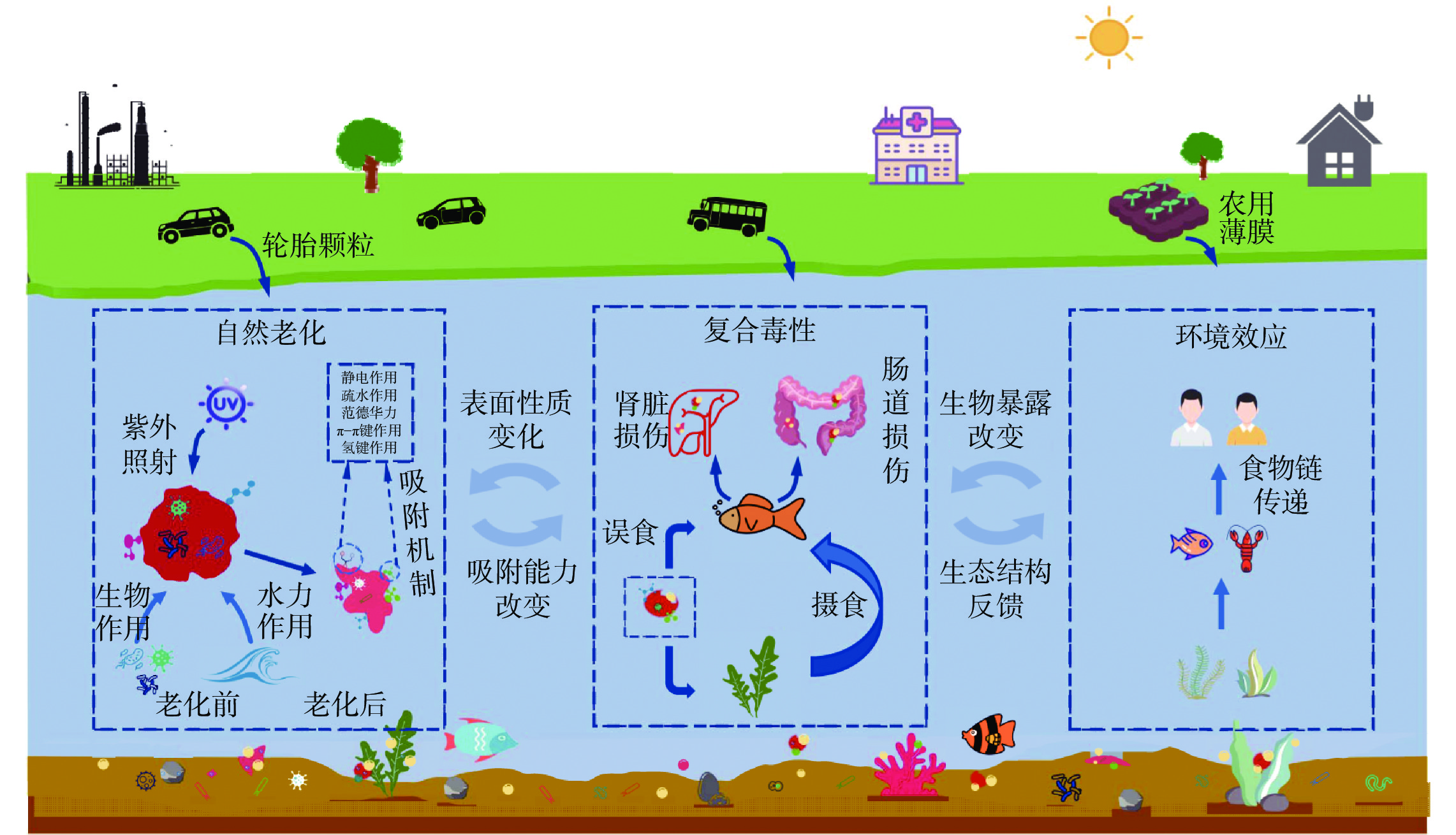
图1
微塑料-抗生素复合污染物在水体中的协同特征"
表1
我国地表水中微塑料分布特征"
| 水域名称 | 主要类型 | 丰度/ (个/L) | 主要形状 | 主要粒径/mm | 颜色 | 采样位置 | 采样时间 | 参考文献 | |
| 河流 | 海河 | PE | 9.30±4.72 | 纤维 | <1 | 白色、透明 | 城市河段 | 2018.06 | [ |
| 长江重庆段 | PP | 71.84 | 纤维、薄膜 | <0.3 | 透明 | 城市河段 | 2018.10 | [ | |
| 汉江 | PA、PET | 4.47 | 纤维、碎片 | <0.5 | 透明 | 农村河段 | 2020.10 | [ | |
| 长江口 | PE、PP | 4.13±2.46 | 纤维、颗粒 | <1 | 透明 | 农村河段 | 2013.07 | [ | |
| 珠江广州段 | PE、PS | 7.85 | 球形、纤维 | <2 | 浅色 | 城市河段 | 2021 | [ | |
| 渭河关中段 | PE、PP、PET | 5.87 (枯) 3.67 (丰) | 纤维、碎片 | <1 | 彩色、透明 | 城市河段 | 2022.12 (枯) 2023.07 (丰) | [ | |
| 灞河 | PE、PS | 6.53±2.36 | 纤维、碎片 | <1 | 黑色, 透明 | 城市河段 | 2018 | [ | |
| 上游无定河 | PE、PP | 2.98±0.69 | 纤维 | <0.5 | 白色 | 农村河段 | 2021 | [ | |
| 黄河入海口 | PP、PE、PS | 654.00 (丰) 930.20 (枯) | 纤维 | <2 | 透明, 白色 | 农村河段 | 2018.07 (丰) 2019.03 (枯) | [ | |
| 河流 | 黄河下游 | PP、PE、PS | 595.27 | 纤维 | <2 | 透明、白色 | 城市河段 | 2019.03 (枯) | [ |
| 东江河源段 | PS | 1.05 | 纤维 | <2 | 蓝色 | 农村河段 | 2019.06 | [ | |
| 汾河 | PES、PET | 13.89±1.97 | 纤维 | <2 | 透明、白色 | 城市河段 | 2020.06 | [ | |
| 香溪河 | PE、PP | 6.64 (平) 5.00 (枯) | 纤维 | <0.5 | 透明 | 农村河段 | 2020.11 (枯) 2021.04 (平) | [ | |
| 沱江 | PP | 1.94 | 纤维 | <1 | 白色 | 城市河段 | 2019.07 | [ | |
| 南明河 | PE、PP | 0.75 (枯) 0.69 (丰) | 纤维、薄膜 | <0.5 | 透明 | 城市河段 | 2021.01 (枯) 2021.09 (丰) | [ | |
| 大辽河 | PE、PP | 4.74 | 纤维、碎片 | <0.5 | - | 农村河段 | 2019.08 | [ | |
| 双台子河 | PE | 4.52 | 纤维、碎片 | <0.5 | - | ||||
| 漳河 | PE、PP | 6.72 (丰) 4.13 (枯) | 纤维 | <2 | 蓝色 | 城市河段 | 2023.07 (丰) 2023.12 (枯) | [ | |
| 大沽河 | PET | 2.00 | 纤维 | >3 | 蓝色 | 城市河段 | 2021.06 | [ | |
| 北运河 | PE、PP | 13.30 | 纤维、薄膜 | <0.5 | 白色 | 城市河段 | 2021.08 | [ | |
| 湖泊 | 洞庭湖 | PET、PP | 7.00 (枯) 12.00 (丰) | 纤维 | <1.5 | 蓝色、黑色 | 农村湖段 | 2020.09 (丰) 2020.12 (枯) | [ |
| 巢湖 | PP、PET、PE | 3.20 | 纤维、碎片 | <2 | 黑色、蓝色 | 农村湖段 | 2020.11 | [ | |
| 太湖 | PET、PP | 13.20 | 纤维、颗粒 | <1 | 透明、黑色 | 城市湖段 | 2019.08 | [ | |
| 大明湖 | PP | 3.23 | 纤维、薄膜 | <0.5 | 透明 | 城市湖段 | 2022.09 | [ | |
| 洪湖 | PE、PP | 1.19 | 纤维 | - | 彩色 | 农村湖段 | 2017.09 | [ | |
| 水库 | 三峡水库 | PS、PP | 4.70±2.81 | 纤维 | <0.5 | 透明、白色 | 城市地段 | 2016.08 | [ |
| 密云水库 | PP、PET | 6.83±1.87 | 纤维 | <0.5 | 透明 | 农村地段 | 2021.08 | [ | |
| 丹江口水库 | PA、PE | 7.25 | 碎片、纤维 | <0.5 | 棕色、透明 | 农村地段 | 2019.08 | [ | |
| 大房郢水库 | PP、PE | 18.62±7.12 | 纤维、颗粒 | <1 | 透明、蓝色 | 城市地段 | 2020.09 | [ | |
| 甲岩水库 | PE | 27.50±23.30 | 碎片 | <0.3 | - | 农村地段 | 2020.08 | [ |
表2
我国地表水中抗生素分布特征"
| 水域名称 | 抗生素类型 | 浓度/(ng/L) | 平均总浓度/(ng/L) | 采样时间 | 参考文献 | |
| 河流 | 潮白河 | 磺胺类 | ND~63.77 | ND~48.56 | 2021 | [ |
| 大环内酯类 | ND~16.07 | |||||
| 喹诺酮类 | ND~101.62 | |||||
| 四环素类 | ND~12.22 | |||||
| 南明河 | 磺胺类 | 257.00 | 173.33 | 2018 | [ | |
| 大环内酯类 | 256.00 | |||||
| 喹诺酮类 | 127.00 | |||||
| 四环素类 | 53.30 | |||||
| 河流 | 锦江流域 | 喹诺酮类 | 33.50~251.00 | 37.57~180.33 | 2021 | [ |
| 大环内酯类 | 22.00~163.00 | |||||
| 磺胺类 | 57.20~127.00 | |||||
| 灞河 | 磺胺类 | 25.90 | 116.33 | 2017 | [ | |
| 喹诺酮类 | 46.00 | |||||
| 大环内酯类 | 63.40 | |||||
| 四环素类 | 330.00 | |||||
| 滏阳河 | 喹诺酮类 | 0.27~1.32 | ND~2.82 | 2024 | [ | |
| 磺胺类 | 0.66~9.27 | |||||
| 大环内酯类 | 0.28~0.67 | |||||
| 珠江广州段 | 大环内酯类 | 643.00 | 673.00 | 2016 | [ | |
| 喹诺酮类 | 703.00 | |||||
| 皂河 | 喹诺酮类 | 0.63~2.47 | ND~7.37 | 2023 | [ | |
| 四环素类 | 1.24~19.28 | |||||
| 磺胺类 | ND~0.36 | |||||
| 贾鲁河 | 喹诺酮类 | ND~29.00 | ND~16.05 | 2024 | [ | |
| 磺胺类 | ND~15.80 | |||||
| 四环素类 | ND~3.35 | |||||
| 辽河流域 | 大环内酯类 | 28.45 | 34.51 | 2019 | [ | |
| 喹诺酮类 | 52.83 | |||||
| 磺胺类 | 20.01 | |||||
| 四环素类 | 36.74 | |||||
| 浑河 | 磺胺类 | ND~25.30 | ND~16.53 | 2018 | [ | |
| 喹诺酮类 | ND~14.20 | |||||
| 四环素类 | ND~10.10 | |||||
| 长江干流 | 喹诺酮类 | ND~2.24 | ND~2.55 | 2020 | [ | |
| 四环素类 | ND~0.33 | |||||
| 大环内酯类 | ND~2.50 | |||||
| 磺胺类 | ND~5.12 | |||||
| 支流汉江 | 喹诺酮类 | ND~2.35 | ND~5.18 | |||
| 四环素类 | ND~1.32 | |||||
| 大环内酯类 | ND~2.50 | |||||
| 磺胺类 | ND~14.53 | |||||
| 支流滠水 | 喹诺酮类 | ND~177.37 | ND~60.67 | |||
| 大环内酯类 | ND~2.00 | |||||
| 磺胺类 | ND~2.63 | |||||
| 流溪河 | 磺胺类 | 189.51 | 91.00 | 2010 | [ | |
| 喹诺酮类 | 7.06 | |||||
| 大环内酯类 | 76.40 | |||||
| 河流 | 珠江河 | 磺胺类 | 208.73 | 115.66 | 2010 | [ |
| 喹诺酮类 | 4.85 | |||||
| 大环内酯类 | 133.40 | |||||
| 石井河 | 磺胺类 | |||||
| 喹诺酮类 | 70.40 | |||||
| 大环内酯类 | ||||||
| 湖泊 | 太湖 | 磺胺类 | 2.60 | 2.38 | 2018 | [ |
| 喹诺酮类 | 3.60 | |||||
| 四环素类 | 2.80 | |||||
| 大环内酯类 | 0.50 | |||||
| 鄱阳湖 | 磺胺甲恶唑 | 156.88 | 116.73 | 2023 | [ | |
| 罗红霉素 | 136.37 | |||||
| 诺氟沙星 | 56.64 | |||||
| 洞庭湖 | 恩诺沙星 | ND~4.61 | ND~20.94 | 2016 | [ | |
| 环丙沙星 | ND~36.17 | |||||
| 四环素 | ND~21.51 | |||||
| 巢湖 | 盐酸强力霉素 | 71.06 | 26.91 | 2022 | [ | |
| 克拉霉素 | 5.11 | |||||
| 磺胺甲恶唑 | 4.55 | |||||
| 东湖 | 四环素 | 3.31 | 4.87 | 2017 | [ | |
| 金霉素 | 2.86 | |||||
| 强力霉素 | 9.94 | |||||
| 土霉素 | 3.36 | |||||
| 水库 | 莲花水库 | 恩诺沙星 | ND~187.69 | ND~142.13 | 2018 | [ |
| 四环素 | ND~155.05 | |||||
| 环丙沙星 | ND~83.66 | |||||
| 青狮潭水库 | 诺氟沙星 | 3.70~5.00 | 3.93~5.76 | 2018 | [ | |
| 环丙沙星 | 3.49~6.22 | |||||
| 恩诺沙星 | 4.59~6.06 | |||||
| 丹江口水库 | 阿莫西林 | 3.47~20.68 | 2.84~15.55 | 2023 | [ | |
| 土霉素 | 2.20~10.41 | |||||
| 碧流河水库 | 磺胺甲恶唑 | ND~15.00 | ND~12.20 | 2015 | [ | |
| 甲氧苄啶 | ND~7.20 | |||||
| 氯霉素 | ND~17.00 | |||||
| 林可霉素 | ND~9.60 |
图2
微塑料与抗生素之间吸附机制"
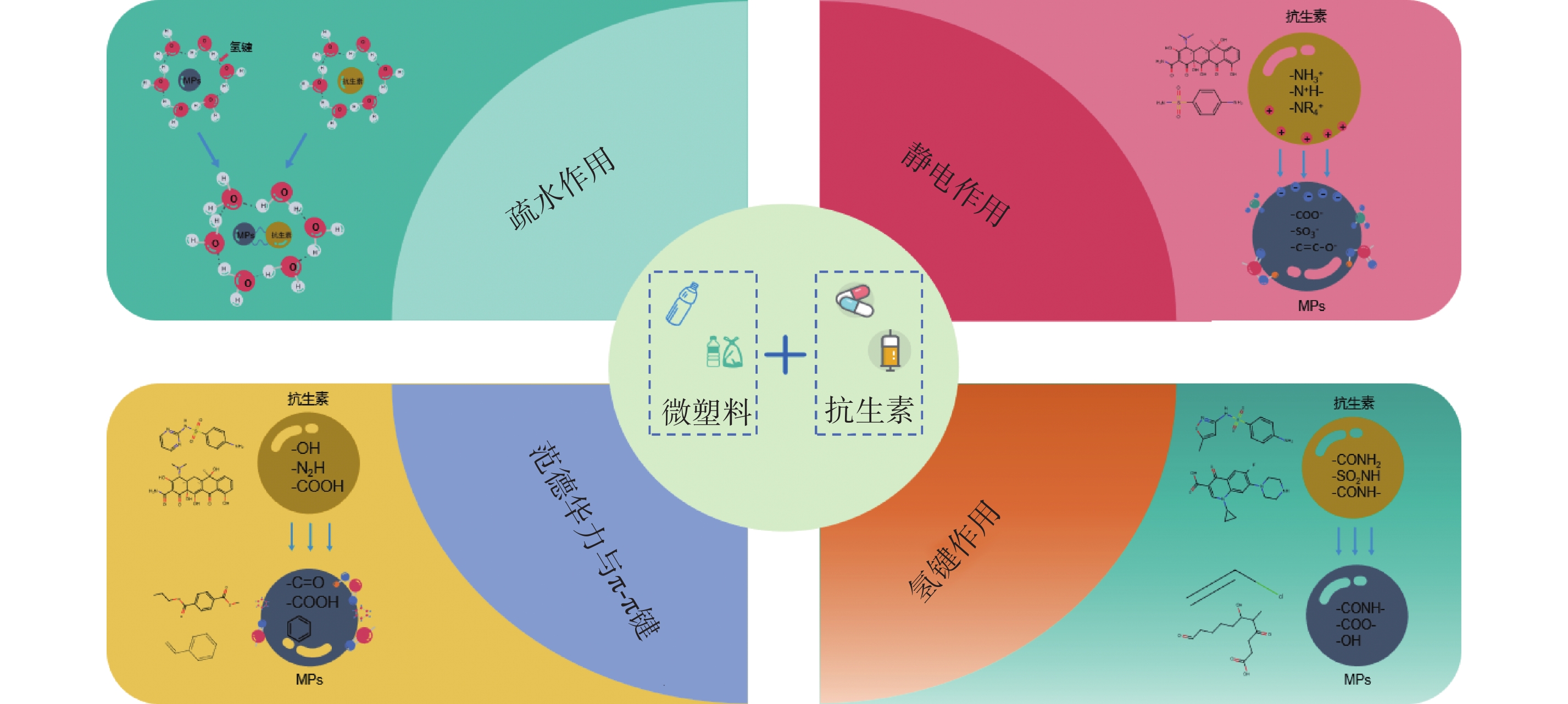
表3
微塑料对抗生素吸附机制"
| 微塑料类型 | 抗生素类型 | 微塑料尺寸/μm | 吸附顺序 | 吸附量/(mg/g) | 吸附方式 | 备注 | 参考文献 |
| PA | 环丙沙星 | 100~180 | PA>PP>PS | 1.205 | 静电作用, 氢键作用 | 极性, 酰胺键 | [ |
| PP | 0.688 | 范德华力 | 较大的孔隙结构 | ||||
| PS | 0.532 | 范德华力, | 苯环 | ||||
| PA | 环丙沙星 | 74 | PA>PP>PS | 3.740 | 静电作用, 氢键作用 | 极性,酰胺键 | [ |
| PP | 2.730 | 静电作用, 范德华力 | 非极性 | ||||
| PS | 2.540 | 范德华力 | |||||
| PBS | 诺氟沙星 | - | PS>PBS>PE | 0.091 | 氢键作用 | 比表面积: PBS>PS>PE | [ |
| PS | 0.186 | ||||||
| PE | 0.038 | ||||||
| PET | 诺氟沙星 | 100~300 | PE>PET>PA | 4.000 | 静电作用, 范德华力 | 比表面积: PET>PE>PA 电负性: PET>PE>PA | [ |
| PE | 4.000 | ||||||
| PA | 3.000 | ||||||
| PE | 土霉素 | 180~250 | PS>PE | 0.410 | 范德华力, 孔隙填充 | 比表面积: PS>PE | [ |
| PS | 180~250 | 2.600 | |||||
| PE | 250~550 | 0.092 | |||||
| PS | 250~550 | 0.290 | |||||
| PET | 头孢氨苄 | 100 | PET>PLA | 0.460 | 范德华力, | 非极性 | [ |
| PLA | 0.418 | 疏水作用, 静电作用 | 极性 |
表4
老化前后微塑料吸附抗生素量对比"
| 微塑料类型 | 抗生素类型 | 老化方法 | 老化前吸附量/(mg/g) | 老化后吸附量/(mg/g) | 参考文献 |
| PLA | 磺胺甲恶唑 | 过硫酸钾法 | 1.500 | 3.620 | [ |
| PE | 1.250 | 2.990 | |||
| PS | 0.730 | 0.804 | |||
| PLA | 四环素 | 过硫酸钾法 | 1.638 | 2.293 | [ |
| PET | 2.261 | 3.617 | |||
| PBS | 左氧氟沙星 | UV | 3.700 | 5.320 | [ |
| PVC | 土霉素 | UV | 1.380 | 2.130 | [ |
| TWP (轮胎颗粒) | 5.140 | 5.820 | |||
| PE | 环丙沙星 | UV + 过硫酸钠 | 0.160 | 0.280 | [ |
| PLA | 0.320 | 0.380 | |||
| PS | 环丙沙星 | 过硫酸钾 | 0.372 | 0.558 | [ |
| PVC | 四环素 | UV | 0.387 | 0.507 | [ |
| PE | 四环素 | UV | 2.023 | 2.138 | [ |
| PVC | 2.225 | 2.348 | |||
| PE | 四环素 | UV | 0.388 | 0.651 | [ |
| PS | 0.730 | 0.804 |
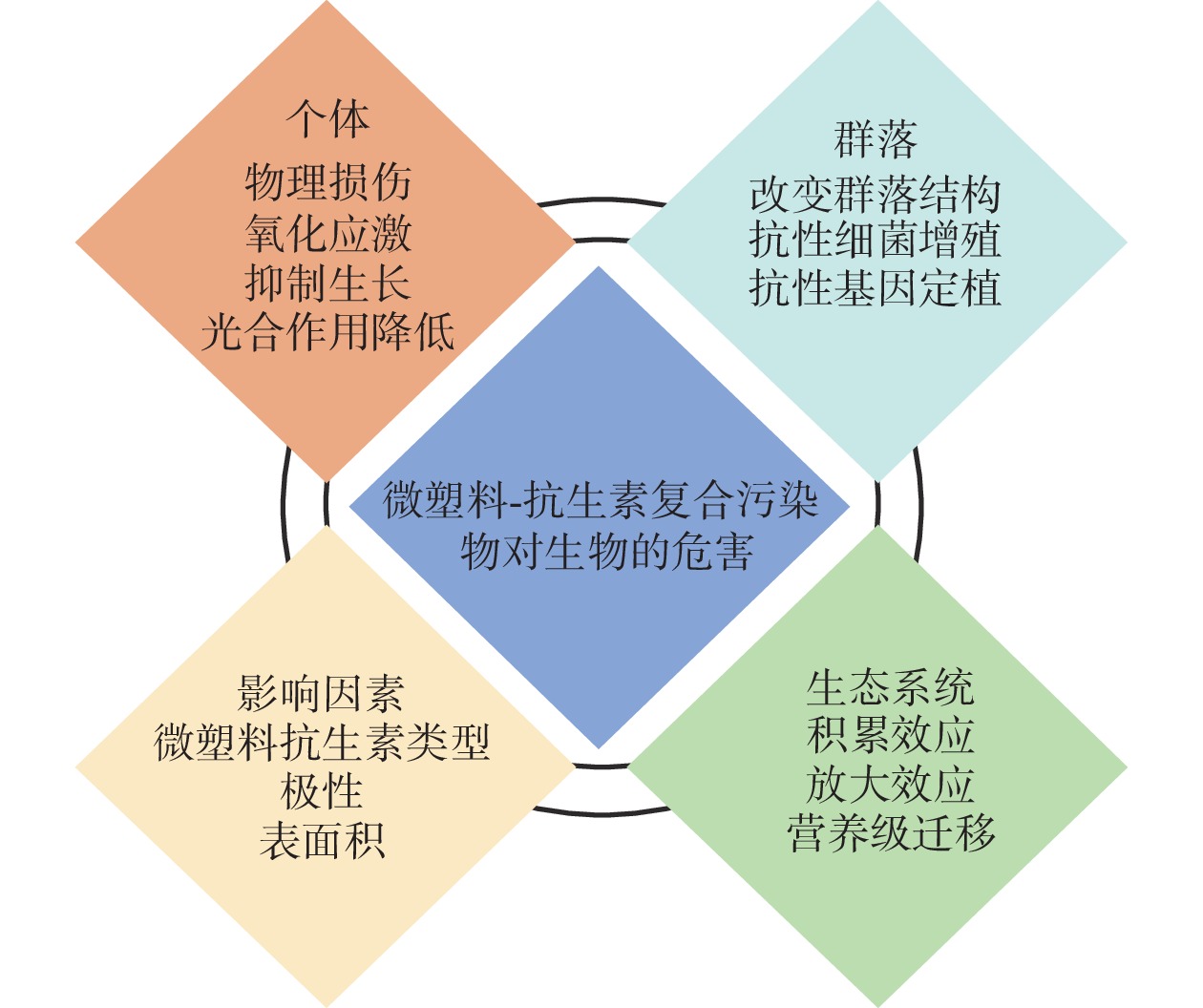
图3
复合污染物对生物的生态毒理"
| 1 | VANDERMEERSCH G, VAN CAUWENBERGHE L, JANSSEN C R, et al.. A critical view on microplastic quantification in aquatic organisms. Environmental Research, 2015, 143, 46- 55. |
| 2 | 杨杰, 李连祯, 周倩, 等.. 土壤环境中微塑料污染: 来源、过程及风险. 土壤学报, 2021, 58 (2): 281- 298. |
| 3 | THOMPSON R C, OLSEN Y, MITCHELL R P, et al.. Lost at sea: Where is all the plastic?. Science, 2004, 304 (5672): 838. |
| 4 | 干牧凡, 陆媛媛, 车景璐, 等.. 中国地表水微塑料分布与生态风险评估. 环境化学, 2025, 44 (9): 3184- 3197. |
| 5 | LIU G Z, ZHU Z L, YANG Y X, et al.. Sorption behavior and mechanism of hydrophilic organic chemicals to virgin and aged microplastics in freshwater and seawater. Environmental Pollution, 2019, 246, 26- 33. |
| 6 | 李佳乐, 王萌, 胡发旺, 等.. 江西锦江流域抗生素污染特征与生态风险评价. 环境科学, 2022, 43 (8): 4064- 4073. |
| 7 | BU Q W, WANG B, HUANG J, et al.. Pharmaceuticals and personal care products in the aquatic environment in China: A review. Journal of Hazardous Materials, 2013, 262, 189- 211. |
| 8 | KOLPIN D W, FURLONG E T, MEYER M T, et al.. Pharmaceuticals, hormones, and other organic wastewater contaminants in U. S. streams, 1999-2000: A national reconnaissance. Environmental Science & Technology, 2002, 36 (6): 1202- 1211. |
| 9 | KHAN N A, AHMED S, FAROOQI I H, et al.. Occurrence, sources and conventional treatment techniques for various antibiotics present in hospital wastewaters: A critical review. TrAC Trends in Analytical Chemistry, 2020, 129, 115921. |
| 10 | 江春雨, 吴兵党, 胡晓晖, 等. 长江流域地表水中抗生素的分布特征、驱动因素及生态健康风险评估 [J/OL]. 环境工程技术学报, 2025: 1-17. [2025-10-28]. https://kns.cnki.net/KCMS/detail/detail.aspx?filename=HKWZ20251027002&dbname=CJFD&dbcode=CJFQ. |
| 11 | 杨灿. 典型抗生素对水生生物的毒性效应及生态风险阈值研究 [D]. 上海: 华东理工大学, 2019. |
| 12 | 丁剑楠, 刘舒娇, 邹杰明, 等.. 太湖表层水体典型抗生素时空分布和生态风险评价. 环境科学, 2021, 42 (4): 1811- 1819. |
| 13 | LIU Y, ZHANG J D, CAI C Y, et al.. Occurrence and characteristics of microplastics in the Haihe River: An investigation of a seagoing river flowing through a megacity in northern China. Environmental Pollution, 2020, 262, 114261. |
| 14 | 赵国良. 微塑料在长江(重庆主城区段)的分布与迁移规律研究 [D]. 重庆: 重庆交通大学, 2020. |
| 15 | 张胜, 林莉, 潘雄, 等.. 汉江(丹江口坝下-兴隆段)水体中微塑料的赋存特征. 环境科学研究, 2022, 35 (5): 1203- 1210. |
| 16 | ZHAO S Y, ZHU L X, WANG T, et al.. Suspended microplastics in the surface water of the Yangtze Estuary System, China: First observations on occurrence, distribution. Marine Pollution Bulletin, 2014, 86 (1/2): 562- 568. |
| 17 | 陈鸿展, 区晖, 叶四化, 等.. 珠江广州段水体微塑料的分布特征及迁移规律. 中国环境监测, 2024, 40 (5): 109- 117. |
| 18 | 张成前, 时鹏, 张妍, 等.. 渭河流域关中段河水和沉积物中微塑料的污染特征对比研究. 环境科学学报, 2023, 43 (2): 241- 253. |
| 19 | 高凡. 内陆城市河流和污水厂中微塑料赋存特征研究 [D]. 西安: 西安工业大学, 2020. |
| 20 | WAN S, XU G C, XIONG P, et al.. Microplastic pollution characteristics and ecological risk assessment in the Wuding River Basin, China. Environmental Pollution, 2024, 356, 124228. |
| 21 | 牛学锐. 黄河口表层水微塑料赋存特征研究 [D]. 济南: 山东师范大学, 2020. |
| 22 | 李敏倩, 董文亮, 郭翊宸, 等.. 东江河源段表层水体及鱼类肠道中的微塑料污染特征. 水生态学杂志, 2024, 45 (5): 159- 169. |
| 23 | 武帆. 城市河道水体和沉积物中微塑料的时空污染特征研究 [D]. 太原: 太原理工大学, 2021. |
| 24 | 陈圣盛, 李卫明, 张坤, 等.. 香溪河流域微塑料的分布特征及其迁移规律分析. 环境科学, 2022, 43 (6): 3077- 3087. |
| 25 | ZHOU G Y, WANG Q G, ZHANG J, et al.. Distribution and characteristics of microplastics in urban waters of seven cities in the Tuojiang River basin, China. Environmental Research, 2020, 189, 109893. |
| 26 | 刘咏雪. 贵阳市南明河流域微塑料分布特征及风险评估研究 [D]. 贵阳: 贵州大学, 2022. |
| 27 | 李江南, 凌玮, 沈茜, 等.. 双台子河与大辽河表层水体微塑料特征与分布研究. 生态毒理学报, 2021, 16 (3): 192- 199. |
| 28 | 李思敏, 赵瑞雪, 孟鑫, 等.. 漳河邯郸段水体微塑料分布特征及影响因素. 环境化学, 2025, 44 (4): 1155- 1168. |
| 29 | 张鹏举, 蓝洁, 张凯璇, 等.. 大沽河流域微塑料在不同介质中的空间分布及其潜在来源探究. 环境化学, 2023, 42 (12): 4093- 4103. |
| 30 | 何文宣, 李垒, 孙思宇, 等.. 北运河水体、沉积物和鱼类中微塑料的分布特征研究. 生态环境学报, 2023, 32 (11): 1901- 1912. |
| 31 | 都皓辰. 洞庭湖流域主要环境介质中微塑料赋存与时空分布特征研究 [D]. 上海: 华东师范大学, 2023. |
| 32 | 陈馨. 巢湖微塑料的污染现状及空间分布差异 [D]. 合肥: 安徽大学, 2023. |
| 33 | ZHANG Q J, LIU T, LIU L, et al.. Distribution and sedimentation of microplastics in Taihu Lake. Science of the Total Environment, 2021, 795, 148745. |
| 34 | 周雨柔, 姚娜, 胡超, 等.. 亚热带浅水型内湖水体与沉积物微塑料分布特征及来源: 以大明湖为例. 环境化学, 2025, 44 (3): 1006- 1014. |
| 35 | WANG W F, YUAN W K, CHEN Y L, et al.. Microplastics in surface waters of Dongting Lake and Hong Lake, China. Science of the Total Environment, 2018, 633, 539- 545. |
| 36 | DI M X, WANG J. Microplastics in surface waters and sediments of the Three Gorges Reservoir, China [J]. Science of the Total Environment, 2018, 616/617: 1620-1627. |
| 37 | 何文宣, 李垒, 李久义, 等.. 密云水库中微塑料的污染特征及生态风险评估. 环境科学学报, 2022, 42 (12): 122- 135. |
| 38 | 潘雄, 林莉, 张胜, 等.. 丹江口水库及其入库支流水体中微塑料组成与分布特征. 环境科学, 2021, 42 (3): 1372- 1379. |
| 39 | 刘运钊. 大房郢水库微塑料污染现状和生态风险评价 [D]. 合肥: 安徽大学, 2022. |
| 40 | NIU J Q, GAO B, WU W Q, et al.. Occurrence, stability and source identification of small size microplastics in the Jiayan reservoir, China. Science of the Total Environment, 2022, 807, 150832. |
| 41 | 任娇阳. 北京市潮白河流域抗生素污染分布与风险评估 [D]. 北京: 北京交通大学, 2021. |
| 42 | 王娅南, 彭洁, 黄合田, 等.. 贵阳市城市河流典型抗生素的分布特征. 环境化学, 2018, 37 (9): 2039- 2048. |
| 43 | 唐文雅, 竺美, 毛淑娟, 等.. 成都市锦江流域抗生素污染特征及生态风险. 四川环境, 2024, 43 (5): 147- 153. |
| 44 | JIA J, GUAN Y J, CHENG M Q, et al.. Occurrence and distribution of antibiotics and antibiotic resistance genes in Ba River, China. Science of the Total Environment, 2018, 642, 1136- 1144. |
| 45 | 李思敏, 郝婧延, 孟鑫, 等.. 典型北方城市河流抗生素时空分布特征、影响因素及生态风险评估. 环境科学, 2025, 46 (10): 6254- 6263. |
| 46 | 周志洪, 赵建亮, 魏晓东, 等.. 珠江广州段水体抗生素的复合污染特征及其生态风险. 生态环境学报, 2017, 26 (6): 1034- 1041. |
| 47 | 周艾诗. 皂河水土环境中抗生素的分布特征及微生物群落的响应机制 [D]. 西安: 长安大学, 2024. |
| 48 | 辛银平, 张培, 侯东瑞, 等. 贾鲁河流域抗生素的污染特征及生态风险评价 [J/OL]. 环境科学与技术, 2025: 1-14. [2025-10-27]. https://kns.cnki.net/KCMS/detail/detail.aspx?filename=FJKS20251024001&dbname=CJFD&dbcode=CJFQ. |
| 49 | GAO H, ZHAO F Q, LI R J, et al.. Occurrence and distribution of antibiotics and antibiotic resistance genes in water of Liaohe River Basin, China. Journal of Environmental Chemical Engineering, 2022, 10 (5): 108297. |
| 50 | 卢正山. 浑河沈抚段水体典型抗生素分布特征及风险评价 [D]. 沈阳: 沈阳师范大学, 2020. |
| 51 | 李柏林, 张贺, 王俊, 等.. 长江武汉段水源地典型抗生素及抗性基因污染特征与生态风险评价. 环境科学, 2023, 44 (4): 2032- 2039. |
| 52 | YANG J F, YING G G, ZHAO J L, et al.. Spatial and seasonal distribution of selected antibiotics in surface waters of the Pearl Rivers, China. Journal of Environmental Science and Health Part B, Pesticides, Food Contaminants, and Agricultural Wastes, 2011, 46 (3): 272- 280. |
| 53 | 邱晓键. 鄱阳湖流域水体和生物体中抗生素浓度分布特征 [D]. 南昌: 南昌大学, 2024. |
| 54 | LIU X H, LU S Y, MENG W, et al.. Occurrence, source, and ecological risk of antibiotics in Dongting Lake, China. Environmental Science and Pollution Research, 2018, 25 (11): 11063- 11073. |
| 55 | 吴海欣, 孙钰钰, 刘桂建, 等.. 巢湖主体流域多种抗生素的空间分布、源解析与风险评估. 环境科学, 2024, 45 (12): 7049- 7059. |
| 56 | 肖鑫鑫, 吴亦潇, 丁惠君, 等.. 武汉城市湖泊抗生素及抗性基因的污染特征研究. 环境科学与技术, 2019, 42 (3): 9- 16. |
| 57 | 廖杰, 魏晓琴, 肖燕琴, 等.. 莲花水库水体中抗生素污染特征及生态风险评价. 环境科学, 2020, 41 (9): 4081- 4087. |
| 58 | 莫苑敏, 黄亮亮, 王倩, 等.. 广西青狮潭水库水体喹诺酮类抗生素的分布特征及生态风险评价. 湖泊科学, 2019, 31 (1): 124- 133. |
| 59 | 李静. 丹江口水库抗生素抗性基因分布及其影响因素分析 [D]. 湖北 十堰: 湖北医药学院, 2024. |
| 60 | 董莞莞, 何欣, 郑洪波, 等.. 大连碧流河水库及河流典型抗生素污染和分布特征研究. 大连理工大学学报, 2020, 60 (2): 119- 127. |
| 61 | LUO Y, XU L, RYSZ M, et al.. Occurrence and transport of tetracycline, sulfonamide, quinolone, and macrolide antibiotics in the Haihe River Basin, China. Environmental Science & Technology, 2011, 45 (5): 1827- 1833. |
| 62 | LIU R M, WANG Y N, WANG L F, et al.. Spatio-temporal distribution and source identification of antibiotics in suspended matter in the Fen River Basin. Chemosphere, 2023, 345, 140497. |
| 63 | 蒋春华, 易津旭, 朱礼鑫, 等.. 水体微塑料的垂向分布及采样方法比较研究——以九龙江河口为例. 华东师范大学学报(自然科学版), 2024, (1): 79- 89. |
| 64 | 王余意, 黄晔, 杨静, 等.. 长江口及其近岸海域抗生素的时空分异特征与生态风险评估. 华东师范大学学报(自然科学版), 2024, (6): 136- 150. |
| 65 | SANTOS L H M L M, RODRÍGUEZ-MOZAZ S, BARCELÓ D.. Microplastics as vectors of pharmaceuticals in aquatic organisms–An overview of their environmental implications. Case Studies in Chemical and Environmental Engineering, 2021, 3, 100079. |
| 66 | ZHUANG S T, WANG J L.. Interaction between antibiotics and microplastics: Recent advances and perspective. Science of the Total Environment, 2023, 897, 165414. |
| 67 | STAPLETON M J, ANSARI A J, HAI F I.. Antibiotic sorption onto microplastics in water: A critical review of the factors, mechanisms and implications. Water Research, 2023, 233, 119790. |
| 68 | GUO X, WANG J L.. Sorption of antibiotics onto aged microplastics in freshwater and seawater. Marine Pollution Bulletin, 2019, 149, 110511. |
| 69 | LI X, JIANG H T, ZHU L Y, et al.. Adsorption interactions between typical microplastics and enrofloxacin: Relevant contributions to the mechanism. Chemosphere, 2024, 351, 141181. |
| 70 | HUANG D F, XU Y B, YU X Q, et al.. Effect of cadmium on the sorption of tylosin by polystyrene microplastics. Ecotoxicology and Environmental Safety, 2021, 207, 111255. |
| 71 | ZHANG Y, LI Y H, WANG Y Y, et al.. Adsorption of levofloxacin by ultraviolet aging microplastics. Chemosphere, 2023, 343, 140196. |
| 72 | GUO C X, WANG L L, LANG D N, et al.. UV and chemical aging alter the adsorption behavior of microplastics for tetracycline. Environmental Pollution, 2023, 318, 120859. |
| 73 | GUO X, LIU Y, WANG J L.. Sorption of sulfamethazine onto different types of microplastics: A combined experimental and molecular dynamics simulation study. Marine Pollution Bulletin, 2019, 145, 547- 554. |
| 74 | LI J, ZHANG K N, ZHANG H.. Adsorption of antibiotics on microplastics. Environmental Pollution, 2018, 237, 460- 467. |
| 75 | ZAHMATKESH ANBARANI M, NAJAFPOOR A, BARIKBIN B, et al.. Adsorption of tetracycline on polyvinyl chloride microplastics in aqueous environments. Scientific Reports, 2023, 13, 17989. |
| 76 | WU J Y, JIANG R F, LIN W, et al.. Effect of salinity and humic acid on the aggregation and toxicity of polystyrene nanoplastics with different functional groups and charges. Environmental Pollution, 2019, 245, 836- 843. |
| 77 | WANG K, HAN T, CHEN X D, et al.. Insights into behavior and mechanism of tetracycline adsorption on virgin and soil-exposed microplastics. Journal of Hazardous Materials, 2022, 440, 129770. |
| 78 | ZHANG Y H, CHEN Z H, SHI Y X, et al.. Revealing the sorption mechanisms of carbamazepine on pristine and aged microplastics with extended DLVO theory. Science of the Total Environment, 2023, 874, 162480. |
| 79 | FENG Y K, ZHANG W, LI J L, et al.. Adsorption behavior and mechanism of tetracycline on microplastics subjected to peroxymonosulfate and alkaline aging. Separation and Purification Technology, 2025, 354, 128956. |
| 80 | 赵靖华. 老化微/纳塑料对水中典型污染物的吸附行为及作用机理研究 [D]. 江西 赣州: 江西理工大学, 2020. |
| 81 | HU P, DOU Y Y, JI B H, et al.. Chlorination-improved adsorption capacity of microplastics for antibiotics: A combined experimental and molecular mechanism investigation. Journal of Hazardous Materials, 2024, 467, 133734. |
| 82 | SUN M, YANG Y K, HUANG M L, et al.. Adsorption behaviors and mechanisms of antibiotic norfloxacin on degradable and nondegradable microplastics. Science of the Total Environment, 2022, 807, 151042. |
| 83 | 王一飞. 微塑料对氟喹诺酮类抗生素的吸附作用 [D]. 浙江 金华: 浙江师范大学, 2021. |
| 84 | 张凯娜. 抗生素在微塑料表面的吸附行为研究 [D]. 山东 烟台: 烟台大学, 2018. |
| 85 | 李哲. 微塑料的老化及其对水中抗生素的吸附行为 [D]. 沈阳: 辽宁大学, 2023. |
| 86 | 范秀磊, 甘容, 谢雅, 等.. 老化前后聚乳酸和聚乙烯微塑料对抗生素的吸附解吸行为. 环境科学研究, 2021, 34 (7): 1747- 1756. |
| 87 | 孔凡星, 许霞, 薛银刚, 等.. 微塑料老化对四环素吸附行为的影响. 环境科学研究, 2021, 34 (9): 2182- 2190. |
| 88 | 王文英, 王继东, 张雪怡, 等.. 老化微塑料对左氧氟沙星吸附行为的影响. 安徽农业大学学报, 2024, 51 (3): 465- 472. |
| 89 | 范秀磊, 邹晔锋, 刘加强, 等.. 老化前后轮胎磨损微粒与聚氯乙烯微粒对抗生素的吸附-解吸行为. 环境科学, 2021, 42 (4): 1901- 1912. |
| 90 | 梁金妮. 珠江河口沉积物微塑料污染及其对环丙沙星的吸附与迁移的影响研究 [D]. 广州: 华南理工大学, 2023. |
| 91 | 张开心. 老化塑料在水环境中迁移性能及其对典型抗生素环境行为的影响研究 [D]. 济南: 山东大学, 2022. |
| 92 | TIAN Y J, ZHU J Y, YING C H, et al.. Photoaging processes of polyvinyl chloride microplastics enhance the adsorption of tetracycline and facilitate the formation of antibiotic resistance. Chemosphere, 2023, 320, 137820. |
| 93 | 程新峰, 留芳芳, 潘玲, 等.. 微塑料老化对其理化性质和盐酸四环素吸附行为的影响研究. 环境科学学报, 2023, 43 (3): 150- 161. |
| 94 | 王林, 王姝歆, 曾祥英, 等.. 老化作用对微塑料吸附四环素的影响及其机制. 环境科学, 2022, 43 (10): 4511- 4521. |
| 95 | ZAFAR R, PARACHA R Z, ALREFAEI A F, et al.. Removal of four antibiotics from the aqueous phase using Polyethylene adsorbent: Mechanistic understanding and reusability potential. Environmental Technology & Innovation, 2024, 36, 103831. |
| 96 | MEJÍAS C, MARTÍN J, MARTÍN-POZO L, et al.. Adsorption of macrolide antibiotics and a metabolite onto polyethylene terephthalate and polyethylene microplastics in aquatic environments. Antibiotics, 2024, 13 (5): 408. |
| 97 | ATUGODA T, WIJESEKARA H, WERELLAGAMA D R I B, et al.. Adsorptive interaction of antibiotic ciprofloxacin on polyethylene microplastics: Implications for vector transport in water. Environmental Technology & Innovation, 2020, 19, 100971. |
| 98 | LIU P, DAI J M, BIE C Y, et al.. Bioaccessibility of microplastic-associated antibiotics in freshwater organisms: Highlighting the impacts of biofilm colonization via an in vitro protocol. Environmental Science & Technology, 2022, 56 (17): 12267- 12277. |
| 99 | 孔娟. 环境浓度氧四环素和聚苯乙烯微塑料复合暴露对斑马鱼生长及肠道健康的影响 [D]. 武汉: 华中农业大学, 2022. |
| 100 | 盛诚, 王馨颖, 易珍, 等.. 不同材质微塑料对三氯生的吸附及其在斑马鱼体内累积分布的影响. 生态毒理学报, 2020, 15 (5): 108- 117. |
| 101 | ZHANG P, LU G H, SUN Y, et al.. Aged microplastics change the toxicological mechanism of roxithromycin on Carassius auratus: Size-dependent interaction and potential long-term effects. Environment International, 2022, 169, 107540. |
| 102 | 刘雪薇. 粒径与表面官能团依赖的微塑料和抗生素对绿藻的联合毒性 [D]. 石家庄: 河北科技大学, 2024. |
| 103 | WEN J Y, GAO J X, LIU Y J, et al.. Toxicological mechanisms and molecular impacts of tire particles and antibiotics on zebrafish. Environmental Pollution, 2024, 362, 124912. |
| 104 | ZHANG P, LU G H, SUN Y, et al.. Effect of microplastics on oxytetracycline trophic transfer: Immune, gut microbiota and antibiotic resistance gene responses. Journal of Hazardous Materials, 2024, 470, 134147. |
| 105 | 韦丽超. 纳米级聚苯乙烯微塑料与磺胺类抗生素对狸藻的生态毒理研究 [D]. 广西 桂林: 桂林理工大学, 2022. |
| 106 | 郝双玲. 微塑料与四环素对铜绿微囊藻的共同影响研究 [D]. 江苏 苏州: 苏州科技大学, 2021. |
| 107 | XU D M, XIAO Y P, PAN H, et al.. Toxic effects of tetracycline and its degradation products on freshwater green algae. Ecotoxicology and Environmental Safety, 2019, 174, 43- 47. |
| 108 | 孔娟, 范博雅, 原居林, 等.. 环境浓度氧四环素与聚苯乙烯微塑料对黄颡鱼幼鱼肠道的联合毒性效应. 生态毒理学报, 2023, 18 (1): 426- 439. |
| 109 | LIU S L, YAN L, ZHANG Y L, et al.. Polystyrene nanoplastics exacerbated the ecotoxicological and potential carcinogenic effects of tetracycline in juvenile grass carp (Ctenopharyngodon idella). Science of the Total Environment, 2022, 803, 150027. |
| 110 | LI N, ZENG Z T, ZHANG Y F, et al.. Higher toxicity induced by co-exposure of polystyrene microplastics and chloramphenicol to Microcystis aeruginosa: Experimental study and molecular dynamics simulation. Science of the Total Environment, 2023, 866, 161375. |
| 111 | ZHANG L, DENG X, QIN Z, et al. Aging amplifies the combined toxic effects of polystyrene nanoplastics and norfloxacin on human intestinal cells [J]. Environmental Science: Nano, 2025(12): 5358-5372. |
| 112 | YU Z Y, ZHANG L, HUANG Q S, et al.. Combined effects of micro-/ nano-plastics and oxytetracycline on the intestinal histopathology and microbiome in zebrafish (Danio rerio). Science of the Total Environment, 2022, 843, 156917. |
| 113 | FANG C L, ZHU J H, XU H G, et al.. Polystyrene microplastics and cypermethrin exposure interfered the complexity of antibiotic resistance genes and induced metabolic dysfunction in the gut of adult zebrafish. Environmental Pollution, 2025, 374, 126288. |
| 114 | YANG H, XU X R, DENG J Y, et al.. Nanoplastics amplify ARG colonization and Alter microbial communities in the phycosphere of Chlorella pyrenoidosa under antibiotic stress. Environmental Chemistry and Ecotoxicology, 2025, 7, 1216- 1226. |
| 115 | JIA J, LIU Q, WU C X.. Microplastic and antibiotic proliferated the colonization of specific bacteria and antibiotic resistance genes in the phycosphere of Chlorella pyrenoidosa. Journal of Hazardous Materials, 2023, 455, 131618. |
| [1] | 胡杨杨, 刘畅, 曹承进, 李俊豪, 吴流星, 朱锐云, 黄民生, 何岩, 都皓辰, 王磊, 严欣霖. 太湖流域重点行业工业废水中微塑料赋存特征与风险评估研究[J]. 华东师范大学学报(自然科学版), 2026, 2026(1): 14-24. |
| [2] | 尹国宇, 郑栋升, 李晔, 黄晔, 刘敏. 中国河口沉积物抗生素及抗性基因地理格局和驱动机制[J]. 华东师范大学学报(自然科学版), 2024, 2024(6): 86-98. |
| [3] | 关铭茵, 刘欣然, 刘敏, 杨静, 谢泽莹, 张庆玲, 李倩. 典型场地土壤剖面中抗生素及其抗性基因的分布特征[J]. 华东师范大学学报(自然科学版), 2024, 2024(6): 74-85. |
| [4] | 胡雯桉, 沈城, 孙慧伦, 王强, 刘敏. 抗生素与抗性基因在畜禽养殖中的环境影响及生态风险[J]. 华东师范大学学报(自然科学版), 2024, 2024(6): 151-160. |
| [5] | 马翠竹, 赵雯君, 陈昱霏, 施华宏. 微塑料的生物示踪和生物成像技术研究进展[J]. 华东师范大学学报(自然科学版), 2024, 2024(6): 14-23. |
| [6] | 王余意, 黄晔, 杨静, 丁方方, 何天豪, 李雨珊, 黄琳, 李晔, 刘敏. 长江口及其近岸海域抗生素的时空分异特征与生态风险评估[J]. 华东师范大学学报(自然科学版), 2024, 2024(6): 136-150. |
| [7] | 刘燕, 邱荣, 曹潇慕, 梁雨晴, 曹雪龙, 何德富. 上海餐厨垃圾处理及有机肥介导的土壤微塑料污染[J]. 华东师范大学学报(自然科学版), 2024, 2024(6): 114-123. |
| [8] | 蒋春华, 易津旭, 朱礼鑫, 刘凯, 宗常兴, 李道季. 水体微塑料的垂向分布及采样方法比较研究——以九龙江河口为例[J]. 华东师范大学学报(自然科学版), 2024, 2024(1): 79-89. |
| [9] | 李道季, 董旭日. 海洋环境中的微塑料及其附着生物研究进展[J]. 华东师范大学学报(自然科学版), 2022, 2022(3): 1-7. |
| [10] | 李翔, 田慧敏, 吴靖颖, 陈思雨, 赵明明, 徐平, 陈雪初, 由文辉. 奉贤滨海湿地蟹类和蟹洞的分布特征及影响因子[J]. 华东师范大学学报(自然科学版), 2021, 2021(2): 160-170. |
| [11] | 李道季, 朱礼鑫, 常思远, 张峰, 王璐. 海洋微塑料污染研究发展态势及存在问题[J]. 华东师范大学学报(自然科学版), 2019, 2019(3): 174-185. |
| [12] | 李仪, 张炎, 张雅婷, 何品刚, 王清江. 微萃取超高效液相色谱检测磺胺类药物的研究[J]. 华东师范大学学报(自然科学版), 2019, 2019(2): 156-163. |
| [13] | 胡雪芹,王强,马明睿,徐春燕,由文辉. 淀山湖叶绿素a分布特征及其与浮游植物密度的相关性[J]. 华东师范大学学报(自然科学版), 2012, 2012(4): 149-156, 163. |
| 阅读次数 | ||||||
|
全文 |
|
|||||
|
摘要 |
|
|||||
