
 中文核心期刊
华东师范大学学报(自然科学版) ›› 2026, Vol. 2026 ›› Issue (1): 66-77.doi: 10.3969/j.issn.1000-5641.2026.01.006
王静1,2,3,4, 何岩1,2,3,4,*( )
)
收稿日期:2025-09-08
接受日期:2025-12-15
出版日期:2026-01-25
发布日期:2026-01-29
通讯作者:
何岩
E-mail:yhe@des.ecnu.edu.cn
基金资助:
Jing WANG1,2,3,4, Yan HE1,2,3,4,*()
Received:2025-09-08
Accepted:2025-12-15
Online:2026-01-25
Published:2026-01-29
Contact:
Yan HE
E-mail:yhe@des.ecnu.edu.cn
摘要:
人工湿地通常作为污水厂尾水排入自然水体前的最后一道屏障, 其如何有效处理“碳源缺乏、高营养负荷”的尾水是亟需解决的瓶颈问题. 富铁基质因具有强吸附性、氧化还原性、生物亲和性的独特优势可为上述问题的有效解决提供新思路. 本文评述了富铁基质在人工湿地中的研究方向与热点, 并基于尾水湿地着重探讨了不同类型富铁基质对低碳氮比废水的净化效果, 同时揭示了富铁基质驱动微生物耦合铁-氮循环脱氮, 协同表面吸附、化学沉淀、配体交换和共沉淀除磷的增效机制. 并针对富铁基质人工湿地长期运行后可能出现的铁钝化与堵塞、铁死亡、反硝化副产物积累等问题, 从材料研发、系统优化、机理探究等方面对未来研究给予建议, 以期为提高污水厂尾水人工湿地净化效率及长期稳定运行提供有力支持.
中图分类号:
王静, 何岩. 富铁基质人工湿地在低碳氮比废水处理中的应用研究进展[J]. 华东师范大学学报(自然科学版), 2026, 2026(1): 66-77.
Jing WANG, Yan HE. Research progress on the application of constructed wetlands with iron-rich substrates for low C/N ratio wastewater treatment[J]. J* E* C* N* U* N* S*, 2026, 2026(1): 66-77.
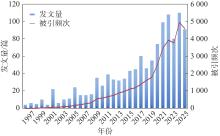
图1
富铁基质人工湿地研究的年发文量及被引频次"
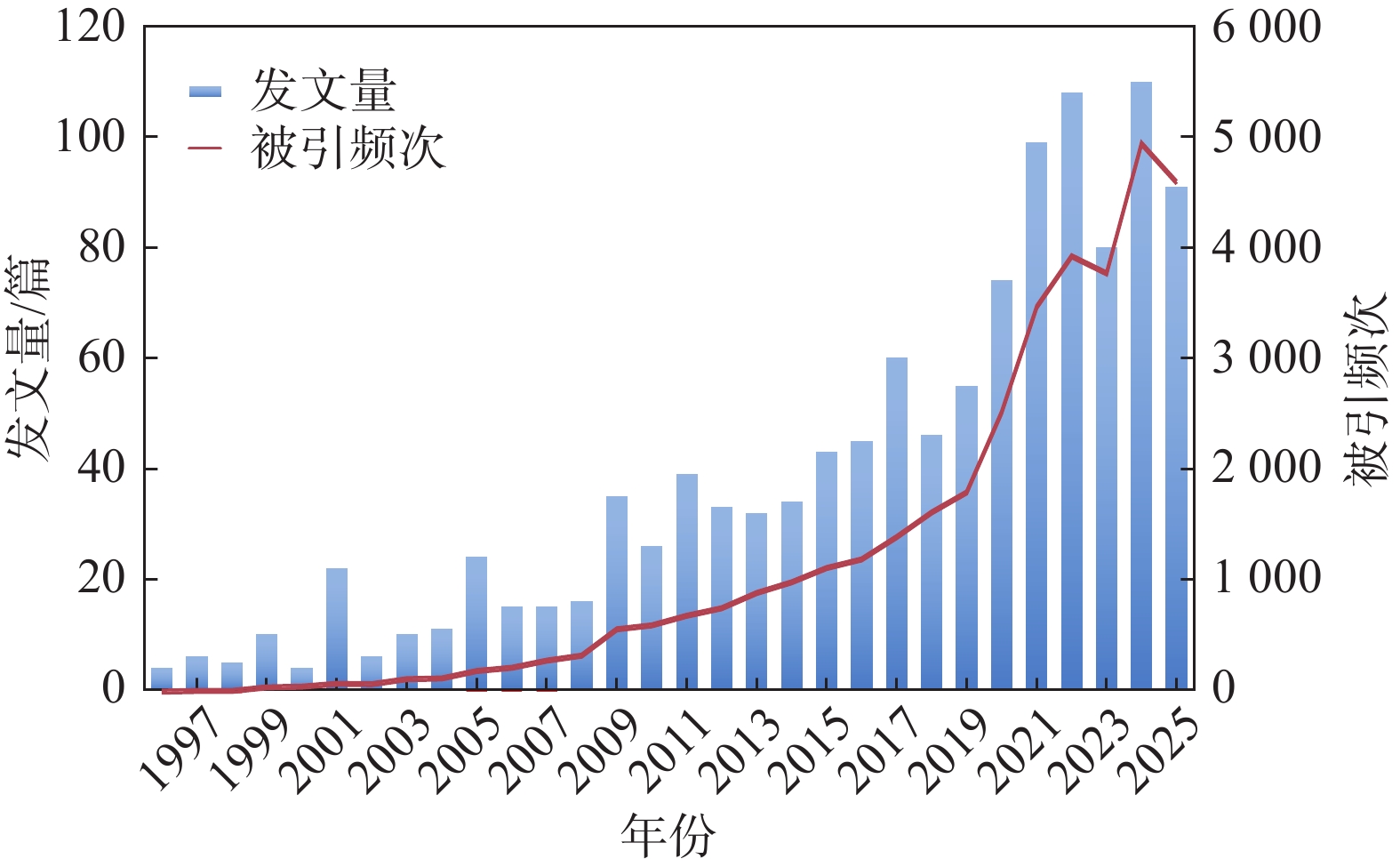
图2
富铁基质人工湿地研究的关键词聚类时间线图"
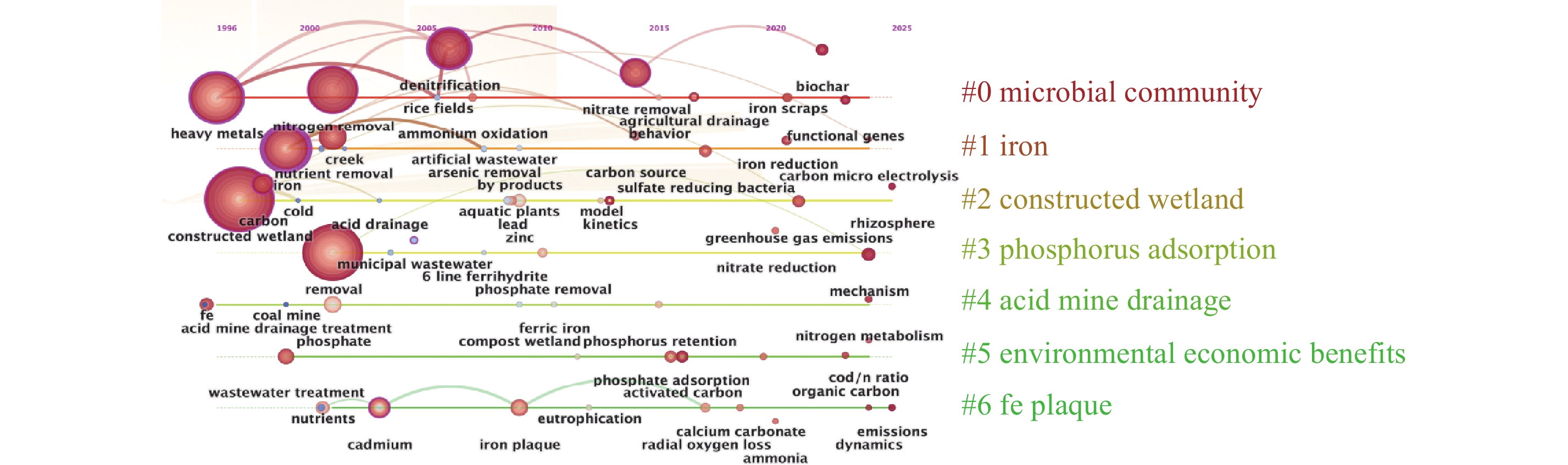
表1
不同类型富铁基质人工湿地处理低碳氮比废水的效能和成本对比"
| 类型 | 特点 | 富铁基质 | 湿地类型 | HRT/d | 进水水质/(mg/L) | C/N | 去除率/% | 成本/ (元/kg NO3–-N) | 文献 |
| 单质铁 | 活性高 还原性强 易钝化 易发生铵的累积 | 纳米零价铁 | 垂直潜流 人工湿地 | 2 | TN: 25.0±0.9 NH4+: 5.0±0.2 NO3–: 20.0±0.6 | 1.6 | TN: 69.92±0.56 NH4+: 86.56±0.93 NO3–: 66.42±1.33 | 900~ | [ |
| 海绵铁 | 垂直潜流 人工湿地 | 2 | TN: 15.23±1.05 NH4+: 5.61±0.55 NO3–: 10.72±0.66 TP: 0.54±0.06 | 1.3 | TN: 93.37 NH4+: 84.31 NO3–: 67.07 TP: 22.22 | 35~45 | [ | ||
| 铁屑 | 垂直潜流 人工湿地 | 1 | TN: 19.92±0.36 NH4+: 7.88±0.19 NO3–: 12.01±0.12 TP: 1.03±0.01 | 1.19 | TN: 71.56 NH4+: 43.73 NO3–: 86.77 TP: 93.54±6.64 | 15~25 | [ | ||
| Fe(Ⅱ)/ Fe(Ⅲ) 矿物 | 成本低廉 生物亲和性较高 化学性质稳定 反应速率较慢 | 黄铁矿 | 垂直潜流 人工湿地 | 3 | NO3–: 22.09±0.56 TP: 1.05±0.04 | 3 | TN: 67.82±0.97 TP: 83.62±4.77 | 8.6~12.5 | [ |
| 赤铁矿 | 垂直潜流 人工湿地 | 2 | NH4+: 35 TP: 5 | 0 | NH4+: 73.43 TP: >90 | [ | |||
| 磁黄铁矿 | 水平潜流 人工湿地 | 1.5 | TN: 23.60±7.12 NH4+: 6.61±4.04 NO3–: 11.85±5.35 TP: 4.88±0.88 | 约1 | TN: 60.40±5.60 NH4+: 66.02±13.82 NO3–: 63.22±12.12 TP: 88.20±5.10 | [ | |||
| 菱铁矿-硫 | 垂直潜流 人工湿地 | 2 | TN: 39.91±1.02 TP: 37.20 | 1.45 | TN: 91.6±2.2 TP: 96.3±1.2 | [ | |||
| 铁碳复 合材料 | 活性高且持久 延缓钝化 降低温室气体排放 成本高 | 铁屑+ 生物炭 | 水平潜流 人工湿地 | 2 | NH4+: 4.05±0.18 NO2–: 0.06±0.02 NO3–: 10.15±0.36 TP: 0.43±0.03 | 0 | TN: 52.08±2.54 NH4+: >95 TP: >76 | 337.5~675.0 | [ |
| 黄铁矿+ 活性炭 | 垂直潜流 人工湿地 | 7 | TN: 15 NH4+: 5 NO3–: 10 TP: 1 | 0.5 | NO3-: 92.55 NH4+: 78.00 TN: 87.59 | [ | |||
| 铁改性 生物炭 | 垂直潜流 人工湿地 | 2 | TN: 20.74±1.82 NH4+: 9.38±0.42 NO3–: 10.68±1.06 TP: 1.01±0.12 | 2.96 | TN: 83.51 NH4+: 98.23 NO3–: 80.88 TP: 86.55 | [ |
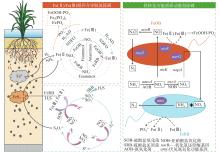
图3
富铁基质强化人工湿地脱氮除磷机制"
表2
富铁基质人工湿地中部分铁氧化菌和铁还原菌及其功能"
| 种类 | 优势菌门 | 富铁基质类型 | 优势菌属 | 功能 | 文献 |
| 铁氧化菌 | 变形菌门 | 铁碳复合材料 | 食酸菌属 (Acidovorax) | 驱动NDFO脱氮 | [ |
| 黄铁矿 铁碳复合材料 铁屑 磁黄铁矿 纳米零价铁 | 硫杆菌属 (Thiobacillus) | 还原NO3− | [ [ [ [ [ | ||
| 铁碳复合材料 铁屑 | 脱氯单胞菌属 (Dechloromonas) | 驱动硝酸盐还原亚铁氧化脱氮 吸收磷 | [ [ | ||
| 磁黄铁矿 | 磁螺菌属 (Magnetospirillum) | 驱动硝酸盐还原亚铁氧化脱氮 | [ | ||
| 纳米零价铁 黄铁矿 | 陶厄氏菌属 (Thauera) | 还原NO2−或NO生成N2 | [ [ | ||
| 黄铁矿 | 罗河杆菌属 (Rhodanobacter) | 驱动硝酸盐还原亚铁氧化脱氮 | [ | ||
| 铁还原菌 | 变形菌门 | 铁碳复合材料 | 希瓦氏菌属 (Shewanella) | 驱动反硝化和DNRA脱氮 | [ |
| 铁碳复合材料 黄铁矿 铁屑 | 地杆菌属 (Geobacter) | 参与Feammox 脱氮 | [ [ [ | ||
| 黄铁矿 铁屑 | 厌氧粘杆菌属 (Anaeromyxobacter) | 驱动DNRA脱氮 | [ [ |
| 1 | FAN Y Y, SUN S S, GU X S, et al.. Boosting the denitrification efficiency of iron-based constructed wetlands in situ via plant biomass-derived biochar: Intensified iron redox cycle and microbial responses. Water Research, 2024, 253, 121285. |
| 2 | LU W W, ZHONG F, WU J, et al.. Decoding constructed wetlands: A meta-analysis of performance and key drivers in tail water treatment. Process Safety and Environmental Protection, 2025, 197, 107040. |
| 3 | YANG Y, CHEN T H, MORRISON L, et al.. Nanostructured pyrrhotite supports autotrophic denitrification for simultaneous nitrogen and phosphorus removal from secondary effluents. Chemical Engineering Journal, 2017, 328, 511- 518. |
| 4 | XU Z S, QIAO W W, SONG X S, et al.. Pathways regulating the enhanced nitrogen removal in a pyrite based vertical-flow constructed wetland. Bioresource Technology, 2021, 325, 124705. |
| 5 | CHANG Y T, MENG J Z, HU Y S, et al.. A review in Fe(0)/Fe(Ⅱ) mediated autotrophic denitrification for low C/N wastewater treatment. Water Research, 2025, 282, 123925. |
| 6 | HU X J, WAN X D, TAN W, et al.. More is better? Constructed wetlands filled with different amount of Fe oxides showed opposite phosphorus removal performance. Journal of Cleaner Production, 2021, 329, 129749. |
| 7 | 梁津铭, 李杰, 王亚娥, 等.. 零价铁强化人工湿地脱氮除磷的研究进展. 中国给水排水, 2024, 40 (24): 1- 10. |
| 8 | WANG X H, SHEN T Y, YANG W J, et al.. A critical review on the application of pyrite in constructed wetlands: Contaminants removal and mechanism. Journal of Water Process Engineering, 2024, 63, 105353. |
| 9 | ZHU B Y, YUAN R F, WANG S N, et al.. Iron-based materials for nitrogen and phosphorus removal from wastewater: A review. Journal of Water Process Engineering, 2024, 59, 104952. |
| 10 | PENG Y Y, HE S B, WU F.. Biochemical processes mediated by iron-based materials in water treatement: Enhancing nitrogen and phosphorus removal in low C/N ratio wastewater. Science of the Total Environment, 2021, 775, 145137. |
| 11 | LUO S Y, ZHAO J H, ZHANG S, et al.. A novel method for enhancing nitrogen removal from wastewater treatment plant tailwater by zeolite-supported nano zero-valent iron substrate constructed wetland. Desalination and Water Treatment, 2024, 317, 100128. |
| 12 | SHEN Y W, HU M J, XU Y S, et al.. Synergistic removal of nitrogen and phosphorus in constructed wetlands enhanced by sponge iron. Water, 2024, 16 (10): 1414. |
| 13 | HE Q M, FENG M Q, WANG J K.. Impact of iron-modified fillers on enhancing water purification performance and mitigating greenhouse effect in constructed wetlands. Environmental Technology, 2025, 46 (11): 1817- 1827. |
| 14 | CHU Y F, LIU W, TAN Q Y, et al.. Vertical-flow constructed wetland based on pyrite intensification: Mixotrophic denitrification performance and mechanism. Bioresource Technology, 2022, 347, 126710. |
| 15 | QIN H, NIE W B, YI D, et al.. Hematite-facilitated microbial ammoxidation for enhanced nitrogen removal in constructed wetlands. Frontiers of Environmental Science & Engineering, 2024, 18 (7): 82. |
| 16 | LIANG Y, WEI D Y, HU J S, et al.. Glyphosate and nutrients removal from simulated agricultural runoff in a pilot pyrrhotite constructed wetland. WaterResearch, 2020, 168, 115154. |
| 17 | FENG C Y, ZHANG X W, GAO G C, et al.. A new insight on simultaneous water purification and greenhouse gas reduction by constructing sulfur-siderite driven autotrophic denitrification pathways in constructed wetlands. Water Research, 2025, 274, 123130. |
| 18 | LIAN J J, WU P, YANG F, et al.. Enhanced nitrogen removal and greenhouse gas reduction via activated carbon coupled iron-based constructed wetlands. Journal of Water Process Engineering, 2024, 66, 106098. |
| 19 | LIU X L, ZHANG Y L, LI X, et al.. Iron-modified biochar and plant species in enhancing wastewater treatment in constructed wetlands. Aquatic Conservation: Marine and Freshwater Ecosystems, 2025, 35 (6): e70162. |
| 20 | DI CAPUA F, PIROZZI F, LENS P N L, et al.. Electron donors for autotrophic denitrification. Chemical Engineering Journal, 2019, 362, 922- 937. |
| 21 | SI Z H, SONG X S, WANG Y H, et al.. Untangling the nitrate removal pathways for a constructed wetland- sponge iron coupled system and the impacts of sponge iron on a wetland ecosystem. Journal of Hazardous Materials, 2020, 393, 122407. |
| 22 | 张燕, 董红云, 李新华, 等.. 人工湿地中典型基质和关键微生物的脱氮作用研究进展. 湿地科学, 2023, 21 (5): 770- 775. |
| 23 | LU J X, DONG L, GUO Z Z, et al.. Highly efficient phosphorous removal in constructed wetland with iron scrap: Insights into the microbial removal mechanism. Journal of Environmental Management, 2023, 347, 119076. |
| 24 | MA Y H, ZHENG X Y, HE S B, et al.. Nitrification, denitrification and anammox process coupled to iron redox in wetlands for domestic wastewater treatment. Journal of Cleaner Production, 2021, 300, 126953. |
| 25 | 朱红娟, 王亚娥, 李杰, 等.. 海绵铁在脱氮和除磷中的研究进展. 应用化工, 2023, 52 (4): 1182- 1187. |
| 26 | 李婷, 朱易春, 康旭, 等.. 海绵铁还原微污染源水中硝酸盐氮的影响因素研究. 工业水处理, 2016, 36 (11): 85- 89. |
| 27 | FENG M Y, LIANG J M, WANG P, et al.. Use of sponge iron dosing in baffled subsurface-flow constructed wetlands for treatment of wastewater treatment plant effluents during autumn and winter. International Journal of Phytoremediation, 2022, 24 (13): 1405- 1417. |
| 28 | 毕玉翠, 刘福兴, 付子轼, 等.. 生物炭或铁矿石添加对人工湿地脱氮效率的影响及微生物机制分析. 环境工程技术学报, 2025, 15 (2): 545- 558. |
| 29 | 刘嘉玮, 汪涵, 王亚宜.. 铁矿物强化厌氧氨氧化效能及其微生物机制研究进展. 微生物学通报, 2022, 49 (10): 4305- 4326. |
| 30 | DONG L, QI Z P, LI M Q, et al.. Organics and nutrient removal from swine wastewater by constructed wetlands using ceramsite and magnetite as substrates. Journal of Environmental Chemical Engineering, 2021, 9 (1): 104739. |
| 31 | SHI L, DONG H L, REGUERA G, et al.. Extracellular electron transfer mechanisms between microorganisms and minerals. Nature Reviews Microbiology, 2016, 14 (10): 651- 662. |
| 32 | LI L Y, FENG J W, ZHANG L, et al.. Enhanced nitrogen and phosphorus removal by natural pyrite-based constructed wetland with intermittent aeration. Environmental Science and Pollution Research International, 2021, 28 (48): 69012- 69028. |
| 33 | DAI N, YAO D D, LI Y K, et al.. Enhanced adaptability of pyrite-based constructed wetlands for low carbon to nitrogen ratio wastewater treatments: Modulation of nitrogen removal mechanisms and reduction of carbon emissions. Bioresource Technology, 2024, 395, 130348. |
| 34 | 陈一帆, 王梦男, 路建平, 等.. 人工湿地反应性填料开发及其脱氮除磷性能研究. 微生物学报, 2023, 63 (6): 2233- 2244. |
| 35 | LIU Y, WANG H C, SUN Y L, et al.. Application of the sulfur-siderite composite filler: A case study of augmented performance and synergistic mechanism for low C/N wastewater treatment in constructed wetland. Chemical Engineering Journal, 2023, 475, 146376. |
| 36 | ZHANG X W, FENG C Y, WEI D, et al.. Optimization of “sulfur–iron–nitrogen” cycle in constructed wetlands by adjusting siderite/sulfur (Fe/S) ratio. Journal of Environmental Management, 2024, 363, 121336. |
| 37 | CHENG L, LIANG H, YANG W B, et al.. The biochar/Fe-modified biocarrier driven simultaneous NDFO and Feammox to remove nitrogen from eutrophic water. Water Research, 2023, 243, 120280. |
| 38 | XU J, LIU X W, HUANG J L, et al.. The contributions and mechanisms of iron-microbes-biochar in constructed wetlands for nitrate removal from low carbon/nitrogen ratio wastewater. RSC Advances, 2020, 10 (39): 23212- 23220. |
| 39 | 王文荟, 季闻翔, 赵杰, 等.. 铁碳微电解基质在人工湿地中的作用机理及研究现状. 环境化学, 2023, 42 (4): 1196- 1208. |
| 40 | CUI X J, ZHANG M P, DING Y J, et al.. Enhanced nitrogen removal via iron-carbon micro-electrolysis in surface flow constructed wetlands: Selecting activated carbon or biochar?. Science of the Total Environment, 2022, 815, 152800. |
| 41 | XU M, GAO P, WU J, et al.. Biochar promotes arsenic sequestration on iron plaques and cell walls in rice roots. Chemosphere, 2022, 288, 132422. |
| 42 | ZHANG J Y, ZHOU H, GU J F, et al.. Effects of nano-Fe3O4-modified biochar on iron plaque formation and Cd accumulation in rice (Oryza sativa L. ). Environmental Pollution, 2020, 260, 113970. |
| 43 | MA Y H, DAI W Q, ZHENG P R, et al.. Iron scraps enhance simultaneous nitrogen and phosphorus removal in subsurface flow constructed wetlands. Journal of Hazardous Materials, 2020, 395, 122612. |
| 44 | 薛佳慧, 李彦宇, 邱旭, 等.. 硝酸盐依赖性亚铁氧化脱氮技术研究进展. 中国环境科学, 2024, 44 (12): 6668- 6680. |
| 45 | YUAN Q, GAO J Q, LIU P P, et al.. Autotrophic denitrification based on sulfur-iron minerals: Advanced wastewater treatment technology with simultaneous nitrogen and phosphorus removal. Environmental Science and Pollution Research International, 2024, 31 (5): 6766- 6781. |
| 46 | FU J M, ZHAO Y Q, DAI Y N, et al.. Pyrite in recirculating stacking hybrid constructed wetland: Electron transfer for nitrate reduction and phosphorus immobilization. Journal of Environmental Management, 2025, 373, 123906. |
| 47 | 张嘉志. 铁碳人工湿地处理农村生活污水尾水的脱氮除磷效果研究 [D]. 广州: 广州大学, 2020. |
| 48 | 曹雪莹, 种云霄, 余光伟, 等.. 根表铁膜在人工湿地磷去除中的作用及基质的影响. 环境科学学报, 2013, 33 (5): 1292- 1297. |
| 49 | FAN Y Y, SUN S S, HE S B.. Iron plaque formation and its effect on key elements cycling in constructed wetlands: Functions and outlooks. Water Research, 2023, 235, 119837. |
| 50 | SHEN C, SU L T, ZHAO Y Q, et al.. Plants boost pyrrhotite-driven nitrogen removal in constructed wetlands. Bioresource Technology, 2023, 367, 128240. |
| 51 | ZHAO Y F, CAO X, SONG X S, et al.. Montmorillonite supported nanoscale zero-valent iron immobilized in sodium alginate (SA/Mt-NZVI) enhanced the nitrogen removal in vertical flow constructed wetlands (VFCWs). Bioresource Technology, 2018, 267, 608- 617. |
| 52 | SI Z H, SONG X S, WANG Y H, et al.. Natural pyrite improves nitrate removal in constructed wetlands and makes wetland a sink for phosphorus in cold climates. Journal of Cleaner Production, 2021, 280, 124304. |
| 53 | GE Z B, WEI D Y, ZHANG J, et al.. Natural pyrite to enhance simultaneous long-term nitrogen and phosphorus removal in constructed wetland: Three years of pilot study. Water Research, 2019, 148, 153- 161. |
| 54 | MA S H, LU J W, REN T, et al.. Integrated soil-crop system management improves rice N uptake and yield by reducing iron plaque formation. Field Crops Research, 2025, 322, 109722. |
| 55 | WAN X D, LI Y, LI C Y, et al.. Effect of iron plaque on the root surface of hydrophyte on nitrogen and phosphorus transformation. Bioresource Technology Reports, 2020, 12, 100566. |
| 56 | LIU T, QIN S P, PANG Y X, et al.. Rice root Fe plaque enhances paddy soil N2O emissions via Fe(II) oxidation-coupled denitrification. Soil Biology and Biochemistry, 2019, 139, 107610. |
| 57 | 王宇娜, 国晓春, 卢少勇, 等.. 人工湿地对低污染水中氮去除的研究进展: 效果、机制和影响因素. 农业资源与环境学报, 2021, 38 (5): 722- 734. |
| 58 | 张子娴, 刘婷, 秦树平, 等.. 铁膜促进水稻土N2O 排放的根际微域反硝化微生物机制解析. 环境科学学报, 2023, 43 (6): 437- 447. |
| 59 | LIU T, LIU M T, ZHANG Z X, et al.. The influences of iron plaque on nitrogen emissions from paddy soils under different water management practices. European Journal of Soil Biology, 2025, 125, 103730. |
| 60 | ITURRALDE E T, STOCCO M C, FAURA A, et al.. Coinoculation of soybean plants with Bradyrhizobium japonicum and Trichoderma harzianum: Coexistence of both microbes and relief of nitrate inhibition of nodulation. Biotechnology Reports, 2020, 26, e00461. |
| 61 | 邵兴华, 章永松, 林咸永, 等.. 三种铁氧化物的磷吸附解吸特性以及与磷吸附饱和度的关系. 植物营养与肥料学报, 2006, 12 (2): 2208- 2212. |
| 62 | KHAN N, SESHADRI B, BOLAN N, et al.. Root iron plaque on wetland plants as a dynamic pool of nutrients and contaminants. Advances in Agronomy, 2016, 138, 1- 96. |
| 63 | 阳路芳, 陈春秀, 田丽, 等.. 外源铁对花叶冷水花根表铁膜及磷吸收的影响. 西南大学学报(自然科学版), 2024, 46 (11): 165- 174. |
| 64 | 戚永洁, 张波, 蒋素英, 等.. 铁碳微电解工艺中的填料板结钝化. 印染, 2017, 43 (4): 43- 46. |
| 65 | WANG X C, LI W X, YANG S R, et al.. Iron-dependent autotrophic denitrification as a novel microbial driven and iron-mediated denitrification process: A critical review. Environmental Research, 2025, 273, 120808. |
| [1] | 郁梦媛, 邱长能, 黄民生, 张彤, 周耀, 余意, 易阳阳. 水力扰动和水位变化对苦草 (Vallisneria natans) 生长及水体水质影响的实验研究[J]. 华东师范大学学报(自然科学版), 2026, 2026(1): 54-65. |
| [2] | 张羽彤, 周焕然, 吴玲玲. 水环境中SSRIs的污染特征与生态毒性研究进展[J]. 华东师范大学学报(自然科学版), 2026, 2026(1): 43-53. |
| [3] | 赵永乐, 张妍. 水体中微塑料和抗生素相互作用及复合毒性的研究进展[J]. 华东师范大学学报(自然科学版), 2026, 2026(1): 25-42. |
| [4] | 马秀娟, 王玉杰, 樊晓燃. 山西大同市唐河流域突发水污染事件环境应急体系建设研究[J]. 华东师范大学学报(自然科学版), 2026, 2026(1): 147-155. |
| [5] | 马秀娟, 王玉杰, 张城, 刘丹, 樊晓燃, 张智渊. 山西省黄河流域典型水生态环境问题诊断及对策研究[J]. 华东师范大学学报(自然科学版), 2026, 2026(1): 140-146. |
| [6] | 胡杨杨, 刘畅, 曹承进, 李俊豪, 吴流星, 朱锐云, 黄民生, 何岩, 都皓辰, 王磊, 严欣霖. 太湖流域重点行业工业废水中微塑料赋存特征与风险评估研究[J]. 华东师范大学学报(自然科学版), 2026, 2026(1): 14-24. |
| [7] | 汪翰林, 李佳乐, 董一慧, 孙占学, 王军澳, 黄钰歆. 碳源对含氮废水生物反硝化的影响研究进展[J]. 华东师范大学学报(自然科学版), 2026, 2026(1): 110-119. |
| [8] | 邱海遥, 何岩, 范业弘, 黄民生, 曹承进, 何培民, 徐兵兵, 何文辉. 连通恢复生态补水对河湖水生态系统影响的研究进展[J]. 华东师范大学学报(自然科学版), 2025, 2025(2): 12-19. |
| [9] | 刘垚燚, 翟凌阁, 曾鹏, 汪逸凡, 田恬, 车越. 基于PCA和CCME-WQI的太湖流域水质评价及时空变化特征[J]. 华东师范大学学报(自然科学版), 2025, 2025(2): 20-33. |
| [10] | 张卓澜, 陈启晴, 陈羽靥, 严笑芸, 杨颜, 施华宏. 塑料入河过程紫外吸收剂的释放和风险研究[J]. 华东师范大学学报(自然科学版), 2024, 2024(6): 188-199. |
| [11] | 邹宏硕, 傅敏, 肖梦蝶, 盛世雯, 徐平, 陈雪初. 基于多功能耦合的潮汐流稻田湿地生态净化系统研究[J]. 华东师范大学学报(自然科学版), 2024, 2024(1): 58-67. |
| [12] | 曹洋, 顾敦罡, 李光辉, 黄民生, 何文辉. 缓释氧材料在河湖水体污染修复中的应用研究进展[J]. 华东师范大学学报(自然科学版), 2024, 2024(1): 9-16. |
| [13] | 崔丹, 李莹, 陈体达, 黄民生. 上海市鲁迅公园浮游植物群落结构分析及评价[J]. 华东师范大学学报(自然科学版), 2022, 2022(3): 27-38. |
| [14] | 杨春懿, 马广翔, 顾俊杰, 顾佳艳, 何国富, 孔维鑫, 杨根森. 底泥疏浚生态环境效应的后评价研究——以山东省某河段整治为例[J]. 华东师范大学学报(自然科学版), 2022, 2022(3): 61-70. |
| [15] | 袁育鑫, 刘佳敏, 潘玲, 王丽红, 张雪俐, 黄民生. 纳米材料在藻华控制方面的应用与研究进展[J]. 华东师范大学学报(自然科学版), 2021, 2021(4): 90-98. |
| 阅读次数 | ||||||
|
全文 |
|
|||||
|
摘要 |
|
|||||
