
 中文核心期刊
J* E* C* N* U* N* S* ›› 2026, Vol. 2026 ›› Issue (1): 156-167.doi: 10.3969/j.issn.1000-5641.2026.01.015
• Watershed Ecological Diagnosis and Emergency Management • Previous Articles
Yi YU1,2, Longyuan ZHAO1,2, Minsheng HUANG1,2,*( ), Changneng QIU1,2, Yao ZHOU1,2, Yangyang YI1,2
Received:2025-07-28
Accepted:2025-10-26
Online:2026-01-25
Published:2026-01-29
Contact:
Minsheng HUANG
E-mail:shuang@des.ecnu.edu.cn
CLC Number:
Yi YU, Longyuan ZHAO, Minsheng HUANG, Changneng QIU, Yao ZHOU, Yangyang YI. Invasion status and risk assessment of Pomacea canaliculata in nearshore waters of Shanghai’s circum-urban greenbelt parks[J]. J* E* C* N* U* N* S*, 2026, 2026(1): 156-167.
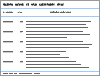
Table 1
Characteristics of monitoring sites"
| 点位 (监测年份) | 公园名称 | 经度/ (°) | 纬度/ (°) | 行政区 |
| X1 (2023、2024) | 丰翔智秀公园 | 宝山区 | ||
| X2 (2023、2024) | 春光公园 | 普陀区 | ||
| X3 (2023、2024) | 绥德公园 | 嘉定区 | ||
| X4 (2023、2024) | 环绿路 | 长宁区 | ||
| X5 (2023) | 得翠园 | 闵行区 | ||
| X5 (2024) | 春申公园 | 闵行区 | ||
| X6 (2023、2024) | 沈杨公园 | 宝山区 | ||
| X7 (2023) | 沔青公园 | 浦东新区 | ||
| X7 (2024) | 申江路基地 | 浦东新区 | ||
| X8 (2024) | 徐汇滨江公园 | 徐汇区 | ||
| X9 (2024) | 秀南公园 | 浦东新区 | ||
| X10 (2024) | 汤巷公园 | 浦东新区 | ||
| X11 (2024) | 唐丰公园 | 浦东新区 | ||
| X12 (2024) | 金海湿地公园 | 浦东新区 | ||
| X13 (2023) | 海徐路公园 | 浦东新区 | ||
| X13 (2024) | 孝亲公园 | 浦东新区 | ||
| X14 (2024) | 凌桥公园 | 浦东新区 |
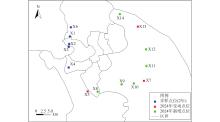
Fig.1
Distribution of sampling sites for Pomacea canaliculata monitoring"
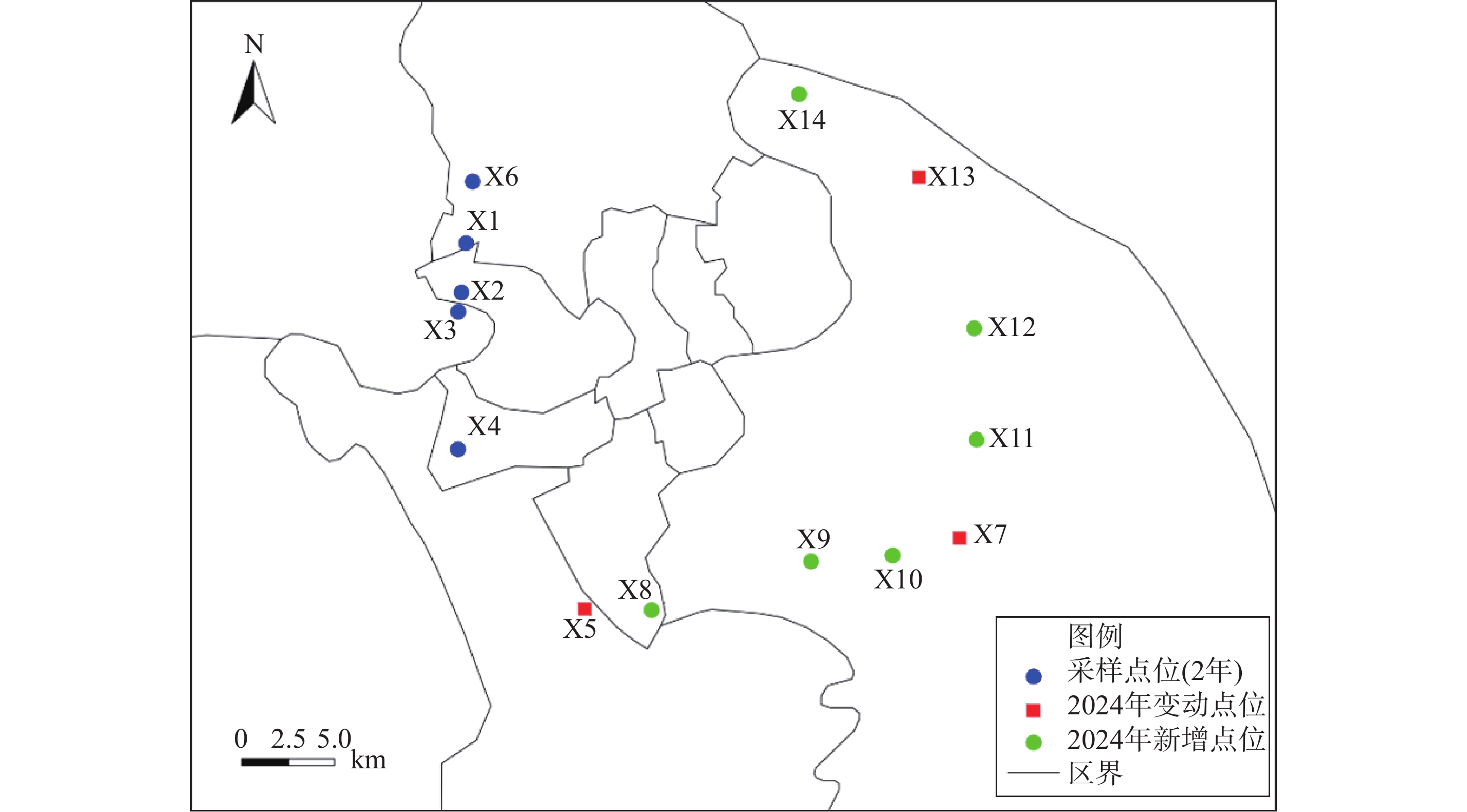
Table 2
Classification of Pomacea canaliculata invasion levels"
| 等级 | 螺害程度 | 螺量/ (头/(5 m2) ) |
| 等级1 | 零星发生 | <1 |
| 等级2 | 轻微发生 | 1~2 |
| 等级3 | 中度发生 | 3~10 |
| 等级4 | 较重发生 | 11~30 |
| 等级5 | 严重发生 | 31~100 |
| 等级6 | 极重发生 | >100 |
Table 3
Pomacea canaliculata monitoring results"
| 点位 (监测年份) | 是否有活螺 | 是否有卵块 | 是否有螺壳 |
| X1 (2023、2024) | + | + | + |
| X2 (2023、2024) | + | + | + |
| X3 (2023、2024) | + | + | + |
| X4 (2023、2024) | + | + | + |
| X5 (2023) | – | – | – |
| X5 (2024) | – | – | – |
| X6 (2023、2024) | – | – | – |
| X7 (2023) | + | + | + |
| X7 (2024) | + | + | + |
| X8 (2024) | – | – | – |
| X9 (2024) | + | + | + |
| X10 (2024) | + | + | + |
| X11 (2024) | – | – | – |
| X12 (2024) | + | + | + |
| X13 (2023) | – | – | – |
| X13 (2024) | + | + | + |
| X14 (2024) | – | – | – |
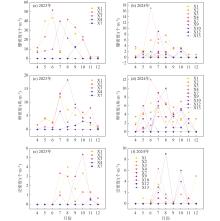
Fig.2
Temporal variation in density of live Pomacea canaliculata, egg masses, and shells"
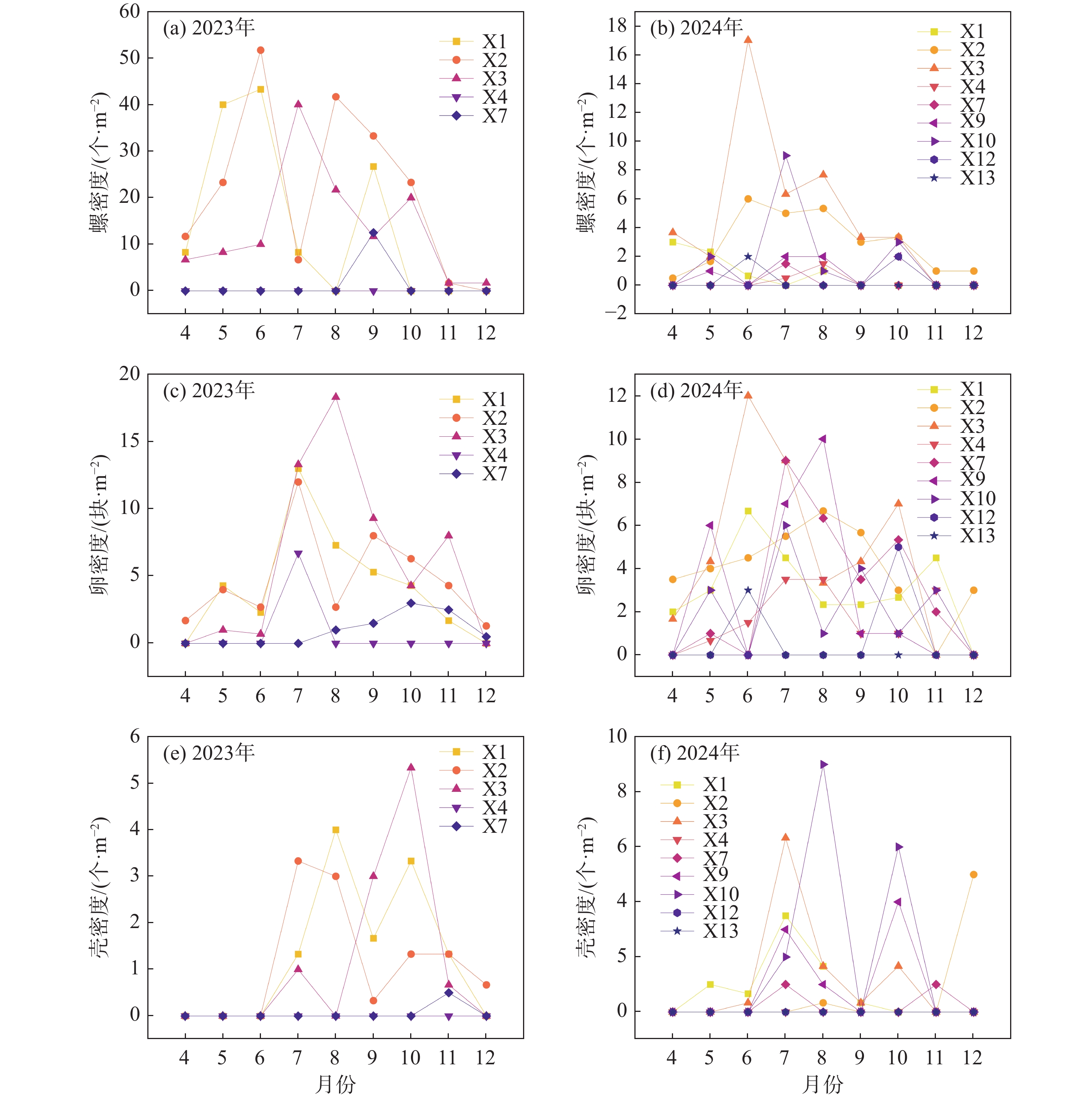
Table 4
Littoral water investigation in urban parks"
| 点位(监测年份) | 水体连通状态 | 驳岸类型 | 驳岸特点 | 水生植物种植情况 |
| X1 (2023、2024) | 封闭 | 生态驳岸 | 缓坡、木桩 | 菖蒲、泽泻 (Alisma plantago-aquatica L.)、再力花、梭鱼草 (Pontederia cordata L.)、菰等挺水植物; 睡莲等浮水植物; 苦草、水盾 (Cabomba caroliniana A.)、轮叶狐尾藻、马来眼子菜 (Potamogeton wrightii M.) 等沉水植物 |
| X2 (2023、2024) | 半连通 | 半生态驳岸 | 木桩围隔 | 菖蒲、泽泻、再力花、梭鱼草等挺水植物; 睡莲等浮水植物; 苦草等沉水植物 |
| X3 (2023、2024) | 连通 | 生态驳岸 | 缓坡 | 菖蒲、风车草 (Cyperus involucratus R.) 等挺水植物; 苦草等沉水植物 |
| X4 (2023、2024) | 半连通 | 生态驳岸 | 坡地、木桩围隔 | 菖蒲、再力花、梭鱼草等挺水植物; 睡莲等浮水植物; 苦草等沉水植物 |
| X5 (2023) | 半连通 | 生态驳岸 | 缓坡、木桩 | 菖蒲、菰等挺水植物; 睡莲等浮水植物 |
| X5 (2024) | 封闭 | 生态驳岸 | 缓坡、木桩 | 菖蒲、水葱 (Schoenoplectus tabernaemontani C.) 等挺水植物; 睡莲等浮水植物; 苦草等沉水植物 |
| X6 (2023、2024) | 连通 | 生态驳岸、硬质驳岸 | 缓坡、硬质 | 菖蒲、泽泻、再力花等挺水植物; 睡莲等浮水植物; 苦草等沉水植物 |
| X7 (2023) | 半连通 | 生态驳岸 | 缓坡、木桩围隔 | 菖蒲、再力花、菰等挺水植物; 睡莲等浮水植物; 轮叶狐尾藻等沉水植物 |
| X7 (2024) | 封闭 | 硬质驳岸 | 木桩围隔 | 再力花、梭鱼草、水葱等挺水植物; 苦草等沉水植物 |
| X8 (2023、2024) | 封闭 | 生态驳岸 | 陡坡 | 菖蒲、菰等挺水植物 |
| X9 (2023、2024) | 连通 | 生态驳岸 | 缓坡 | 菖蒲、菰等挺水植物; 睡莲等浮水植物; 苦草、轮叶狐尾藻等沉水植物 |
| X10 (2023、2024) | 连通 | 生态驳岸 | 缓坡 | 菖蒲、再力花、菰等挺水植物; 睡莲等浮水植物; 苦草、轮叶狐尾藻等沉水植物 |
| X11 (2023、2024) | 连通 | 生态驳岸、硬质驳岸 | 缓坡、木桩 | 菖蒲、荷花 (Nelumbo nucifera)、再力花等挺水植物; 睡莲等浮水植物; 苦草等沉水植物 |
| X12 (2023、2024) | 连通 | 生态驳岸、硬质驳岸 | 缓坡 | 菖蒲、再力花、菰、芦苇 (Phragmites australis) 等挺水植物; 苦草等沉水植物 |
| X13 (2023) | 连通 | 生态驳岸、硬质驳岸 | 缓坡、硬质 | 菖蒲、菰、芦苇等挺水植物; 睡莲等浮水植物; 苦草等沉水植物 |
| X13 (2024) | 封闭 | 硬质驳岸 | 硬质 | 菰、芦苇等挺水植物; 苦草等沉水植物 |
| X14 (2023、2024) | 连通 | 生态驳岸 | 缓坡 | 菖蒲、芦苇等挺水植物 |
Fig.3
Correlation between Pomacea canaliculata density and field-measured variables"
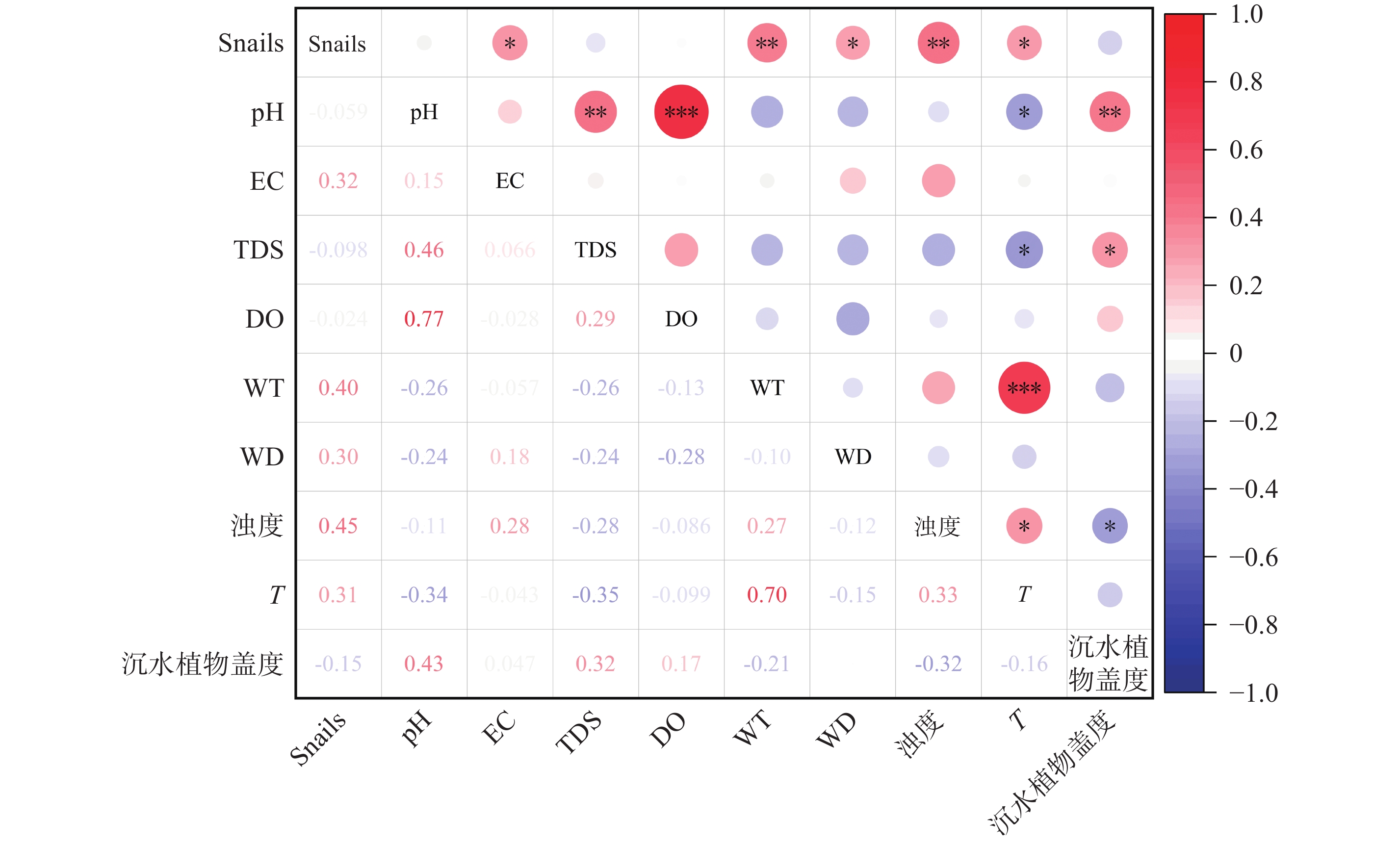
Fig.4
Correlation between Pomacea canaliculata density and laboratory-measured variables"
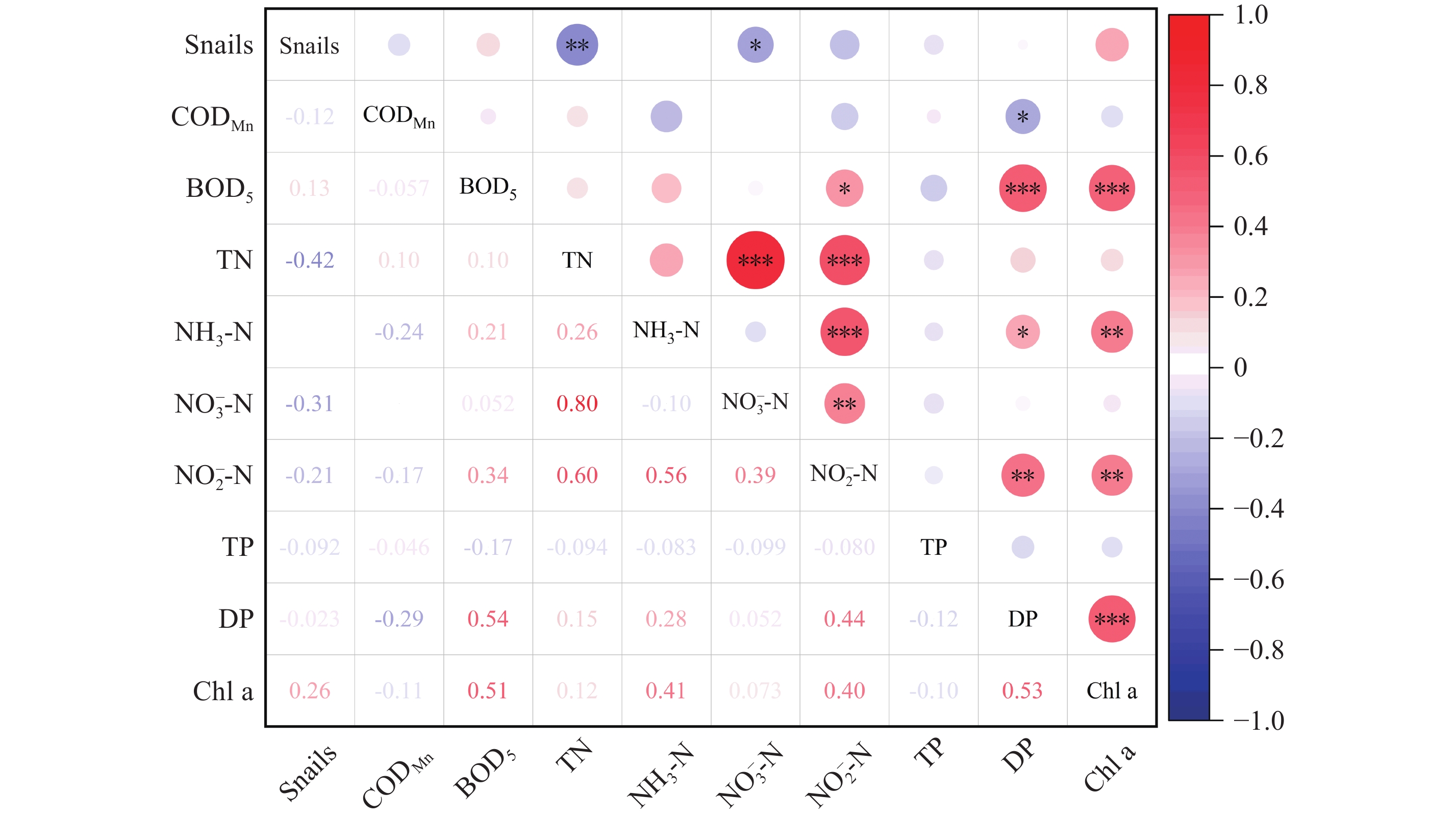
Table 5
Correlation between Pomacea canaliculata egg mass density and field-measured variables"
| eggs | pH | EC | TDS | DO | WT | WD | 浊度 | T | 植物盖度 | |
| eggs | 1 | |||||||||
| pH | –0.118 | 1 | ||||||||
| EC | –0.113 | 0.082 | 1 | |||||||
| TDS | –0.200 | 0.246 | 0.185 | 1 | ||||||
| DO | –0.172 | 0.736** | 0.007 | 0.281* | 1 | |||||
| WT | 0.510** | –0.254 | –0.109 | –0.392** | –0.303* | 1 | ||||
| WD | 0.143 | –0.278* | 0.136 | –0.149 | –0.246 | –0.090 | 1 | |||
| 浊度 | –0.005 | –0.135 | 0.247 | –0.176 | –0.113 | 0.251 | –0.182 | 1 | ||
| T | 0.283* | –0.340* | –0.043 | –0.351* | –0.099 | 0.695** | –0.148 | 0.330* | 1 | |
| 植物盖度 | –0.077 | 0.432** | 0.047 | 0.322* | 0.173 | –0.215 | 0.006 | –0.323* | –0.162 | 1 |
Table 6
Correlation between Pomacea canaliculata egg mass density and laboratory-quantified parameters"
| eggs | CODMn | BOD5 | TN | NH3-N | NO3–-N | NO2–-N | TP | DP | Chl a | |
| eggs | 1 | |||||||||
| CODMn | 0.011 | 1 | ||||||||
| BOD5 | –0.177 | –0.057 | 1 | |||||||
| TN | –0.186 | 0.104 | 0.103 | 1 | ||||||
| NH3-N | 0.273 | –0.239 | 0.213 | 0.264 | 1 | |||||
| NO3–-N | –0.312* | –0.017 | 0.052 | 0.800** | –0.100 | 1 | ||||
| NO2–-N | 0.012 | –0.175 | 0.335* | 0.599** | 0.560** | 0.391** | 1 | |||
| TP | 0.140 | –0.046 | –0.171 | –0.094 | –0.083 | –0.099 | –0.080 | 1 | ||
| DP | –0.281* | –0.290* | 0.536** | 0.148 | 0.279* | 0.052 | 0.443** | –0.124 | 1 | |
| Chl a | –0.029 | –0.114 | 0.514** | 0.122 | 0.412** | 0.073 | 0.404** | –0.103 | 0.527** | 1 |
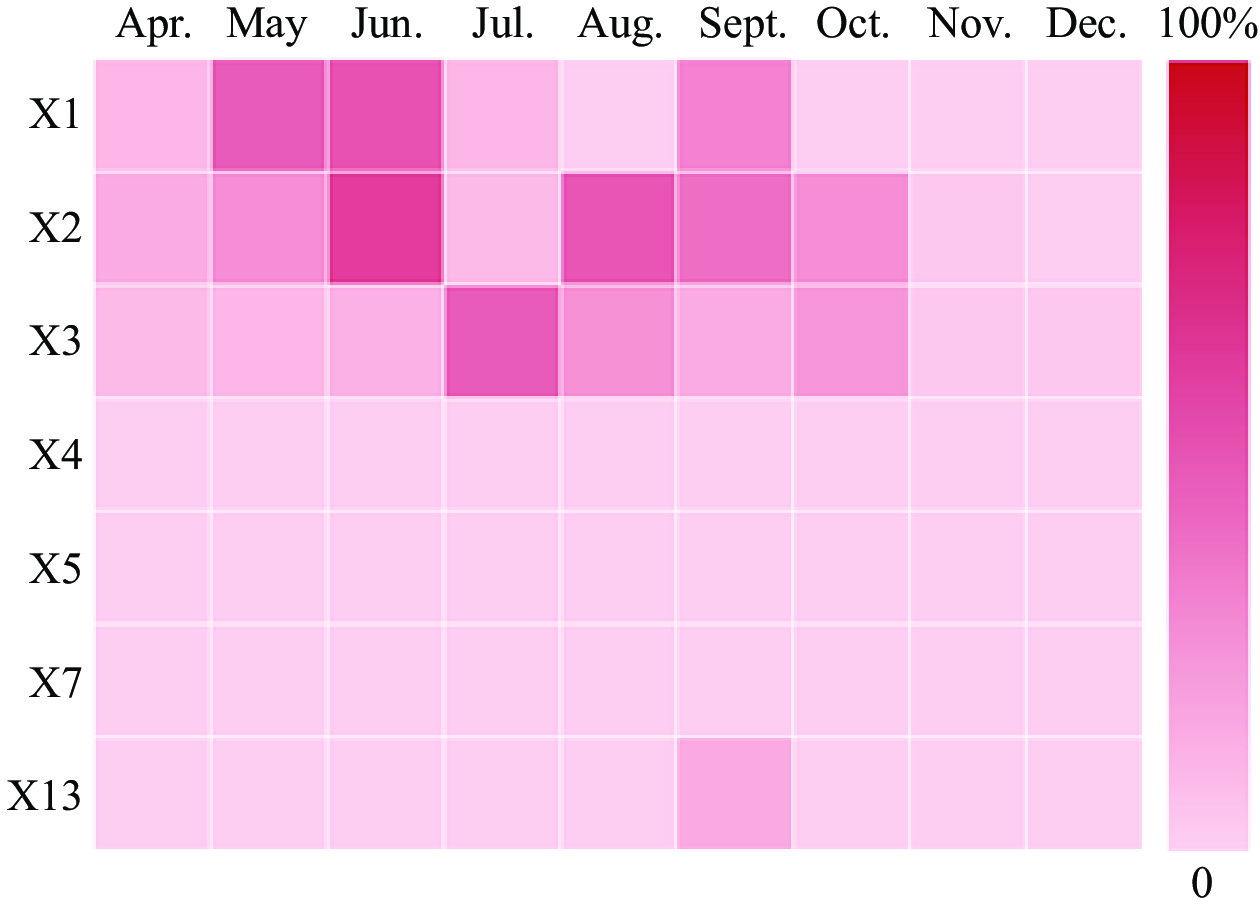
Fig.5
Degree of Pomacea canaliculata invasion in 2023"
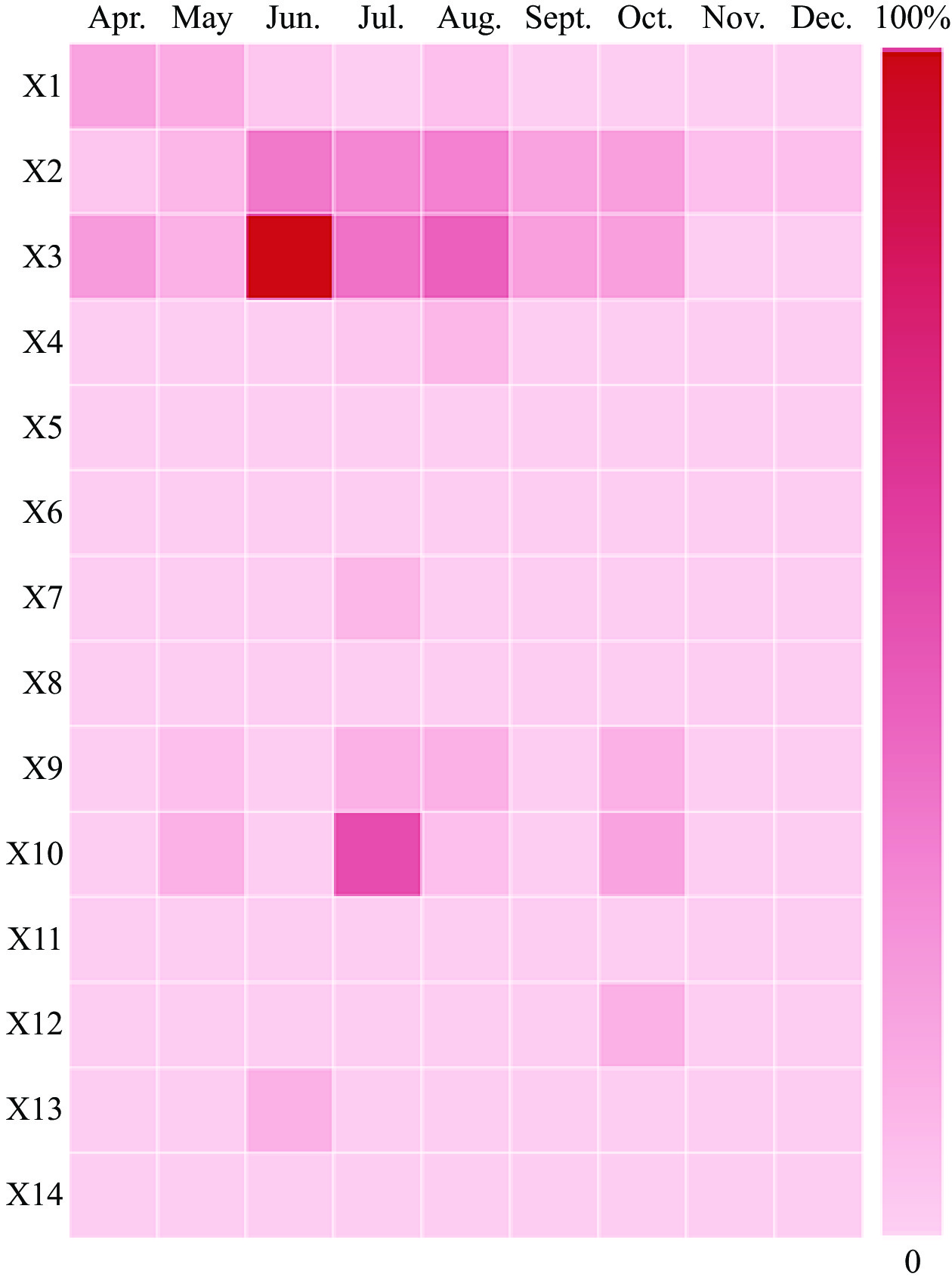
Fig.6
Degree of Pomacea canaliculata invasion in 2024"
| 1 | 黎栩霞, 吕鹤, 王伟民, 等.. 福寿螺的分布现状、危害及其防治对策研究. 江西科学, 2023, 41 (2): 236- 243. |
| 2 | 李小慧, 胡隐昌, 宋红梅, 等.. 中国福寿螺的入侵现状及防治方法研究进展. 中国农学通报, 2009, 25 (14): 229- 232. |
| 3 | 任和, 高红娟, 薛娟, 等.. 福寿螺的生物学特性与防治. 生物学通报, 2020, 55 (12): 1- 3. |
| 4 | SEUFFERT M E, BURELA S, MARTÍN P R.. Influence of water temperature on the activity of the freshwater snail Pomacea canaliculata (Caenogastropoda: Ampullariidae) at its southernmost limit (Southern Pampas, Argentina). Journal of Thermal Biology, 2010, 35 (2): 77- 84. |
| 5 | 周卫川, 吴宇芬, 杨佳琪.. 福寿螺在中国的适生性研究. 福建农业学报, 2003, 18 (1): 25- 28. |
| 6 | CRUZ C, SILVA A F, VENTURINI F P, et al.. Food preference and consumption of aquatic macrophytes submerged by snail Pomacea canaliculata. Planta Daninha, 2015, 33 (3): 433- 439. |
| 7 | 刘义满, 戢小梅, 李长林, 等.. 福寿螺[Pomacea canaliculata(Lamarck, 1819)]的世界分布. 湖北农业科学, 2019, 58 (6): 70- 72. |
| 8 | HORGAN F G, STUART A M, KUDAVIDANAGE E P.. Impact of invasive apple snails on the functioning and services of natural and managed wetlands. Acta Oecologica, 2014, 54, 90- 100. |
| 9 | 刘川, 刘懿霆, 万自学.. 福寿螺危害早稻秧苗的水体环境影响因素初步研究. 作物研究, 2022, 36 (4): 342- 346. |
| 10 | 方玲. 福寿螺(Pomacea canaliculata)对湿地水生植物以及水体营养盐的影响 [D]. 广州: 中山大学, 2010. |
| 11 | O’NEIL C M, GUO Y X, PIERRE S, et al.. Invasive snails alter multiple ecosystem functions in subtropical wetlands. The Science of the Total Environment, 2023, 864, 160939. |
| 12 | 王蝉娟, 宋增福, 鲁仙, 等.. 我国福寿螺入侵现状和防控研究进展. 生物安全学报, 2021, 30 (3): 178- 182. |
| 13 | 李玏, 刘家明, 宋涛, 等.. 城市绿带及其游憩利用研究进展. 地理科学进展, 2014, 33 (9): 1252- 1261. |
| 14 | 管群飞, 徐岭.. 上海市环城绿带植物群落构建初步研究. 中国园林, 2009, 25 (6): 92- 94. |
| 15 | 刘颂, 李春晖, 赖思琪.. 上海市环城绿带的游憩转型潜力分析及策略. 上海城市规划, 2019, (3): 77- 83. |
| 16 | 卢雪凝. 福寿螺螺壳、螺肉及螺卵的资源化利用研究 [D]. 广州: 华南农业大学, 2019. |
| 17 | 储少媛, 章家恩, 郭靖, 等.. 不同插竿方式诱集稻田福寿螺产卵的效应. 华南农业大学学报, 2018, 39 (5): 39- 46. |
| 18 | 何铭谦, 宋春秀, 章家恩, 等.. 广东省典型地区福寿螺越冬后的种群密度调查研究. 中国农学通报, 2011, 27 (1): 428- 432. |
| 19 | 杨诚, 康玉辉, 高健, 等.. 外来种福寿螺 (Pomacea canaliculata) 对3种沉水植物的牧食偏好及水体理化因子的响应. 湖泊科学, 2021, 33 (4): 1241- 1253. |
| 20 | 傅先源, 王洪全.. 温度对福寿螺生长发育的影响. 水产学报, 1999, 23 (1): 21- 26. |
| 21 | 刘军, 何跃进, 谭济才, 等.. 自然条件下福寿螺繁殖特性. 应用生态学报, 2012, 23 (2): 559- 565. |
| 22 | 刘艳斌, 韩微, 贤振华.. 温度对福寿螺生长发育及摄食的影响. 南方农业学报, 2011, 42 (8): 901- 905. |
| 23 | 刘鹏远, 张春霞, 赵本良, 等.. 盐胁迫对福寿螺耗氧率和排氨率的影响. 中国生态农业学报(中英文), 2020, 28 (7): 1072- 1078. |
| 24 | 张春霞. 福寿螺与本地田螺在不同生境胁迫下的响应差异与作用机制研究 [D]. 广州: 华南农业大学, 2016. |
| 25 | 段清星, 李湘, 王本君, 等.. 福寿螺密度变化的环境影响因素研究. 四川动物, 2016, 35 (4): 503- 510. |
| 26 | 梁碧霞, 陈欣宇, 武正军, 等.. 广西夏季不同生境福寿螺繁殖力研究. 湖北农业科学, 2020, 59 (8): 83- 88. |
| 27 | FANG M, YU F D, SHU L, et al. Structural and functional differences of gut microbiota in Pomacea canaliculata from different geographical locations and habitats [J]. Ecology and Evolution, 2024, 14(10): e70283. |
| 28 | 赵本良, 章家恩, 戴晓燕, 等.. 福寿螺对稻田水生植物群落结构的影响. 生态学报, 2014, 34 (4): 907- 915. |
| 29 | 黄鹏. 福寿螺生物学特性及药剂毒力测定[D]. 福州: 福建农林大学, 2010. |
| 30 | 郭靖, 章家恩.. 福寿螺的生物防治现状、问题与对策. 生态学杂志, 2015, 34 (10): 2943- 2950. |
| 31 | 郭靖, 章家恩.. 福寿螺应对天敌的响应策略与机制研究进展. 生态学杂志, 2020, 39 (8): 2776- 2784. |
| 32 | 韩学忠, 祝玮, 曾文超, 等.. 茭白套养中华鳖防治福寿螺试验. 江西水产科技, 2017, (6): 14- 15. |
| 33 | 李乐林, 李涵, 余进祥, 等.. 福寿螺防控及其综合利用技术集成创新与推广. 江西水产科技, 2023, (2): 31- 34. |
| 34 | SEUFFERT M E, MARTÍN P R. Global distribution of the invasive apple snail Pomacea canaliculata: Analyzing possible shifts in climatic niche between native and invaded ranges and future spread [J]. Aquatic Sciences, 2023, 86(1): 17. |
| 35 | 吕海涛, 李建忠, 鲁艳辉, 等.. 稻田福寿螺的发生、危害及其防控技术研究进展. 中国水稻科学, 2024, 38 (2): 127- 139. |
| [1] | Yangyang HU, Chang LIU, Chengjin CAO, Junhao LI, Liuxing WU, Ruiyun ZHU, Minsheng HUANG, Yan HE, Haochen DU, Lei WANG, Xinlin YAN. Occurrence characteristics and risk assessment of microplastics in industrial wastewater from key industries in the Taihu Lake Basin [J]. J* E* C* N* U* N* S*, 2026, 2026(1): 14-24. |
| [2] | Chenming GU, Jing YANG, Ye LI, Ye HUANG, Yan WU, Guoyu YIN, Ruihe JIN, Yi YANG, Min LIU. Advances in research on multimedia fate, risks, and simulation of contaminants of emerging concern in urban agglomerations [J]. Journal of East China Normal University(Natural Science), 2024, 2024(6): 24-38. |
| [3] | Jing YANG, Yan WU, Yue LI, Xia LIU, Dingye YANG, Yuanyuan CHEN, Ruihe JIN, Ye LI, Min LIU. Occurrence characteristics and healthy risk assessment of hexabromocyclododecane in agricultural soils in Shanghai [J]. Journal of East China Normal University(Natural Science), 2024, 2024(6): 178-187. |
| [4] | Dingye YANG, Jing YANG, Ruihe JIN, Fangfang DING, Yuxin ZHANG, Min LIU. Occurrence characteristics and risk assessment of halogenated flame retardants in soils of Hefei City [J]. Journal of East China Normal University(Natural Science), 2024, 2024(6): 161-177. |
| [5] | Tiefeng CUI, Daoji LI. Progress and critical issues in research on micro- and nanoplastics in human body [J]. Journal of East China Normal University(Natural Science), 2024, 2024(6): 1-13. |
| [6] | Zhifu LI, Yonghong WU, Xuemei LIU, Dan LI. Assessment of water quality and heavy metal contamination of sediments after rice harvesting in a rice-shrimp co-cropping system [J]. Journal of East China Normal University(Natural Science), 2024, 2024(1): 122-133. |
| [7] | Dan CUI, Ying LI, Tida CHEN, Minsheng HUANG. Analysis and evaluation of the phytoplankton community structure in Luxun Park, Shanghai [J]. Journal of East China Normal University(Natural Science), 2022, 2022(3): 27-38. |
| [8] | ZHANG Yan-Yan, WEI Jin-Bao, HUANG Min-Sheng, CAO Cheng-Jin, HE Yan. Effects of environment factors on the growth of phytoplankton in Dishui Lake [J]. Journal of East China Normal University(Natural Sc, 2015, 2015(2): 48-57. |
| [9] | YU Qiu-Jia, WANG Hao-Bin, TAN Yu-Feng, YOU Wen-Hui. Ecological characteristics analysis of phytoplankton’s dominant species in summer and autumn in the Dianshan Lake, China [J]. Journal of East China Normal University(Natural Sc, 2014, 2014(6): 90-100. |
| [10] | NIU Hai-yan, LIU Min, LU Min, QUAN Rui-song, ZHANG Li-jia,WANG Jing-jing, XU Shi-yuan. Risk assessment of typhoon hazard factors in China coastal areas [J]. Journal of East China Normal University(Natural Sc, 2011, 2011(6): 20-25,35. |
| [11] | CHEN Li-qiao;LI Yun-kai;HOU Jun-li;LI Kai;CHEN Yong. A Survey of Managements of Non-indigenous Species via Ballast Water Transport(Chinese) [J]. Journal of East China Normal University(Natural Sc, 2005, 2005(5/6): 40-48. |
| [12] | ZHAO Qin-na;XU Qi-xin;YANG Kai. Application of Potential Ecological Risk Index in Soil Pollution of Typical Polluting Industries(Chinese) [J]. Journal of East China Normal University(Natural Sc, 2005, 2005(1): 111-116. |
| Viewed | ||||||
|
Full text |
|
|||||
|
Abstract |
|
|||||
