
 中文核心期刊
J* E* C* N* U* N* S* ›› 2026, Vol. 2026 ›› Issue (5): 51-65.doi: 10.3969/j.issn.1000-5641.2026.05.005
• Data Systems and Platforms • Previous Articles Next Articles
Hu WANG1,2, Han ZHANG1, Tianhua WANG3, Chunyan ZHAO1,*( )
)
Received:2026-07-17
Accepted:2026-08-05
Online:2026-09-25
Published:2026-09-12
Contact:
Chunyan ZHAO
E-mail:cyzhao@dase.ecnu.edu.cn
CLC Number:
Hu WANG, Han ZHANG, Tianhua WANG, Chunyan ZHAO. Design and scenario analysis of a trusted access mechanism for data resources[J]. J* E* C* N* U* N* S*, 2026, 2026(5): 51-65.
Table 1
Comparison between existing mechanisms and the proposed mechanism in terms of capability boundaries"
| 能力维度 | API key/白名单 | OAuth/OIDC/JWT | ABAC/XACML | 普通API网关 | 零信任网关 | 本文方案 |
| 调用方身份认证 | √ | √ | △ | √ | √ | √ |
| 主体授权事件绑定 | × | △ | △ | △ | △ | √ |
| 请求参数一致性校验 | △ | △ | △ | △ | △ | √ |
| 业务用途约束 | × | △ | √ | △ | △ | √ |
| 资源侧强制执行 | △ | △ | △ | √ | √ | √ |
| 防重放与撤销控制 | △ | △ | △ | △ | △ | √ |
| 审计证据关联 | △ | △ | △ | √ | √ | √ |
| 跨机构策略协同 | × | △ | △ | △ | △ | △ |
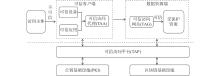
Fig.1
System model for trusted access to data resources"
Table 2
Main symbols and definitions for the trusted access problem"
| 符号 | 定义 | 符号 | 定义 | |
| 数据主体集合 | 单次API访问请求 | |||
| 调用应用身份集合 | 数据主体授权事件 | |||
| 具体终端或应用运行实例集合 | 可信访问令牌 | |||
| 数据资源集合 | 业务流水号 | |||
| 访问操作集合 | 令牌使用状态集合 | |||
| 业务用途集合 | 资源侧安全上下文 | |||
| 访问策略集合 |
Fig.2
Generation and verification process of the trusted access token"
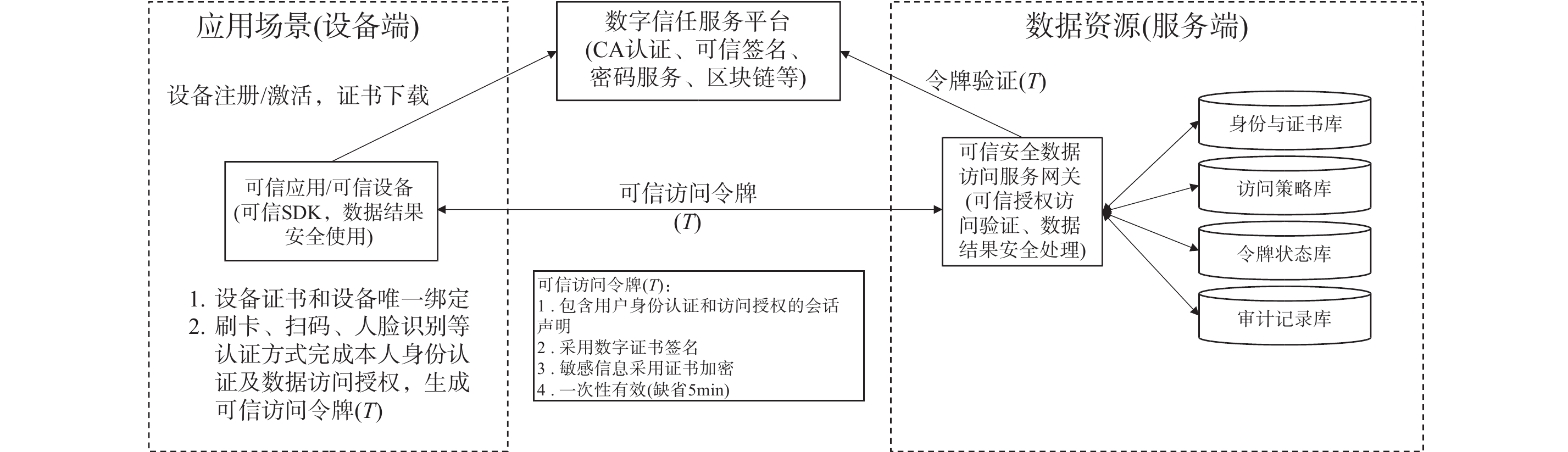
Table 3
Key claims and verification constraints of the trusted access token"
| 声明域 | 关键声明 | 技术含义 | 资源侧验证约束 |
| 身份域 | sub_id、sub_type | 访问主体标识及主体类型, 可采用摘要化或脱敏标识 | 与请求中的数据主体、证照持有人或授权对象一致 |
| 调用域 | app_id、device_id、taa_id | 调用应用、可信终端和TAA实例标识 | 应在TAP登记, 证书状态有效, 且与准入场景匹配 |
| 授权域 | auth_id、auth_time、auth_method | 主体身份认证和主体主动授权事件 | 授权记录存在、未撤销, 授权时间和认证方式满足策略 |
| 资源域 | resource_id、scope、purpose | 可访问的数据资源、接口范围、 业务使用用途 | 请求接口、证照类型、 业务用途应包含在授权范围内 |
| 时效域 | iat、exp、jti、biz_no | 签发时间、失效时间、 令牌唯一标识和业务流水号 | 令牌未过期, 唯一标识或流水号未被重复使用 |
| 完整性保护域 | alg、kid、sig、enc | 签名算法、密钥标识、签名值和加密标识 | 验证签名、证书链、密钥状态和敏感字段保护方式 |
Table 4
Boundary conditions and handling boundaries"
| 边界条件 | 处置方案 | 外部依赖与残余风险 |
| TAP 密钥泄露 | 吊销密钥版本和相关令牌 | 密钥托管、轮换与泄露响应; 泄露窗口内令牌仍有风险 |
| TAA 或调用方被攻陷 | 证书撤销、范围用途校验、异常拒绝 | 授权交互真实性和端侧最小权限; 合法权限可能被滥用 |
| 终端/应用伪造 | 未登记、证书无效或绑定不一致拒绝 | 设备标识与证书生命周期; 完整性证明为可选扩展 |
| 绕过TAG直连资源 | 算法无法覆盖绕行请求 | 网络隔离、入口收敛和后端访问控制必须关闭直连 |
| 撤销同步延迟 | 短时效、在线状态查询、缓存过期 | 撤销传播仍存在时间窗口 |
| 系统时钟偏差 | 按策略容差校验iat/exp | 统一授时与监测; 偏差过大可能误拒或误放 |
| 审计日志篡改 | 关联摘要、签名或存证发现不一致 | 访问控制、备份和完整性保护; 不能证明业务事实本身 |
| 合法重试与重放冲突 | 原子状态区分首次、重试和冲突重放 | 幂等键、请求摘要与有限重试窗口 |
Table 5
Key interfaces, inputs, and outputs for trusted access"
| 接口类型 | 调用方向 | 主要输入 | 主要输出 |
| 终端与应用注册 | TAA/应用 -> TAP | 应用标识、终端指纹、 证书申请、场景编号 | 注册结果、证书或密钥材料、 准入策略 |
| 令牌申领 | TAA -> TAP | 可信访问凭证、授权事件、 资源范围、业务流水号 | 可信访问令牌、有效期、 令牌状态 |
| 令牌验证 | TAG -> TAP | 令牌标识或令牌摘要、 请求接口、请求上下文 | 验证结果、主体标识、 授权范围、处置建议 |
| 资源代理 | 调用方 -> TAG -> 资源服务 | API请求、可信访问令牌、 业务参数 | 资源响应、 拒绝原因或安全封装结果 |
| 审计写入 | TAA/TAP/TAG -> 审计模块 | 认证、授权、签发、 验证、访问事件摘要 | 全流程审计记录、 存证索引、追溯关联标识 |
Table 6
Component mapping for the electronic certificate scenario"
| 电子证照场景要素 | 本文模型对应项 | 主要职责或约束 |
| 持证主体 | 数据主体 | 完成身份认证、亮证或授权确认 |
| 社会化用证主体应用 | 调用应用 | 经场景准入后获得应用标识、密钥、账号和目录权限 |
| 可信设备或可信应用 | 可信终端 | 预先注册纳管, 持有设备证书或应用证书 |
| 可信访问代理 | TAA | 发起注册、签名、令牌申领和敏感字段保护 |
| 可信授权访问系统 | TAP | 管理证书、策略、令牌签发、令牌状态和审计记录 |
| 电子证照社会化应用系统 | TAG | 校验可信访问令牌, 执行资源侧强制鉴权 |
| 市电子证照库 | 受保护资源 | 在令牌验证通过后提供证照查询、照面、派生件等服务 |
| 防火墙、网闸、负载均衡 | 网络与部署组件 | 实现网络边界隔离、访问路径收敛、流量分发和高可用 |
| 数据库、消息队列和存储 | 平台基础设施 | 支撑业务、令牌状态、策略数据、审计数据和异步处理 |
Fig.3
Trusted access framework for socialized applications of electronic certificates"
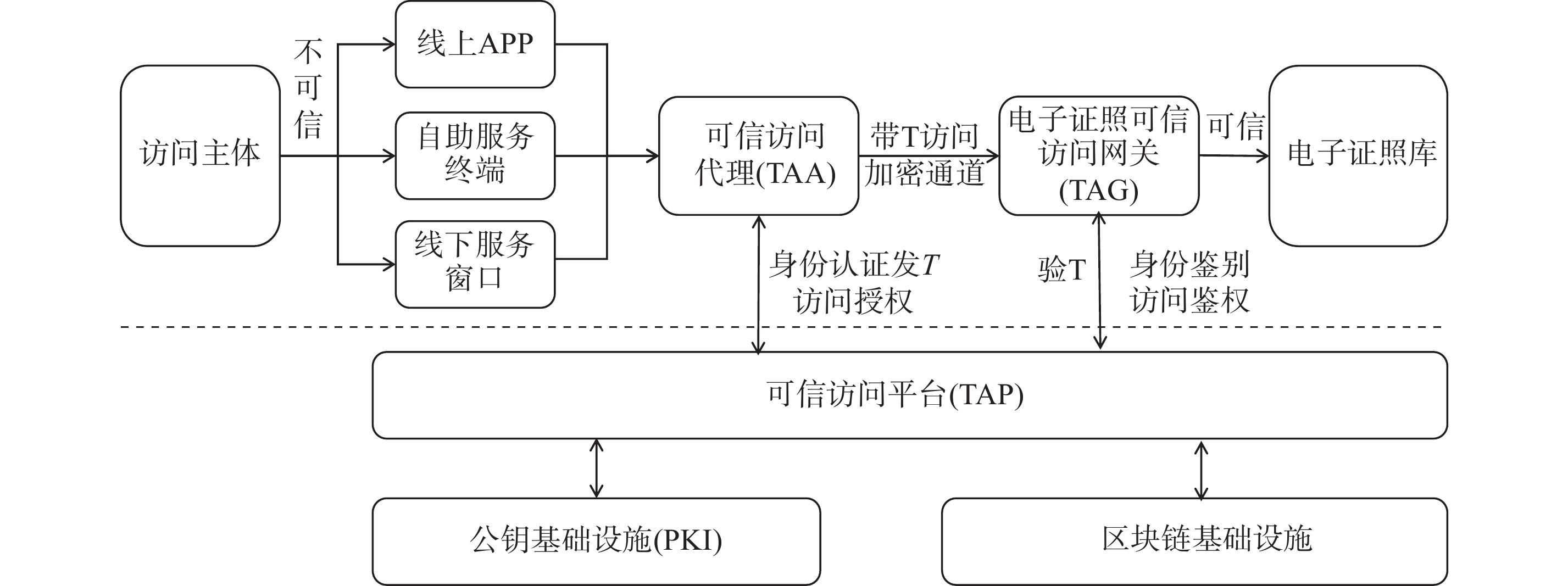
Fig.4
Deployment architecture for trusted access in socialized electronic certificate applications"
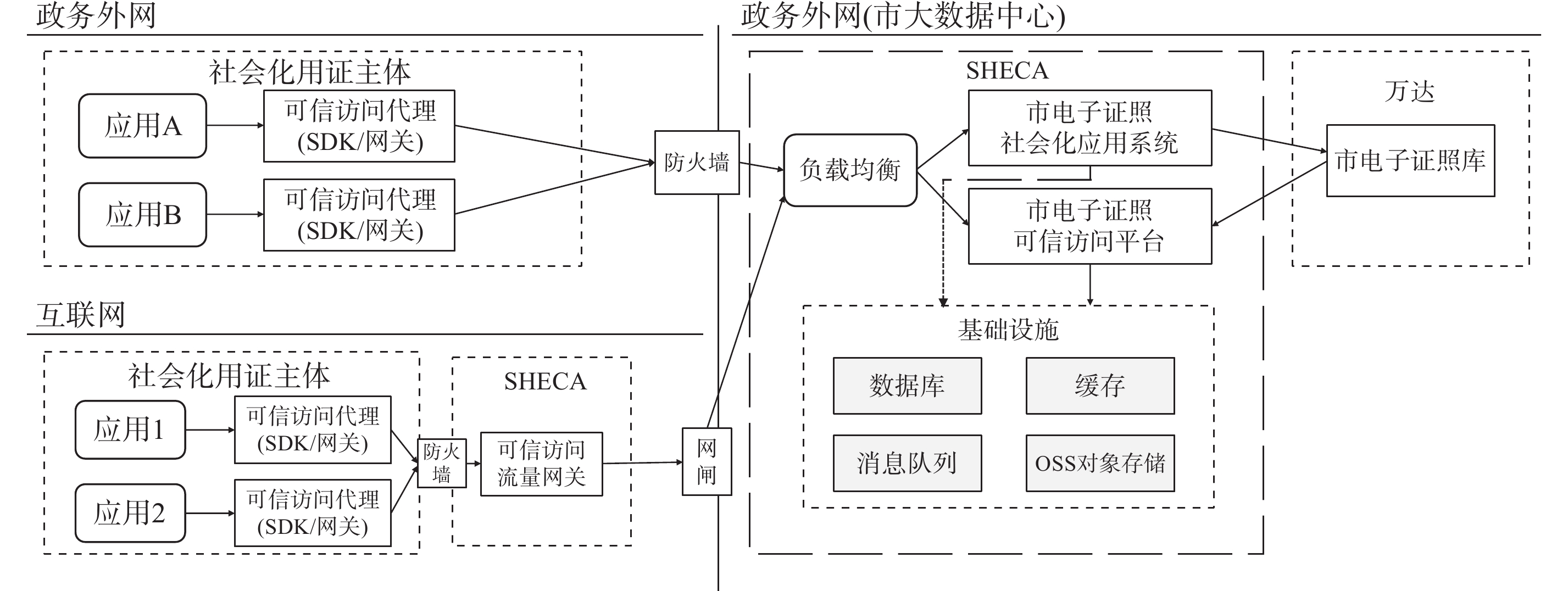
Fig.5
Trusted access process in socialized applications of electronic certificates"
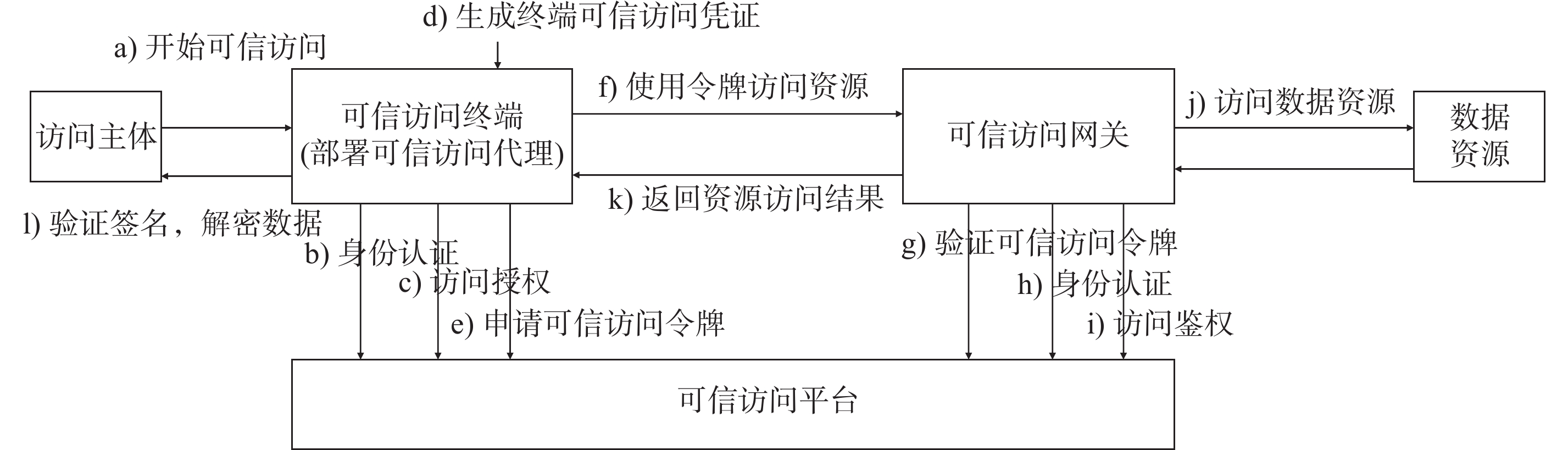
Table 7
Invocation chain for trusted access to electronic certificates"
| 调用阶段 | 关键控制目标 | 验证或记录内容 |
| 场景与应用准入 | 确认用证处于许可范围 | 应用标识、终端状态、证书状态、证照目录权限 |
| 主体认证与授权 | 形成可验证的主体授权事件 | 主体标识摘要、授权方式、授权时间、业务流水号 |
| 令牌申领与签发 | 将授权事件转化为可验证凭据 | TAA签名、授权范围、业务用途、令牌有效期 |
| 证照服务请求 | 绑定请求参数与可信访问令牌 | 证照类型、访问接口、业务用途、业务流水号 |
| 资源侧验证 | 执行六元匹配和策略判定 | 签名、时效、撤销状态、资源范围、用途、防重放 |
| 资源访问与返回 | 通过后访问受保护证照资源 | 安全上下文、证照服务结果、返回状态 |
| 审计关联 | 关联认证、授权、签发、验证和访问事件 | 令牌标识、请求摘要、拒绝原因或访问结果 |
Table 8
Representative abnormal conditions and expected handling measures"
| 异常情形 | 触发条件 | 处置结果 |
| 未携带可信访问令牌 | 请求缺少可信访问令牌 | 拒绝访问 |
| 令牌伪造或篡改 | 签名、证书链或密钥状态校验失败 | 拒绝访问 |
| 令牌过期或撤销 | 超出有效期或令牌状态失效 | 拒绝访问 |
| 主体参数不一致 | 请求主体与令牌主体声明不匹配 | 拒绝访问 |
| 资源范围越权 | 请求证照类型或接口超出授权范围 | 拒绝访问 |
| 业务用途不一致 | 请求用途与令牌用途声明不一致 | 拒绝访问 |
| 重放或重复使用 | 非幂等请求命中已使用状态 | 拒绝访问或按幂等规则处理 |
| 应用或终端无效 | 应用、设备未登记或证书无效 | 拒绝访问 |
| 绕过TAG直连资源 | 请求未经过资源侧可信验证入口 | 阻断直连或拒绝资源服务访问 |
| 1 | 国务院. 关于构建数据基础制度更好发挥数据要素作用的意见 [Z]. 2022. |
| 2 | 国务院. 关于加快推进电子证照扩大应用领域和全国互通互认的意见 [Z]. 2022. |
| 3 | 全国人民代表大会常务委员会. 中华人民共和国数据安全法 [Z]. 2021. |
| 4 | 全国人民代表大会常务委员会. 中华人民共和国个人信息保护法 [Z]. 2021. |
| 5 | 上海市人民政府办公厅. 上海市电子证照管理办法 [Z]. 2022. |
| 6 | Hardt D. RFC 6749: the OAuth 2.0 authorization framework [EB/OL]. (2012-10)[2026-06-25]. https://www.rfc-editor.org/rfc/rfc6749. |
| 7 | Sakimura N, Bradley J, Jones M, et al. OpenID Connect Core 1.0 [EB/OL]. (2014-11-08)[2026-06-25]. https://openid.net/specs/openid-connect-core-1_0.html. |
| 8 | Jones M, Bradley J, Sakimura N. JSON Web Token (JWT): RFC 7519 [EB/OL]. (2015-05)[2026-06-25]. https://www.rfc-editor.org/rfc/rfc7519. |
| 9 | Rose S, Borchert O, Mitchell S, et al. Zero trust architecture: NIST SP 800-207 [R/OL]. (2020-08)[2026-06-25]. https://doi.org/10.6028/NIST.SP.800-207. |
| 10 | Ferraiolo D F, Kuhn D R. Role-based access controls [C]//15th National Computer Security Conference. 1992: 554-563. |
| 11 | Sandhu R S, Coyne E J, Feinstein H L, et al.. Role-based access control models. Computer, 1996, 29 (2): 38- 47. |
| 12 | Hu V C, Ferraiolo D F, Kuhn R, et al. Guide to attribute based access control (ABAC) definition and considerations: NIST SP 800-162 [R]. Gaithersburg, MD, USA: National Institute of Standards and Technology, 2014. |
| 13 | OASIS. eXtensible access control markup language (XACML) version 3.0 [EB/OL]. (2013-01-22)[2026-06-25]. https://docs.oasis-open.org/xacml/3.0/xacml-3.0-core-spec-os-en.html. |
| 14 | Salehi S A, Han R C, Rudolph C, et al.. DACP: enforcing a dynamic access control policy in cross-domain environments. Computer Networks, 2023, 237, 110049. |
| 15 | Tsai M, Lee S, Shieh S W.. Strategy for implementing of zero trust architecture. IEEE Transactions on Reliability, 2024, 73 (1): 93- 100. |
| 16 | Denis N, Laurent M, Chabridon S.. A decentralized model for usage and information flow control in distributed systems. Computers & Security, 2024, 144, 103975. |
| 17 | U-ruekolan S, Rattananen M, Ponharn J, et al.. Enforcing data access control and privacy: the graph-driven data regulatory approach. Journal of Information Security and Applications, 2025, 93, 104163. |
| 18 | Jussen I, Möller F, Schweihoff J, et al.. Issues in inter-organizational data sharing: findings from practice and research challenges. Data & Knowledge Engineering, 2024, 150, 102280. |
| 19 | GB/T 35273—2020 信息安全技术 个人信息安全规范 [S]. |
| 20 | GB/T 36901—2018 电子证照 总体技术架构 [S]. |
| 21 | GB/T 36906—2018 电子证照 共享服务接口规范 [S]. |
| 22 | 全国人民代表大会常务委员会. 中华人民共和国电子签名法 [Z]. 2019. |
| 23 | Zhang Q H, Yuan L Y, Xie T Y, et al.. Auditable and dynamic access control scheme with behavior and identity tracing. Computer Networks, 2024, 251, 110623. |
| 24 | Ou Z S, Xing X F, He S Q, et al.. TDS-NA: blockchain-based trusted data sharing scheme with PKI authentication. Computer Communications, 2024, 218, 240- 252. |
| 25 | Wang Q, Liu Y.. Blockchain empowered dynamic access control for secure data sharing in collaborative emergency management. Information Processing & Management, 2025, 62 (3): 103960. |
| [1] | Hanghang GENG, Xiaowei CHEN, Fanyu HAN, Wei WANG. Open-source collaboration governance for AI Agent capability ecosystems: A case study of OpenClaw [J]. J* E* C* N* U* N* S*, 2026, 2026(5): 167-177. |
| [2] | Weiru HAN, Wenyi HE, Yisheng JIN, Wei WANG, Moming DUAN. Open-source AI governance and discursive power in data standard-setting: Dilemmas, paths, and disciplinary perspectives [J]. J* E* C* N* U* N* S*, 2026, 2026(5): 145-152. |
| [3] | Pu ZHAO, Qingxi PENG, Yuang ZHANG, Xiejie JIN, Dezhou ZHAO. Open-source collaboration structure modeling and multilayer-network link-prediction methods [J]. J* E* C* N* U* N* S*, 2025, 2025(5): 109-124. |
| [4] | Rui WANG, Qiuyue LYU, Jia LIAO. Analysis of the status, hotspots, and trends of open-source innovation: A bibliometric study based on CNKI literature from 2005 to 2024 [J]. J* E* C* N* U* N* S*, 2025, 2025(5): 125-139. |
| [5] | Yunhu ZHAO, Yuzhou YANG, Lin QIN. Brief discussion on fair use for distribution of open-source large model datasets [J]. J* E* C* N* U* N* S*, 2025, 2025(5): 183-190. |
| [6] | Biaowei ZHUANG, Runtao LIU. Historical transformations and future prospects of open source ethics [J]. J* E* C* N* U* N* S*, 2025, 2025(5): 202-208. |
| [7] | Xudong REN, Zhipeng HUANG, Jiaheng PENG, Wei WANG. Liquidity design for ecological industries in the large language model era: Analysis of liquidity elements represented by open-source communities [J]. J* E* C* N* U* N* S*, 2025, 2025(5): 25-31. |
| [8] | Yuang ZHANG, Zhong XIE, Qinjun QIU, Liufeng TAO. Research and analysis of the development of the open source ecosystem in the field of geographic information system [J]. J* E* C* N* U* N* S*, 2025, 2025(5): 99-108. |
| [9] | Yuhang CHEN, Shizhou WANG, Zhengting TANG, Liangyu CHEN, Ningkang JIANG. Research on software classification based on the fusion of code and descriptive text [J]. J* E* C* N* U* N* S*, 2025, 2025(1): 46-58. |
| [10] | Chengyu ZHANG, Jiayi ZHU, Yihao HUANG, Di YANG, Jianwen LI, Weikai MIAO, Di YAN, Bin GU, Naijun ZHAN, Geguang PU. Machine-learning-based model checker performance prediction [J]. Journal of East China Normal University(Natural Science), 2024, 2024(4): 18-29. |
| [11] | Jie CHEN, Wenyi SHEN, Wenyu WU, Jiali MAO. Method for improving the quality of trajectory data for riding-map inference [J]. Journal of East China Normal University(Natural Science), 2023, 2023(6): 14-27. |
| [12] | Zhaoyang WU, Jiali MAO. Research on travel time prediction based on neural network [J]. Journal of East China Normal University(Natural Science), 2023, 2023(2): 106-118. |
| [13] | Yiming YU, Yuchen HONG, Ye WANG, Qiwen DONG. Design of experimental data governance module for chemical material formulation [J]. Journal of East China Normal University(Natural Science), 2022, 2022(5): 1-13. |
| [14] | Jiling LI, Baolin LI, Songru YAN. Research on user behavior portrait and subject mining in the express logistics field during Coronavirus epidemic [J]. Journal of East China Normal University(Natural Science), 2022, 2022(5): 100-114. |
| [15] | Xiao PAN, Dongna LU, Shuhai WANG. Capacitated route planning for supermarket distribution based on order splitting [J]. Journal of East China Normal University(Natural Science), 2022, 2022(5): 147-164. |
| Viewed | ||||||
|
Full text |
|
|||||
|
Abstract |
|
|||||
