
 中文核心期刊
J* E* C* N* U* N* S* ›› 2026, Vol. 2026 ›› Issue (3): 30-43.doi: 10.3969/j.issn.1000-5641.2026.03.003
• Carbon Cycling Processes and Organic Matter Characteristics • Previous Articles Next Articles
Hongsheng CAO, Qi WU, Fang CAO*( )
)
Received:2024-12-30
Accepted:2025-04-18
Online:2026-05-25
Published:2026-05-27
Contact:
Fang CAO
E-mail:fcao@sklec.ecnu.edu.cn
CLC Number:
Hongsheng CAO, Qi WU, Fang CAO. Distribution and modulators of dissolved organic matter in the East China Sea during spring[J]. J* E* C* N* U* N* S*, 2026, 2026(3): 30-43.
Fig.1
Map of sampling stations occupied in the East China Sea in spring 2023"
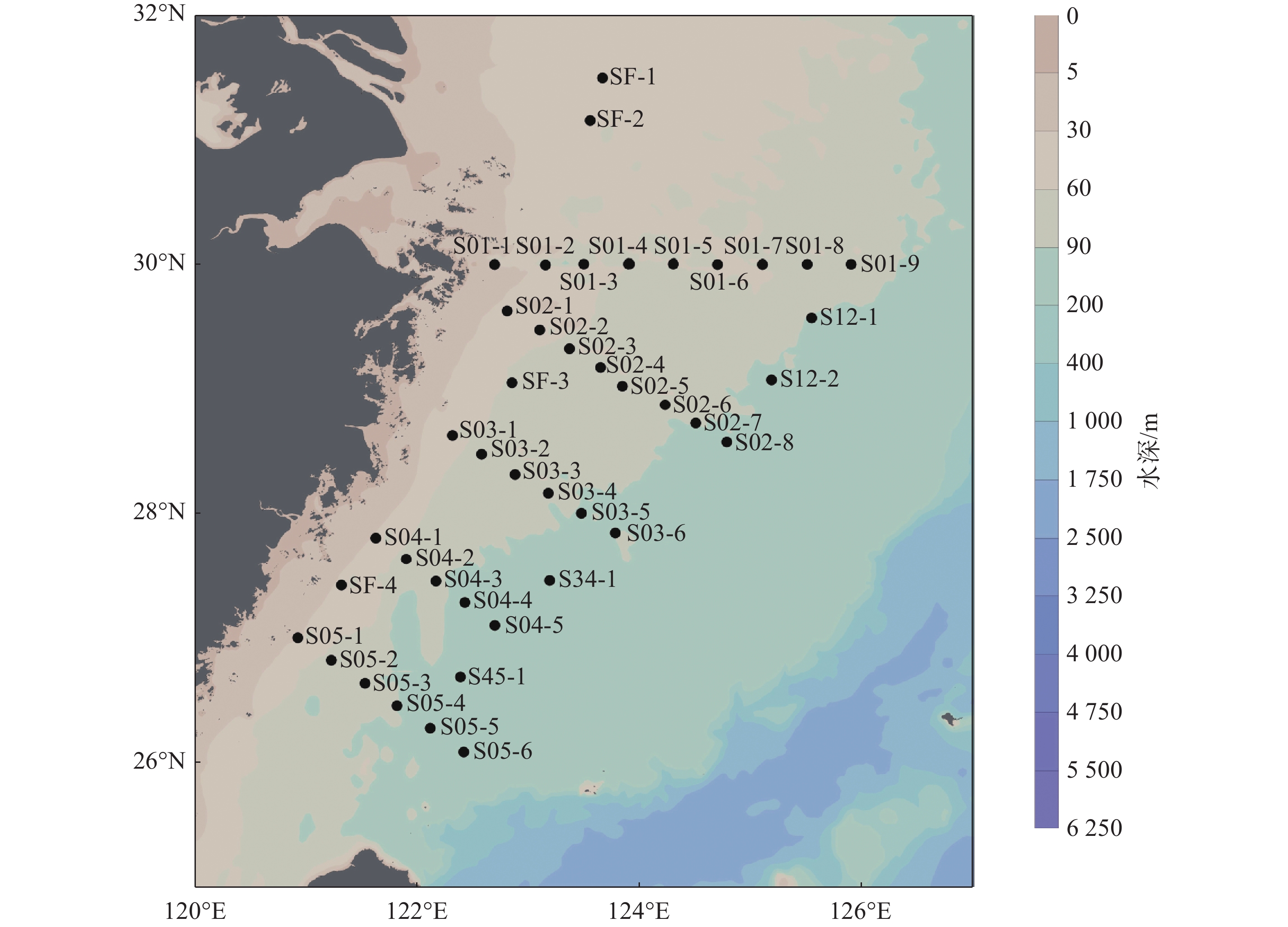
Fig.2
Temperature–salinity diagram in the study area"
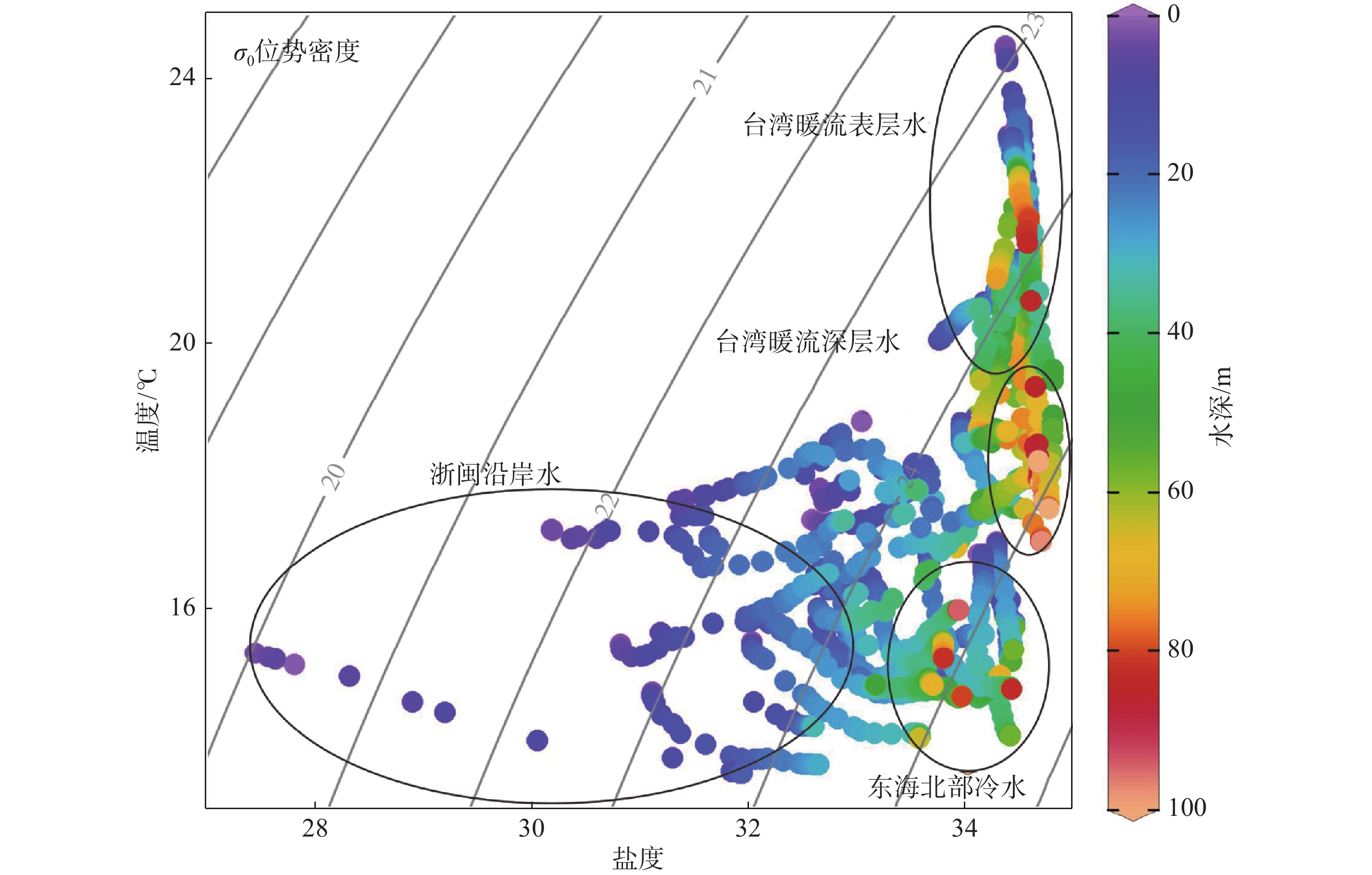
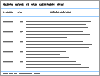
Table 1
Characteristics of temperature and salinity with different water masses in study area"
| 水团名称 | 温度/℃ | 盐度 |
| 台湾暖流表层水[ | 19.5~24.5 | 34.0~34.2 |
| 台湾暖流深层水[ | 17.0~19.5 | 34.2~34.6 |
| 东海北部冷水[ | 15.0~16.8 | 33.6~34.3 |
| 浙闽沿岸水[ | 13.5~18.8 | 27.3~33.0 |
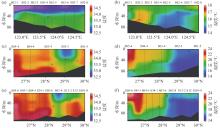
Fig.3
Distributions of salinity and temperature along vertical profiles of transect S02 and two meridional sections"
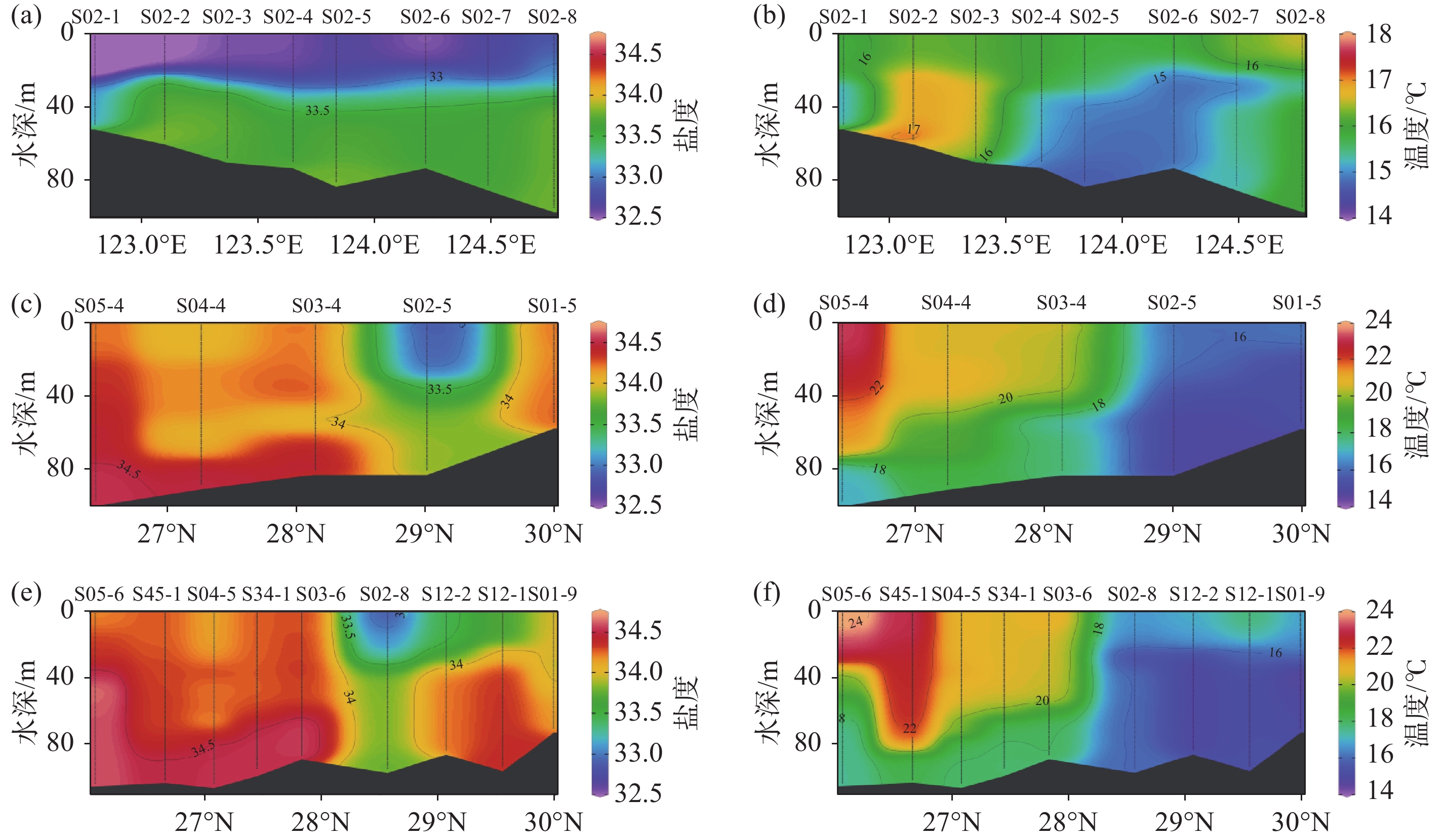
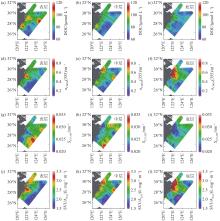
Fig.4
Horizontal distributions of DOC, aCDOM(355), S275-295, and SUVA254"
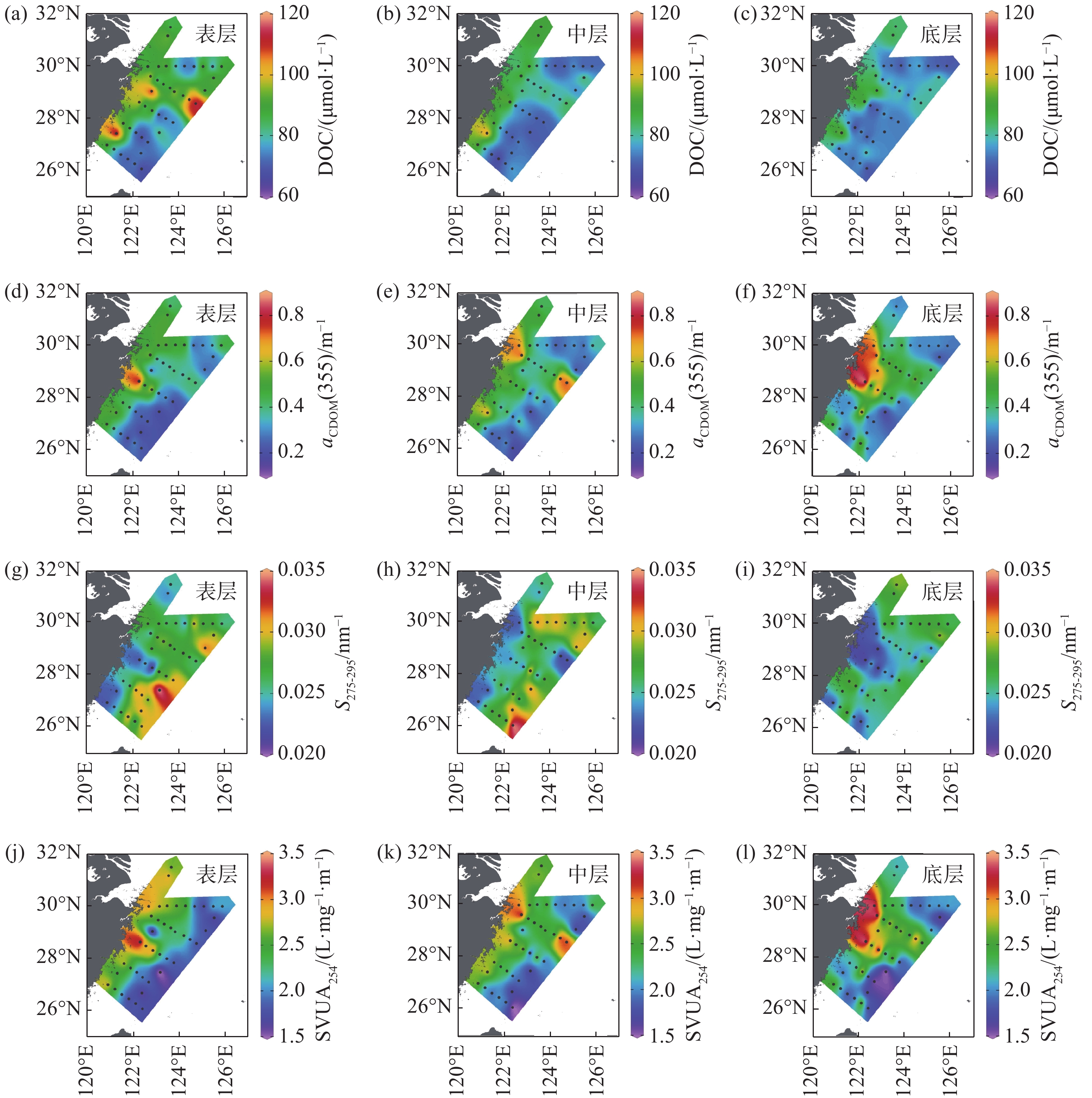
Table 2
Values of DOC, aCDOM(355), S275-295, and SUVA254"
| 参数 | DOC/(μmol·L–1) | aCDOM(355)/m–1 | S275-295/nm–1 | SUVA254/(L·mg–1·m–1) | |||||||
| 范围 | 平均值 | 范围 | 平均值 | 范围 | 平均值 | 范围 | 平均值 | ||||
| 表层 | 63.92~122.83 | 85.55 | 0.15~0.89 | 0.38 | 1.24~3.47 | 2.25 | |||||
| 中层 | 61.57~108.58 | 78.78 | 0.16~0.88 | 0.39 | 1.31~3.58 | 2.31 | |||||
| 底层 | 62.08~100.58 | 76.96 | 0.13~1.03 | 0.42 | 1.37~3.78 | 2.30 | |||||
Fig.5
Four fluorescent components identified by the PARAFAC model"
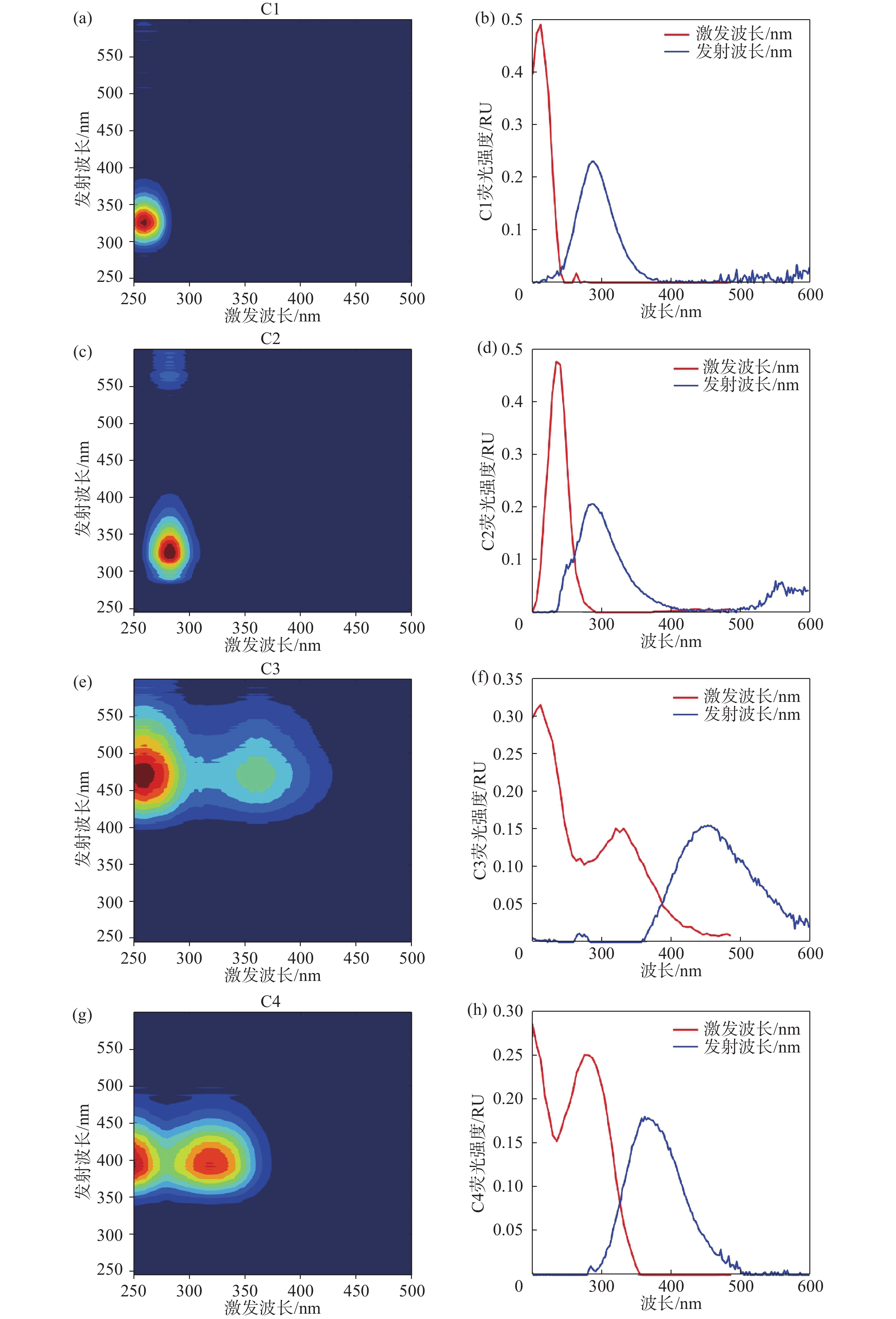
Table 3
Four fluorescent components and their characteristics"
| 荧光组分 | 激发波长/nm | 发射波长/nm | 组分类型及意义 | 相似组分 |
| C1 | 260 | 325 | 不同激发下的类色氨酸, 通常与微生物活动相关 | C7[ |
| C2 | 280 | 325 | C3[ | |
| C3 | 265/365 | 475 | 典型陆源类腐殖质, 具有较高分子量, 生物可利用性低 | C3[ |
| C4 | 250/315 | 400 | 类腐殖质, 在海洋中原位生产, 废水中较为普遍 | C1[ |
Fig.6
Horizontal distributions of four fluorescent components and HIX"
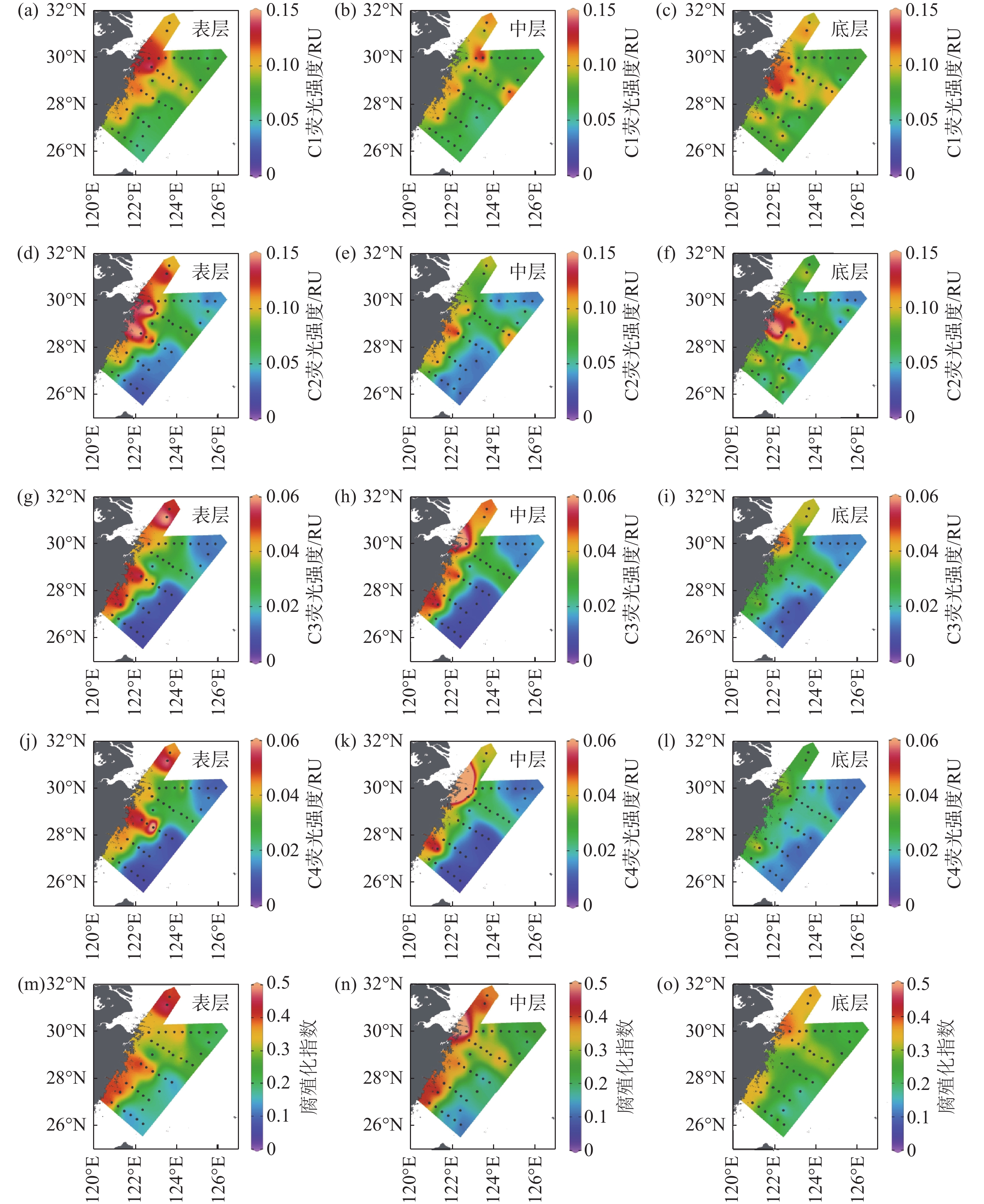
Table 4
Fluorescence intensity of FDOM components 单位: RU"
| 荧光组分 | 表层荧光强度 | 表层平均荧光强度 | 中层荧光强度 | 中层平均荧光强度 | 底层荧光强度 | 底层平均荧光强度 |
| C1 | ||||||
| C2 | ||||||
| C3 | ||||||
| C4 |
Fig.7
Plots of scores (a) and loadings (b) derived with principal component analysis"
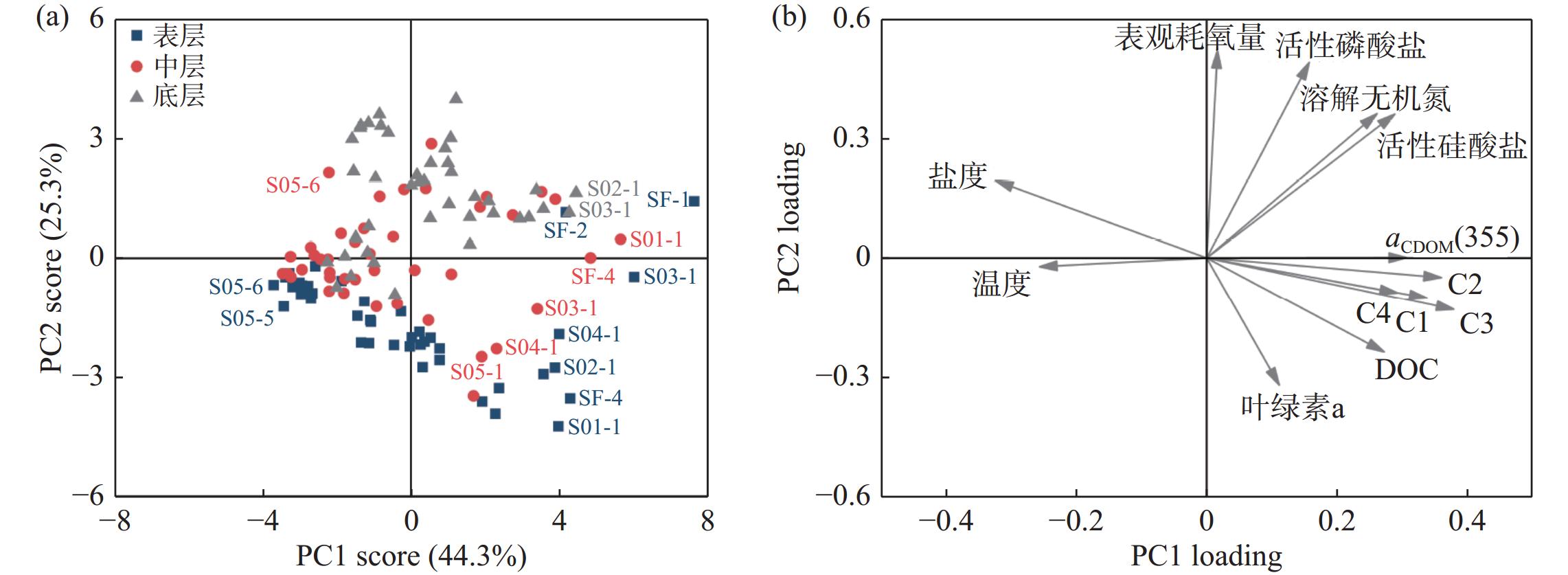
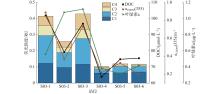
Fig.8
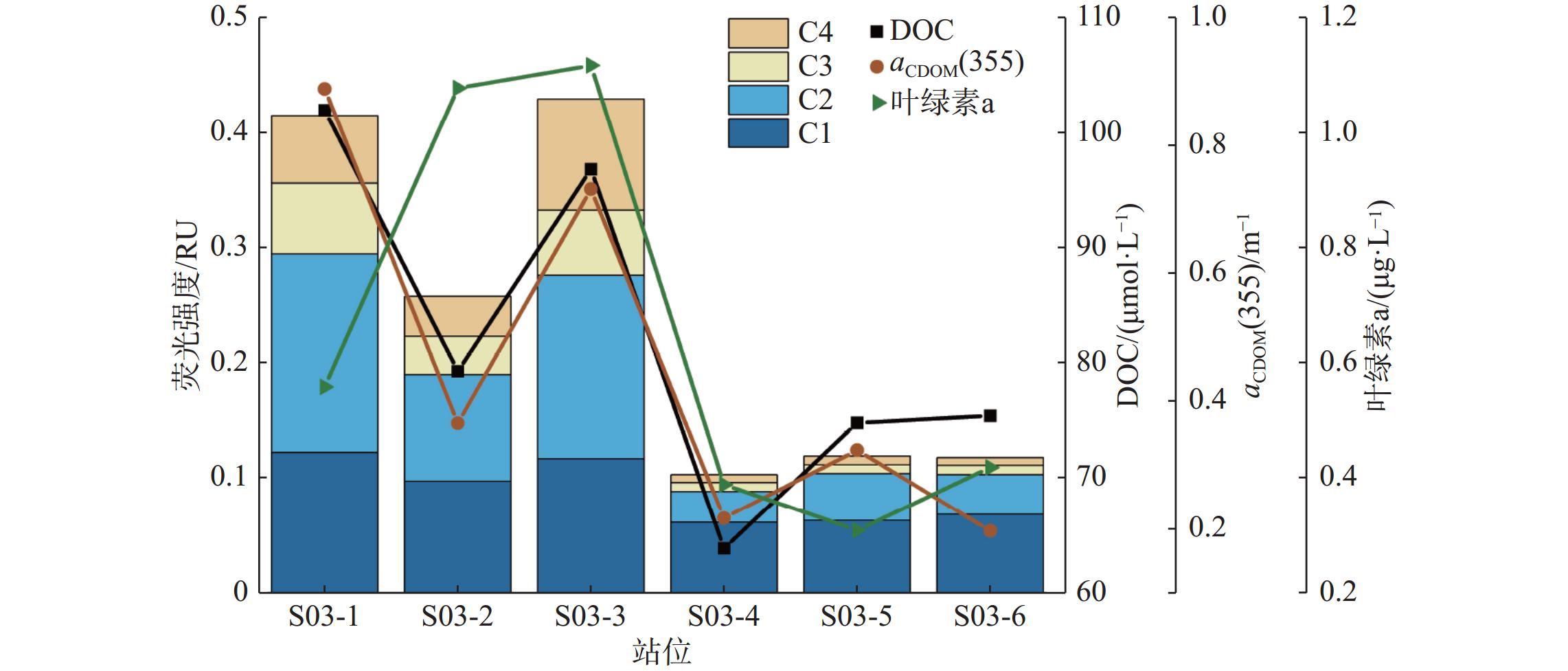
Distribution of DOC, aCDOM(355), chlorophyll-a, and FDOM components in the surface layer of the S03 transect"
| 1 | HANSELL D, CARLSON C, REPETA D, et al.. Dissolved organic matter in the ocean: A controversy stimulates new insights. Oceanography, 2009, 22 (4): 202- 211. |
| 2 | MURPHY K R, TIMKO S A, GONSIOR M, et al.. Photochemistry illuminates ubiquitous organic matter fluorescence spectra. Environmental Science & Technology, 2018, 52 (19): 11243- 11250. |
| 3 | LI P H, HUR J.. Utilization of UV-Vis spectroscopy and related data analyses for dissolved organic matter (DOM) studies: A review. Critical Reviews in Environmental Science and Technology, 2017, 47 (3): 131- 154. |
| 4 | BAUER J E, CAI W J, RAYMOND P A, et al.. The changing carbon cycle of the coastal ocean. Nature, 2013, 504 (7478): 61- 70. |
| 5 | 冉祥滨, 徐腾飞, 赵彬, 等.. 东海区域海洋学调查研究回顾. 海洋科学进展, 2024, 42 (1): 1- 20. |
| 6 | 张明宇, 常鑫, 胡利民, 等.. 东海内陆架有机碳的源—汇过程及其沉积记录. 沉积学报, 2021, 39 (3): 593- 609. |
| 7 | BENNER R, STROM M.. A critical evaluation of the analytical blank associated with DOC measurements by high-temperature catalytic oxidation. Marine Chemistry, 1993, 41 (1/2/3): 153- 160. |
| 8 | BRICAUD A, MOREL A, PRIEUR L.. Absorption by dissolved organic matter of the sea (yellow substance) in the UV and visible domains. Limnology and Oceanography, 1981, 26 (1): 43- 53. |
| 9 | HELMS J R, STUBBINS A, RITCHIE J D, et al.. Absorption spectral slopes and slope ratios as indicators of molecular weight, source, and photobleaching of chromophoric dissolved organic matter. Limnology and Oceanography, 2008, 53 (3): 955- 969. |
| 10 | WEISHAAR J L, AIKEN G R, BERGAMASCHI B A, et al.. Evaluation of specific ultraviolet absorbance as an indicator of the chemical composition and reactivity of dissolved organic carbon. Environmental Science & Technology, 2003, 37 (20): 4702- 4708. |
| 11 | STEDMON C A, MARKAGER S, BRO R.. Tracing dissolved organic matter in aquatic environments using a new approach to fluorescence spectroscopy. Marine Chemistry, 2003, 82 (3/4): 239- 254. |
| 12 | MURPHY K R, STEDMON C A, GRAEBER D, et al.. Fluorescence spectroscopy and multi-way techniques. PARAFAC. Analytical Methods, 2013, 5 (23): 6557- 6566. |
| 13 | MURPHY K R, STEDMON C A, WENIG P, et al.. OpenFluor–an online spectral library of auto-fluorescence by organic compounds in the environment. Analytical Methods, 2014, 6 (3): 658- 661. |
| 14 | QI J F, YIN B S, ZHANG Q L, et al.. Seasonal variation of the Taiwan warm current water and its underlying mechanism. Chinese Journal of Oceanology and Limnology, 2017, 35 (5): 1045- 1060. |
| 15 | ZHANG Q L, LIU H W, QIN S S, et al.. The study on seasonal characteristics of water masses in the western East China Sea shelf area. Acta Oceanologica Sinica, 2014, 33 (11): 64- 74. |
| 16 | 苏育嵩, 李凤岐, 马鹤来, 等.. 东海北部区域底层冷水团的形成及其季节变化. 青岛海洋大学学报, 1989, 19 (S1): 1- 14. |
| 17 | 翁学传, 王从敏.. 台湾暖流水的研究. 海洋科学, 1985, 9 (1): 7- 10. |
| 18 | 王翠, 郭晓峰, 方婧, 等.. 闽浙沿岸流扩展范围的季节特征及其对典型海湾的影响. 应用海洋学学报, 2018, 37 (1): 1- 8. |
| 19 | 于非, 张志欣, 刁新源, 等.. 黄海冷水团演变过程及其与邻近水团关系的分析. 海洋学报, 2006, 28 (5): 26- 34. |
| 20 | 齐继峰. 东海水团特征及黑潮与东海陆架水交换研究 [D]. 山东 青岛: 中国科学院研究生院(海洋研究所), 2014. |
| 21 | YUAN D L, QIAO F L, SU J.. Cross-shelf penetrating fronts off the southeast coast of China observed by MODIS. Geophysical Research Letters, 2005, 32 (19): L19603. |
| 22 | YUAN D L, LI Y, HE L, et al.. An observation of the three-dimensional structure of a cross-shelf penetrating front off the Changjiang mouth. Deep Sea Research Part II: Topical Studies in Oceanography, 2010, 57 (19/20): 1827- 1834. |
| 23 | GAO L, GAO Y Q, SONG S Z, et al.. Non-conservative behavior of dissolved organic carbon in the Changjiang (Yangtze River) Estuary and the adjacent East China Sea. Continental Shelf Research, 2020, 197, 104084. |
| 24 | 李润, 陈洁南, 陈灏, 等.. 河口盐沼水体溶解态有机质的动态变化特征及降解转化机理——以上海崇明东滩盐沼湿地为例. 华东师范大学学报(自然科学版), 2025 (2): 55- 67. |
| 25 | HUNG J J, CHEN C H, GONG G C, et al.. Distributions, stoichiometric patterns and cross-shelf exports of dissolved organic matter in the East China Sea. Deep Sea Research Part Ⅱ: Topical Studies in Oceanography, 2003, 50 (6/7): 1127- 1145. |
| 26 | COBLE P G.. Characterization of marine and terrestrial DOM in seawater using excitation-emission matrix spectroscopy. Marine Chemistry, 1996, 51 (4): 325- 346. |
| 27 | MENENDEZ A, TZORTZIOU M.. Driving factors of colored dissolved organic matter dynamics across a complex urbanized estuary. Science of the Total Environment, 2024, 921, 171083. |
| 28 | DAINARD P G, GUÉGUEN C, YAMAMOTO-KAWAI M, et al.. Interannual variability in the absorption and fluorescence characteristics of dissolved organic matter in the Canada Basin polar mixed waters. Journal of Geophysical Research: Oceans, 2019, 124 (7): 5258- 5269. |
| 29 | ZHOU X Z, JOHNSTON S E, BOGARD M J.. Organic matter cycling in a model restored wetland receiving complex effluent. Biogeochemistry, 2023, 162 (2): 237- 255. |
| 30 | MURPHY K R, STEDMON C A, WAITE T D, et al.. Distinguishing between terrestrial and autochthonous organic matter sources in marine environments using fluorescence spectroscopy. Marine Chemistry, 2008, 108 (1/2): 40- 58. |
| 31 | KULKARNI H, MLADENOV N, DATTA S.. Effects of acidification on the optical properties of dissolved organic matter from high and low arsenic groundwater and surface water. Science of the Total Environment, 2019, 653, 1326- 1332. |
| 32 | CHEN S, DU Y X, DAS P, et al.. Agricultural land use changes stream dissolved organic matter via altering soil inputs to streams. Science of the Total Environment, 2021, 796, 148968. |
| 33 | 朱晓敏, 黄清辉, 李建华.. 咸水藻水华期溶解有机质光谱特征变化的模拟. 中国环境科学, 2009, 29 (1): 68- 72. |
| 34 | 侯树冉, 纪璇, 张婧.. 藻源有色溶解有机物的光学特性变化及一氧化碳的光生成——以中肋骨条藻为例. 中国环境科学, 2023, 43 (6): 3118- 3128. |
| [1] | LUO Heng, CAI Ming-juan, CHEN Xiang, DING Mei,LI Kun, XU Hou-qiang. Study on the effects of Mg2+ on the binding between Bloom syndrome helicase and G4DNA [J]. Journal of East China Normal University(Natural Sc, 20120, 2012(6): 81-88. |
| [2] | Qiuxun LIN, Boshuang WU, Guangyue DU, Yuxuan FU, Yifan PAN, Mengting QI, Zhenyang SONG, Yongqiang ZHOU, Xiaofei LI. Characteristics and associated sources of fluorescent dissolved organic matter in the Yellow River Estuary, the Changjiang River Estuary and their adjacent seas [J]. J* E* C* N* U* N* S*, 2026, 2026(3): 44-55. |
| [3] | Yongqing LEI, Jinwei HU, Chaoyu WANG, Biao ZHONG, Jianping YIN. Comparison of Yb3+-doped LiYF4 and Y3Al5O12 in anti-Stokes fluorescence cooling [J]. J* E* C* N* U* N* S*, 2025, 2025(3): 33-42. |
| [4] |
Jianuan PAN, Chengcheng ZHU, Hailing WANG.
Spectroscopic study on the |
| [5] | Ziheng ZHANG, Biao ZHONG, Chaoyu WANG, Jiajin XU, Jiayi ZHANG, Chenle PAN, Jianping YIN. Design and analysis of thermal link for cryogenic optical cooler based on Yb3+:LuLiF4 crystal [J]. J* E* C* N* U* N* S*, 2025, 2025(3): 72-79. |
| [6] | Run LI, Jienan CHEN, Hao CHEN, Fang CAO. Dynamic characteristics and degradation transformation mechanism of dissolved organic matter in estuarine wetlands: A case study of Chongming Dongtan salt marsh wetland in Shanghai [J]. J* E* C* N* U* N* S*, 2025, 2025(2): 55-67. |
| [7] | Hao CHEN, Xianqiang HE, Run LI, Fang CAO. Machine learning-based remote sensing retrievals of dissolved organic carbon in the Yangtze River Estuary [J]. Journal of East China Normal University(Natural Science), 2024, 2024(4): 123-136. |
| [8] | Xiaoyan LIU, Enqing GAO. N-alkylation modification of metal-organic frameworks to afford responsive fluorescence [J]. Journal of East China Normal University(Natural Science), 2023, 2023(1): 73-81. |
| [9] | Jiqing TAN, Qiangqiang WANG, Wei XIE. Superfluorescence behavior of excitons in a quantum dot superlattice [J]. Journal of East China Normal University(Natural Science), 2022, 2022(4): 163-168. |
| [10] | Cheng ZHOU, Ying HUANG, Hualei YANG, Minghui DU, Ying ZHANG, Jianwu TANG. Photosynthesis and fluorescence characteristics of mangrove Kandelia candel leaves in southern Zhejiang Province [J]. Journal of East China Normal University(Natural Science), 2022, 2022(3): 90-100. |
| [11] | Rui WENG, Zheng WEI, Yanmei YANG, Jing HAN, Yan HE, Minsheng HUANG. Characteristics of dissolved organic matter and its effects on denitrification in urban river sediments [J]. Journal of East China Normal University(Natural Science), 2021, 2021(4): 46-54. |
| [12] | Can GE, Weiguo ZHANG. Magnetic properties of particle-sized fractions of sediments in the Changjiang Estuary and neighboring shelf, and its environmental implications [J]. Journal of East China Normal University(Natural Science), 2021, 2021(2): 30-41. |
| [13] | HUANG Binbing, XIE Yan, XIE Wenhui, ZHAO Zhenjie, LI Xin. Preparation and fluorescence detection properties of ZnO nanostructure based on microdroplets [J]. Journal of East China Normal University(Natural Science), 2020, 2020(2): 131-139. |
| [14] | CHEN Jian-zhong, GE Jian-zhong, BELLERBY Richard. Numerical simulation of pelagic ecosystem's seasonal variation in the central East China Sea [J]. Journal of East China Normal University(Natural Sc, 2019, 2019(6): 153-168. |
| [15] | LI Shi-hua, XIE Li-na, CHEN Wei, FEI Bei-li, YUAN Lin, GE Zhen-ming. Comparison of growth and photosynthesis characteristics of native and exotic salt marsh vegetation under elevated temperature and waterlogging conditions [J]. Journal of East China Normal University(Natural Sc, 2019, 2019(1): 144-155. |
| Viewed | ||||||
|
Full text |
|
|||||
|
Abstract |
|
|||||
