
 中文核心期刊
J* E* C* N* U* N* S* ›› 2026, Vol. 2026 ›› Issue (1): 66-77.doi: 10.3969/j.issn.1000-5641.2026.01.006
• Innovation in Watershed Ecological Restoration Technologies • Previous Articles Next Articles
Jing WANG1,2,3,4, Yan HE1,2,3,4,*( )
)
Received:2025-09-08
Accepted:2025-12-15
Online:2026-01-25
Published:2026-01-29
Contact:
Yan HE
E-mail:yhe@des.ecnu.edu.cn
CLC Number:
Jing WANG, Yan HE. Research progress on the application of constructed wetlands with iron-rich substrates for low C/N ratio wastewater treatment[J]. J* E* C* N* U* N* S*, 2026, 2026(1): 66-77.
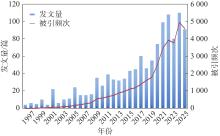
Fig.1
Annual number of publications and citation frequency for research on iron-rich substrates in CWs"
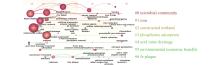
Fig.2
Timeline map of keywords development for iron-rich substrates in CWs"
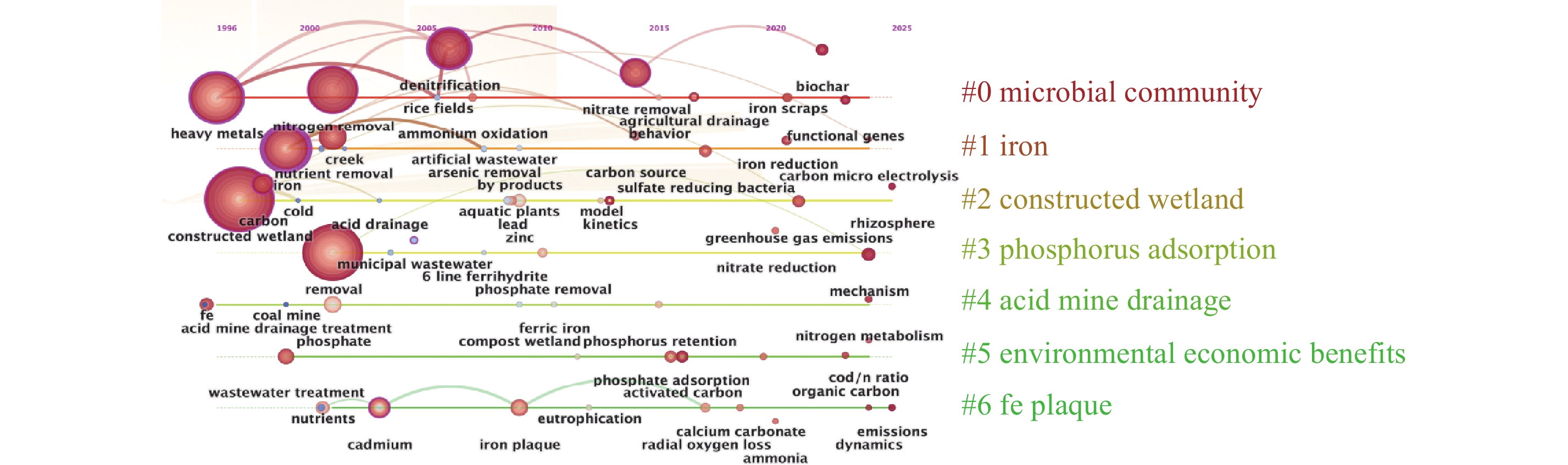
Table 1
Performance and cost of low C/N ratio wastewater treatment using different types of iron-rich CWs"
| 类型 | 特点 | 富铁基质 | 湿地类型 | HRT/d | 进水水质/(mg/L) | C/N | 去除率/% | 成本/ (元/kg NO3–-N) | 文献 |
| 单质铁 | 活性高 还原性强 易钝化 易发生铵的累积 | 纳米零价铁 | 垂直潜流 人工湿地 | 2 | TN: 25.0±0.9 NH4+: 5.0±0.2 NO3–: 20.0±0.6 | 1.6 | TN: 69.92±0.56 NH4+: 86.56±0.93 NO3–: 66.42±1.33 | 900~ | [ |
| 海绵铁 | 垂直潜流 人工湿地 | 2 | TN: 15.23±1.05 NH4+: 5.61±0.55 NO3–: 10.72±0.66 TP: 0.54±0.06 | 1.3 | TN: 93.37 NH4+: 84.31 NO3–: 67.07 TP: 22.22 | 35~45 | [ | ||
| 铁屑 | 垂直潜流 人工湿地 | 1 | TN: 19.92±0.36 NH4+: 7.88±0.19 NO3–: 12.01±0.12 TP: 1.03±0.01 | 1.19 | TN: 71.56 NH4+: 43.73 NO3–: 86.77 TP: 93.54±6.64 | 15~25 | [ | ||
| Fe(Ⅱ)/ Fe(Ⅲ) 矿物 | 成本低廉 生物亲和性较高 化学性质稳定 反应速率较慢 | 黄铁矿 | 垂直潜流 人工湿地 | 3 | NO3–: 22.09±0.56 TP: 1.05±0.04 | 3 | TN: 67.82±0.97 TP: 83.62±4.77 | 8.6~12.5 | [ |
| 赤铁矿 | 垂直潜流 人工湿地 | 2 | NH4+: 35 TP: 5 | 0 | NH4+: 73.43 TP: >90 | [ | |||
| 磁黄铁矿 | 水平潜流 人工湿地 | 1.5 | TN: 23.60±7.12 NH4+: 6.61±4.04 NO3–: 11.85±5.35 TP: 4.88±0.88 | 约1 | TN: 60.40±5.60 NH4+: 66.02±13.82 NO3–: 63.22±12.12 TP: 88.20±5.10 | [ | |||
| 菱铁矿-硫 | 垂直潜流 人工湿地 | 2 | TN: 39.91±1.02 TP: 37.20 | 1.45 | TN: 91.6±2.2 TP: 96.3±1.2 | [ | |||
| 铁碳复 合材料 | 活性高且持久 延缓钝化 降低温室气体排放 成本高 | 铁屑+ 生物炭 | 水平潜流 人工湿地 | 2 | NH4+: 4.05±0.18 NO2–: 0.06±0.02 NO3–: 10.15±0.36 TP: 0.43±0.03 | 0 | TN: 52.08±2.54 NH4+: >95 TP: >76 | 337.5~675.0 | [ |
| 黄铁矿+ 活性炭 | 垂直潜流 人工湿地 | 7 | TN: 15 NH4+: 5 NO3–: 10 TP: 1 | 0.5 | NO3-: 92.55 NH4+: 78.00 TN: 87.59 | [ | |||
| 铁改性 生物炭 | 垂直潜流 人工湿地 | 2 | TN: 20.74±1.82 NH4+: 9.38±0.42 NO3–: 10.68±1.06 TP: 1.01±0.12 | 2.96 | TN: 83.51 NH4+: 98.23 NO3–: 80.88 TP: 86.55 | [ |
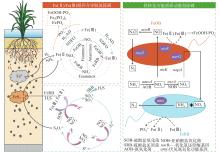
Fig.3
Mechanism of iron-rich substrates for enhancing nitrogen and phosphorus removal in CWs"
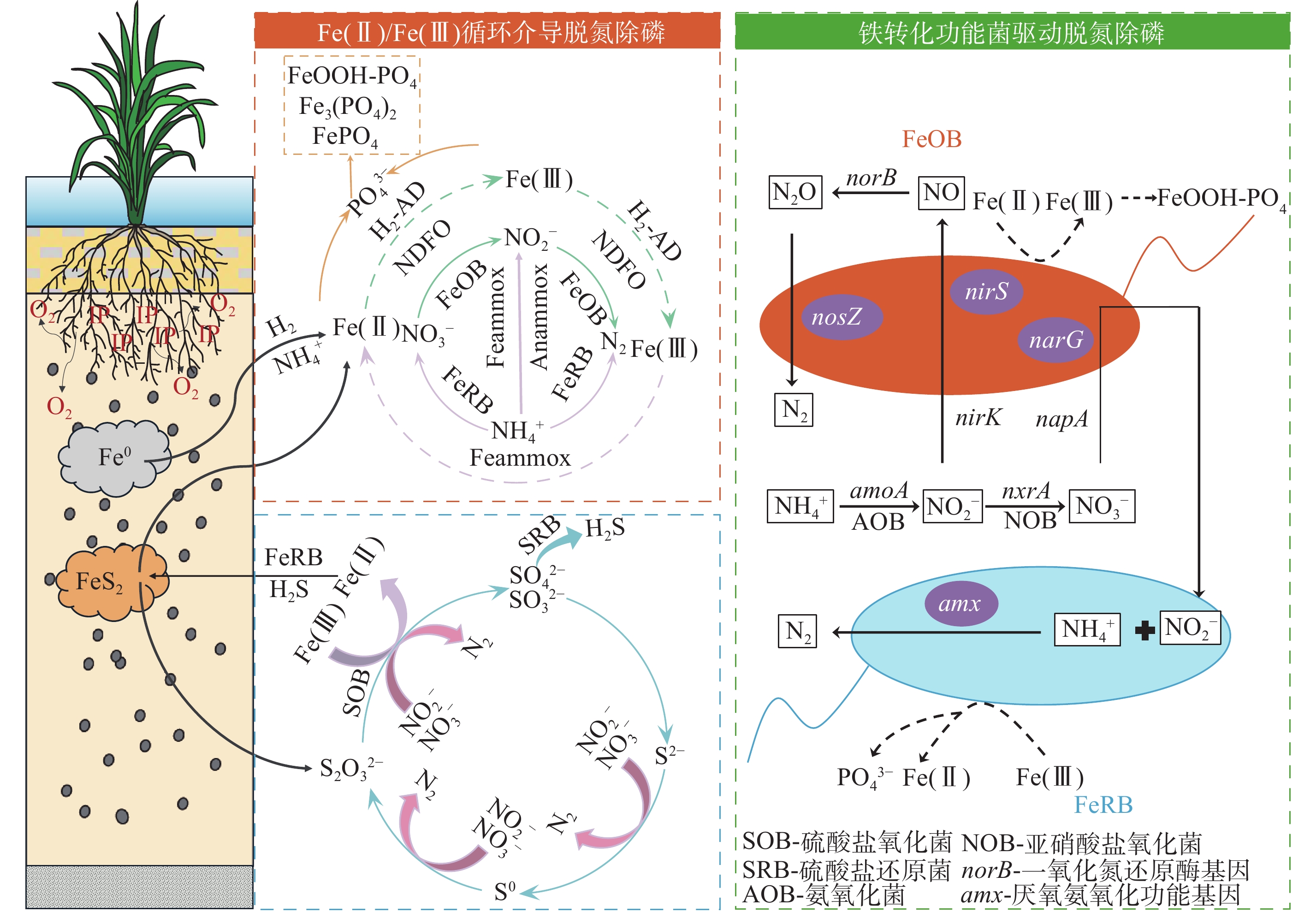
Table 2
Functions of several FeOB and FeRB in iron-rich CWs"
| 种类 | 优势菌门 | 富铁基质类型 | 优势菌属 | 功能 | 文献 |
| 铁氧化菌 | 变形菌门 | 铁碳复合材料 | 食酸菌属 (Acidovorax) | 驱动NDFO脱氮 | [ |
| 黄铁矿 铁碳复合材料 铁屑 磁黄铁矿 纳米零价铁 | 硫杆菌属 (Thiobacillus) | 还原NO3− | [ [ [ [ [ | ||
| 铁碳复合材料 铁屑 | 脱氯单胞菌属 (Dechloromonas) | 驱动硝酸盐还原亚铁氧化脱氮 吸收磷 | [ [ | ||
| 磁黄铁矿 | 磁螺菌属 (Magnetospirillum) | 驱动硝酸盐还原亚铁氧化脱氮 | [ | ||
| 纳米零价铁 黄铁矿 | 陶厄氏菌属 (Thauera) | 还原NO2−或NO生成N2 | [ [ | ||
| 黄铁矿 | 罗河杆菌属 (Rhodanobacter) | 驱动硝酸盐还原亚铁氧化脱氮 | [ | ||
| 铁还原菌 | 变形菌门 | 铁碳复合材料 | 希瓦氏菌属 (Shewanella) | 驱动反硝化和DNRA脱氮 | [ |
| 铁碳复合材料 黄铁矿 铁屑 | 地杆菌属 (Geobacter) | 参与Feammox 脱氮 | [ [ [ | ||
| 黄铁矿 铁屑 | 厌氧粘杆菌属 (Anaeromyxobacter) | 驱动DNRA脱氮 | [ [ |
| 1 | FAN Y Y, SUN S S, GU X S, et al.. Boosting the denitrification efficiency of iron-based constructed wetlands in situ via plant biomass-derived biochar: Intensified iron redox cycle and microbial responses. Water Research, 2024, 253, 121285. |
| 2 | LU W W, ZHONG F, WU J, et al.. Decoding constructed wetlands: A meta-analysis of performance and key drivers in tail water treatment. Process Safety and Environmental Protection, 2025, 197, 107040. |
| 3 | YANG Y, CHEN T H, MORRISON L, et al.. Nanostructured pyrrhotite supports autotrophic denitrification for simultaneous nitrogen and phosphorus removal from secondary effluents. Chemical Engineering Journal, 2017, 328, 511- 518. |
| 4 | XU Z S, QIAO W W, SONG X S, et al.. Pathways regulating the enhanced nitrogen removal in a pyrite based vertical-flow constructed wetland. Bioresource Technology, 2021, 325, 124705. |
| 5 | CHANG Y T, MENG J Z, HU Y S, et al.. A review in Fe(0)/Fe(Ⅱ) mediated autotrophic denitrification for low C/N wastewater treatment. Water Research, 2025, 282, 123925. |
| 6 | HU X J, WAN X D, TAN W, et al.. More is better? Constructed wetlands filled with different amount of Fe oxides showed opposite phosphorus removal performance. Journal of Cleaner Production, 2021, 329, 129749. |
| 7 | 梁津铭, 李杰, 王亚娥, 等.. 零价铁强化人工湿地脱氮除磷的研究进展. 中国给水排水, 2024, 40 (24): 1- 10. |
| 8 | WANG X H, SHEN T Y, YANG W J, et al.. A critical review on the application of pyrite in constructed wetlands: Contaminants removal and mechanism. Journal of Water Process Engineering, 2024, 63, 105353. |
| 9 | ZHU B Y, YUAN R F, WANG S N, et al.. Iron-based materials for nitrogen and phosphorus removal from wastewater: A review. Journal of Water Process Engineering, 2024, 59, 104952. |
| 10 | PENG Y Y, HE S B, WU F.. Biochemical processes mediated by iron-based materials in water treatement: Enhancing nitrogen and phosphorus removal in low C/N ratio wastewater. Science of the Total Environment, 2021, 775, 145137. |
| 11 | LUO S Y, ZHAO J H, ZHANG S, et al.. A novel method for enhancing nitrogen removal from wastewater treatment plant tailwater by zeolite-supported nano zero-valent iron substrate constructed wetland. Desalination and Water Treatment, 2024, 317, 100128. |
| 12 | SHEN Y W, HU M J, XU Y S, et al.. Synergistic removal of nitrogen and phosphorus in constructed wetlands enhanced by sponge iron. Water, 2024, 16 (10): 1414. |
| 13 | HE Q M, FENG M Q, WANG J K.. Impact of iron-modified fillers on enhancing water purification performance and mitigating greenhouse effect in constructed wetlands. Environmental Technology, 2025, 46 (11): 1817- 1827. |
| 14 | CHU Y F, LIU W, TAN Q Y, et al.. Vertical-flow constructed wetland based on pyrite intensification: Mixotrophic denitrification performance and mechanism. Bioresource Technology, 2022, 347, 126710. |
| 15 | QIN H, NIE W B, YI D, et al.. Hematite-facilitated microbial ammoxidation for enhanced nitrogen removal in constructed wetlands. Frontiers of Environmental Science & Engineering, 2024, 18 (7): 82. |
| 16 | LIANG Y, WEI D Y, HU J S, et al.. Glyphosate and nutrients removal from simulated agricultural runoff in a pilot pyrrhotite constructed wetland. WaterResearch, 2020, 168, 115154. |
| 17 | FENG C Y, ZHANG X W, GAO G C, et al.. A new insight on simultaneous water purification and greenhouse gas reduction by constructing sulfur-siderite driven autotrophic denitrification pathways in constructed wetlands. Water Research, 2025, 274, 123130. |
| 18 | LIAN J J, WU P, YANG F, et al.. Enhanced nitrogen removal and greenhouse gas reduction via activated carbon coupled iron-based constructed wetlands. Journal of Water Process Engineering, 2024, 66, 106098. |
| 19 | LIU X L, ZHANG Y L, LI X, et al.. Iron-modified biochar and plant species in enhancing wastewater treatment in constructed wetlands. Aquatic Conservation: Marine and Freshwater Ecosystems, 2025, 35 (6): e70162. |
| 20 | DI CAPUA F, PIROZZI F, LENS P N L, et al.. Electron donors for autotrophic denitrification. Chemical Engineering Journal, 2019, 362, 922- 937. |
| 21 | SI Z H, SONG X S, WANG Y H, et al.. Untangling the nitrate removal pathways for a constructed wetland- sponge iron coupled system and the impacts of sponge iron on a wetland ecosystem. Journal of Hazardous Materials, 2020, 393, 122407. |
| 22 | 张燕, 董红云, 李新华, 等.. 人工湿地中典型基质和关键微生物的脱氮作用研究进展. 湿地科学, 2023, 21 (5): 770- 775. |
| 23 | LU J X, DONG L, GUO Z Z, et al.. Highly efficient phosphorous removal in constructed wetland with iron scrap: Insights into the microbial removal mechanism. Journal of Environmental Management, 2023, 347, 119076. |
| 24 | MA Y H, ZHENG X Y, HE S B, et al.. Nitrification, denitrification and anammox process coupled to iron redox in wetlands for domestic wastewater treatment. Journal of Cleaner Production, 2021, 300, 126953. |
| 25 | 朱红娟, 王亚娥, 李杰, 等.. 海绵铁在脱氮和除磷中的研究进展. 应用化工, 2023, 52 (4): 1182- 1187. |
| 26 | 李婷, 朱易春, 康旭, 等.. 海绵铁还原微污染源水中硝酸盐氮的影响因素研究. 工业水处理, 2016, 36 (11): 85- 89. |
| 27 | FENG M Y, LIANG J M, WANG P, et al.. Use of sponge iron dosing in baffled subsurface-flow constructed wetlands for treatment of wastewater treatment plant effluents during autumn and winter. International Journal of Phytoremediation, 2022, 24 (13): 1405- 1417. |
| 28 | 毕玉翠, 刘福兴, 付子轼, 等.. 生物炭或铁矿石添加对人工湿地脱氮效率的影响及微生物机制分析. 环境工程技术学报, 2025, 15 (2): 545- 558. |
| 29 | 刘嘉玮, 汪涵, 王亚宜.. 铁矿物强化厌氧氨氧化效能及其微生物机制研究进展. 微生物学通报, 2022, 49 (10): 4305- 4326. |
| 30 | DONG L, QI Z P, LI M Q, et al.. Organics and nutrient removal from swine wastewater by constructed wetlands using ceramsite and magnetite as substrates. Journal of Environmental Chemical Engineering, 2021, 9 (1): 104739. |
| 31 | SHI L, DONG H L, REGUERA G, et al.. Extracellular electron transfer mechanisms between microorganisms and minerals. Nature Reviews Microbiology, 2016, 14 (10): 651- 662. |
| 32 | LI L Y, FENG J W, ZHANG L, et al.. Enhanced nitrogen and phosphorus removal by natural pyrite-based constructed wetland with intermittent aeration. Environmental Science and Pollution Research International, 2021, 28 (48): 69012- 69028. |
| 33 | DAI N, YAO D D, LI Y K, et al.. Enhanced adaptability of pyrite-based constructed wetlands for low carbon to nitrogen ratio wastewater treatments: Modulation of nitrogen removal mechanisms and reduction of carbon emissions. Bioresource Technology, 2024, 395, 130348. |
| 34 | 陈一帆, 王梦男, 路建平, 等.. 人工湿地反应性填料开发及其脱氮除磷性能研究. 微生物学报, 2023, 63 (6): 2233- 2244. |
| 35 | LIU Y, WANG H C, SUN Y L, et al.. Application of the sulfur-siderite composite filler: A case study of augmented performance and synergistic mechanism for low C/N wastewater treatment in constructed wetland. Chemical Engineering Journal, 2023, 475, 146376. |
| 36 | ZHANG X W, FENG C Y, WEI D, et al.. Optimization of “sulfur–iron–nitrogen” cycle in constructed wetlands by adjusting siderite/sulfur (Fe/S) ratio. Journal of Environmental Management, 2024, 363, 121336. |
| 37 | CHENG L, LIANG H, YANG W B, et al.. The biochar/Fe-modified biocarrier driven simultaneous NDFO and Feammox to remove nitrogen from eutrophic water. Water Research, 2023, 243, 120280. |
| 38 | XU J, LIU X W, HUANG J L, et al.. The contributions and mechanisms of iron-microbes-biochar in constructed wetlands for nitrate removal from low carbon/nitrogen ratio wastewater. RSC Advances, 2020, 10 (39): 23212- 23220. |
| 39 | 王文荟, 季闻翔, 赵杰, 等.. 铁碳微电解基质在人工湿地中的作用机理及研究现状. 环境化学, 2023, 42 (4): 1196- 1208. |
| 40 | CUI X J, ZHANG M P, DING Y J, et al.. Enhanced nitrogen removal via iron-carbon micro-electrolysis in surface flow constructed wetlands: Selecting activated carbon or biochar?. Science of the Total Environment, 2022, 815, 152800. |
| 41 | XU M, GAO P, WU J, et al.. Biochar promotes arsenic sequestration on iron plaques and cell walls in rice roots. Chemosphere, 2022, 288, 132422. |
| 42 | ZHANG J Y, ZHOU H, GU J F, et al.. Effects of nano-Fe3O4-modified biochar on iron plaque formation and Cd accumulation in rice (Oryza sativa L. ). Environmental Pollution, 2020, 260, 113970. |
| 43 | MA Y H, DAI W Q, ZHENG P R, et al.. Iron scraps enhance simultaneous nitrogen and phosphorus removal in subsurface flow constructed wetlands. Journal of Hazardous Materials, 2020, 395, 122612. |
| 44 | 薛佳慧, 李彦宇, 邱旭, 等.. 硝酸盐依赖性亚铁氧化脱氮技术研究进展. 中国环境科学, 2024, 44 (12): 6668- 6680. |
| 45 | YUAN Q, GAO J Q, LIU P P, et al.. Autotrophic denitrification based on sulfur-iron minerals: Advanced wastewater treatment technology with simultaneous nitrogen and phosphorus removal. Environmental Science and Pollution Research International, 2024, 31 (5): 6766- 6781. |
| 46 | FU J M, ZHAO Y Q, DAI Y N, et al.. Pyrite in recirculating stacking hybrid constructed wetland: Electron transfer for nitrate reduction and phosphorus immobilization. Journal of Environmental Management, 2025, 373, 123906. |
| 47 | 张嘉志. 铁碳人工湿地处理农村生活污水尾水的脱氮除磷效果研究 [D]. 广州: 广州大学, 2020. |
| 48 | 曹雪莹, 种云霄, 余光伟, 等.. 根表铁膜在人工湿地磷去除中的作用及基质的影响. 环境科学学报, 2013, 33 (5): 1292- 1297. |
| 49 | FAN Y Y, SUN S S, HE S B.. Iron plaque formation and its effect on key elements cycling in constructed wetlands: Functions and outlooks. Water Research, 2023, 235, 119837. |
| 50 | SHEN C, SU L T, ZHAO Y Q, et al.. Plants boost pyrrhotite-driven nitrogen removal in constructed wetlands. Bioresource Technology, 2023, 367, 128240. |
| 51 | ZHAO Y F, CAO X, SONG X S, et al.. Montmorillonite supported nanoscale zero-valent iron immobilized in sodium alginate (SA/Mt-NZVI) enhanced the nitrogen removal in vertical flow constructed wetlands (VFCWs). Bioresource Technology, 2018, 267, 608- 617. |
| 52 | SI Z H, SONG X S, WANG Y H, et al.. Natural pyrite improves nitrate removal in constructed wetlands and makes wetland a sink for phosphorus in cold climates. Journal of Cleaner Production, 2021, 280, 124304. |
| 53 | GE Z B, WEI D Y, ZHANG J, et al.. Natural pyrite to enhance simultaneous long-term nitrogen and phosphorus removal in constructed wetland: Three years of pilot study. Water Research, 2019, 148, 153- 161. |
| 54 | MA S H, LU J W, REN T, et al.. Integrated soil-crop system management improves rice N uptake and yield by reducing iron plaque formation. Field Crops Research, 2025, 322, 109722. |
| 55 | WAN X D, LI Y, LI C Y, et al.. Effect of iron plaque on the root surface of hydrophyte on nitrogen and phosphorus transformation. Bioresource Technology Reports, 2020, 12, 100566. |
| 56 | LIU T, QIN S P, PANG Y X, et al.. Rice root Fe plaque enhances paddy soil N2O emissions via Fe(II) oxidation-coupled denitrification. Soil Biology and Biochemistry, 2019, 139, 107610. |
| 57 | 王宇娜, 国晓春, 卢少勇, 等.. 人工湿地对低污染水中氮去除的研究进展: 效果、机制和影响因素. 农业资源与环境学报, 2021, 38 (5): 722- 734. |
| 58 | 张子娴, 刘婷, 秦树平, 等.. 铁膜促进水稻土N2O 排放的根际微域反硝化微生物机制解析. 环境科学学报, 2023, 43 (6): 437- 447. |
| 59 | LIU T, LIU M T, ZHANG Z X, et al.. The influences of iron plaque on nitrogen emissions from paddy soils under different water management practices. European Journal of Soil Biology, 2025, 125, 103730. |
| 60 | ITURRALDE E T, STOCCO M C, FAURA A, et al.. Coinoculation of soybean plants with Bradyrhizobium japonicum and Trichoderma harzianum: Coexistence of both microbes and relief of nitrate inhibition of nodulation. Biotechnology Reports, 2020, 26, e00461. |
| 61 | 邵兴华, 章永松, 林咸永, 等.. 三种铁氧化物的磷吸附解吸特性以及与磷吸附饱和度的关系. 植物营养与肥料学报, 2006, 12 (2): 2208- 2212. |
| 62 | KHAN N, SESHADRI B, BOLAN N, et al.. Root iron plaque on wetland plants as a dynamic pool of nutrients and contaminants. Advances in Agronomy, 2016, 138, 1- 96. |
| 63 | 阳路芳, 陈春秀, 田丽, 等.. 外源铁对花叶冷水花根表铁膜及磷吸收的影响. 西南大学学报(自然科学版), 2024, 46 (11): 165- 174. |
| 64 | 戚永洁, 张波, 蒋素英, 等.. 铁碳微电解工艺中的填料板结钝化. 印染, 2017, 43 (4): 43- 46. |
| 65 | WANG X C, LI W X, YANG S R, et al.. Iron-dependent autotrophic denitrification as a novel microbial driven and iron-mediated denitrification process: A critical review. Environmental Research, 2025, 273, 120808. |
| [1] | Mengyuan YU, Changneng QIU, Minsheng HUANG, Tong ZHANG, Yao ZHOU, Yi YU, Yangyang YI. Effects of hydraulic disturbance and water level changes on the growth of Vallisneria natans and water quality [J]. J* E* C* N* U* N* S*, 2026, 2026(1): 54-65. |
| [2] | Yutong ZHANG, Huanran ZHOU, Lingling WU. Research progress on pollution characteristics and ecotoxicity of SSRIs in aquatic environments [J]. J* E* C* N* U* N* S*, 2026, 2026(1): 43-53. |
| [3] | Yongle ZHAO, Yan ZHANG. Research progress on the interaction mechanisms and combined toxicity of microplastics and antibiotics in aquatic environments [J]. J* E* C* N* U* N* S*, 2026, 2026(1): 25-42. |
| [4] | Xiujuan MA, Yujie WANG, Xiaoran FAN. Research on the construction of an environmental emergency response system for sudden water pollution incidents in the Tang River Basin of Datong City in Shanxi Province [J]. J* E* C* N* U* N* S*, 2026, 2026(1): 147-155. |
| [5] | Xiujuan MA, Yujie WANG, Cheng ZHANG, Dan LIU, Xiaoran FAN, Zhiyuan ZHANG. Problem diagnosis and countermeasure research of water ecological environmental protection in the Yellow River Basin of Shanxi Province [J]. J* E* C* N* U* N* S*, 2026, 2026(1): 140-146. |
| [6] | Yangyang HU, Chang LIU, Chengjin CAO, Junhao LI, Liuxing WU, Ruiyun ZHU, Minsheng HUANG, Yan HE, Haochen DU, Lei WANG, Xinlin YAN. Occurrence characteristics and risk assessment of microplastics in industrial wastewater from key industries in the Taihu Lake Basin [J]. J* E* C* N* U* N* S*, 2026, 2026(1): 14-24. |
| [7] | Hanlin WANG, Jiale LI, Yihui DONG, Zhanxue SUN, Jun’ao WANG, Yuxin HUANG. Research progress on the effect of carbon source on biological denitrification in nitrogen-containing wastewater [J]. J* E* C* N* U* N* S*, 2026, 2026(1): 110-119. |
| [8] | Haiyao QIU, Yan HE, Yehong FAN, Minsheng HUANG, Chengjin CAO, Peimin HE, Bingbing XU, Wenhui HE. Research progress on the impact of connectivity restoration and ecological water replenishment on river-lake water ecosystem [J]. J* E* C* N* U* N* S*, 2025, 2025(2): 12-19. |
| [9] | Yaoyi LIU, Lingge ZHAI, Peng ZENG, Yifan WANG, Tian TIAN, Yue CHE. Water quality evaluation and spatial-temporal variation characteristics of the Taihu Lake Basin based on PCA and CCME-WQI [J]. J* E* C* N* U* N* S*, 2025, 2025(2): 20-33. |
| [10] | Zhuolan ZHANG, Qiqing CHEN, Yuye CHEN, Xiaoyun YAN, Yan YANG, Huahong SHI. Release and risk of UV absorbers from plastics entering rivers [J]. Journal of East China Normal University(Natural Science), 2024, 2024(6): 188-199. |
| [11] | Hongshuo ZOU, Min FU, Mengdie XIAO, Shiwen SHENG, Ping XU, Xuechu CHEN. Study on ecological purification system of tidal-flow paddy wetland based on multifunctional coupling [J]. Journal of East China Normal University(Natural Science), 2024, 2024(1): 58-67. |
| [12] | Yang CAO, Dungang GU, Guanghui LI, Minsheng HUANG, Wenhui HE. A review on the application of slow-release oxygen materials in the remediation of polluted rivers and lakes [J]. Journal of East China Normal University(Natural Science), 2024, 2024(1): 9-16. |
| [13] | Dan CUI, Ying LI, Tida CHEN, Minsheng HUANG. Analysis and evaluation of the phytoplankton community structure in Luxun Park, Shanghai [J]. Journal of East China Normal University(Natural Science), 2022, 2022(3): 27-38. |
| [14] | Chunyi YANG, Guangxiang MA, Junjie GU, Jiayan GU, Guofu HE, Weixin KONG, Gensen YANG. Study on ecological environmental effects of sediment dredging: A case study on river regulation in Shandong Province [J]. Journal of East China Normal University(Natural Science), 2022, 2022(3): 61-70. |
| [15] | Yuxin YUAN, Jiamin LIU, Ling PAN, Lihong WANG, Xueli ZHANG, Minsheng HUANG. A review of applications and research progress on the use of nanoparticles for the inhibition of harmful algal bloom [J]. Journal of East China Normal University(Natural Science), 2021, 2021(4): 90-98. |
| Viewed | ||||||
|
Full text |
|
|||||
|
Abstract |
|
|||||
