
 中文核心期刊
J* E* C* N* U* N* S* ›› 2026, Vol. 2026 ›› Issue (2): 59-70.doi: 10.3969/j.issn.1000-5641.2026.02.006
• RF Front-Ends and Millimeter-Wave Integrated Circuits • Previous Articles Next Articles
Ziyao WANG, Yuri LU, Runxi ZHANG*( )
)
Received:2025-12-24
Online:2026-03-25
Published:2026-04-03
Contact:
Runxi ZHANG
E-mail:rxzhang@ee.ecnu.edu.cn
CLC Number:
Ziyao WANG, Yuri LU, Runxi ZHANG. A 20~25 GHz transformer-based improved multi-path noise-canceling low noise amplifier[J]. J* E* C* N* U* N* S*, 2026, 2026(2): 59-70.
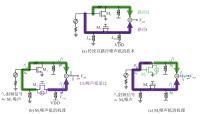
Fig.1
Conventional dual-path noise-canceling technique and scheme"
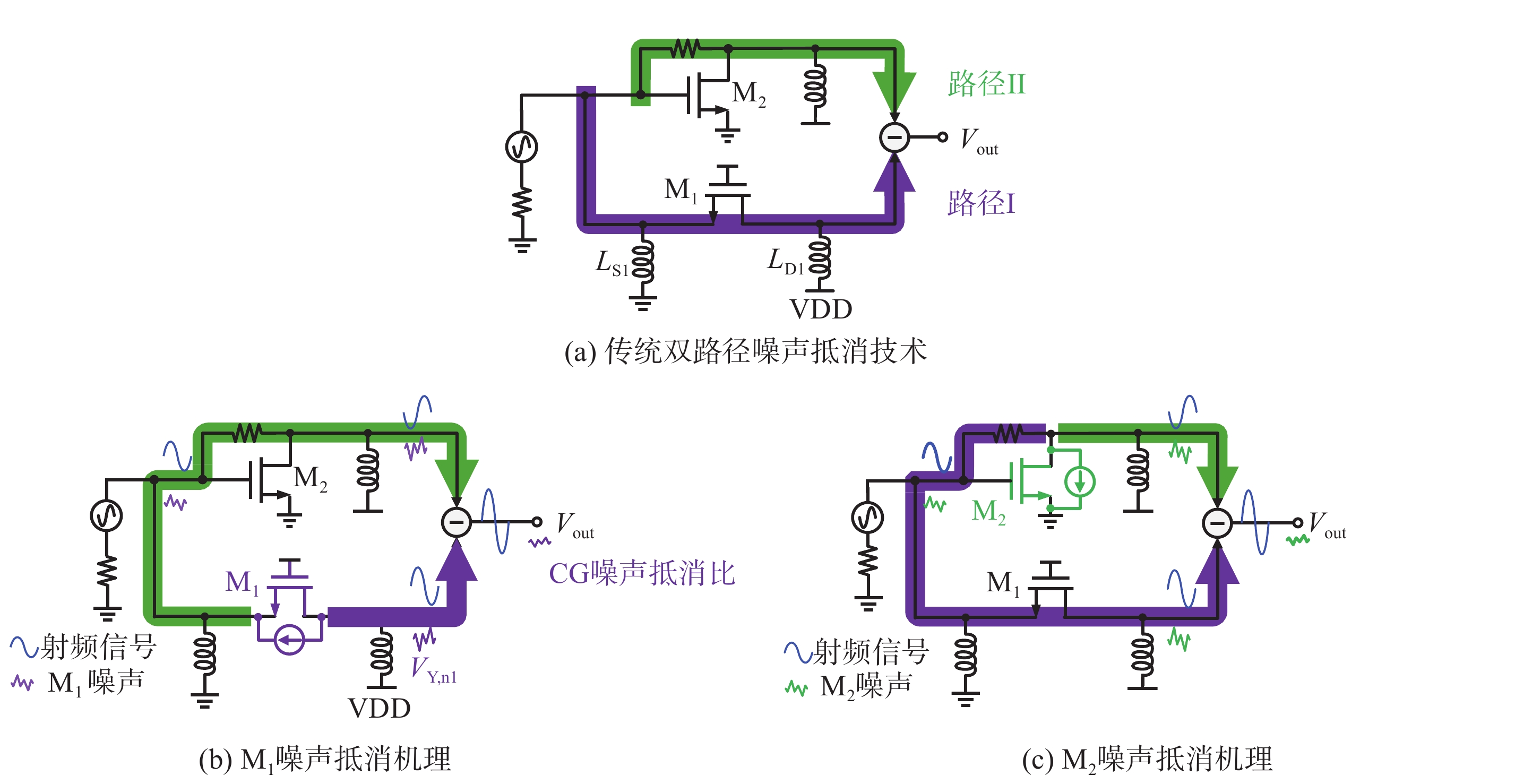
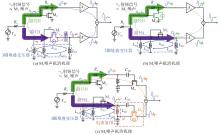
Fig.2
Three types of improved multi-path noise-canceling mechanism"
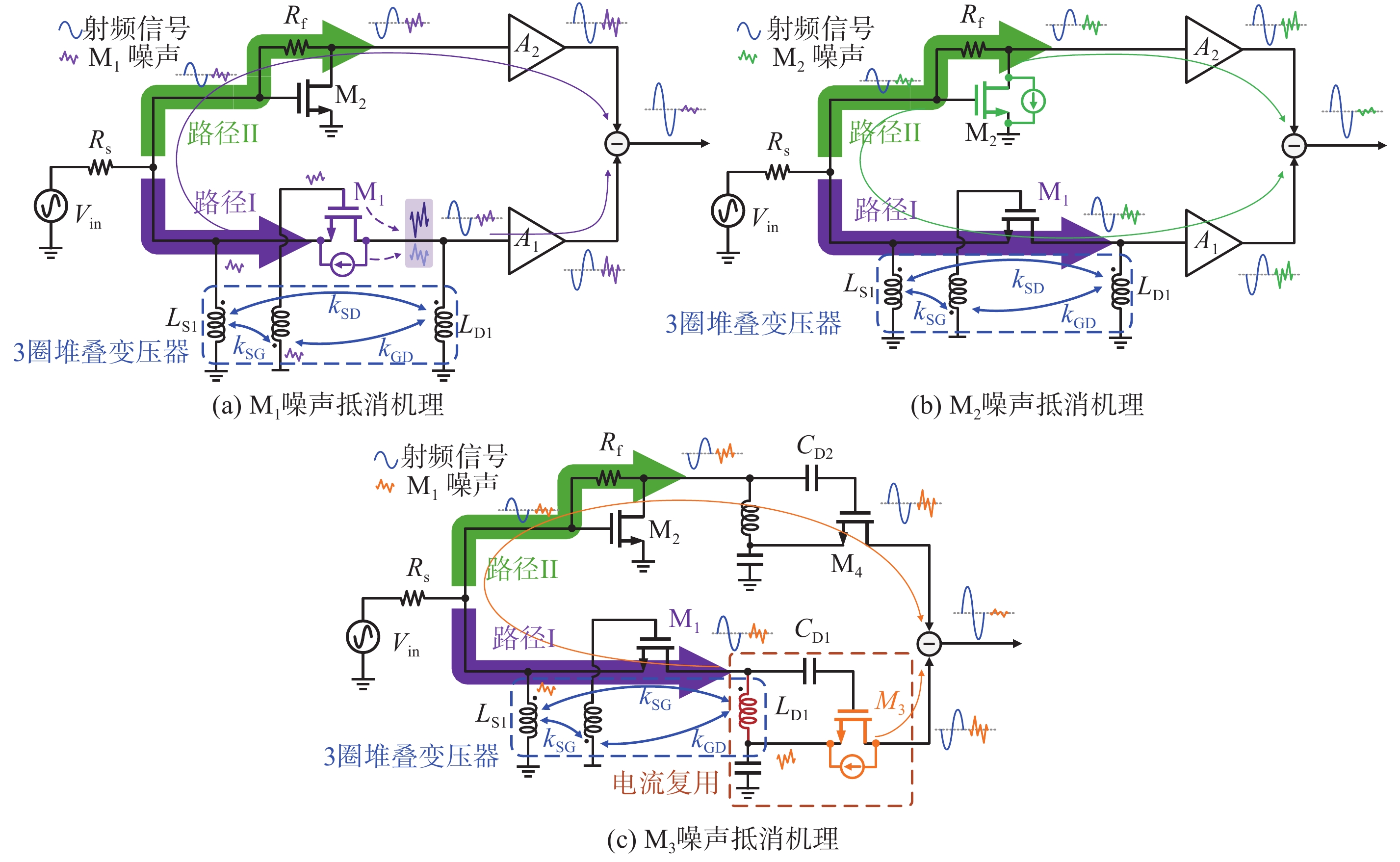
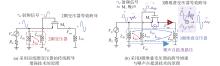
Fig.3
The principles of the traditional transconductance enhancement technology and the proposed transconductance enhancement and noise self-cancellation technology"
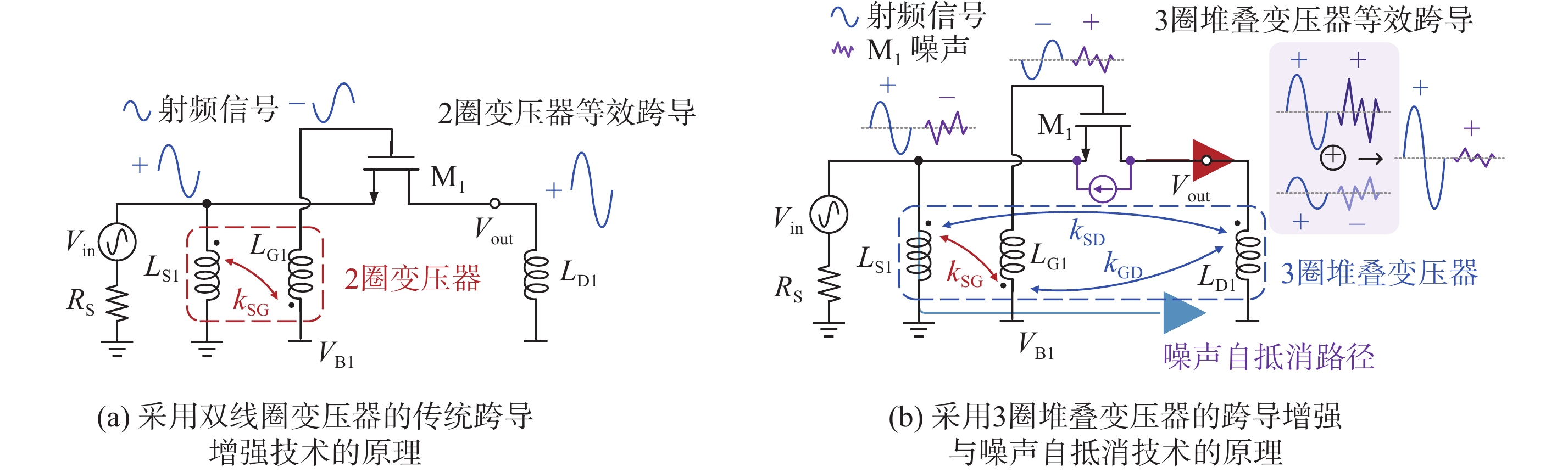
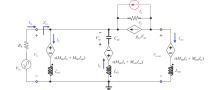
Fig.4
Small-signal equivalent model of the CG stage with three-coil transformer"
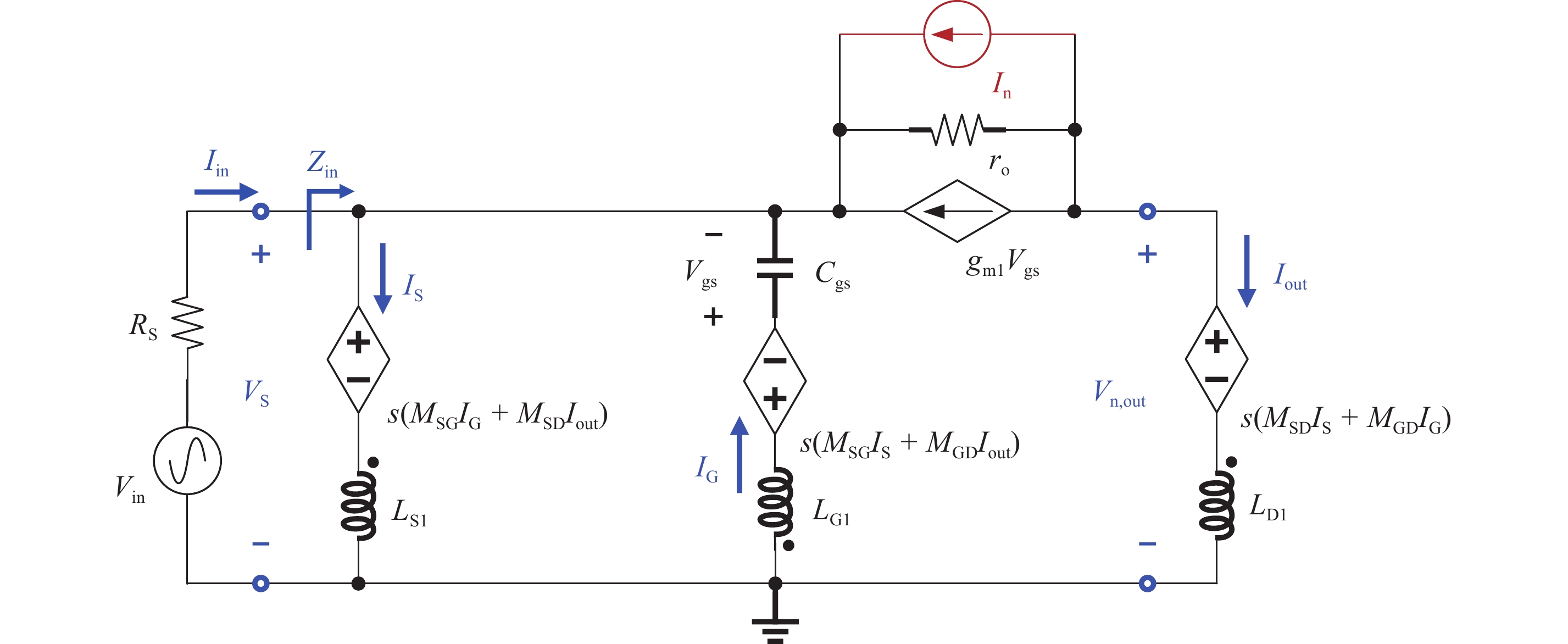
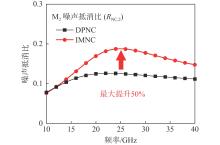
Fig.5
Simulated M2 noise-canceling ratio RNC,2 of the proposed improved multi-path noise-canceling low noise amplifier compared with the conventional DPNC low noise amplifier"
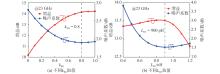
Fig.6
The simulation results of Path I gain and NF using the transformer-based transconductance enhancement and noise self-cancellation technology at 23 GHz"
Fig.7
Comparison of the simulation results of Path I under different kSG and kSD conditions"
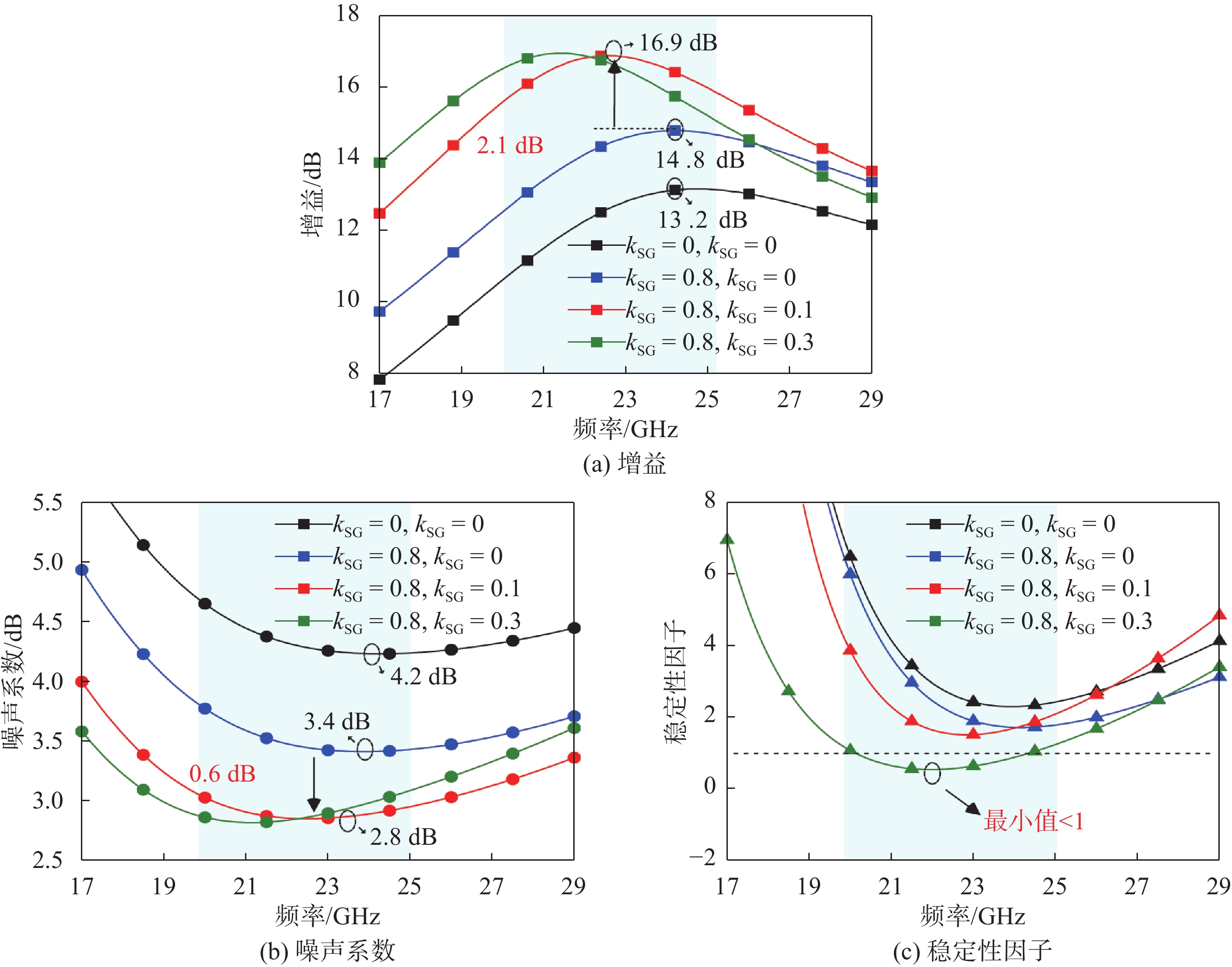
Fig.8
The simulation results of the proposed improved multipath noise cancellation low-noise amplifier and comparison with the traditional DPNC low-noise amplifier"
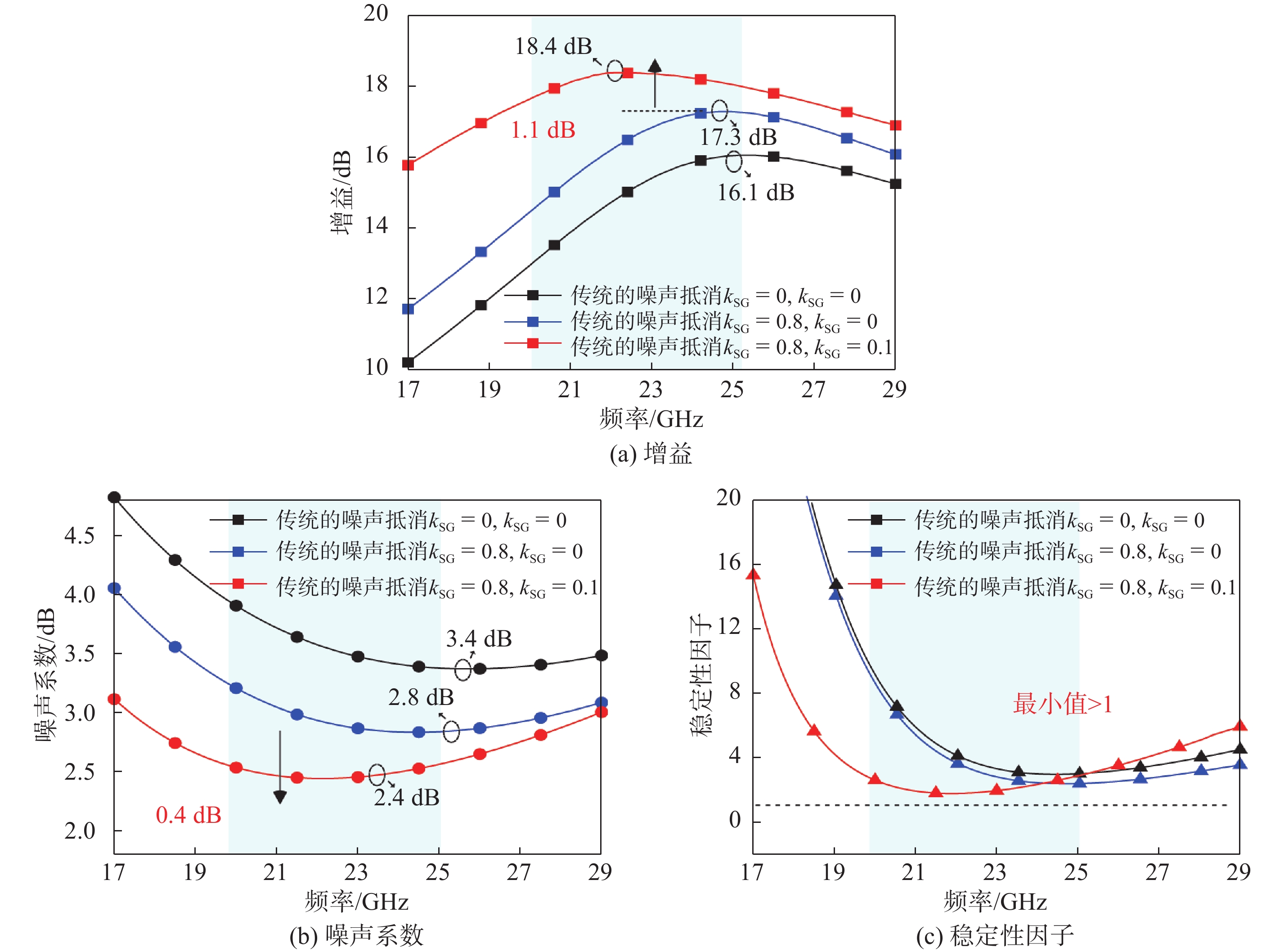
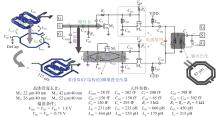
Fig.9
Schematic of the proposed IMNC low noise amplifier and the layout of the three-coil transformer with dual eight-shaped inductor LD1"
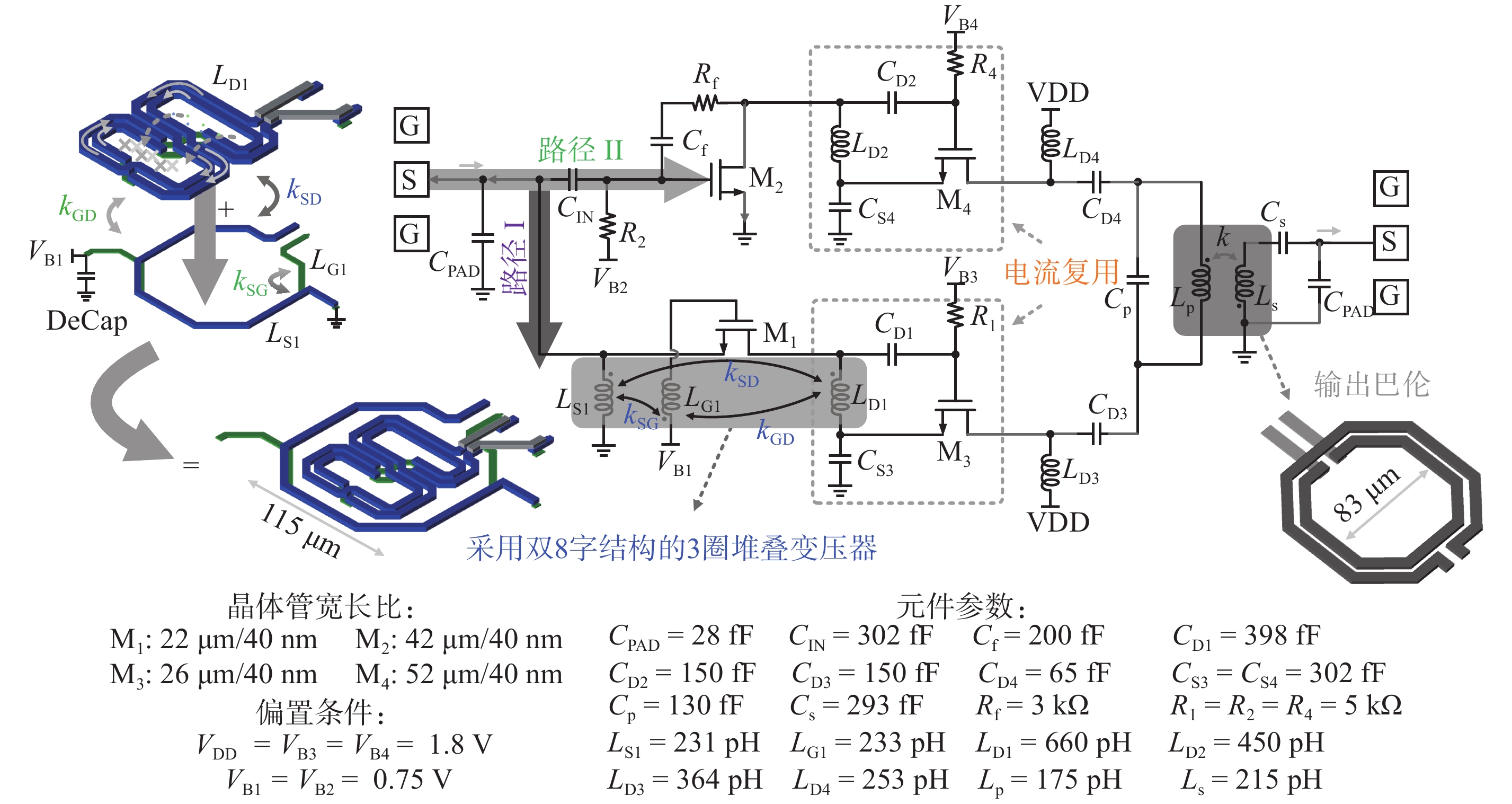
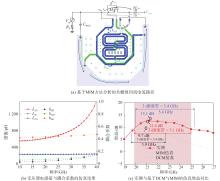
Fig.10
Analysis of the multi-component integrated modeling method"
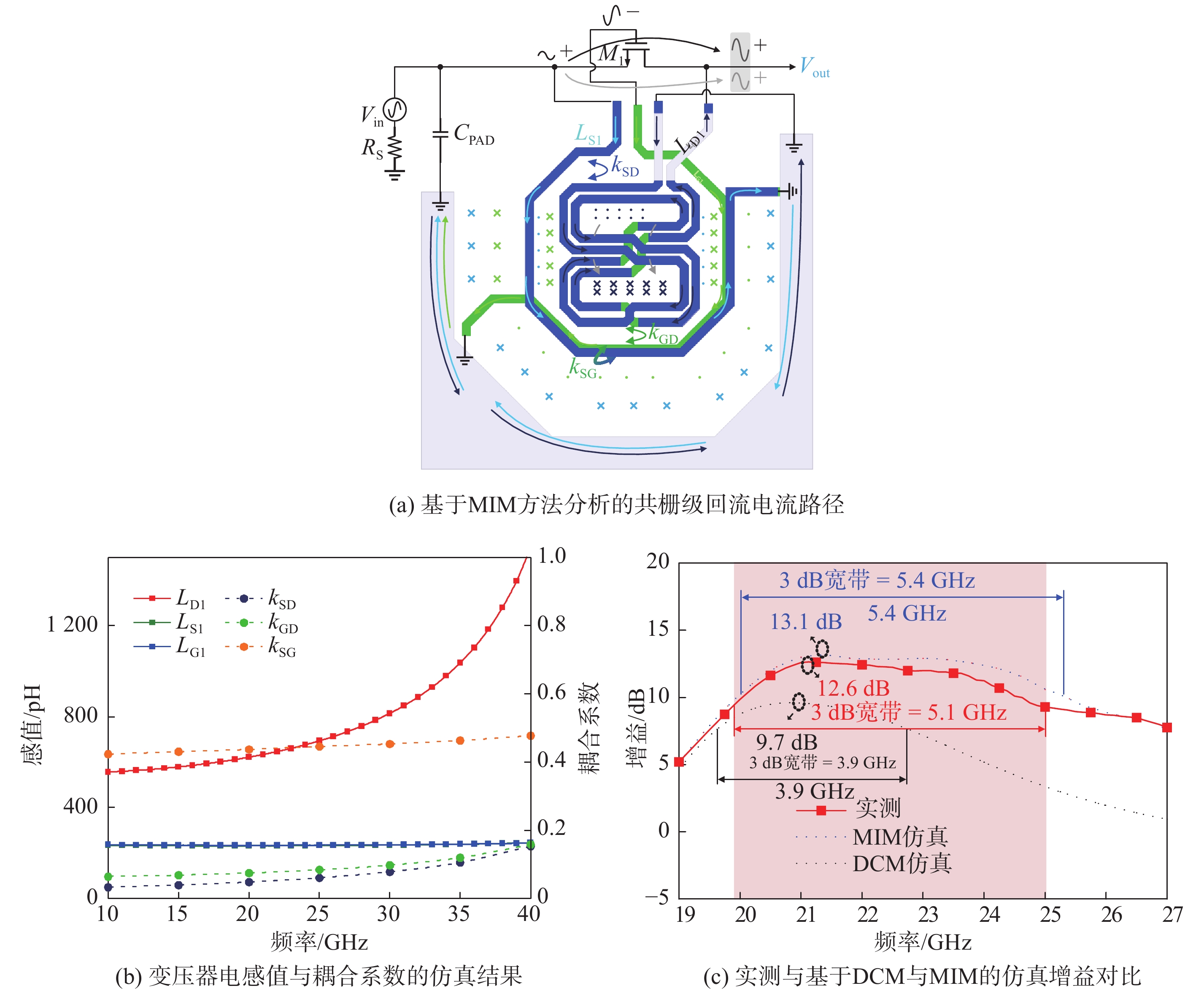
Fig.11
Chip micrograph and measurement setup"
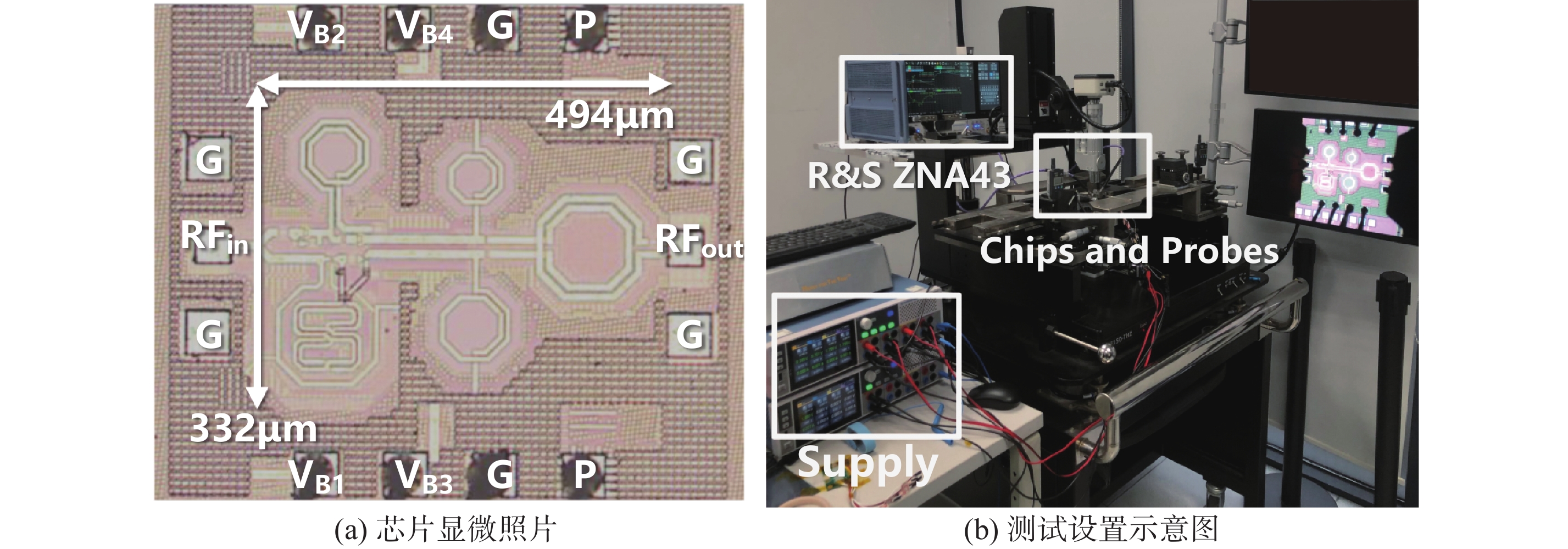
Fig.12
The simulation and measured results of the proposed low-noise amplifier"
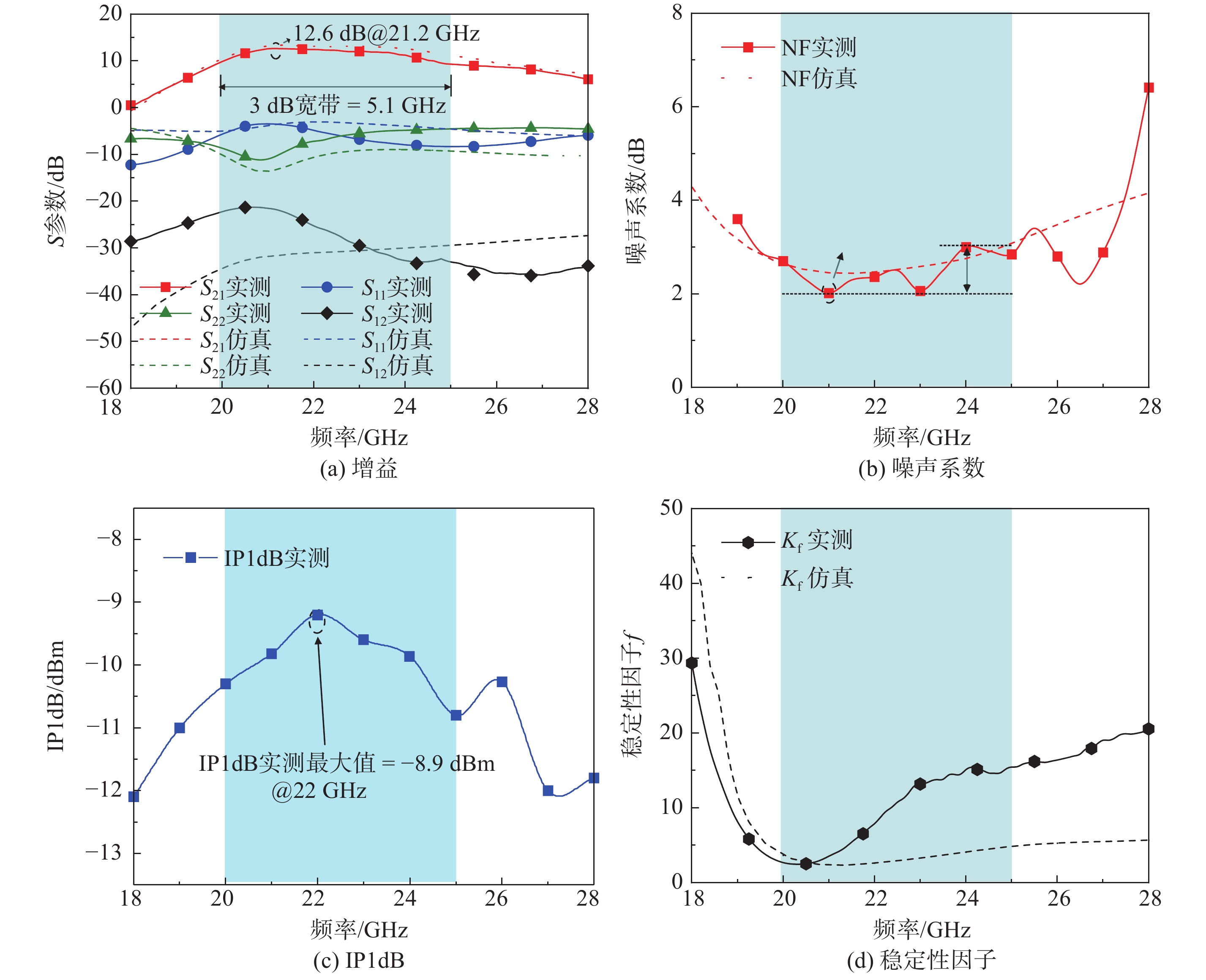
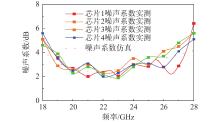
Fig.13
Simulated noise figure of the proposed low noise amplifier and the measured noise figure of the four fabricated low noise amplifier chips"
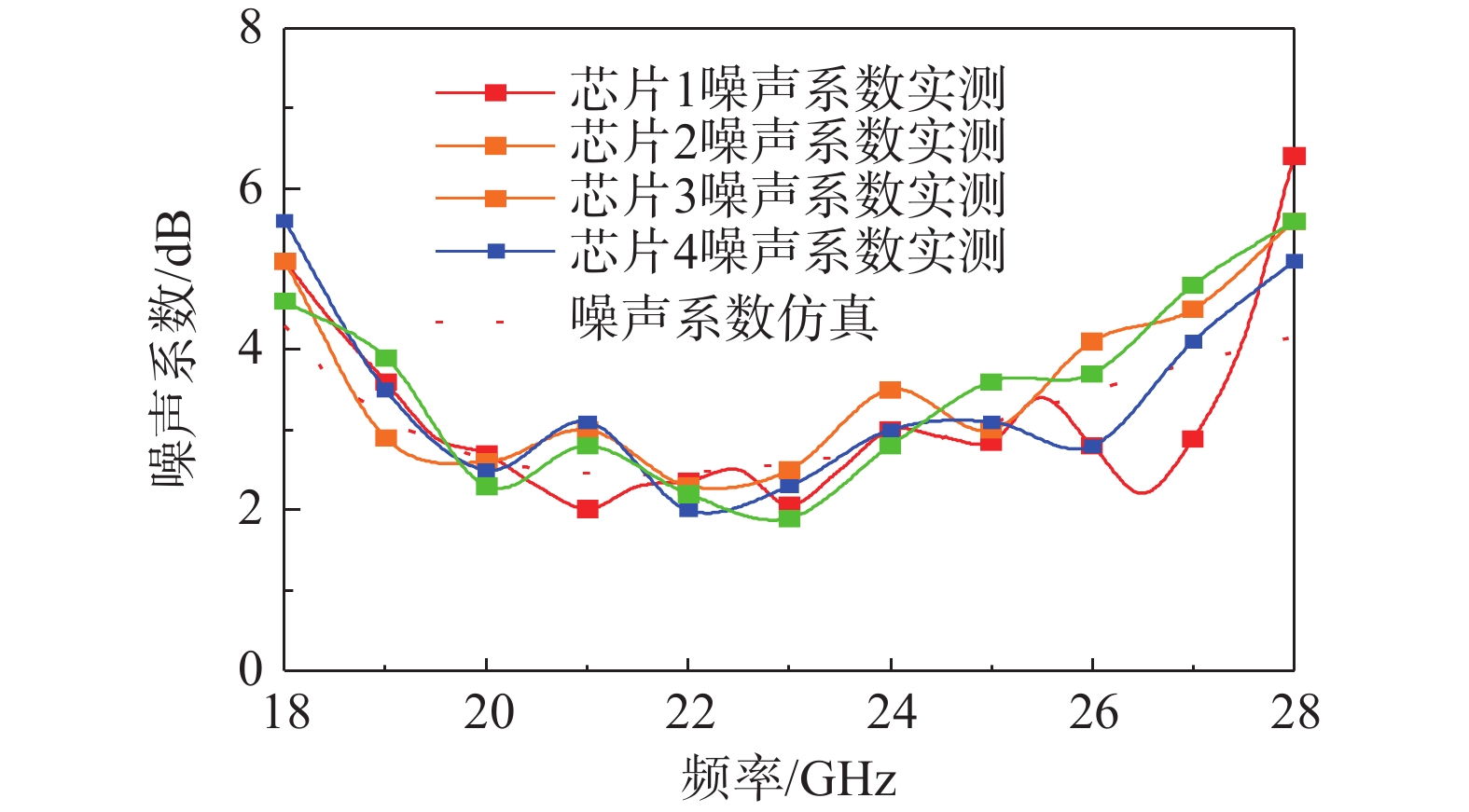
Table 1
Performance comparison of the proposed low noise amplifier with state-of-the-art designs"
| 数据来源 | 工艺 | 频率/GHz | 3 dB带宽/GHz | 增益/dB | 噪声系数/dB | IP1dB /dBm | 功耗/mW | 核心面积/mm² |
| TMTT 2019[ | 40 nm RFSOI | 28.5 | 11.0 | 8.5 | 2.7 | –15.0 | 28.0 | 0.25 |
| RFIC 2019[ | 65 nm CMOS | 28.7 | 7.6 | 18.3 | 3.3 | –24.0 | 20.7 | 0.11 |
| TCAS-II 2021[ | 45 nm CMOS | 23.5 | 5.0 | 9.5 | 4.5 | –12.0 | 20.7 | 0.69 |
| TCAS-I 2022[ | 28 nm CMOS | 27.1 | 4.8 | 19.1 | 3.3 | –8.7 | 25.5 | 0.17 |
| MWCL 2024[ | 65 nm CMOS | 28.0 | 7.5 | 16.6 | 4.1 | –12.1 | 26.4 | 0.10 |
| TMTT 2024[ | 65 nm CMOS | 39.0 | 20.0 | 21.5 | 2.2 | –17.2 | 22.0 | 0.16 |
| 本文 | 40 nm CMOS | 22.5 | 5.1 | 14.5 | 2.0 | –8.9 | 22.4 | 0.16 |
| 1 | TABARANI F, BOCCIA L, PURTOVA T, et al.. 0.25-μm BiCMOS system-on-chip for K-/Ka-band satellite communication transmit–receive active phased arrays. IEEE Transactions on Microwave Theory and Techniques, 2018, 66 (5): 2325- 2339. |
| 2 | LOW K K W, KANAR T, ZIHIR S, et al.. A 17.7–20.2-GHz 1024-element K-band SATCOM phased-array receiver with 8.1-dB/K G/T, ±70° beam scanning, and high transmit isolation. IEEE Transactions on Microwave Theory and Techniques, 2022, 70 (3): 1769- 1778. |
| 3 | FU X, YOU D, WANG X L, et al.. A low-power 256-element ka-band CMOS phased-array receiver with on-chip distributed radiation sensors for small satellite constellations. IEEE Journal of Solid-State Circuits, 2023, 58 (12): 3380- 3395. |
| 4 | LU H, LI N Y, GAO H Y, et al. A K-band 4-element 8-beam phased-array receiver with hybrid vector interpolation and impedance-adapted multibeam combining techniques for satellite communications [C]// 2024 IEEE Radio Frequency Integrated Circuits Symposium (RFIC). IEEE, 2024: 167-170. |
| 5 | FU X, YOU D, WANG Y, et al.. A low-power radiation-hardened ka-band CMOS phased-array receiver for small satellite constellation. IEEE Journal of Solid-State Circuits, 2024, 59 (2): 349- 363. |
| 6 | FRIESICKE C, FEUERSCHUTZ P, QUAY R, et al. A 40 dBm AlGaN/GaN HEMT power amplifier MMIC for SatCom applications at K-band [C]// 2016 IEEE MTT-S International Microwave Symposium (IMS). IEEE, 2016: 1-4. |
| 7 | ALJUHANI A H, REBEIZ G M. A 12.5 mW packaged K-band CMOS SOI LNA with 1.5 dB NF [C]// 2019 IEEE MTT-S International Microwave Symposium (IMS). IEEE, 2019: 156-159. |
| 8 | ZHANG J, ZHAO D, and YOU X. A 20 GHz 1.9-mW LNA using gm-boost and current-reuse techniques in 65-nm CMOS for satellite communications[J]. IEEE Journal of Solid-State Circuits, 2020, 55(10): 2714-2723. |
| 9 | ZHANG H, FAN X H, SINENCIO E S.. A low-power, linearized, ultra-wideband LNA design technique. IEEE Journal of Solid-State Circuits, 2009, 44 (2): 320- 330. |
| 10 | SHIM Y, KIM C W, LEE J, et al. Design of full band UWB common-gate LNA [J]. IEEE Microwave and Wireless Components Letters, 2007, 17(10): 721-723. |
| 11 | LO Y T, KIANG J F.. Design of wideband LNAs using parallel-to-series resonant matching network between common-gate and common-source stages. IEEE Transactions on Microwave Theory and Techniques, 2011, 59 (9): 2285- 2294. |
| 12 | MONDAL S, SINGH R, HUSSEIN A I, et al.. A 25–30 GHz fully-connected hybrid beamforming receiver for MIMO communication. IEEE Journal of Solid-State Circuits, 2018, 53 (5): 1275- 1287. |
| 13 | LEE J, HONG S.. A 21–41-GHz common-gate LNA with TLT matching networks in 28-nm FDSOI CMOS. IEEE Microwave and Wireless Components Letters, 2022, 32 (9): 1051- 1054. |
| 14 | SHAEFFER D K, LEE T H.. A 1.5-V, 1.5-GHz CMOS low noise amplifier. IEEE Journal of Solid-State Circuits, 1997, 32 (5): 745- 759. |
| 15 | NGUYEN T K, KIM C H, IHM G J, et al.. CMOS low-noise amplifier design optimization techniques. IEEE Transactions on Microwave Theory and Techniques, 2004, 52 (5): 1433- 1442. |
| 16 | CUI B L, LONG J R.. A 1.7-dB minimum NF, 22–32-GHz low-noise feedback amplifier with multistage noise matching in 22-nm FD-SOI CMOS. IEEE Journal of Solid-State Circuits, 2020, 55 (5): 1239- 1248. |
| 17 | BHAGAVATULA V, TAGHIVAND M, RUDELL J C.. A compact 77% fractional bandwidth CMOS band-pass distributed amplifier with mirror-symmetric Norton transforms. IEEE Journal of Solid-State Circuits, 2015, 50 (5): 1085- 1093. |
| 18 | LIAO C F, LIU S I.. A broadband noise-canceling CMOS LNA for 3.1–10.6-GHz UWB receivers. IEEE Journal of Solid-State Circuits, 2007, 42 (2): 329- 339. |
| 19 | BLAAKMEER S C, KLUMPERINK E A M, LEENAERTS D M W, et al.. Wideband Balun-LNA with simultaneous output balancing, noise-canceling and distortion-canceling. IEEE Journal of Solid-State Circuits, 2008, 43 (6): 1341- 1350. |
| 20 | LIU Z, BOON C C, LI C, et al. A 0.0078 mm2 3.4 mW wideband positive-feedback-based noise-cancelling LNA in 28-nm CMOS exploiting Gm boosting [C]// IEEE International Solid-State Circuits Conference. 2022: 1-3. |
| 21 | YU H H, CHEN Y, BOON C C, et al.. A 0.096-mm2 1–20-GHz triple-path noise- canceling common-gate common-source LNA with dual complementary pMOS–nMOS configuration. IEEE Transactions on Microwave Theory and Techniques, 2020, 68 (1): 144- 159. |
| 22 | DENG Z X, ZHOU J, QIAN H J, et al.. A 22.9–38.2-GHz dual-path noise-canceling LNA with 2.65–4.62-dB NF in 28-nm CMOS. IEEE Journal of Solid-State Circuits, 2021, 56 (11): 3348- 3359. |
| 23 | ALI M H M, LER C L, RUSTAGI S C, et al. The impact of electromagnetic coupling of guard ring metal lines on the performance of on-chip spiral inductor in silicon CMOS [C]// 2nd Asia Symposium on Quality Electronic Design (ASQED). IEEE, 2010: 285-288. |
| 24 | KANAR T, REBEIZ G M.. X- and K-band SiGe HBT LNAs with 1.2- and 2.2-dB mean noise figures. IEEE Transactions on Microwave Theory and Techniques, 2014, 62 (10): 2381- 2389. |
| 25 | KODAK U, REBEIZ G M.. A 5G 28-GHz common-leg T/R front-end in 45-nm CMOS SOI with 3.7-dB NF and −30-dBc EVM with 64-QAM/500-MBaud modulation. IEEE Transactions on Microwave Theory and Techniques, 2019, 67 (1): 318- 331. |
| 26 | KONG S, LEE H D, JANG S, et al. A 28-GHz CMOS LNA with stability-enhanced gm-boosting technique using transformers [C]// 2019 IEEE Radio Frequency Integrated Circuits Symposium (RFIC). IEEE, 2019: 7-10. |
| 27 | SHAHEEN R A, RAHKONEN T, PÄRSSINEN A.. Millimeter-wave frequency reconfigurable low noise amplifiers for 5G. IEEE Transactions on Circuits and Systems II: Express Briefs, 2021, 68 (2): 642- 646. |
| 28 | KOBAL E, SIRIBURANON T, CHEN X, et al.. A Gm-boosting technique for millimeter-wave low-noise amplifiers in 28-nm triple-well bulk CMOS using floating resistor in body biasing. IEEE Transactions on Circuits and Systems I: Regular Papers, 2022, 69 (12): 5007- 5017. |
| 29 | CHENG D P, CHEN X, CHEN Q, et al.. A reconfigurable LNA with compact magnetic-capacitive coupling transformer networks for 5G 28-/ 39-GHz applications. IEEE Microwave and Wireless Technology Letters, 2024, 34 (7): 915- 918. |
| 30 | KIM J H, SON J T, LIM J T, et al.. Ultralow noise figure and broadband CMOS LNA with three-winding transformer and large transistor. IEEE Transactions on Microwave Theory and Techniques, 2024, 72 (5): 2734- 2744. |
| [1] | Can LIU, Kangjie ZHAO, Runxi ZHANG. A high-energy-efficiency and high-linearity digital transmitter based on switched capacitor power amplifier (SCPA) for Wi-Fi communications [J]. J* E* C* N* U* N* S*, 2026, 2026(2): 12-24. |
| Viewed | ||||||
|
Full text |
|
|||||
|
Abstract |
|
|||||
