
 中文核心期刊
J* E* C* N* U* N* S* ›› 2026, Vol. 2026 ›› Issue (5): 66-76.doi: 10.3969/j.issn.1000-5641.2026.05.006
• Data Intelligent Technologies • Previous Articles Next Articles
Renjun HU*( )
)
Received:2026-07-09
Accepted:2026-07-12
Online:2026-09-25
Published:2026-09-12
Contact:
Renjun HU
E-mail:rjhu@dase.ecnu.edu.cn
CLC Number:
Renjun HU. Artificial intelligence through the lens of large-scale machine empiricism and its application prospects[J]. J* E* C* N* U* N* S*, 2026, 2026(5): 66-76.

Fig.1
Human intelligence (blue) and AI (red) both exhibit jagged profiles[9]"
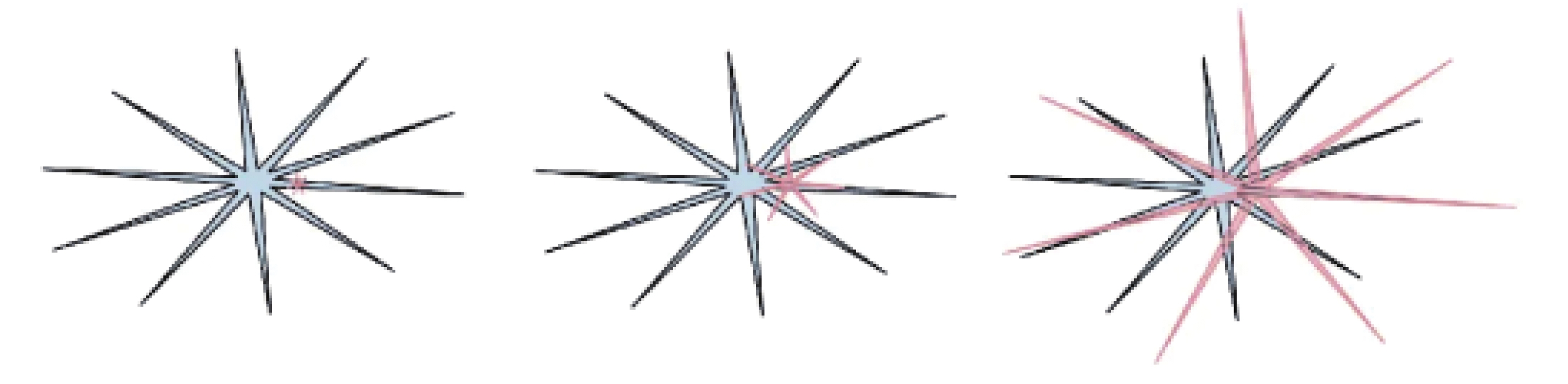
Table 1
Training costs of DeepSeek-V3 across different stages"
| 阶段 | 训练开销 | 阶段 | 训练开销 | |||
| H800 GPU小时 | 比例/% | H800 GPU小时 | 比例/% | |||
| 预训练 | 95.55 | 后训练 | 0.18 | |||
| 上下文扩展 | 4.27 | 总计 | 100 | |||
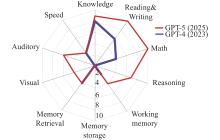
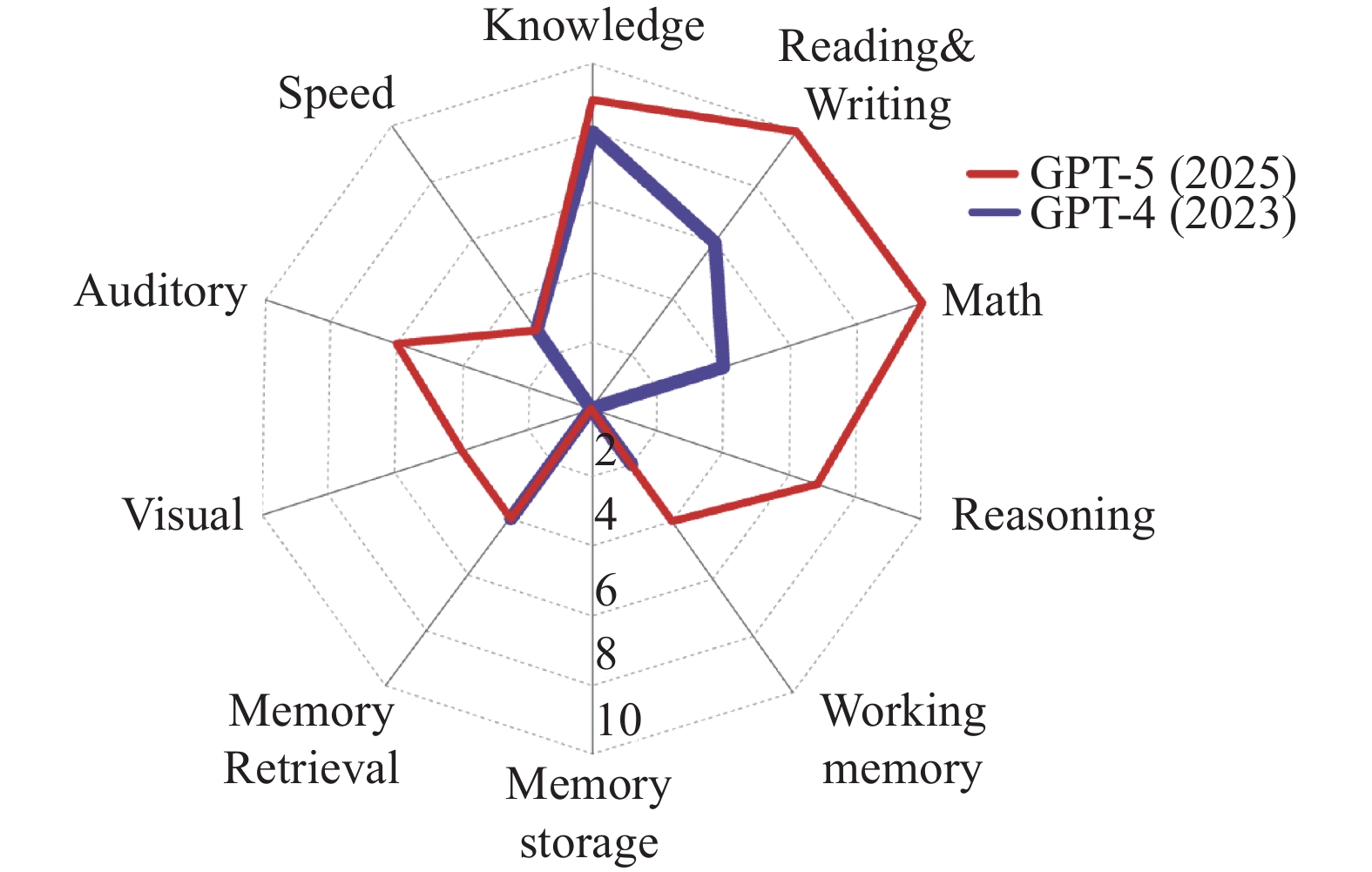
Fig.2
Capability levels of GPT-4/5 in 10 core cognitive dimensions[20]"
| 1 | Radford A, Narasimhan K, Salimans T, et al. Improving language understanding by generative pre-training [R]. OpenAI, 2018. |
| 2 | Radford A, Wu J, Child R, et al. Language models are unsupervised multitask learners [R]. OpenAI, 2019. |
| 3 | Brown T B, Mann B, Ryder N, et al. Language models are few-shot learners [C]//Proceedings of the 34th International Conference on Neural Information Processing Systems. ACM, 2020: 1877-1901. |
| 4 | Zhang K C, Li J, Li G, et al. CodeAgent: enhancing code generation with tool-integrated agent systems for real-world repo-level coding challenges [C]//Proceedings of the 62nd Annual Meeting of the Association for Computational Linguistics (Volume 1: Long Papers). Association for Computational Linguistics, 2024: 13643-13658. |
| 5 | Abramson J, Adler J, Dunger J, et al.. Accurate structure prediction of biomolecular interactions with AlphaFold 3. Nature, 2024, 630, 493- 500. |
| 6 | McDuff D, Schaekermann M, Tu T, et al.. Towards accurate differential diagnosis with large language models. Nature, 2025, 642 (8067): 451- 457. |
| 7 | Katz D M, Bommarito M J, Gao S, et al.. GPT-4 passes the bar exam. Philosophical Transactions of the Royal Society A: Mathematical, Physical and Engineering Sciences, 2024, 382 (2270): 20230254. |
| 8 | Bengio Y, Hinton G, Yao A, et al.. Managing extreme AI risks amid rapid progress. Science, 2024, 384 (6698): 842- 845. |
| 9 | Karpathy A. 2025 LLM Year in Review [EB/OL]. (2025-12-20)[2026-07-10]. https://karpathy.bearblog.dev/year-in-review-2025/ |
| 10 | Kwon W, Li Z H, Zhuang S Y, et al. Efficient memory management for large language model serving with PagedAttention [C]//Proceedings of the 29th Symposium on Operating Systems Principles. ACM, 2023: 611-626. |
| 11 | Zheng L M, Yin L S, Xie Z Q, et al. SGLang: efficient execution of structured language model programs [C]//Advances in Neural Information Processing Systems 37. 2024: 62557-62583. |
| 12 | Krizhevsky A, Sutskever I, Hinton G E.. ImageNet classification with deep convolutional neural networks. Communications of the ACM, 2017, 60 (6): 84- 90. |
| 13 | Vaswani A, Shazeer N, Parmar N, et al. Attention is all you need [C]//Proceedings of the 31st International Conference on Neural Information Processing Systems. ACM, 2017: 6000-6010. |
| 14 | Sutton R. The bitter lesson [EB/OL]. (2019-03-13) [2026-07-10]. http://www.incompleteideas.net/IncIdeas/BitterLesson.html |
| 15 | DeepSeek-AI, Liu A X, Feng B, et al. DeepSeek-V3 technical report [PP/OL]. V2. arXiv (2025-02-18) [2026-07-10]. https://doi.org/10.48550/arXiv.2412.19437. |
| 16 | Zhou C T, Liu P F, Xu P X, et al. LIMA: less is more for alignment [C]//Advances in Neural Information Processing Systems 36 (NeurIPS 2023). 2023: 55006-55021. |
| 17 | Lin B Y, Ravichander A, Lu X M, et al. The unlocking spell on base LLMs: rethinking alignment via in-context learning [C]//International Conference on Learning Representations. 2024: 24907-24933. |
| 18 | Liu Z C, Chen C, Li W, et al. Understanding R1-zero-like training: a critical perspective [C]//Proceedings of the Second Conference on Language Modeling. 2025. DOI:10.48550/arXiv.2503.20783. |
| 19 | Yue Y, Chen Z Q, Lu R, et al. Does reinforcement learning really incentivize reasoning capacity in LLMs beyond the base model? [C]//Advances in Neural Information Processing Systems 38 Main Conference (NeurIPS 2025). 2025: 57654-57689. |
| 20 | Hendrycks D, Song D, Szegedy C, et al. A definition of AGI [PP/OL]. V3. arXiv (2025-12-03) [2026-07-10]. https://doi.org/10.48550/arXiv.2510.18212. |
| 21 | Li J T, Hu R J, Huang K Z, et al. PertEval: unveiling real knowledge capacity of LLMs with knowledge-invariant perturbations [C]//Advances in Neural Information Processing Systems 37. Neural Information Processing Systems Foundation, Inc. (NeurIPS), 2024: 10679-10706. |
| 22 | Xu Y Y, Hu R J, Ying H C, et al. Large language models could be rote learners [PP/OL]. V5. arXiv (2026-05-15) [2026-07-10]. https://doi.org/10.48550/arXiv.2504.08300. |
| 23 | Borisov V, Leemann T, Seßler K, et al.. Deep neural networks and tabular data: a survey. IEEE Transactions on Neural Networks and Learning Systems, 2024, 35 (6): 7499- 7519. |
| 24 | Chen T Q, Guestrin C. XGBoost: a scalable tree boosting system [C]//Proceedings of the 22nd ACM SIGKDD International Conference on Knowledge Discovery and Data Mining. ACM, 2016: 785-794. |
| 25 | Cheng Y, Hu R J, Ying H C, et al. Arithmetic feature interaction is necessary for deep tabular learning [C]//Proceedings of the AAAI Conference on Artificial Intelligence. 2024, 38(10): 11516-11524. |
| 26 | Yuan Y F, Li J T, Zhang W J, et al. Summarize-exemplify-reflect: data-driven insight distillation empowers LLMs for few-shot tabular classification [C]//Findings of the Association for Computational Linguistics: EMNLP 2025. Association for Computational Linguistics. 2025: 12324-12348. |
| 27 | Zhang Y B, Ye H H, Bai Y, et al. Automating complex document workflows via stepwise and rollback-enabled operation orchestration [C]//Proceedings of the AAAI Conference on Artificial Intelligence. 2026, 40(43): 36518-36526. |
| 28 | Pancha N, Zhai A, Leskovec J, et al. PinnerFormer: sequence modeling for user representation at Pinterest [C]//Proceedings of the 28th ACM SIGKDD Conference on Knowledge Discovery and Data Mining. ACM, 2022: 3702-3712. |
| 29 | Botta E, Yang J, Hsu Y P, et al. PinRec: unified generative retrieval for Pinterest recommender systems [PP/OL]. V7. arXiv (2026-06-18) [2026-07-10]. https://doi.org/10.48550/arXiv.2504.10507. |
| [1] | Zhao ZHANG, Xinran LI. Distributed multi-agent collaboration framework for open environments [J]. J* E* C* N* U* N* S*, 2026, 2026(5): 42-50. |
| [2] | Kunhua JI, Haoyang JIN, Wenhui LIU, Dingjiang HUANG. Large language models and multi-agent systems empowering new-type power systems [J]. J* E* C* N* U* N* S*, 2026, 2026(5): 178-195. |
| [3] | Yiming ZHAO, Haoyang LIU, Yitao DONG, Jiali MAO, Zhongbin LI. Semantic-enabled scheduling with uncertainty quantification for steel logistics [J]. J* E* C* N* U* N* S*, 2026, 2026(5): 133-144. |
| [4] | Yao LIU, Runmeng DU, Lei CHEN. Gradient boosting decision tree based federated learning framework [J]. J* E* C* N* U* N* S*, 2026, 2026(4): 42-50. |
| [5] | Qiandi YU, Faming FANG, Guixu ZHANG. A prompt-driven unified unpaired magnetic resonance image translation method based on generative adversarial networks [J]. J* E* C* N* U* N* S*, 2026, 2026(4): 83-91. |
| [6] | Zefeng HE, Fuke SHEN, Tongquan WEI. Dual decision adaptive freezing for fast and accurate transfer learning [J]. J* E* C* N* U* N* S*, 2025, 2025(6): 29-38. |
| [7] | Yuanyuan MAO, Xin LIN, Qin NI, Ciping DENG, Yiming MA. Research on video question answer for the development of theory of mind [J]. J* E* C* N* U* N* S*, 2025, 2025(6): 46-52. |
| [8] | Xufei WANG, Huarong XU, Panfeng CHEN, Mei CHEN, Dan MA, Zhengxi CHEN, Xu TIAN, Hui LI. ATBench: Benchmark for evaluating analysis trajectories in end-to-end data analysis [J]. J* E* C* N* U* N* S*, 2025, 2025(5): 43-52. |
| [9] | Wenjing HU, Longquan JIANG, Junlong YU, Yiqian XU, Qipeng LIU, Lei LIANG, Jiahao LI. Knowledge-distillation-based lightweight crop-disease-recognition algorithm [J]. J* E* C* N* U* N* S*, 2025, 2025(1): 59-71. |
| [10] | Yinshuai JI, Jinhua XU. Surface-height- and uncertainty-based depth estimation for Mono3D [J]. J* E* C* N* U* N* S*, 2025, 2025(1): 72-81. |
| [11] | Chang WANG, Dan MA, Huarong XU, Panfeng CHEN, Mei CHEN, Hui LI. SA-MGKT: Multi-graph knowledge tracing method based on self-attention [J]. Journal of East China Normal University(Natural Science), 2024, 2024(5): 20-31. |
| [12] | Chao KONG, Jiahui CHEN, Dan MENG, Huabin DIAO, Wei WANG, Liping ZHANG, Tao LIU. Personalized knowledge concept recommendation for massive open online courses [J]. Journal of East China Normal University(Natural Science), 2024, 2024(5): 32-44. |
| [13] | Zhihong ZHENG, Haichuan SONG. Group contrastive learning for weakly-supervised 3D point cloud semantic segmentation [J]. Journal of East China Normal University(Natural Science), 2024, 2024(2): 108-118. |
| [14] | Xinxin HE, Haichuan SONG. Hidden layer Fourier convolution for non-stationary texture synthesis [J]. Journal of East China Normal University(Natural Science), 2024, 2024(2): 119-130. |
| [15] | Lulu JIANG, Siqi SUN, Haidong ZOU, Lina LU, Rui FENG. Diabetic retinopathy grading based on dual-view image feature fusion [J]. Journal of East China Normal University(Natural Science), 2023, 2023(6): 39-48. |
| Viewed | ||||||
|
Full text |
|
|||||
|
Abstract |
|
|||||
