
 中文核心期刊
J* E* C* N* U* N* S* ›› 2026, Vol. 2026 ›› Issue (3): 17-29, 43.doi: 10.3969/j.issn.1000-5641.2026.03.002
• Carbon Cycling Processes and Organic Matter Characteristics • Previous Articles Next Articles
Xingyu LU, Ying WU*( ), Junning FAN, Yuping YE, Jia WANG
Received:2024-11-22
Accepted:2025-04-10
Online:2026-05-25
Published:2026-05-27
Contact:
Ying WU
E-mail:wuying@sklec.ecnu.edu.cn
CLC Number:
Xingyu LU, Ying WU, Junning FAN, Yuping YE, Jia WANG. Long-term variations and driving factors of dissolved organic carbon transport in the Yangtze River using machine learning[J]. J* E* C* N* U* N* S*, 2026, 2026(3): 17-29, 43.
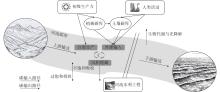
Fig.1
Conceptual diagram of riverine carbon cycling[5]"
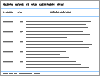
Table 1
The KPCA analysis results of year scale variables and month scale variables"
| 月度变量 | 年度变量 | |||||||
| 核主成分 | 特征值 | 解释率/% | 累计解释率/% | 核主成分 | 特征值 | 解释率/% | 累计解释率/% | |
| 1 | 31.56 | 50.50 | 50.50 | 1 | 35.65 | 46.40 | 46.40 | |
| 2 | 14.53 | 23.30 | 73.80 | 2 | 22.80 | 29.60 | 76.00 | |
| 3 | 4.63 | 7.42 | 81.22 | 3 | 10.38 | 13.50 | 89.50 | |
| 4 | 4.05 | 6.48 | 87.70 | 4 | 5.16 | 6.70 | 96.20 | |
| 5 | 3.25 | 5.21 | 92.91 | 5 | 2.92 | 3.80 | 100 | |
| 6 | 2.58 | 4.13 | 97.00 | |||||
| 7 | 1.86 | 2.98 | 100 | |||||
Table 2
The load analysis results of year scale variables and month scale variables"
| 变量 | 不同核主成分下的载荷 | |||||||
| 1 | 2 | 3 | 4 | 5 | 6 | 7 | ||
| 月度变量 | Temp | 0.940 | 0.035 | 0.125 | −0.187 | −0.202 | −0.052 | 0.057 |
| NDVI | 0.907 | 0.053 | 0.293 | 0.101 | −0.129 | −0.066 | 0.050 | |
| SM | 0.901 | 0.075 | 0.326* | 0.155 | 0.122 | −0.033 | −0.029 | |
| PET | 0.931 | −0.045 | 0.079 | −0.305 | −0.111 | −0.046 | 0.033 | |
| GPP | 0.958* | 0.036 | 0.153 | −0.150 | −0.088 | −0.041 | −0.020 | |
| Precip | 0.888 | −0.142 | 0.086 | −0.258 | 0.293 | 0.028 | 0.040 | |
| Q | 0.847 | −0.188* | 0.316 | −0.043 | 0.001 | 0.287 | −0.067 | |
| 年度变量 | Grassland | −0.894 | −0.037 | −0.289 | 0.079 | 0.024 | ||
| Forest | 0.806 | 0.291* | 0.456 | −0.136 | 0.023 | |||
| Cropland | −0.807 | 0.010 | −0.563* | 0.032 | 0.158 | |||
| PD | 0.941* | 0.033 | 0.306 | 0.045 | −0.110 | |||
| Shrub | −0.922 | −0.068 | −0.130 | −0.032 | 0.195 | |||
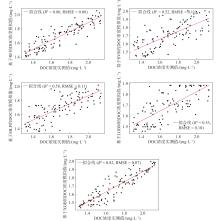
Fig.2
The prediction and errors of 5 machine learning models in the training sets"
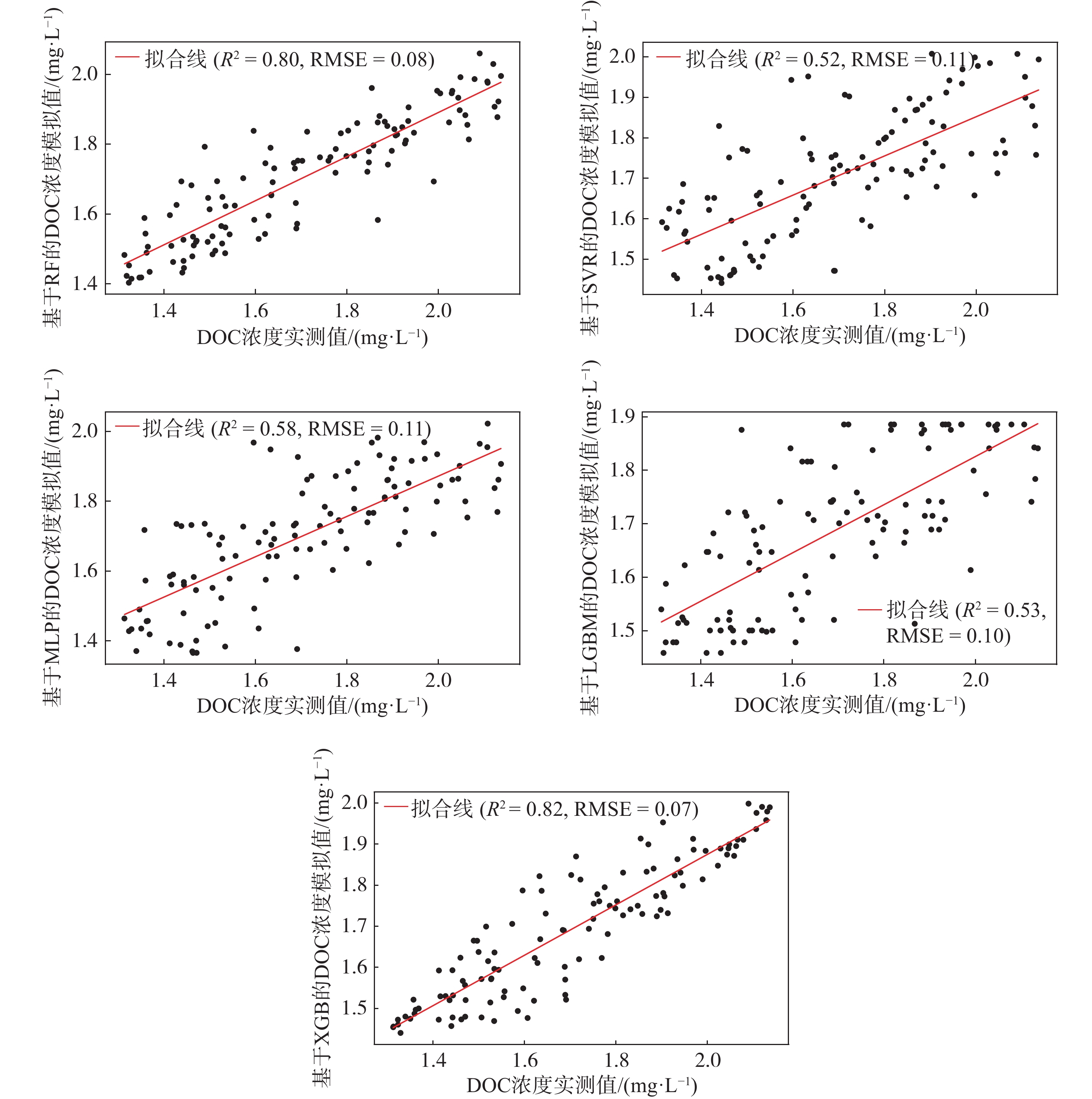
Fig.4
Monthly DOC concentrations and fluxes simulated by the RF model at the Yangtze River’s Xuliujing Station from 2001 to 2020 and their intra-annual distribution characteristics"
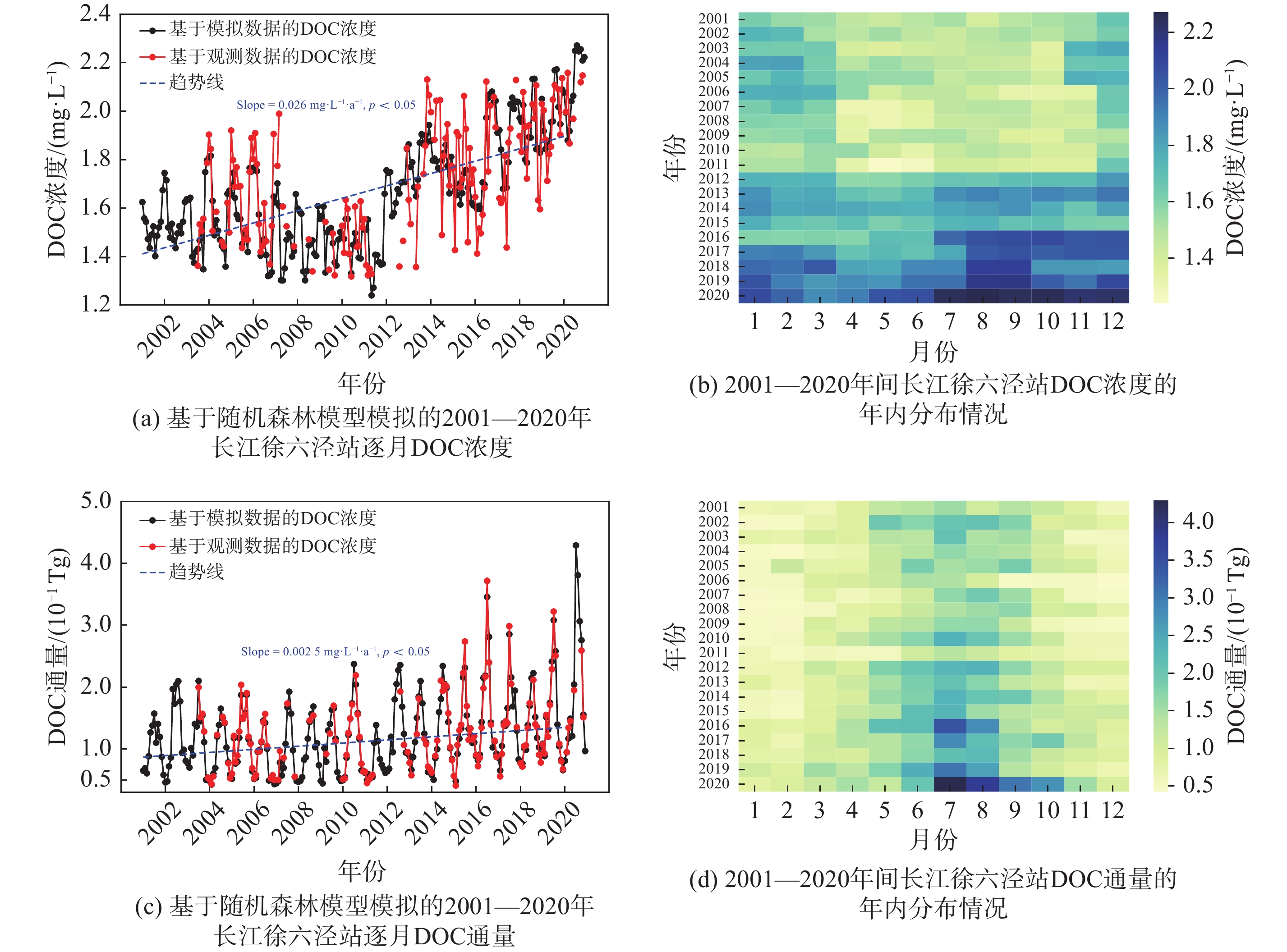
Fig.5
SHAP summary plot and relative contribution rates for variables"
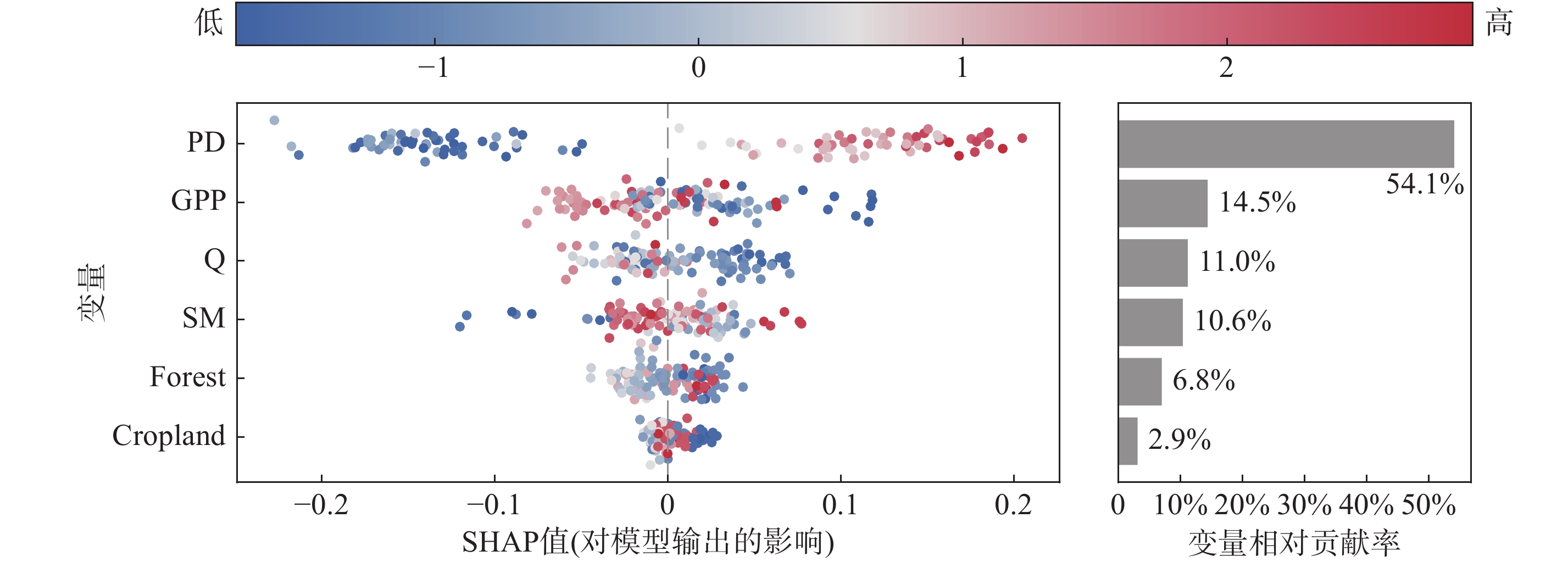
Fig.3
The prediction and errors of 5 machine learning models in the test sets"
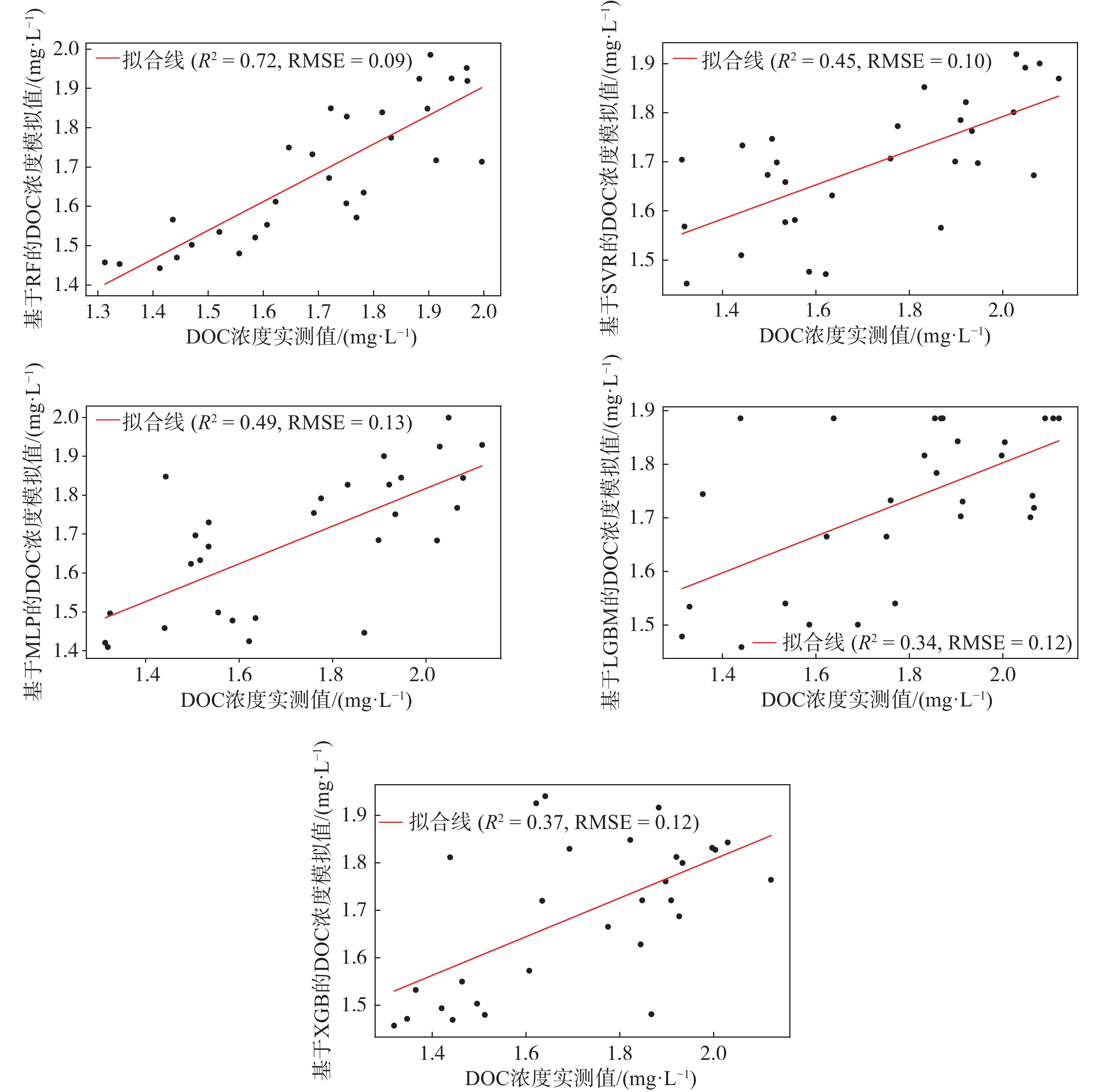
Fig.6
Changes in the relationship between flow and DOC concentrations at the Yangtze River’s Xuliujing Station from 2001 to 2020"
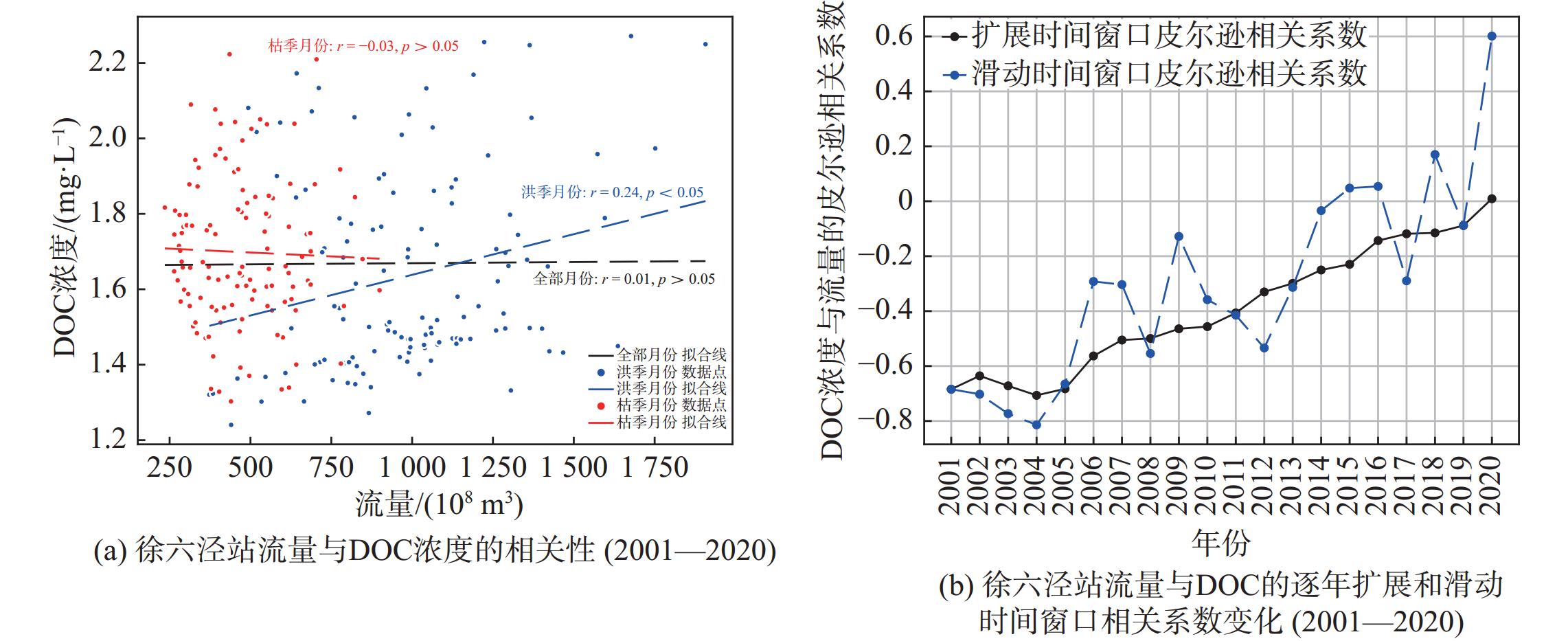
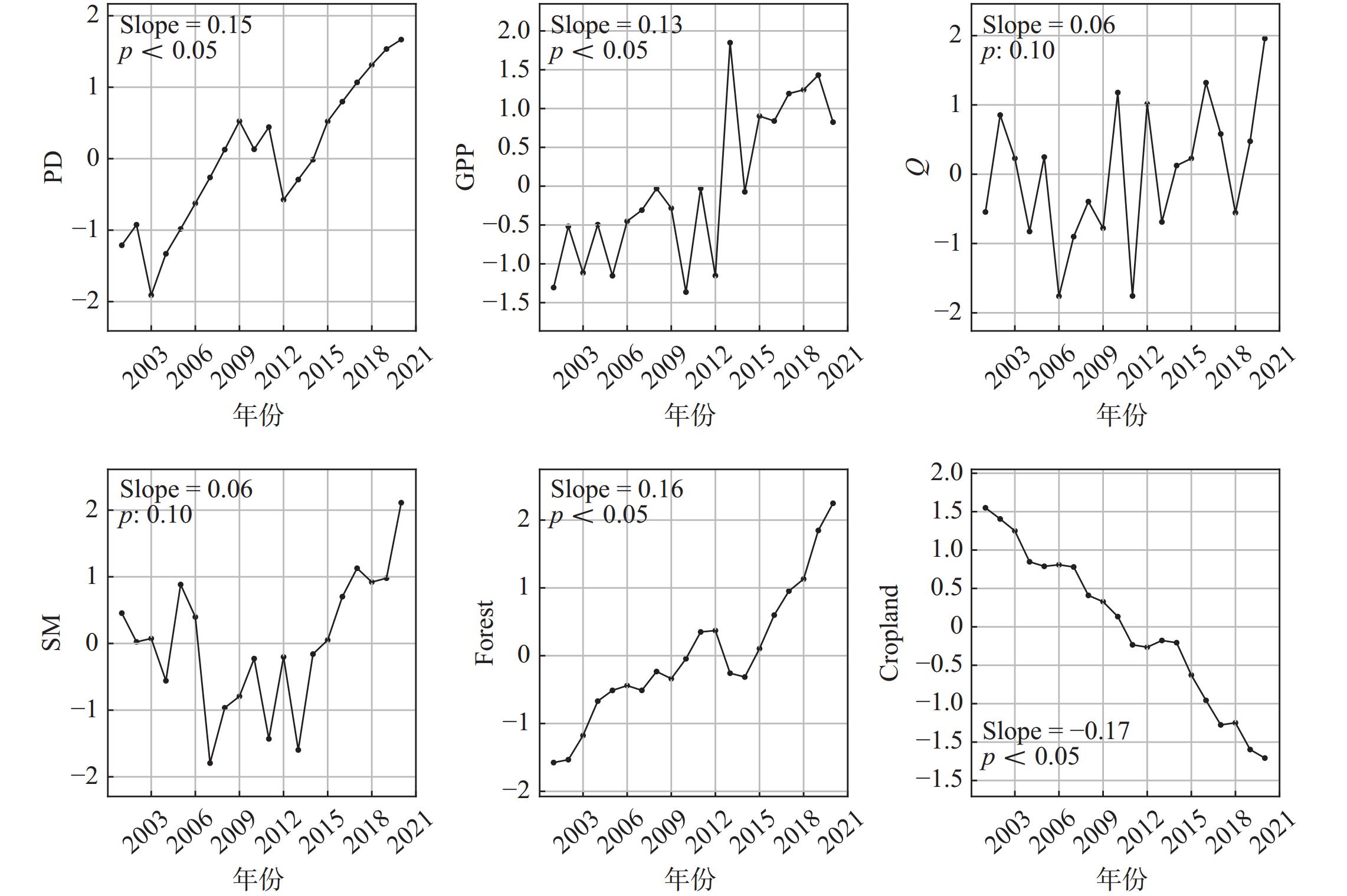
Fig.7
Interannual variation trends in six variables in machine learning models from 2001 to 2020"
| 1 | FRIEDLINGSTEIN P, O’SULLIVAN M, JONES M W, et al.. Global carbon budget 2023. Earth System Science Data, 2023, 5 (12): 5301- 5369. |
| 2 | LUDWIG W, PROBST J L, KEMPE S.. Predicting the oceanic input of organic carbon by continental erosion. Global Biogeochemical Cycles, 1996, 10 (1): 23- 41. |
| 3 | REGNIER P, FRIEDLINGSTEIN P, CIAIS P, et al.. Anthropogenic perturbation of the carbon fluxes from land to ocean. Nature Geoscience, 2013, 6, 597- 607. |
| 4 | LIU D, JIANG X T, DUAN M W, et al.. Human and natural activities regulate organic matter transport in Chinese rivers. Water Research, 2023, 245, 120622. |
| 5 | 刘娇娇, 刘军志, 宋超, 等.. 河流碳循环模型研究进展. 地球科学进展, 2024, 39 (2): 111- 123. |
| 6 | AITKENHEAD J A, MCDOWELL W H.. Soil C: N ratio as a predictor of annual riverine DOC flux at local and global scales. Global Biogeochemical Cycles, 2000, 14 (1): 127- 138. |
| 7 | REN W, TIAN H Q, CAI W J, et al.. Century-long increasing trend and variability of dissolved organic carbon export from the Mississippi River basin driven by natural and anthropogenic forcing. Global Biogeochemical Cycles, 2016, 30 (9): 1288- 1299. |
| 8 | BAO H Y, WU Y, ZHANG J.. Spatial and temporal variation of dissolved organic matter in the Changjiang: Fluvial transport and flux estimation. Journal of Geophysical Research: Biogeosciences, 2015, 120 (9): 1870- 1886. |
| 9 | LYU S C, YU Q B, WANG F, et al.. A synthetic model to quantify dissolved organic carbon transport in the Changjiang River system: Model structure and spatiotemporal patterns. Journal of Advances in Modeling Earth Systems, 2019, 11 (9): 3024- 3041. |
| 10 | MING Y, GAO L, GUO L D.. Dissolved and particulate organic carbon dynamics in the lower Changjiang River on timescales from seasonal to decades: Response to climate and human impacts. Journal of Marine Systems, 2023, 239, 103855. |
| 11 | 谢莹, 张军, 王子腾, 等.. 1980—2019年人为干扰和绿色投资对长江干流有机碳的影响. 生态学杂志, 2024, 43 (11): 3456- 3469. |
| 12 | PARK J H, NAYNA O K, BEGUM M S, et al.. Reviews and syntheses: Anthropogenic perturbations to carbon fluxes in Asian river systems–concepts, emerging trends, and research challenges. Biogeosciences, 2018, 15 (9): 3049- 3069. |
| 13 | ZHONG J, LI S L, ZHU X T, et al.. Dynamics and fluxes of dissolved carbon under short-term climate variabilities in headwaters of the Changjiang River, draining the Qinghai-Tibet Plateau. Journal of Hydrology, 2021, 596, 126128. |
| 14 | LIU D, PAN D L, BAI Y, et al.. Variation of dissolved organic carbon transported by two Chinese rivers: The Changjiang River and Yellow River. Marine Pollution Bulletin, 2015, 100 (1): 60- 69. |
| 15 | 王威, 郭庆军, 杜陈军, 等.. 长江流域水环境碳循环研究进展. 生态学杂志, 2023, 42 (3): 736- 747. |
| 16 | 黄春林, 侯金亮, 李维德, 等.. 深度学习融合遥感大数据的陆地水文数据同化: 进展与关键科学问题. 地球科学进展, 2023, 38 (5): 441- 452. |
| 17 | 林晶, 吴莹, 张经, 等.. 长江有机碳通量的季节变化及三峡工程对其影响. 中国环境科学, 2007, 27 (2): 246- 249. |
| 18 | ZHAO L B, GAO L, GUO L D.. Seasonal variations in molecular size of chromophoric dissolved organic matter from the lower Changjiang (Yangtze) river. Journal of Geophysical Research: Biogeosciences, 2021, 126 (8): e2020JG006160. |
| 19 | 徐新良. 中国年度NDVI、EVI 1KM数据集[Z/OL]. 北京: 资源环境科学数据注册与出版系统. [2025-03-01]. https://www.resdc.cn/DOI/doi.aspx?DOIid=49. |
| 20 | PENG S Z, DING Y X, LIU W Z, et al.. 1 km monthly temperature and precipitation dataset for China from 1901 to 2017. Earth System Science Data, 2019, 11 (4): 1931- 1946. |
| 21 | SIMS K, REITH A, BRIGHT E, et al. LandScan global 2022 [Z/OL]. Oak Ridge National Laboratory, 2023. [2025-03-01]. https://doi.org/10.48690/1529167. |
| 22 | SUN H, QIAN X, ZHAO Z Y. Monthly gap-filled CCI soil moisture over region of China (Combined Product) [Z/OL]. Science Data Bank, 2023. [2025-03-01]. https://doi.org/10.57760/sciencedb.07849. |
| 23 | YANG J, HUANG X.. The 30 m annual land cover dataset and its dynamics in China from 1990 to 2019. Earth System Science Data, 2021, 13 (8): 3907- 3925. |
| 24 | GUYON I, ELISSEEFF A.. An introduction to variable and feature selection. Journal of Machine Learning Research, 2003, 3, 1157- 1182. |
| 25 | SCHÖLKOPF B, SMOLA A, MÜLLER K R.. Nonlinear component analysis as a kernel eigenvalue problem. Neural Computation, 1998, 10 (5): 1299- 1319. |
| 26 | SMOLA A J, SCHÖLKOPF B.. A tutorial on support vector regression. Statistics and Computing, 2004, 14 (3): 199- 222. |
| 27 | BREIMAN L.. Random forests. Machine Learning, 2001, 45 (1): 5- 32. |
| 28 | CHEN T, GUESTRIN C. XGBoost: A scalable tree boosting system[C]// KDD’16: Proceedings of the 22nd ACM SIGKDD International Conference on Knowledge Discovery and Data Mining. New York: Assoc Computing Machinery, 2016: 785-794. |
| 29 | KE G, MENG Q, FINLEY T, et al. LightGBM: A highly efficient gradient boosting decision tree[C]// Neural Information Processing Systems 30. La Jolla, California, 2017. |
| 30 | ROGERS T T, MCCLELLAND J L.. Parallel distributed processing at 25: Further explorations in the microstructure of cognition. Cognitive Science, 2014, 38 (6): 1024- 1077. |
| 31 | GHAHRAMANI Z.. Probabilistic machine learning and artificial intelligence. Nature, 2015, 521, 452- 459. |
| 32 | LUNDBERG S, LEE S I. A unified approach to interpreting model predictions [EB/OL]. (2017-05-22)[2025-02-01]. https://arxiv.org/abs/1705.07874. |
| 33 | ZHANG L J, XUE M, LIU Q Z.. Distribution and seasonal variation in the partial pressure of CO2 during autumn and winter in Jiaozhou Bay, a region of high urbanization. Marine Pollution Bulletin, 2012, 64 (1): 56- 65. |
| 34 | YOU Y B, XIE Z H, JIA B H, et al.. Impacts of anthropogenic water regulation on global riverine dissolved organic carbon transport. Earth System Dynamics, 2023, 14 (5): 897- 914. |
| 35 | ZHOU Y Q, YAO X L, ZHOU L, et al.. How hydrology and anthropogenic activity influence the molecular composition and export of dissolved organic matter: Observations along a large river continuum. Limnology and Oceanography, 2021, 66 (5): 1730- 1742. |
| 36 | LIU Y Y, DENG B, DU J Z, et al.. Nutrient burial and environmental changes in the Yangtze Delta in response to recent river basin human activities. Environmental Pollution, 2019, 249, 225- 235. |
| 37 | 孔令桥, 张路, 郑华, 等.. 长江流域生态系统格局演变及驱动力. 生态学报, 2018, 38 (3): 741- 749. |
| 38 | LAN Z L, ZHAO Y, ZHANG J G, et al.. Long-term vegetation restoration increases deep soil carbon storage in the Northern Loess Plateau. Scientific Reports, 2021, 11 (1): 13758. |
| 39 | YAN Y Z, LAUERWALD R, WANG X H, et al.. Increasing riverine export of dissolved organic carbon from China. Global Change Biology, 2023, 29 (17): 5014- 5032. |
| 40 | WANG S, FU B J, PIAO S L, et al.. Reduced sediment transport in the Yellow River due to anthropogenic changes. Nature Geoscience, 2016, 9, 38- 41. |
| 41 | ZHANG W H, ZHU G F, WAN Q Z, et al.. Influence of irrigation on vertical migration of soil organic carbon in arid area of inland river. Land, 2023, 12 (8): 1532. |
| 42 | CLARK J M, LANE S N, CHAPMAN P J, et al.. Export of dissolved organic carbon from an upland peatland during storm events: Implications for flux estimates. Journal of Hydrology, 2007, 347 (3/4): 438- 447. |
| 43 | YU Q, LI H, ZHAO Y, et al.. Long-term trends of dissolved organic carbon dynamics in a subtropical forest responding to environmental changes. Environmental Science & Technology, 2024, 58 (28): 12420- 12429. |
| 44 | LIU D, TIAN L Q, JIANG X T, et al.. Human activities changed organic carbon transport in Chinese rivers during 2004—2018. Water Research, 2022, 222, 118872. |
| 45 | LEVSHINA S I.. Dissolved and suspended organic matter in the Amur and Songhua River water. Water Resources, 2008, 35 (6): 716- 724. |
| 46 | KRAUSE A, PAPASTEFANOU P, GREGOR K, et al.. Quantifying the impacts of land cover change on gross primary productivity globally. Scientific Reports, 2022, 12 (1): 18398. |
| 47 | 吴健敏, 郗敏, 孔范龙, 等.. 土壤溶解性有机碳(DOC)动态变化影响因素研究进展. 地质论评, 2013, 59 (5): 953- 961. |
| 48 | 梁红霞, 陈富荣, 陈永宁, 等.. 安徽省怀远-灵璧地区表层土壤碳储量研究. 安徽大学学报(自然科学版), 2014, 38 (6): 96- 103. |
| 49 | 王敏, 张龙军, 桂祖胜.. 长江干流有机碳的时空输运特征及三峡工程对其影响. 中国海洋大学学报(自然科学版), 2011, 41 (S1): 117- 124. |
| 50 | LIU D, BAI Y, HE X Q, et al.. Changes in riverine organic carbon input to the ocean from mainland China over the past 60 years. Environment International, 2020, 134, 105258. |
| 51 | ITTEKKOT V, ARAIN R.. Nature of particulate organic matter in the River Indus, Pakistan. Geochimica et Cosmochimica Acta, 1986, 50 (8): 1643- 1653. |
| [1] | Pengquan ZHONG, Wei WANG, Jiawei ZHANG, Xu LI, Ziqing ZHOU, Miaoxun WANG, Yuan XU. Effects of the ecological restoration project in the coastal wetlands of the Yangtze River Estuary on benthic ciliate communities [J]. J* E* C* N* U* N* S*, 2026, 2026(3): 110-123. |
| [2] | Yufei FU, Zesong XU, Anhao FENG, Tongquan WEI. Online grant prediction for mobile networks based on traffic perception [J]. J* E* C* N* U* N* S*, 2025, 2025(4): 1-14. |
| [3] | Ke YE, Bo TIAN, Yuchun WANG. Development of estuarine tidal flat vegetation index based on Sentinel-2 satellite remote sensing [J]. J* E* C* N* U* N* S*, 2025, 2025(2): 141-153. |
| [4] | Run LI, Jienan CHEN, Hao CHEN, Fang CAO. Dynamic characteristics and degradation transformation mechanism of dissolved organic matter in estuarine wetlands: A case study of Chongming Dongtan salt marsh wetland in Shanghai [J]. J* E* C* N* U* N* S*, 2025, 2025(2): 55-67. |
| [5] | Feng TIAN, Lin YUAN, Liquan ZHANG, Yang LI, Lu BAN, Pingya CHEN. Study on seed production, characteristics of dormancy, and germination of Scirpus mariqueter in the Yangtze River Estuary [J]. J* E* C* N* U* N* S*, 2025, 2025(2): 68-76. |
| [6] | Yuyi WANG, Ye HUANG, Jing YANG, Fangfang DING, Tianhao HE, Yushan LI, Lin HUANG, Ye LI, Min LIU. Spatiotemporal differential distribution characteristics and ecological risk assessment of antibiotics in the Yangtze River Estuary and offshore areas [J]. Journal of East China Normal University(Natural Science), 2024, 2024(6): 136-150. |
| [7] | Hao CHEN, Xianqiang HE, Run LI, Fang CAO. Machine learning-based remote sensing retrievals of dissolved organic carbon in the Yangtze River Estuary [J]. Journal of East China Normal University(Natural Science), 2024, 2024(4): 123-136. |
| [8] | Yong ZHANG, Hui WANG, Chuanhua ZHU, Hao ZHOU, Yu ZHAN, Can LI, Yifan XIAO, Lili YANG, Jiaqi LIU. Evaluation of eutrophication by satellite remote sensing based on machine learning: A case study of Huancheng River in Hefei [J]. Journal of East China Normal University(Natural Science), 2024, 2024(1): 1-8, 112. |
| [9] | Jiaming CHEN, Shiming WANG, Rongrong YANG, Ziyan CHEN, Xia LIANG, Lijun HOU. Temperature adaptability of dark carbon fixation in seawater fromthe Yangtze River Estuary [J]. Journal of East China Normal University(Natural Science), 2024, 2024(1): 104-112. |
| [10] | Zhi JIN, Jianrong ZHU, Wei QIU. Effects of cascade reservoirs in the Yangtze River Basin on estuarine saltwater intrusion and freshwater resources during late summer and early autumn [J]. Journal of East China Normal University(Natural Science), 2024, 2024(1): 90-103. |
| [11] | Hong QIN, Lingge ZHAI, Feng XU, Cui WANG, Mian CHENG, Yaoyi LIU, Yue CHE. Applicability of benthic macroinvertebrate evaluation methods in lake-swamp areas: An example in the Yangtze River Delta integration demonstration zone [J]. Journal of East China Normal University(Natural Science), 2023, 2023(6): 134-144. |
| [12] | Xiangyun GAO, Dan MENG, Mingkai LUO, Jun WANG, Liping ZHANG, Chao KONG. Privacy-preserving cloud-end collaborative training [J]. Journal of East China Normal University(Natural Science), 2023, 2023(5): 77-89. |
| [13] | Xiaoting WANG, Hualong LUAN, Weiguo ZHANG, Nina Siu-Ngan LAM. Assessment of land use exposure to coastal erosion in the delta region and its implications on spatial planning: An example from the Pudong New Area of Shanghai [J]. Journal of East China Normal University(Natural Science), 2023, 2023(3): 181-193. |
| [14] | Zhiyong YOU, Bolin LIU, Cheng LIU, Dengzhou GAO. Temperature sensitivity and controlling factors of nitrogen fixation processes in sediments of the Yangtze River Estuary [J]. Journal of East China Normal University(Natural Science), 2022, 2022(3): 101-108. |
| [15] | Zhipeng LI, Jianrong ZHU. Numerical simulation of the North Branch regime change impact on saltwater intrusion in the Yangtze River Estuary from 2007 to 2016 [J]. Journal of East China Normal University(Natural Science), 2022, 2022(3): 109-124. |
| Viewed | ||||||
|
Full text |
|
|||||
|
Abstract |
|
|||||
